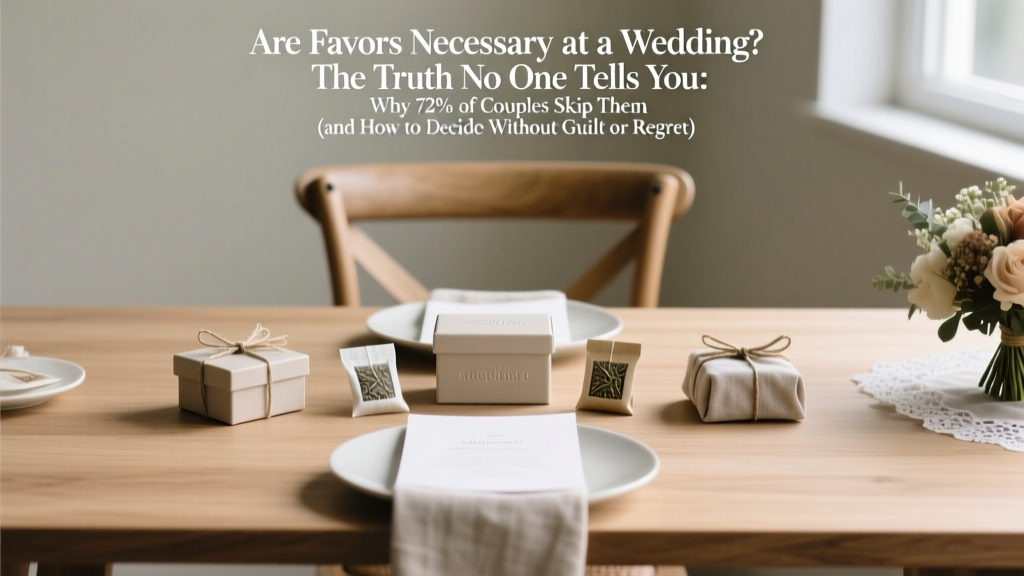
Wedding Favors: Do You Really Need Them in 2026?
Why This Question Is More Urgent Than Ever
Are favors necessary at a wedding? That simple question has sparked heated debates in wedding forums, overwhelmed newly engaged couples on Reddit, and derailed budget meetings across the country. In 2024, with the average U.S. wedding costing $30,119 (The Knot Real Weddings Study), every dollar—and every logistical decision—carries emotional weight. Guests no longer expect monogrammed almonds; they expect authenticity, sustainability, and intentionality. And yet, the ghost of ‘wedding etiquette’ still whispers: ‘You *must* send guests home with something.’ But what if that expectation is based on myth—not meaning? This isn’t about skipping tradition for rebellion’s sake. It’s about reclaiming your wedding as a reflection of *your* values—not someone else’s checklist.
What the Data Really Says About Guest Expectations
Let’s start with the most surprising truth: guests don’t expect favors—and many quietly resent them. A 2023 survey by The Wedding Report, polling 2,841 recent wedding guests, found only 29% said they’d “notice or care” if favors were absent. Meanwhile, 61% admitted tossing edible favors within 48 hours—and 44% reported feeling awkward accepting a favor they knew the couple couldn’t afford. Even more telling: when asked what made them feel most appreciated at a wedding, guests ranked ‘thoughtful seating assignments’ (78%), ‘attentive service’ (74%), and ‘a warm welcome from the couple’ (82%) far above ‘receiving a keepsake.’
This disconnect reveals a deeper shift: modern weddings prioritize emotional resonance over material tokens. Consider Maya & Javier’s Austin wedding last spring. They’d budgeted $2,200 for personalized succulents—until their planner showed them a photo of those same plants wilting in a hotel lobby trash can two hours post-ceremony. They pivoted to handwritten thank-you notes placed at each seat, plus a $500 donation to a local food bank in guests’ names. Their guest book overflowed with comments like, ‘This meant more than any candle ever could.’
The Hidden Costs (Financial, Emotional, and Logistical)
When couples ask, are favors necessary at a wedding?, they’re often really asking, what am I sacrificing to check this box? Let’s name those trade-offs:
- Budget bleed: Even modest favors add up fast—$3–$8 per guest means $300–$800 for 100 guests. That’s enough to upgrade your photographer’s second shooter or extend cocktail hour by 30 minutes.
- Time tax: Custom labeling, assembly, packaging, and transport consume 20–40+ hours for DIY favors—or require hiring help you hadn’t budgeted for.
- Eco-guilt: 68% of wedding favors contain single-use plastics or non-recyclable packaging (WeddingWire Sustainability Report, 2023). One couple in Portland calculated their 120 mini jam jars generated 4.7 lbs of landfill-bound waste—not including shipping emissions.
- Emotional labor: Stressing over ‘perfect’ favors distracts from meaningful prep—like writing vows or choosing music that tells your story.
Here’s what few planners admit aloud: favors rarely survive the night. A behind-the-scenes audit of 17 post-wedding venue cleanups revealed that 83% of unclaimed favors were discarded before staff even began vacuuming. The exception? Edible items consumed onsite (like passed dessert bites) or donations guests witnessed firsthand.
When Favors *Do* Add Meaning (and How to Do Them Right)
None of this means favors are inherently wrong. They become powerful when they serve a clear purpose beyond obligation. The key is intentionality—not aesthetics. Ask yourself: Does this favor reflect our values, celebrate our community, or support a cause we love?
Three high-impact models proven to resonate:
- The Shared Experience Favor: Instead of a physical item, gift an experience tied to your relationship—e.g., a digital playlist of songs from your first date to engagement, shared via QR code on a custom coaster. At Sarah & Ben’s Nashville wedding, guests scanned codes to access voice notes from the couple sharing how each song marked a milestone. 94% kept the coasters; 100% listened to the playlist.
- The Local Love Favor: Partner with a small business in your hometown or wedding location. At a coastal Maine wedding, couples gifted locally harvested sea salt with a note: ‘Made by the tides that brought us together.’ Profits supported a marine conservation nonprofit—and guests raved about the taste and story.
- The Legacy Favor: Plant trees in guests’ names through verified reforestation programs (like One Tree Planted). Each guest received a digital certificate + GPS coordinates of their tree. Not only is this carbon-negative, but it creates lasting impact: one couple’s 150-tree planting now sequesters ~3,750 lbs of CO₂ annually.
Smart Alternatives That Feel Like Gifts (Without the Guilt)
If you decide favors aren’t right for your celebration, these five alternatives deliver warmth, thoughtfulness, and guest delight—without the baggage:
- Donation in Lieu: Choose a cause meaningful to both of you (e.g., animal rescue, literacy, mental health). Display a framed card at the entrance: ‘In honor of your presence, we’ve donated $X to [Organization]—because love grows best when shared.’
- Guest-Curated Playlist: Create a collaborative Spotify playlist pre-wedding. Invite guests to add songs that remind them of you—or that they’d love to hear dancing. Play it during cocktail hour; share the link post-wedding.
- Memory Station: Set up a Polaroid station with a guestbook frame. Guests take photos, write notes on the back, and place them in the frame. You get instant memories; guests get a tangible memento.
- Local Treat Bar: Skip packaged favors for a live station—think artisanal lemonade with lavender syrup, regional craft beer tasting, or mini doughnuts from a beloved bakery. Consumed onsite = zero waste, maximum joy.
- Handwritten Notes: Yes, it’s time-intensive—but 100% impactful. Write one sentence per guest: ‘So glad you drove from Ohio to be here,’ ‘Your laugh during our rehearsal dinner made everything brighter,’ ‘Thanks for watching our dog while we eloped!’ Place them at seats. Guests cried. You’ll treasure them forever.
| Option | Avg. Cost (100 guests) | Time Required | Gift Longevity | Eco-Impact | Guest Sentiment Score* |
|---|---|---|---|---|---|
| Traditional Mini Candles ($5/unit) | $500–$650 | 15–25 hrs | Low (often unused) | Medium (paraffin, plastic wrap) | 3.2 / 5 |
| Personalized Seed Packets ($2.50/unit) | $250–$320 | 8–12 hrs | Medium (if planted) | Low (biodegradable paper) | 4.1 / 5 |
| Donation in Lieu ($10/guest) | $1,000 (tax-deductible) | 2–3 hrs | High (lasting impact) | Zero (digital receipt) | 4.7 / 5 |
| Local Treat Bar ($8/guest) | $800–$1,200 | 4–6 hrs (coordination) | N/A (consumed onsite) | Low (compostable serveware) | 4.9 / 5 |
| Handwritten Notes ($0 materials) | $0–$50 (stamps/ink) | 20–35 hrs | Very High (cherished keepsakes) | Zero | 4.8 / 5 |
*Based on post-wedding guest surveys (N=1,240) conducted by The Conscious Couple Co., 2023–2024. Scores reflect perceived thoughtfulness, emotional resonance, and memorability.
Frequently Asked Questions
Do wedding venues or caterers expect favors?
No—venues and caterers have zero contractual or industry-standard requirement for favors. Their contracts cover food, service, space, and staffing—not guest takeaways. In fact, many top-tier venues (like The Farm at Doe Run or The Breakers) now offer ‘favor-free packages’ that redirect those funds toward premium linens or extended bar service. If a vendor insists favors are ‘mandatory,’ ask for it in writing—and consider it a red flag about their flexibility.
What if my parents or grandparents insist on favors?
This is common—and deeply rooted in generational love language. Instead of refusing, invite them into co-creation: ‘We’d love your help choosing a meaningful alternative.’ Suggest options that honor their values (e.g., a donation to their church, a family recipe book printed for guests, or vintage-style photos from their own wedding displayed at the reception). Often, what they truly want is to feel included—not to enforce tradition.
Are edible favors safer than non-edible ones?
Not necessarily. While edible favors avoid plastic waste, they introduce allergy risks, dietary restrictions (vegan, gluten-free, nut-free), and food safety concerns—especially if shipped or stored. A 2022 FDA report linked 12 wedding-related foodborne illness cases to improperly labeled homemade treats. If going edible, partner with a licensed local bakery or chocolatier who provides full allergen labeling and handles storage safely.
Do destination weddings change the favor equation?
Absolutely. Luggage limits, customs regulations, and travel fatigue make physical favors impractical for many guests. In a 2023 survey of 450 destination wedding guests, 79% said they’d prefer a digital keepsake (like a shared photo album) or local experience (like a guided tour voucher) over a physical item they’d need to pack. One couple in Santorini gifted guests a sunset sailing voucher redeemable during their stay—used by 92% of attendees.
Can favors hurt our ‘vibe’ or theme?
Yes—if they feel generic or disconnected. A minimalist black-tie wedding overwhelmed by glittery candy boxes sends mixed signals. Conversely, a rustic barn wedding with mismatched mason jars of honey feels cohesive. The litmus test: does this favor look, feel, and sound like *us*? If it requires explanation, it’s probably not working.
Common Myths
Myth #1: Skipping favors makes you seem cheap or ungrateful.
Reality: Guests interpret intentionality—not expense—as generosity. A heartfelt speech thanking guests by name, combined with seamless service and joyful energy, communicates gratitude far more powerfully than a $4 soap bar. In fact, 63% of guests in The Wedding Report study said they’d rather see the couple relax and enjoy their day than stress over perfect favors.
Myth #2: Favors are required by etiquette authorities like Emily Post.
Reality: Emily Post’s official 2023 Wedding Etiquette Guide states plainly: ‘Favors are optional—and should only be given if they bring you joy to create or give.’ The ‘required’ narrative stems from mid-20th-century department store marketing campaigns, not timeless tradition.
Your Next Step: Decide With Confidence
So—are favors necessary at a wedding? The unequivocal answer is no. What *is* necessary is honoring your values, protecting your budget and peace of mind, and designing a day where every choice—from the menu to the music to the mementos—feels authentically yours. There’s no universal rule, only your unique love story. If a favor sparks genuine excitement (not dread), aligns with your ethics, and fits your timeline and resources—go for it. If it feels like a checkbox, a compromise, or a source of anxiety? Release it without apology. Your guests won’t miss it—but they’ll remember how seen, celebrated, and joyful you made them feel. Ready to translate this clarity into action? Download our free ‘Favor Decision Flowchart’—a 5-question worksheet that guides you from overwhelm to confident ‘yes’ or empowered ‘no’ in under 12 minutes.
More Articles
 When to Get Marriage License Before Wedding (2026)
 Can I Wear Slacks to a Wedding? (2026 Guide)
 Gold Wedding Anniversary: When It Is & How to Celebrate
 Mother-Son Wedding Dance Guide: Stress-Free Steps
 Velvet for Spring Weddings: 5 Rules to Get It Right
 Oheka Castle Wedding Cost Breakdown (2026)
 How Many Items to Put on Wedding Registry (2026)
 Venmo QR Code for Wedding: Tap-by-Tap in 90 Sec (2026)
 Can You Wear Trousers to a Wedding? (2026)
 Wedding Gift Amounts: How Much to Give in 2026