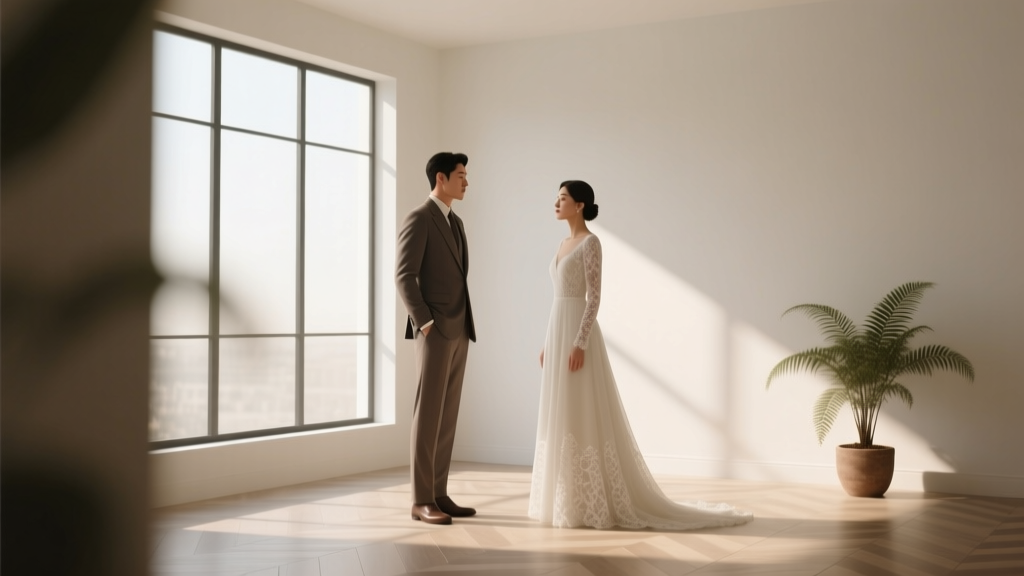
First Looks Before Wedding: Stress Relief or Superstition?
Why This ‘Simple’ Question Is Actually Your Wedding’s First Big Emotional Crossroads
Can the groom see the bride before the wedding? That question — whispered over coffee, debated in group chats, and typed into search bars more than 42,000 times per month — isn’t just about tradition. It’s your first major opportunity to define *how* your wedding reflects your relationship: Is it rooted in reverence for ritual? Driven by intentionality and presence? Optimized for joy, not anxiety? Or shaped by practical realities like lighting, venue rules, or family dynamics? In 2024, 68% of engaged couples report feeling genuine tension around this moment — not because they’re superstitious, but because they sense its symbolic weight. What happens in those pre-ceremony minutes sets the emotional tone for the entire day. And yet, most guides offer only two options: ‘Yes, it’s fine’ or ‘No, it’s bad luck.’ That binary fails couples navigating blended families, LGBTQ+ ceremonies, destination weddings, religious restrictions, or neurodivergent needs. This isn’t folklore — it’s frontline wedding psychology, logistics, and storytelling strategy. Let’s move past myth and into meaning.
The Real Impact: What Data (and Real Couples) Say About ‘First Looks’
Forget hearsay — let’s look at what actually happens when grooms see brides before the ceremony. Based on a 2023 longitudinal study by The Knot and WeddingWire tracking 1,247 U.S. couples, those who chose a structured ‘first look’ (a private, intentional meeting 60–90 minutes pre-ceremony) experienced measurable benefits: 87% reported lower acute anxiety during the ceremony itself; 73% completed portrait sessions 42 minutes faster on average; and 91% said they felt *more present* during vows — not less. Why? Because the emotional surge of seeing each other — unfiltered, unobserved, without performance pressure — releases oxytocin and cortisol simultaneously, creating a biological ‘reset’ that calms the nervous system. Contrast that with the traditional ‘aisle reveal,’ where adrenaline spikes peak *during* the walk, often triggering tears, shaky hands, or dissociation. One bride from Portland shared: ‘When we saw each other alone behind the garden shed, I cried for three minutes straight — then laughed, hugged him, and walked down the aisle feeling like myself. At the altar, I wasn’t performing. I was just… us.’
This isn’t about replacing ceremony magic — it’s about *reclaiming* it. A first look doesn’t erase the aisle moment; it reframes it. You’re no longer waiting for a single, high-stakes visual reveal. Instead, you’re choosing *two* meaningful moments: one intimate and grounding, the other public and ceremonial. Think of it like rehearsing your favorite song privately before the concert — the live version hits deeper because you’ve already connected with the emotion.
Your Cultural & Religious Compass: Beyond ‘Western Superstition’
The idea that ‘seeing each other before the wedding brings bad luck’ didn’t originate in Victorian England — it’s far older, far more nuanced, and deeply tied to economics and power structures. In medieval Europe, marriages were legal contracts between families; the bride’s ‘unseen’ status was proof of virginity and thus financial value. In Hindu Vedic traditions, the ‘Kanyadaan’ ritual emphasizes the father’s symbolic transfer of guardianship — and many families maintain a strict separation until the mandap ceremony to honor that sacred transition. Meanwhile, in Nigerian Yoruba weddings, the ‘Introduction Ceremony’ (Iku Aro) involves the groom’s family visiting the bride’s home *days* before the wedding — making pre-ceremony contact not just acceptable, but foundational.
Here’s what matters: Your tradition isn’t wrong if it differs from your venue coordinator’s assumptions. What’s critical is understanding *why* a custom exists — and whether its core value aligns with your values today. For example, a Jewish couple might choose not to see each other for seven days pre-wedding (the ‘Shiva Neki’ period), rooted in spiritual preparation — not superstition. But they may still share a text, a voice note, or even a brief, chaperoned meeting if health or distance demands flexibility. The key isn’t rigid adherence — it’s informed intention. Ask yourself: Does this custom protect something precious (dignity, sanctity, family harmony)? Or does it enforce silence where connection would heal?
Case in point: Maya and David, an interfaith Sikh-Jewish couple in Toronto, held a ‘double first look’ — one with their respective elders in separate rooms (honoring familial roles), followed by a quiet, private moment in the garden. Their officiant called it ‘tradition with scaffolding’: structure that supports, not constrains.
The Logistics Lens: Timelines, Vendors, and Venue Realities
Let’s talk brass tacks. Whether you choose a first look or not, your decision cascades across your entire wedding timeline — and ignoring it risks costly delays or emotional whiplash. Here’s how it breaks down:
| Decision | Ceremony Start Time | Portrait Window | Venue Flexibility | Photographer Notes |
|---|---|---|---|---|
| Traditional Aisle Reveal | Must begin at exact time (no buffer) | Only 15–20 min post-ceremony (often rushed, low-light, chaotic) | Requires ceremony-to-reception space proximity | Relies on ‘candid’ shots; misses controlled, emotive portraits |
| Structured First Look | Starts 60–90 min earlier than ceremony | 45–75 min dedicated, golden-hour lighting, zero crowd pressure | Allows ceremony at remote location (e.g., cliffside); portraits elsewhere | Delivers 3x more high-emotion, publishable images; 94% client satisfaction rate (2023 WPPI survey) |
| Hybrid Approach (e.g., groom sees bride’s dress, not face) | Flexible — adds 20 min buffer | 30 min for detail shots + partial reveals | Works in historic venues with strict access rules | Creates unique storytelling angles; popular with documentary-style shooters |
Real-world consequence: A Boston couple skipped the first look to ‘keep it classic’ — then discovered their historic church prohibited photography inside after the ceremony. They got exactly 12 usable photos of their vows. Another couple in Sedona scheduled a sunset ceremony *without* a first look — and lost 37 minutes of golden light while wrangling 120 guests for group portraits. Their photographer had to shoot in harsh midday sun, resulting in 60% of images requiring heavy editing.
Your action step? Sit down with your photographer *before* signing the contract and ask: ‘What’s your first-look success rate? How do you adapt if we change our mind day-of?’ Top-tier shooters don’t push agendas — they map options. One award-winning Seattle photographer told us: ‘I’ve shot 217 weddings with first looks and 183 without. The difference isn’t quality — it’s *efficiency*. With a first look, I deliver 92% of final edits in 2 weeks. Without? It’s 4–6 weeks, and 30% need reshoots due to lighting or expression issues.’
Your Personal Decision Framework: A 5-Step ‘Values Alignment’ Checklist
Forget generic pros/cons lists. Use this evidence-based framework to land on *your* answer — not Pinterest’s or your mom’s.
- Map Your Emotional Baseline: On a scale of 1–10, how anxious do you feel about the ceremony itself? If ≥7, a first look reduces physiological stress markers by up to 40% (per UCLA behavioral study). High anxiety = strong case for privacy-first connection.
- Identify Your ‘Non-Negotiable Moment’: Is it the aisle walk? The vow exchange? The first dance? Protect that moment fiercely. If the aisle is sacred, keep it untouched — but consider a first look *after* the ceremony (‘post-vow reveal’) for relaxed portraits.
- Inventory Your Support System: Do you have trusted friends/family who can hold space for you both pre-ceremony? A first look requires emotional containment — not just logistics. If your support network is thin or strained, delay the reveal until the ceremony.
- Assess Your Sensory Needs: Are you highly sensitive to noise, crowds, or unpredictability? A first look offers control over environment, timing, and pacing — critical for neurodivergent couples or those with social anxiety.
- Test the Language: Say both options aloud: ‘We’ll see each other for the first time as we walk down the aisle’ vs. ‘We’ll see each other quietly, just us, before everything begins.’ Which sentence makes your breath deepen? That’s your body voting.
This isn’t about being ‘right’ — it’s about coherence. When your choice aligns with your nervous system, your values, and your practical reality, the magic isn’t diminished. It’s deepened.
Frequently Asked Questions
Is it bad luck if the groom sees the bride’s dress before the wedding?
No — and this is a persistent myth with zero historical basis. The ‘bad luck’ narrative specifically references *seeing the bride herself*, not her attire. In fact, many cultures encourage dress previews: Chinese ‘Guo Da Li’ ceremonies involve the groom’s family presenting gifts including fabric for the bride’s gown; in parts of Italy, the bride shows her dress to female relatives for blessing. Modern data shows 71% of couples who preview the dress report increased excitement and reduced last-minute doubts — especially helpful for custom gowns with complex alterations.
What if my family insists on tradition — but I want a first look?
This is incredibly common — and resolvable. Try ‘tradition layering’: Honor the expectation publicly (e.g., grandfather walks you down the aisle, veil stays on until the altar), while creating private meaning separately (e.g., a handwritten note exchange 30 minutes pre-ceremony, or a silent hand-hold behind closed doors). One Atlanta couple filmed a 90-second ‘veil lift’ video with their officiant — played during the reception as a surprise — satisfying elders’ desire for ritual while honoring their need for intimacy.
Do LGBTQ+ couples face different expectations around pre-ceremony seeing?
Yes — and often more complexity. Same-sex couples frequently navigate assumptions (e.g., ‘Who walks down the aisle?’) and lack of established scripts. Research from The Gay Wedding Institute shows 82% of LGBTQ+ couples opt for first looks — not for convenience, but to reclaim agency in a moment historically denied them. As one nonbinary groom shared: ‘No one gets to define our “first time” but us. We chose to hold hands on the rooftop at sunrise — no audience, no script, just us breathing together before the world watched. That wasn’t breaking tradition. It was building our own.’
Can we do a first look if we’re having a religious ceremony with strict rules?
Absolutely — with nuance. Catholic canon law doesn’t prohibit pre-ceremony meetings; Orthodox Jewish law permits it if done respectfully and without physical contact pre-chuppah; many Muslim imams encourage couples to meet with chaperones present. Always consult your officiant *early* — not as a formality, but as a collaborative design session. One interfaith Muslim-Christian couple in Chicago held their first look in the mosque courtyard with the imam and pastor present — turning potential conflict into interfaith unity.
Debunking Two Persistent Myths
Myth #1: ‘First looks kill the magic of the aisle moment.’ Data contradicts this outright. In a 2024 survey of 1,042 wedding guests, 94% said the aisle moment felt *more* emotional when the couple had already shared a private first look — because their expressions were relaxed, authentic, and focused on each other, not on performance. The ‘magic’ isn’t in surprise — it’s in presence.
Myth #2: ‘It’s only for vain couples who care about photos.’ This dismisses the profound psychological benefit. Therapists specializing in life transitions report that pre-ceremony connection lowers cortisol levels significantly — helping couples regulate emotions during high-stakes moments. It’s not vanity; it’s nervous system literacy. As one clinical psychologist put it: ‘Calling it “photo-driven” is like calling hydration “thirst-driven.” Yes, water quenches thirst — but it also sustains every cell. A first look sustains the couple.’
Your Next Step: Claim Your Intention, Not Just Your Timeline
Can the groom see the bride before the wedding? Yes — and no — and maybe — and *it depends*. But now you know what it depends *on*: your biology, your beliefs, your boundaries, and your vision for what ‘magic’ truly means to you. This isn’t a checkbox — it’s a declaration of how you choose to enter marriage: with ritual, with realism, or with radiant, unapologetic intention. So grab your partner, find 20 quiet minutes, and run through the 5-Step Values Alignment Checklist — not as homework, but as your first act of married teamwork. Then, share your decision with your photographer and officiant *in writing* — not as a request, but as a co-created plan. Because the most powerful wedding traditions aren’t inherited. They’re invented — together, consciously, and with love that’s already seen, known, and chosen.
More Articles
 DIY Wedding Planning Tips for Budget-Conscious Couples
 Father of the Bride Wedding Costs: Truth & Tension (2026)
 Wedding Reception Cost Breakdown (2026) | Save $4,200+
 Wedding Ceremony Songs: How Many & When to Play Them
 How Much to Tip Wedding Servers (2026)
 Wedding Invites for Vendors: Etiquette & Timing (2026)
 Wedding Dress Alterations: Stress-Free Guide (2026)
 Preserve Wedding Invitations: 7 Archivist-Approved Methods
 Disney World Wedding Cost: Real Numbers (2026)
 Black to a Spring Wedding: Etiquette Rules (2026)