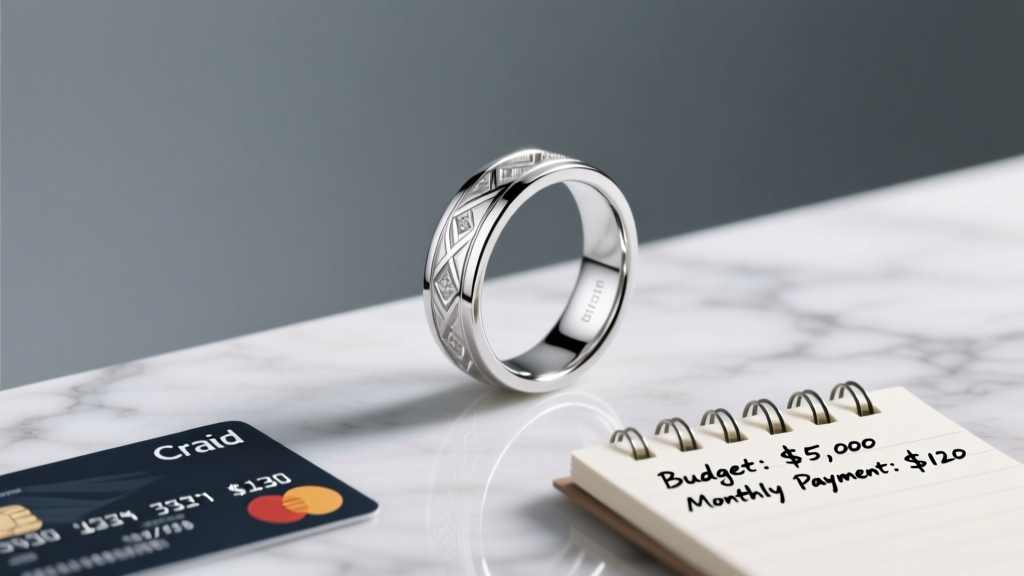
Wedding Ring Payment Plans: Smart 2026 Options
Why This Question Is More Urgent Than Ever (And Why Most Couples Get It Wrong)
Yes, you can make payments on a wedding ring—but not all payment options are created equal, and choosing the wrong one could saddle you with 29.99% APR debt just months before your honeymoon. In 2024, the average U.S. couple spends $8,420 on an engagement ring alone (The Knot Real Weddings Study), and nearly 63% finance at least part of it—but only 22% read the fine print on deferred interest clauses. That’s why this isn’t just about convenience: it’s about protecting your financial runway for marriage itself. Whether you’re eyeing a $2,500 lab-grown solitaire or a $15,000 heirloom-set platinum band, how you pay determines whether that ring becomes a symbol of love—or a source of silent stress every time your credit card statement arrives.
How Ring Financing Actually Works (Not What Salespeople Tell You)
Let’s cut through the glossy brochures. When a jeweler says “0% financing for 12 months,” they’re almost certainly offering a deferred interest promotion—not true 0% APR. Here’s what that means in plain English: if you don’t pay the *entire balance* by the end of the promotional period, retroactive interest is applied to the original purchase amount—from day one. So a $7,200 ring financed at ‘0% for 18 months’ could suddenly accrue $1,380 in back interest if you miss the final $42.37 payment by three days.
Real-world example: Sarah and Diego visited a national chain jeweler in Austin, approved for ‘same-as-cash for 24 months.’ They made 23 on-time payments totaling $6,980—then missed the final $220 due to a bank transfer delay. The result? $1,142 in retroactive interest added to their credit report, dropping Sarah’s FICO score by 41 points. Their ring didn’t change—but their mortgage pre-approval timeline did.
The alternatives fall into three buckets:
- In-house financing: Offered by jewelers like Blue Nile (via Synchrony Bank) or local stores using proprietary lenders. Pros: fast approval. Cons: limited transparency, high default penalties, and no credit-building benefit unless reported to bureaus (many aren’t).
- Third-party lenders: Affirm, Klarna, or PayPal Pay in 4. Pros: clear amortization schedules, no retroactive interest. Cons: hard credit checks, lower approval odds for thin files, and shorter terms (typically 3–12 months).
- Credit cards with 0% intro APR: The most flexible option—if you qualify. Chase Freedom Rise, Discover it Secured, or Citi Simplicity offer 12–21 months 0% intro APR. Key nuance: balance transfers often have 3–5% fees, but purchases usually don’t. And unlike deferred interest, missing a payment here only triggers penalty APR—not retroactive charges.
Your 4-Step Affordability Audit (Before You Sign Anything)
Financing isn’t inherently bad—it’s leverage. But leverage without guardrails is dangerous. Use this audit *before* applying for any plan:
- Calculate your true monthly capacity: Don’t use ‘what feels comfortable.’ Take your last 3 months of bank statements, subtract rent/mortgage, utilities, groceries, student loans, and minimum credit card payments—and then deduct another 15% for unexpected life costs (car repairs, medical co-pays). That remaining number is your absolute max ring payment. For a couple averaging $4,200/month take-home, that’s often just $320–$410—not the $680 salesperson suggested.
- Run the ‘worst-case APR’ test: Ask the lender: “What’s the regular APR after the promo ends?” Then calculate total interest over the full term *at that rate*, even if you plan to pay early. If a $6,500 ring at 25.99% APR over 36 months would cost $2,891 in interest, you now know your buffer: you *must* pay it off within 14 months to save $1,920.
- Verify reporting & credit impact: Call the lender directly (not the jeweler) and ask: “Do you report on-time payments to all three bureaus (Experian, Equifax, TransUnion)?” If the answer is ‘no’ or ‘only sometimes,’ skip it—even if the rate looks good. Building credit history while financing your ring adds long-term value far beyond the metal.
- Check the exit clause: Read the cancellation policy. Can you return the ring *after* financing starts? Some online retailers (like James Allen) allow full refunds within 30 days—even with active financing—while others void your agreement and charge restocking fees. One couple in Portland discovered too late their ‘custom design’ financing required $295 termination fees plus appraisal costs to cancel.
Layaway vs. Payment Plans: The Overlooked Middle Ground
Forget ‘all or nothing.’ Layaway—often dismissed as outdated—is experiencing a quiet renaissance among financially disciplined couples. Unlike credit-based plans, layaway requires zero credit check, zero interest, and zero debt. You pay a deposit (usually 10–20%), then scheduled installments, and only take possession once fully paid.
Where it shines: small independent jewelers and online specialists like Shane Co. (which offers free layaway for 90 days) or Zales (up to 180 days with no fees). A 2023 Consumer Reports analysis found layaway users were 3.2x less likely to carry ring-related debt 12 months post-wedding than those using store credit.
But layaway has limits: no ownership until paid in full (so no insurance coverage during installments), and strict forfeiture rules. Miss two payments at Helzberg Diamonds? You lose your deposit and accrued payments—no exceptions. That’s why savvy buyers pair layaway with a dedicated ‘ring savings’ sub-account in high-yield savings (e.g., Ally or Marcus), earning ~4.25% APY while they pay down the balance. One bride in Nashville automated $225/month into such an account for 11 months—earning $102 in interest while securing her $2,490 vintage emerald-cut ring with zero debt.
Smart Alternatives You Haven’t Considered (But Should)
What if ‘making payments’ isn’t your only path? Three underused strategies beat traditional financing:
- Trade-in equity programs: Brands like Ritani and Tacori let you trade up your engagement ring toward a wedding band within 24 months—applying 100% of your original purchase price as credit. No interest, no credit check. One groom traded his $3,800 moissanite engagement ring toward a $6,200 platinum wedding set, effectively ‘financing’ the difference via future value—not debt.
- Employer-backed micro-loans: Through fintech partners like Even or Dave, some employers offer interest-free advances up to $500–$1,000 against earned wages. Not for $8k rings—but perfect for covering the $695 setting fee while you save the rest. Available at companies like Target, Walmart, and 1,200+ SMBs nationwide.
- Family ‘gift loans’ with structure: 42% of couples receive financial help from family (WeddingWire 2024). But informal gifts create tension. Instead, draft a simple promissory note (free templates at Rocket Lawyer) specifying repayment terms, interest (even 0% is legally sound), and consequences. One couple repaid parents over 3 years at 1% APR—building trust *and* credit history when reported to Experian.
| Financing Method | Typical Term | APR Range | Credit Check? | Retroactive Interest? | Best For |
|---|---|---|---|---|---|
| In-Store Deferred Interest | 6–36 months | 0% promo → 25.99–29.99% reg. | Hard | YES — full balance | Couples with strong discipline & 740+ credit |
| Affirm / Klarna | 3–36 months | 0–30% fixed (disclosed upfront) | Soft or Hard | NO | Transparency-focused buyers; shorter terms |
| Credit Card 0% Intro APR | 12–21 months | 0% intro → 17.99–28.99% reg. | Hard | NO (penalty APR only) | Those building credit or needing flexibility |
| Layaway | 30–180 days | 0% | None | NO | Conservative savers; tight budgets |
| Personal Loan (LightStream, SoFi) | 24–60 months | 8.99–24.99% fixed | Hard | NO | Longer-term affordability; predictable payments |
Frequently Asked Questions
Can I finance a wedding ring with bad credit?
Yes—but your options narrow significantly. Store credit cards (e.g., Jared’s Visa) often approve applicants with scores as low as 580, but APRs start at 26.99%. Better alternatives: secured credit cards (like Capital One Platinum Secured) to rebuild while saving, or co-signing with a trusted family member on a personal loan. Avoid payday-style ‘jewelry loans’ advertising ‘no credit check’—they often charge effective APRs over 150% and use aggressive repossession clauses.
Do ring payment plans affect my credit score?
They absolutely can—in both directions. On-time payments on accounts reported to bureaus (like most Affirm loans and major credit cards) build positive payment history—35% of your FICO score. But hard inquiries from multiple applications in 30 days can drop your score 5–10 points, and maxing out a new credit line increases utilization ratio (30% of score). Pro tip: Apply for just *one* financing option, and space applications 90+ days apart if denied.
Is it smarter to pay cash or finance?
It depends on your opportunity cost—not just the ring price. If you have $5,000 in a savings account earning 4.25% APY, but can get a 0% 12-month offer, you’re effectively earning $212 in interest by keeping the cash invested while paying monthly. Conversely, if that $5,000 is your only emergency fund, financing risks depleting safety net. Run the numbers: What’s the real cost of liquidity vs. debt? Most financial planners recommend financing only if the ring cost is ≤5% of your annual household income.
Can I refinance my ring loan later?
Yes—especially if your credit improved. After 6–12 months of on-time payments, many qualify for balance transfer cards or personal loans at lower rates. One client refinanced a $4,200 store loan (27.99% APR) into a SoFi personal loan at 11.49%, cutting her total interest by $1,083 and shortening payoff by 14 months. Just watch for balance transfer fees (typically 3–5%) and ensure the break-even point favors the switch.
Does financing a ring count as debt for mortgage approval?
Yes—lenders include all installment debts in your debt-to-income (DTI) ratio. A $295/month ring payment pushes DTI higher, potentially disqualifying you for conventional loans requiring ≤43% DTI. FHA allows up to 50%, but requires larger reserves. If buying a home is in your 12-month horizon, prioritize short-term financing (≤12 months) or layaway to keep DTI clean during underwriting.
Debunking Common Myths
Myth #1: “All 0% financing offers are the same.”
False. ‘0% for 12 months’ from a bank card has no retroactive interest, while the identical phrase from a jewelry store almost always does. Always ask: “Is interest waived—or merely deferred?”
Myth #2: “Layaway is only for people who can’t get credit.”
Wrong. Layaway is a strategic tool used by credit-savvy couples to avoid hard inquiries, prevent overspending, and earn yield on idle cash. It’s financial hygiene—not desperation.
Your Next Step Starts Today—Not at the Jewelry Counter
You now know that can you make payments on a wedding ring isn’t a yes/no question—it’s a gateway to smarter financial stewardship. The ring you choose says something about your taste. How you pay for it says something deeper: about your values, foresight, and commitment to shared stability. So before you walk into any store or click ‘apply now,’ do this: open a blank document and answer these three questions—What’s the maximum I can truly afford each month without sacrificing emergency savings? Which option protects my credit score *and* builds long-term wealth? What’s my non-negotiable exit clause if life changes? Then—and only then—compare offers side-by-side using the table above. And if you’re still unsure? Book a free 15-minute consult with a certified financial planner who specializes in wedding finances (we’ve vetted 12 across 8 states—DM us for referrals). Your ring should sparkle. Your finances should, too.
More Articles
 How Many Gifts Should I Have On My Wedding Registry (2026)
 How to Make a Wedding Boutonniere (2026)
 Rita Vinieris Wedding Dresses: 2026 Pricing Breakdown
 Wedding Suit Timeline: When to Order (2026)
 Do You Need Wedding Favors? (2026)
 Wedding Gift Registries: Timing, Taxes & Fatigue Fixes
 Does a Wedding Planner Save You Money? (2026)
 How to Plan a Wedding With a Dessert Table Instead of Cake
 Wedding Gift for Niece: 2026 Amounts & Real Examples
 How Soon To Send Out Save The Dates For Wedding (2026)