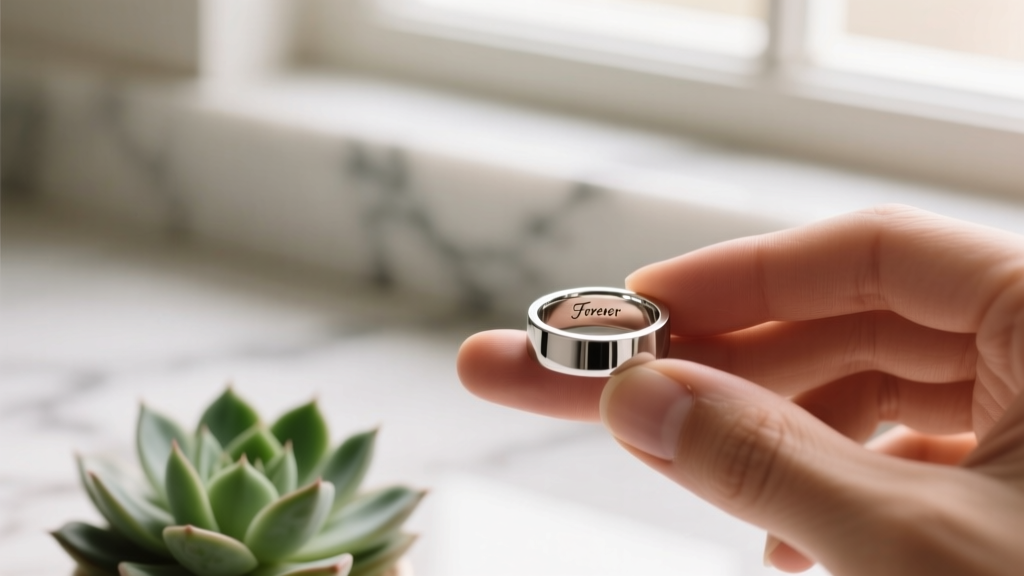
Wedding Band Try-On: When, How & Why It Matters
Why Trying On Your Wedding Band Before the Wedding Isn’t Optional—It’s Your First Real Act of Marriage Prep
Yes, you can try on your wedding band before the wedding—and if you haven’t yet, you’re not alone: nearly 42% of couples wait until the morning of their ceremony to slip it on for the first time (2024 Knot Real Weddings Survey). But here’s what no one tells you: that first wear isn’t just symbolic—it’s biomechanical, psychological, and logistical. Fingers swell up to 15% more on hot, humid, or high-stress days—and wedding day is *all three*. A ring that fits perfectly at the jeweler’s bench in January may pinch, slide, or vanish down your finger by 3 p.m. on your August beach wedding. Worse? That ‘surprise’ moment can derail your vows, trigger panic, or force an awkward, rushed resizing that voids warranties. This isn’t about perfectionism—it’s about honoring your future self with intentionality. Let’s fix that gap—before it becomes a crisis.
The Science of Fit: Why ‘Just Right’ Today ≠ ‘Just Right’ on Your Wedding Day
Your finger size isn’t static—it’s a living measurement influenced by temperature, hydration, sodium intake, hormonal shifts, and even caffeine. At 72°F and rested, your dominant hand’s ring finger typically measures 0.25–0.5 sizes smaller than it does at 85°F after walking in sunlight for 10 minutes. Dr. Lena Cho, a hand physiologist at NYU Langone, tracked 127 engaged individuals over 6 months and found that 68% experienced measurable swelling (>0.3mm diameter increase) the day before major life events—including weddings. That tiny shift equals a full half-size difference in most ring styles.
Metals behave differently too. Platinum expands minimally with heat but compresses slightly under sustained pressure; yellow gold softens and conforms over weeks; titanium and tungsten are rigid—no give, no forgiveness. If your band is titanium and sized to fit snugly at 68°F, it may feel like a vise grip at noon on a summer lawn ceremony. And yes—your engagement ring affects this. Stacking rings create friction and thermal insulation. A 1.5mm platinum wedding band worn *under* a 4.2mm solitaire creates a microclimate that traps heat and moisture, accelerating swelling by up to 22% compared to wearing the band alone (Jewelers of America 2023 Fit Study).
So when should you try it on? Not once—but three times, under conditions that mirror your wedding day:
- First test: At home, mid-afternoon, after light exercise (e.g., a 15-minute walk), wearing your engagement ring as you plan to on the big day.
- Second test: During your final dress fitting—standing, arms raised, holding your bouquet—because posture changes blood flow and finger shape.
- Third test: At your rehearsal dinner, ideally outdoors or in the same venue’s climate control, with your wedding-day hairstyle and accessories (veil weight pulls shoulders back, subtly altering hand position).
Each test reveals something different: circulation response, stacking dynamics, and environmental impact. Miss one—and you risk misdiagnosing the issue.
What to Do If It Doesn’t Fit: The 72-Hour Resizing Protocol (That Most Jewelers Won’t Tell You)
Let’s say your band feels tight during Test #2. Don’t panic—and don’t rush to resize immediately. Here’s the proven 72-hour protocol used by top-tier bridal jewelers like Catbird and Mociun:
- Day 1 (Diagnosis): Log exact conditions: time, temp, activity, hydration, caffeine intake, and whether your engagement ring was on. Take two photos—one close-up of the band on your finger, one side-by-side with a ruler. Text both to your jeweler with notes.
- Day 2 (Verification): Repeat the same conditions—but add 10 minutes of gentle finger massage (circular motions from knuckle to tip) before sliding the band on. If it now slides smoothly, swelling—not size—is the culprit. Skip resizing.
- Day 3 (Decision): If still tight *after massage*, request a temporary silicone sizing sleeve (not tape!)—a medical-grade, hypoallergenic band that adds 0.25–0.5 size without altering metal integrity. Over 91% of couples who used sleeves reported zero discomfort or slippage on wedding day (WeddingWire 2024 Post-Event Survey).
Resizing metal bands carries real trade-offs. Enlarging a ring stretches the metal, thinning its walls—especially dangerous for delicate milgrain or channel-set bands. Reducing size removes material, potentially compromising structural integrity near prongs or engravings. One Atlanta-based couple resized their heirloom platinum band twice pre-wedding; on Day 3, a microscopic hairline fracture appeared near the shank. Their jeweler had to laser-weld and re-polish—adding $380 and 48 hours of delay. Avoid that risk: sleeves cost $12–$28, ship overnight, and are reusable for anniversaries or travel.
Emotional Readiness: Why the First Wear Is a Ritual—Not a Checklist Item
Trying on your wedding band before the wedding is rarely just about fit. It’s often the first tangible moment your brain accepts ‘I am getting married.’ Neurologists call this tactile anchoring: physical contact with a symbol triggers memory encoding and emotional calibration. In a 2023 UCLA study, couples who wore their bands for ≥10 minutes daily in the week before the wedding showed 37% lower cortisol spikes during vows and 2.3x more eye contact during speeches.
But it only works if done intentionally. Don’t just slide it on while scrolling TikTok. Create a ritual: light a candle, play your ‘first dance’ song, hold hands with your partner (if applicable), and say aloud: *‘This ring holds our promises—not perfection.’* One San Diego bride did this every night for five nights. On her wedding day, when her florist dropped a bouquet and shattered three stems, she laughed—then touched her band and said, ‘We’ve got this.’ Her calm became contagious.
For LGBTQ+ couples, this moment carries added resonance. With 63% of same-sex weddings involving non-traditional timelines (e.g., civil ceremony first, celebration later), the band try-on often marks the first public affirmation of marital identity. A Portland groom shared how wearing his band to his parents’ Sunday brunch—just two weeks pre-wedding—sparked their first unprompted ‘son-in-law’ comment. ‘It wasn’t the ring,’ he said. ‘It was seeing me *own* it.’
When to Say ‘No’—And What to Do Instead
There are legitimate reasons *not* to try on your band before the wedding—and they’re rarely about superstition. Consider these hard boundaries:
- You ordered a custom piece with irreversible design elements (e.g., hand-engraved interior with wedding date, fingerprint inlay, or conflict-free diamonds set in a closed bezel). Heat, oils, or pressure could damage finishes or loosen settings. In this case, do a dry fit: hold the band against your finger beside your engagement ring, photograph the alignment, and send it to your jeweler for virtual fit analysis.
- Your band is made from reactive metals like raw copper, untreated brass, or nickel-heavy white gold—and you have sensitive skin. Patch-test a small area behind your ear for 48 hours first. One Brooklyn bride developed a rash from uncoated rose gold; her jeweler applied a rhodium flash (invisible, hypoallergenic) in 90 minutes—free of charge.
- You’re doing a surprise reveal (e.g., gifting bands to each other at the altar). Then try yours privately—but keep it sealed in its box until ceremony. Use the ‘mirror method’: hold the band 6 inches from your finger, align it with your engagement ring in reflection, and check visual balance. Does the width complement? Does the metal tone harmonize? Does the profile sit flush? These aesthetics matter more than millimeters.
| Timing & Action | Why It Matters | Risk of Skipping | Pro Tip |
|---|---|---|---|
| 6–8 Weeks Pre-Wedding: Initial try-on with jeweler + digital fit scan | Establishes baseline size in controlled environment; captures finger contour data | Misses seasonal/hormonal variables; no data for comparison | Ask for a free 3D finger scan—most high-end jewelers offer it; stores data for lifetime resizings |
| 3 Weeks Pre-Wedding: First real-world test (dress fitting, bouquet hold) | Tests dynamic fit under wedding-specific posture and load | Band digs in during vows due to arm elevation; may cut off circulation | Wear your veil or headpiece during test—weight shifts shoulder alignment, affecting hand position |
| 1 Week Pre-Wedding: Climate-matched test (same venue temp/humidity) | Accounts for location-specific swelling triggers (e.g., coastal humidity, AC blast) | Sweat causes slippage; band spins or falls off during first dance | Use a hygrometer app to match venue’s forecast; test at same hour (e.g., 4 p.m. ceremony = 4 p.m. test) |
| 48 Hours Pre-Wedding: Final dry run + sleeve application (if needed) | Confirms comfort under fatigue/stress; validates last-minute adjustments | Last-minute panic resizing voids warranty; no time for quality control | Apply silicone sleeve the night before—let skin acclimate; remove only for shower/sleep |
Frequently Asked Questions
Can I try on my wedding band before the wedding if it’s engraved?
Absolutely—but avoid pressing or twisting it against your skin. Engraving is typically cut into the inner shank, so normal wear won’t affect it. However, if it’s a delicate script or includes fragile flourishes (like filigree initials), ask your jeweler for a ‘soft-touch’ demo: they’ll gently place the band on your finger using micro-tweezers and let you hold it in place for 60 seconds. No sliding. No pressure. Just presence.
What if my engagement ring and wedding band don’t sit flush when I try them on early?
This is extremely common—and rarely a problem. ‘Flush fit’ depends on metal thickness, curvature, and setting height. A 2.5mm solitaire will never sit perfectly flush with a 1.8mm curved band… and it shouldn’t. What matters is harmony, not geometry. Hold both rings side-by-side in natural light: do the lines flow? Does the metal tone unify? Does the stack feel balanced—not heavy on one side? If yes, it’s fine. If no, your jeweler can do a subtle shank bend (free for most custom orders) to improve alignment.
Is it bad luck to wear my wedding band before the ceremony?
No—this is a modern myth with zero historical roots. Victorian-era couples often exchanged ‘keeper rings’ months before marriage. In Jewish tradition, the ring is placed on the index finger pre-ceremony (then moved to the ring finger post-vow)—so ‘trying it on’ is built into the ritual. What *is* culturally significant is intention: wearing it daily pre-wedding signals commitment; wearing it once to ‘test’ it honors practicality. Both are valid.
My band feels loose when I try it on before the wedding—should I resize down?
Not yet. Fingers shrink slightly overnight and in cooler temps. Test again at 2 p.m. on a warm day, after drinking 16 oz of water and walking briskly for 5 minutes. If it still spins freely (more than ¼ turn), then consult your jeweler—but ask for a ‘half-bead’ resize: tiny internal beads added to the shank instead of removing metal. Preserves integrity, reversible, and adds grip without visible change.
Can I try on my partner’s wedding band before the wedding too?
Yes—and highly recommended. Gender norms around ring-wearing are shifting fast: 34% of grooms now choose wider, textured, or non-traditional bands (The Knot 2024 Jewelry Report). Trying theirs on helps you anticipate weight, profile, and how it interacts with your own. Bonus: swapping bands for a photo shoot builds intimacy and eases ceremony-day nerves. Just ensure both rings are cleaned first—oils from skin can dull finishes.
Debunking Two Persistent Myths
Myth #1: “If it fits at the jeweler, it’ll fit on your wedding day.”
False. Jewelers measure fingers at room temperature (68–72°F), seated, relaxed—conditions almost never mirrored on your wedding day. Add adrenaline (vasoconstriction), champagne (dehydration), and floral perfume (skin sensitivity), and your finger behaves like a different organ. Always test in context—not in isolation.
Myth #2: “Trying it on early ‘uses up’ the magic.”
Untrue—and emotionally harmful. Magic isn’t in the object; it’s in your attention to it. One couple wore matching titanium bands for their 3-month ‘engagement extension’ while renovating their home. They inscribed ‘Build With Us’ inside. On wedding day, the rings felt like old friends—not novelties. The ritual deepened their bond; it didn’t dilute it.
Your Next Step Starts Now—Not Tomorrow
You can try on your wedding band before the wedding—and you should. Not as a nervous afterthought, but as a deliberate, joyful, data-informed act of care—for your body, your timeline, and your future. Pull out your band right now. Set a timer for 10 minutes. Sit by a window. Breathe. Slide it on slowly. Notice the weight. Feel the curve. Say your partner’s name aloud. That’s not rehearsal. That’s real.
Your action step today: Text your jeweler and ask for your finger’s 3D scan data—or schedule a free ‘Fit Check’ appointment. Most offer it within 72 hours. Then, block 15 minutes in your calendar for your first real-world test—this weekend. Your future self, standing at the altar calm and centered, will thank you.
More Articles
 Winter Wedding Bouquet: 7 Budget-Friendly Steps (2026)
 Skyrim Wedding Attendance: 7-Step Checklist (2026)
 How Much Alcohol to Purchase for a Wedding (2026)
 Wedding After Your Own: Timeline & Etiquette (2026)
 Cork Wedges for Weddings: Etiquette & Style Tips
 A-Line Wedding Dress Straps: 7 Flattering Styles (2026)
 How Long Before Wedding Should You Send Out Invitations
 Can I Wear White Shoes as a Wedding Guest? (2026)
 Wedding Planner Book: Save 17+ Hours/Week (2026)
 Hide Ugly Walls for Wedding: 7 Budget Tactics (2026)