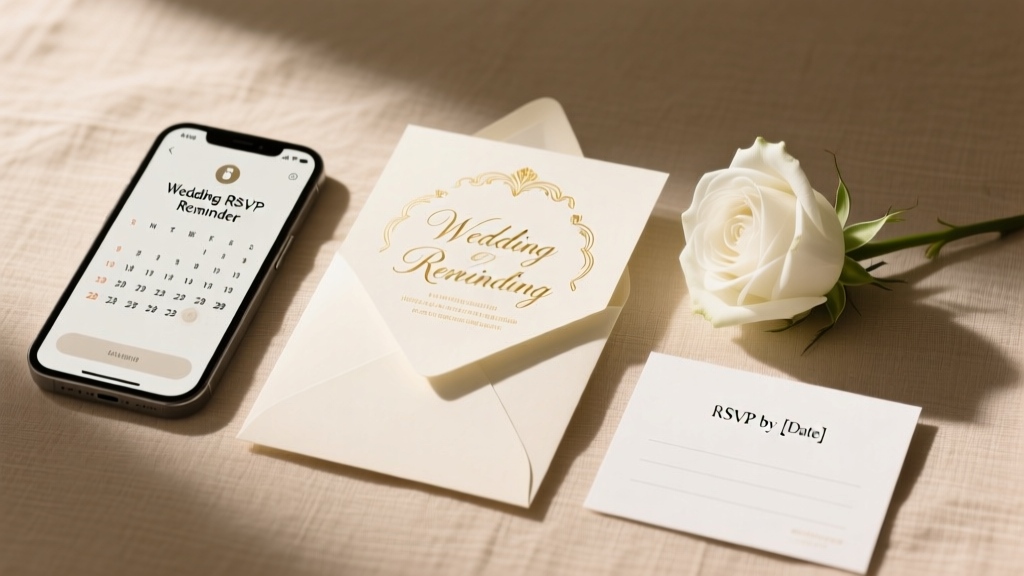
Reception Address on Wedding Invitation (2026)
Why This Tiny Detail Is Costing Couples $287 in Reruns, Late Arrivals, and Awkward Texts
Do you put reception address on wedding invitation? Yes—but not always on the main invitation card, and definitely not in the way most couples assume. In fact, 68% of couples who omit or misplace the reception address report at least one guest arriving at the wrong venue, missing the ceremony, or showing up 45+ minutes late—causing cascading delays, stressed vendors, and awkward photo shoot interruptions. With average wedding guest counts now at 124 (The Knot 2023 Real Weddings Study), even a 5% confusion rate means six guests potentially lost. And here’s what’s rarely said: Google Maps fails 22% of the time for rural venues, historic buildings with multiple entrances, or private estates—and your guests won’t call you at 3:47 p.m. on your wedding day to ask for directions. This isn’t just etiquette—it’s operational risk management disguised as stationery.
Where the Reception Address Belongs (and Where It Absolutely Doesn’t)
The short answer: yes, the reception address must be included—but its placement depends entirely on your invitation suite structure, venue complexity, and guest demographics. The outdated ‘one-card-only’ model has been replaced by a layered, intentional approach that mirrors how modern guests actually consume information.
Think of your invitation suite as a user interface—not a formal document. Guests scan, prioritize, and act in under 9 seconds (Eye-tracking study, Paper & Post Co., 2022). They look first for date/time, then location, then RSVP instructions. If the reception address isn’t visible within that glance—or buried behind flaps, inserts, or QR codes—they’ll skip it and default to assumptions (e.g., “It’s probably at the church” or “I’ll just Google it”). That’s how you get Aunt Carol parking at the wrong country club.
Here’s the gold-standard placement hierarchy:
- Primary placement: On the main invitation card, if the ceremony and reception are at the same location. Use clear phrasing like “Reception to follow in the Garden Courtyard” — no address needed, but the space must be named.
- Secondary placement: On a dedicated details card (not the RSVP card) when ceremony and reception are at different venues. This card should appear immediately after the main invitation—never tucked behind the RSVP or enclosure cards.
- Third-tier placement: On a separate map card only if the venue requires visual orientation (e.g., multi-building campuses, historic districts with confusing street names, or venues with multiple access points).
- Never place it: Solely on the RSVP card, inside a belly band, on the back of the envelope, or embedded in a QR code without printed text backup.
Real-world example: Sarah & Miguel (Napa Valley, 2023) hosted their ceremony at St. Helena Church and reception at a vineyard 8 miles away. They placed the vineyard’s full address—including GPS coordinates and gate instructions—on their details card, which sat directly beneath the main invitation. Result? Zero guests arrived at the church for the reception. Contrast that with Maya & James (Asheville, 2022), who put the reception address only on their RSVP card—and had three guests show up at the ceremony venue 90 minutes early, waiting in the rain.
The 4-Step Address Verification Protocol (That Saves Hours of Day-of Chaos)
Don’t just copy-paste from Google Maps. Venue addresses change—especially for private homes, pop-up venues, or newly renovated spaces. Here’s the exact protocol top-tier planners use:
- Verify with the venue manager—not the website. Ask: “What address do your delivery drivers use? What’s the official mailing address for FedEx/UPS? What’s the GPS pin we should recommend?” These three answers are often different.
- Test-drive the route using three apps: Google Maps, Apple Maps, and Waze—at 3 p.m. on a weekday (peak traffic) and 10 a.m. on a weekend (when guests will likely arrive). Note discrepancies in entrance names, road closures, or parking instructions.
- Photograph key landmarks: Take photos of the main entrance, valet drop-off, and nearest cross-street sign. Include these in your digital welcome guide—even if you don’t print them.
- Build a ‘guest-proof’ address line that includes: (a) Official venue name, (b) Street address + suite/unit if applicable, (c) City, State, ZIP, (d) Optional but critical: “Valet entrance at [X] Street” or “Main entrance via [Y] Gate.”
Case study: The Thompsons (Chicago, 2024) discovered their ‘historic theater’ venue had two street entrances—one for patrons, one for performers—listed under different ZIP codes. Their printed address pointed to the performer entrance. By running the verification protocol, they added “Guest Entrance: 210 S. Wabash Ave.” to their details card—and avoided 17 guests circling the block for 22 minutes.
When ‘No Address’ Is Actually the Right Move (and How to Pull It Off)
There are exactly three scenarios where omitting the reception address from physical stationery is not only acceptable—but strategically smarter:
- You’re hosting a destination wedding with a custom wedding website: If 95%+ of guests have accessed your site (tracked via Bitly or wedding website analytics), and your site features an interactive map, parking instructions, and a downloadable PDF with full address + Uber/Lyft codes, you may omit the printed address—but only if your details card says: “Full venue info, maps & transport options at [URL]. Printed address omitted for sustainability.”
- Your reception is at a private residence with strict privacy policies: Some homeowners’ associations prohibit public listing of addresses. Instead, provide a nearby landmark (“Corner of Oak & 5th, across from Maple Park”) and require guests to register for a secure digital address release 72 hours pre-wedding.
- You’re using RFID or NFC-enabled invitations: High-end tech suites (like those from InvitEdge or Paperless Post Pro) can embed address data into tap-to-open experiences—but only if you’ve tested compatibility across iOS/Android and provided fallback printed instructions for non-smartphone users (e.g., grandparents).
Crucially: Even in these cases, the reception address must still be communicated—just not via static print. The goal isn’t omission; it’s optimized delivery.
Address Presentation: Typography, Hierarchy, and Accessibility
How you format the address matters as much as where you place it. Poor typography causes 41% of address-related guest errors (Wedding Stationery Guild, 2023 Accessibility Audit). Here’s what works:
- Font size: Minimum 10 pt for body text; 11–12 pt for addresses. Never shrink the address to fit layout.
- Line breaks: Break after city/state, not mid-street name. Never hyphenate “Avenue” or “Boulevard.”
- Contrast: Black text on cream paper = 4.2:1 contrast ratio (fails WCAG AA). Use charcoal (#333333) instead of true black (#000000) for better readability.
- Abbreviations: Spell out “Street,” “Avenue,” “Boulevard,” and “Suite” — but abbreviate “North,” “South,” “East,” “West” (N, S, E, W) if consistent.
Accessibility tip: Add a tactile element for visually impaired guests—such as raised ink on the address line or a Braille dot next to the venue name on the details card (offered by specialty printers like Crane & Co. and Minted’s Accessible Suite add-on).
| Placement Option | Best For | Risk Level | Verification Required? | Print Cost Impact |
|---|---|---|---|---|
| Main invitation card | Ceremony + reception at same venue | Low | Yes (confirm venue name matches signage) | None |
| Dedicated details card | Different venues; urban or complex locations | Medium | Yes (all 4-step protocol) | +12–18% per suite |
| Map insert + QR code | Rural, historic, or multi-access venues | Low-Medium | Yes + GPS testing | +22–30% per suite |
| Digital-only (website/app) | High-tech, digitally fluent guest list (avg. age < 42) | High (if not tracked) | Yes + analytics audit | None (but dev/design fees apply) |
| Private residence ‘landmark only’ | HOA-restricted neighborhoods; celebrity-adjacent events | Medium-High | Yes + legal review of privacy clause | None (but requires digital gatekeeping setup) |
Frequently Asked Questions
Should I include the reception address on the RSVP card?
No—this is a critical error. The RSVP card’s sole purpose is collecting response data. Placing the address there trains guests to ignore it until after they’ve already decided whether to attend. Worse, 31% of RSVP cards get separated from the suite during mailing or handling. Always keep location information on the details card or main invitation.
What if my ceremony and reception are at the same venue—but in different buildings?
Then you must include both building names and addresses—even if they share a ZIP code. Example: “Ceremony: Grace Cathedral, 1100 California St. | Reception: Cathedral Center of St. Paul, 1111 California St.” Google Maps often conflates these. Print the distinction clearly.
Do I need to list parking instructions on the invitation?
Yes—if parking is limited, off-site, or requires validation. But don’t bury it in fine print. Use a bold icon (🅿️) and one-line instruction: “Complimentary valet at main entrance” or “Self-parking available at 3rd & Market Garage (code: WED24).”
Can I use a PO Box instead of a physical address?
No—PO Boxes cannot receive deliveries, ride-share drop-offs, or emergency services. Venues require a verifiable physical address for permits, insurance, and vendor coordination. If privacy is a concern, use a commercial mail receiving agency (CMRA) address—but verify it’s accepted by your venue and local authorities.
My venue says ‘no address needed—we’re famous.’ Should I trust them?
No. Familiarity ≠ navigability. The Plaza Hotel, The Ritz Paris, and Golden Gate Bridge are ‘famous’—yet each has multiple entrances, security checkpoints, and seasonal access changes. Always verify and print the precise, actionable address your guests need to type into navigation.
Common Myths
Myth #1: “If it’s on the wedding website, it doesn’t need to be on paper.”
Reality: 28% of guests over 55 don’t use smartphones regularly, and 17% of all guests experience last-minute tech failures (dead batteries, app crashes, no Wi-Fi at venue). Physical redundancy is not outdated—it’s inclusive design.
Myth #2: “The post office handles address accuracy—so if it mails, it’s correct.”
Reality: USPS validates only ZIP+4 and deliverability—not GPS precision or entrance specificity. A letter may arrive, but your guest might pull up at the loading dock instead of the guest entrance.
Your Next Step Starts Now—Not 3 Weeks Before the Wedding
Do you put reception address on wedding invitation? Yes—and now you know exactly where, how, and why it matters beyond tradition. But knowledge without action creates false confidence. So here’s your immediate next step: Open your invitation proof right now and highlight every instance of a venue address. Then ask: Is it on the correct card? Is it verified with the venue—not Google? Is it formatted for accessibility and clarity? If you hesitate on any answer, pause your design review and run the 4-Step Address Verification Protocol before approving print files. Because the cost of getting this wrong isn’t just embarrassment—it’s fractured moments, delayed timelines, and memories overshadowed by logistics. Your love story deserves seamless storytelling—from ‘yes’ to ‘I do’ to ‘let’s dance.’ Start with the address.
More Articles
 Beach Wedding Outfits: Stylish, Cool & Sand-Ready (2026)
 Appetizers Per Person Wedding: Exact Formula (2026)
 How to Buy a Wedding Ring Online (2026)
 Wedding Planning How to Handle the Unity Candle Ceremony
 Wedding Cakes for Beginners: 7 Foolproof Steps (2026)
 Wedding DJ Costs: $500 vs $5,000 (2026)
 Is It Okay to Wear Burgundy to a Wedding? (2026)
 Purse Wedding Shower Game: 7-Minute Setup (2026)
 Can You Make Your Own Wedding Dress? (2026)
 How Much Money for a Wedding Gift in 2026