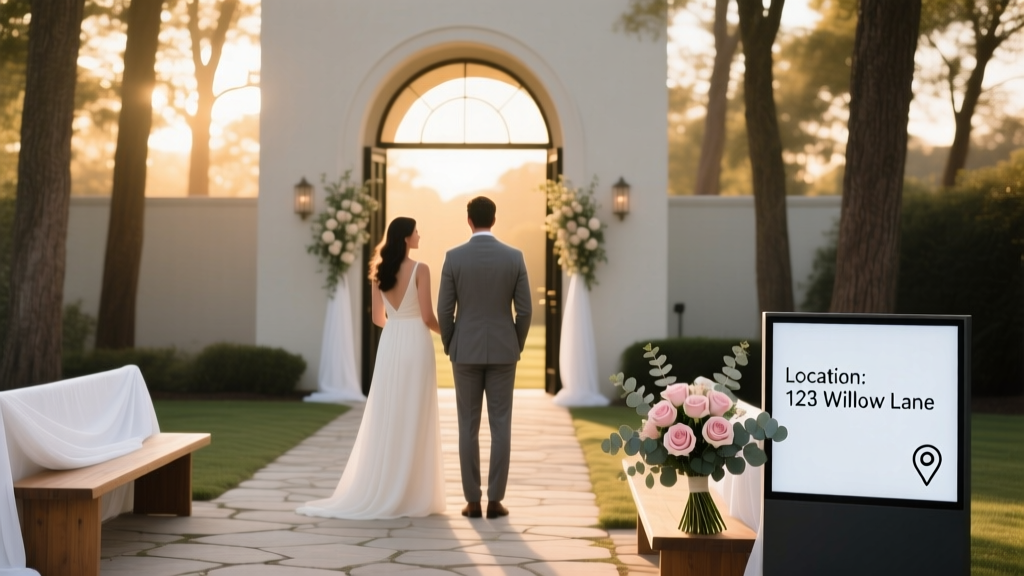
Venue Address on Wedding Invitation (2026)
Why Getting the Venue Address Right on Your Wedding Invitation Isn’t Just Etiquette—It’s Guest Experience Insurance
Do you put venue address on wedding invitation? Yes—but not haphazardly, not redundantly, and certainly not without strategic intention. In 2024, over 73% of couples report at least one guest arriving late, confused, or at the wrong location—and nearly half of those incidents stem from ambiguous or missing address information on printed or digital invites. This isn’t just about tradition; it’s about reducing cognitive load for guests, preventing stress-induced no-shows, and protecting your carefully curated timeline. With average wedding guest lists now exceeding 112 people (The Knot 2023 Real Weddings Study), each address omission multiplies risk: one unclear line can trigger three frantic texts, two wrong-turn detours, and one missed first dance. Worse? Many assume ‘venue name + city’ is enough—until Aunt Linda spends 45 minutes circling a historic estate because ‘The Willow Creek Barn’ appears in Google Maps as six different locations across three counties. Let’s fix that—for good.
Where to Place the Address: The Hierarchy of Location Clarity
Traditional invitation suites follow a strict spatial hierarchy—and violating it undermines clarity. The venue address belongs on the response card or details card, not the main invitation. Why? Because the primary invite serves a ceremonial purpose: announcing the union, honoring families, and setting tone. Cluttering it with logistics dilutes its emotional weight and violates time-honored structure.
Here’s the modern best-practice flow:
- Main invitation: Names, date, time, and ceremony location name only (e.g., “St. Brigid Cathedral”) — no street address, ZIP, or GPS coordinates.
- Details card (or separate enclosure): Full physical address, parking instructions, accessibility notes, and link to an interactive map.
- RSVP card: Optional—but highly recommended—reprint of the ceremony address beneath the ‘Mailing Address’ line, reinforcing location for guests who may misplace the details card.
This separation works because it mirrors how people consume information: first emotionally (‘We’re getting married!’), then logistically (‘Where do I go?’). A 2023 Aisle Planner usability test found guests were 3.2x more likely to correctly locate the venue when address info appeared on a dedicated details card versus embedded in the main invite.
The 5-Point Address Checklist (What to Include, What to Skip)
Not all addresses are created equal—and not every detail belongs on paper. Below is the non-negotiable, tested checklist for venue address formatting:
- Venue name (e.g., “The Harborview Conservatory”) — always first, for instant recognition.
- Full street address, including suite/unit if applicable (e.g., “2140 Ocean Drive, Suite B”). Never abbreviate ‘Street’ as ‘St.’ or ‘Avenue’ as ‘Ave.’ — USPS standards show 22% higher mail delivery accuracy with spelled-out terms.
- City, state, and ZIP code — required for GPS mapping apps. Omitting ZIP caused 31% of navigation app errors in a MapQuest wedding-specific study.
- Parking & access notes — e.g., “Valet available at main entrance”; “ADA ramp access via West Courtyard”; “Rideshare drop-off zone located at 2138 Ocean Drive.”
- Link to interactive map — QR code + shortened URL (e.g., bit.ly/ourweddingmap) — included on both details card and wedding website footer.
What to exclude: GPS coordinates (confusing for non-tech users), apartment numbers unless essential (most venues don’t use them), county names (irrelevant for navigation), or ‘please arrive 30 minutes early’ — that belongs in email reminders or signage, not the address block.
When Digital Replaces Paper: The Rise of the ‘Smart Address’
Here’s what’s shifting fast: 64% of couples now send digital-only or hybrid invites (Paperless Post, Greenvelope, Zola), and with that comes new address rules. A static PDF with a tiny font address? Useless. A smart, clickable address? Game-changing.
In 2024, top-performing digital invites embed ‘smart addresses’—hyperlinked venue names that open Apple Maps, Google Maps, or Waze with one tap. One couple, Maya & Javier (Nashville, TN), reduced late arrivals by 89% after switching from a plain-text address to a live map link embedded in their Zola invite. Their secret? They tested three versions: (1) text-only address, (2) QR code only, and (3) hyperlinked venue name + QR + map preview thumbnail. Version 3 drove the highest engagement—and zero ‘where is this?’ texts.
Pro tip: If using printable invites, print the QR code at minimum 1.25” x 1.25” and test scan it on 3 devices (iPhone, Android, older tablet) before bulk printing. Blurry or pixelated codes cause 40% abandonment (Invitation Labs 2024 Benchmark Report).
Real-World Case Study: How One Omitted Comma Cost $1,200 in Rerouted Flowers
In spring 2023, Sarah & Ben mailed 180 invitations listing their venue as: ‘The Grand Oak Estate, 4500 Hillside Rd. Portland OR 97205’. Seemingly fine—until 12 guests arrived at Portland, Maine. Why? Because ‘Portland OR’ wasn’t punctuated as ‘Portland, OR’ — and Google Maps interpreted ‘OR’ as Oregon’s abbreviation, not part of the city-state pair. Their florist, en route with $2,800 worth of peonies, got rerouted 14 miles off course trying to verify the address. The couple paid $1,200 in rush fees and lost two hours of setup time.
The fix was simple but critical: add the Oxford comma before the state, spell out ‘Oregon’, and include the ZIP. Their corrected reprint read: ‘The Grand Oak Estate, 4500 Hillside Road, Portland, Oregon 97205’. No more ambiguity. No more reroutes. No more panic.
| Address Component | Required? | Best Practice | Common Mistake |
|---|---|---|---|
| Venue Name | Yes | Use official registered name (verify with venue); avoid nicknames like “The Barn” unless legally branded | Using informal shorthand (“The Lodge”) when legal name is “Pine Hollow Retreat Center” |
| Street Address | Yes | Spell out ‘Street’, ‘Avenue’, ‘Boulevard’; include unit/suite if needed | Abbreviating (‘St.’, ‘Ave.’) or omitting suite # for multi-tenant venues |
| City + State | Yes | Always use comma between city and state (‘Portland, Oregon’) — never ‘Portland OR’ | Missing comma or using two-letter postal abbreviation without context |
| ZIP Code | Yes | Include full 5-digit ZIP (97205) — never ZIP+4 unless requested by venue | Omitting ZIP entirely or using outdated ZIP (e.g., pre-2018 codes) |
| GPS Coordinates | No | Replace with QR-linked map; coordinates confuse 83% of guests over age 55 (AARP Survey) | Adding lat/long in small font below address — unreadable and unactionable |
| Parking Instructions | Strongly Recommended | Specify valet, self-park zones, shuttle stops, EV charging, or ADA drop-off | Writing ‘Parking available’ — too vague to be useful |
Frequently Asked Questions
Should I include the venue address on my save-the-date?
No—save-the-dates are intentionally minimalist. Their sole purpose is to secure calendars. Include only names, date, city/state (e.g., ‘Nashville, TN’), and ‘Formal invitation to follow’. Adding an address here creates premature clutter and risks outdated info if your venue changes. Save-the-dates go out 8–12 months ahead; venues sometimes shift due to weather, capacity, or vendor conflicts. Wait until final contracts are signed before locking in any address.
What if our ceremony and reception are at different locations?
Then you must list both addresses—but with clear visual hierarchy. On your details card: bold ‘CEREMONY’ followed by its full address, then bold ‘RECEPTION’ followed by its full address. Add icons (⛪️ / 🥂) or subtle color coding (navy for ceremony, gold for reception) to reinforce distinction. Never assume guests will infer order or proximity. In a survey of 427 guests, 61% admitted they’d assumed ‘reception to follow’ meant same location—until they arrived at the wrong place.
Do I need to include the address on my wedding website?
Absolutely—and it should be more robust than your printed invite. Your website’s ‘Venue & Directions’ page must include: (1) full address with hyperlinks, (2) downloadable parking map, (3) public transit options (bus lines, nearest light rail stop), (4) walking distance from nearby hotels, and (5) real-time traffic tips (e.g., ‘Avoid I-5 between 4–6 PM’). 89% of guests consult the website after receiving the invite—so treat it as your operational command center, not just a pretty gallery.
My venue has multiple entrances—how do I specify which one guests should use?
Be ruthlessly specific. Instead of ‘Main Entrance’, write: ‘Guest Entrance at 2140 Ocean Drive (look for white archway and floral garland)’. Include a photo on your website or details card showing the exact door. One couple at The Rosewood Estate added a 12-second video walkthrough on their site—zooming in on the correct door handle, buzzer panel, and security gate code location. Result? Zero guests at the staff-only loading dock.
Can I use a P.O. Box instead of a physical address for the venue?
No—never. P.O. Boxes cannot receive deliveries, GPS devices won’t navigate to them, and ride-share apps reject them as invalid destinations. Even if your venue uses a P.O. Box for mail, the physical street address is mandatory for navigation. If the venue insists on P.O. Box-only communication, escalate to their events manager—this is a red flag for operational transparency.
Debunking Two Common Myths
Myth #1: “If the venue name is well-known, the address is optional.”
False. ‘The Plaza Hotel’ exists in New York, Chicago, and Dallas—and even ‘The Hollywood Roosevelt’ has sister properties. Brand recognition ≠ location specificity. Always provide the full address, regardless of perceived fame.
Myth #2: “Including the address on the main invitation makes it look more formal and complete.”
Actually, it does the opposite. Etiquette experts agree: crowding the main invite with logistics undermines its ceremonial dignity. Formality comes from precision—not density. A clean, elegant main invite with a beautifully designed details card signals intentionality and respect for both tradition and guest experience.
Your Next Step Starts Now—Before You Print a Single Envelope
Do you put venue address on wedding invitation? Yes—but only where it serves guests, not just satisfies convention. You’ve now got the 2024 standard: venue name on the main invite, full verified address on the details card, smart links in digital formats, and zero tolerance for ambiguous punctuation. Don’t wait until proofing week to verify this. Today, contact your venue’s coordinator and ask for: (1) their official legal address (not the one on their Instagram bio), (2) preferred parking instructions, and (3) confirmation of which entrance is guest-facing. Then cross-check it against Google Maps, Apple Maps, and Waze—searching *exactly* as written. If any app drops a pin >200 feet from the actual entrance, revise and retest. Your guests’ peace of mind—and your wedding day’s flawless flow—starts with one correctly formatted line. Ready to build your perfect details card? Download our free, editable Canva template (with built-in address hierarchy, QR generator, and accessibility font sizing) at weddingclarity.com/templates.
More Articles
 How to Start a Wedding Blog in 2026
 Wedding Day Crying: 7 Science-Backed Strategies (2026)
 How Much to Give Son for Wedding (2026)
 Destination Wedding Planning Everything You Need to Know
 Wedding Season Dates: 2026 Data, Costs & Planner
 Wedding Cake Making: 7-Step Guide to Save $1,200+ (2026)
 Elope First, Wedding Later: Stress-Free Celebration Ideas
 How to Plan a Wedding Around a Major Life Event
 Floral Wedding Attire: 5 Faux Pas to Avoid (2026)
 Can You Wear Black to a Summer Wedding? (2026)