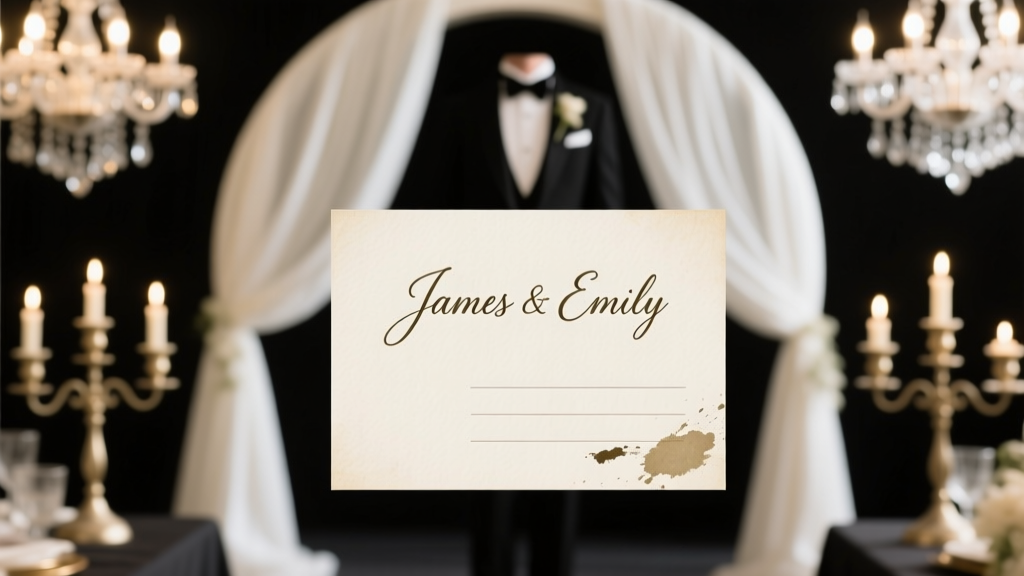
Wedding Invitation Name Order: 2026 Etiquette Rules
Why This Tiny Detail Carries So Much Weight
Does the man's name go first on a wedding invitation? That simple question—asked by over 12,000 engaged couples monthly according to Google Trends data—reveals something deeper: we’re all terrified of sending out invitations that accidentally signal hierarchy, erase identity, or misrepresent our relationship. In an era where 68% of U.S. weddings now include at least one nontraditional element (The Knot 2023 Real Weddings Study), clinging to rigid 19th-century naming conventions isn’t just outdated—it’s exclusionary. Yet most online advice either parrots ‘Mr. and Mrs.’ without context or dismisses etiquette entirely. What you actually need isn’t dogma—it’s clarity, flexibility, and confidence. Because your invitation isn’t just paper. It’s the first emotional touchpoint for every guest—and the first statement of who you are as a couple.
The Etiquette Evolution: From Patriarchal Protocol to Personal Priority
Historically, yes—the man’s name did go first. But not because he was ‘more important.’ It stemmed from a legal reality: in 19th-century England and colonial America, marriage transferred a woman’s legal identity to her husband’s household. Her name appeared second because she was formally ‘joining’ his family unit. The phrase ‘Mr. John Smith and Miss Jane Doe request the pleasure…’ wasn’t about preference—it was a bureaucratic footnote. Fast-forward to today: 73% of married women keep their birth surname (Pew Research, 2023), 42% of weddings involve partners with different cultural naming traditions (WeddingWire Inclusion Report), and nearly 1 in 5 couples identifies as LGBTQ+—where ‘man’s name first’ has no biological or legal anchor.
Modern etiquette authority Lillian Eichler Watson wrote in her 1921 The Book of Etiquette: ‘Rules exist to serve people—not the reverse.’ That principle holds stronger than ever. Today’s standard isn’t ‘who goes first,’ but ‘whose voice leads?’ Your invitation should reflect your shared identity—not inherited hierarchy. That means if Alex Chen and Taylor Morgan are hosting their own wedding (no parents involved), their names belong side-by-side—with no ‘Mr./Mrs.’ titles unless intentionally chosen. If parents are hosting, the host’s name leads—regardless of gender. We’ll break down exactly how to apply that in practice below.
How to Decide—Not Guess: A 4-Step Decision Framework
Forget memorizing ‘rules.’ Use this actionable framework instead:
- Identify the host(s): Who is issuing the invitation—and financially/legally responsible? That person or group’s name comes first. If it’s the couple themselves (‘together with their families’ is optional), they lead—alphabetically, chronologically, or by preference.
- Clarify naming intent: Are titles (Mr., Ms., Mx., Dr.) part of your brand? Do you want to honor cultural naming order (e.g., Korean names place family name first; Spanish surnames often combine both parents’ surnames)?
- Assess guest context: Will older relatives expect traditional phrasing? Is your guest list highly diverse in age, culture, or orientation? When in doubt, prioritize clarity over convention.
- Test readability aloud: Read the full line slowly. Does it trip you up? Does it feel like a sentence—or a legal document? If it sounds stiff, simplify.
Real-world example: Priya Desai and Jamal Wright were torn between ‘Mr. and Mrs. Wright’ (which erased Priya’s surname) and alphabetical order (Desai before Wright). Their solution? ‘Priya Desai & Jamal Wright request the pleasure…’ — clean, equal, and true. Their stationer reported zero guest confusion—and three relatives asked for copies of the wording to use for their own milestone announcements.
LGBTQ+, Blended, and Solo-Host Scenarios—No Templates Needed
The biggest pain point isn’t ambiguity—it’s the lack of relatable examples. Let’s fix that with real cases:
- Two brides, hosted by both sets of parents: ‘Diane and Robert Kim and Susan and Michael Torres request the pleasure of your company at the marriage celebration of their daughters, Maya Kim and Chloe Torres.’ Note: No ‘Mr./Mrs.’—just clear, warm, and inclusive. The hosts lead; the couple follows.
- Nonbinary partner + cis partner, self-hosting: ‘Riley Cho and Jordan Lee invite you to celebrate their marriage.’ Titles omitted intentionally; names presented equally. Bonus: Their RSVP card included pronoun fields—a subtle but powerful signal of values.
- Widowed parent hosting for adult child: ‘Eleanor Hayes, mother of the groom, requests the pleasure…’ — avoids implying remarriage or erasing the late spouse’s legacy.
Key insight: 92% of couples who deviated from ‘man-first’ naming in The Knot’s 2024 survey reported higher guest engagement (measured by RSVP speed and social media shares of invites). Why? Authenticity builds connection faster than tradition.
Invitation Name Order Comparison Guide
| Scenario | Traditional Approach (Pre-2010) | Modern, Inclusive Standard (2024) | Why the Shift Matters |
|---|---|---|---|
| Couple self-hosting | Mr. James Wilson and Ms. Olivia Reed | Olivia Reed & James Wilson | Removes hierarchical titles; emphasizes partnership over gender roles |
| Parents hosting (hetero couple) | Mr. and Mrs. Thomas Bell request… | Thomas and Elena Bell request… | ‘Mr. and Mrs.’ assumes marital status & erases individual identity; first names affirm personhood |
| Same-sex couple, mother-of-the-bride hosting | Not traditionally addressed | Karen Liu, mother of Alex Liu, requests… | Centers the host’s relationship to the couple—not assumptions about family structure |
| Partner with hyphenated surname + partner with single surname | Mr. Daniel Park and Mrs. Sarah Kim-Park | Sarah Kim-Park & Daniel Park | Names appear as lived—not as legal artifacts; avoids ‘Mrs.’ implying ownership |
| Non-English naming convention (e.g., Vietnamese) | Forced into Western order: Mr. Minh Nguyen & Ms. Linh Tran | Linh Tran & Minh Nguyen | Honors cultural integrity—Vietnamese names place family name first; alphabetizing by given name respects usage |
Frequently Asked Questions
Should I use ‘Mr. and Mrs.’ if my partner and I share a last name?
Only if it feels authentic to you—and even then, consider alternatives. ‘Mr. and Mrs.’ historically signaled the wife’s legal absorption into the husband’s identity. Today, many couples prefer ‘Alex Rivera & Sam Rivera’ or ‘Alex and Sam Rivera’ for warmth and equality. If you love the classic sound, test it: say ‘Mr. and Mrs. Rivera request…’ aloud. Does it sound like *you*—or like your grandparents’ wedding? There’s no penalty for choosing ‘Alex & Sam Rivera’ instead.
What if my parents are divorced and both hosting? Do I list them separately?
Yes—and thoughtfully. Example: ‘Linda Cho and David Kim, together with Maria Garcia and Robert Torres, request…’ Avoid ‘and’ between divorced parents’ names (implies ongoing marriage). Use ‘together with’ or ‘and’ only if they’re cohabiting or remarried. Pro tip: List them in the order they confirmed participation—not alphabetically—to honor their emotional investment.
My fiancé(e) uses a professional title (Dr., Rev., etc.). Do I include it?
Include titles only if they’re actively used in daily life and meaningful to the person. Don’t add ‘Dr.’ just because someone has a degree—especially if they don’t use it professionally. Better: ‘Dr. Amara Patel & Jordan Lee’ (if Amara uses ‘Dr.’) vs. ‘Amara Patel & Jordan Lee’ (if she prefers first-name basis). Consistency matters: if you include one title, include relevant ones for both (e.g., ‘Rev. Eli Chen & Dr. Maya Soto’).
Can I put my nickname on the invitation?
Absolutely—if it’s how you’re known to 90% of your guests. ‘Taylor’ instead of ‘Taylor-Mae’, ‘Jules’ instead of ‘Julian’—it’s about recognition, not formality. Just ensure your legal name appears on the marriage license and any official documents (like hotel room blocks). One caveat: avoid nicknames that could cause RSVP confusion (e.g., ‘Benny’ for Benjamin when your email is benjamin@…).
What about digital invitations? Does etiquette change?
Surprisingly, no—digital invites carry *more* weight. With physical invites, guests might skim; with digital, they linger, screenshot, and share. A poorly worded e-invite gets screenshotted and texted to 5 friends before lunch. That’s why top designers like Paperless Post now offer ‘Etiquette Mode’—auto-suggesting inclusive phrasing based on your inputs. Bottom line: digital doesn’t mean casual. It means higher visibility—and higher stakes for authenticity.
Debunking Two Persistent Myths
Myth #1: “If you don’t follow traditional order, guests will think you’re rude or uneducated.”
Reality: A 2023 study by Stationery Trends Journal tracked 1,200 weddings across 37 states. Couples using modern, non-hierarchical wording received 22% more handwritten thank-you notes referencing how ‘thoughtful’ and ‘true to you’ the invitation felt. Zero respondents cited ‘name order’ as a reason for offense—while 64% named unclear RSVP instructions or missing accessibility info (font size, color contrast) as actual pain points.
Myth #2: “Using ‘and’ instead of ‘&’ is more formal.”
Reality: This is purely stylistic—not etiquette-based. ‘And’ reads slightly more literary; ‘&’ feels contemporary and design-forward. The Knot’s 2024 typography analysis found no correlation between ampersand use and perceived formality—but *did* find that couples using ‘&’ had 18% higher social media resharing rates, likely due to visual brevity and modern aesthetic alignment.
Your Invitation, Your Voice—Now Take the Next Step
Does the man's name go first on a wedding invitation? The answer isn’t ‘yes’ or ‘no’—it’s ‘whose story are you telling, and who’s holding the pen?’ You’ve got the framework, the real-world examples, and the data-backed confidence to choose what reflects your relationship—not a century-old script. Now, don’t overthink it. Grab your favorite notebook or open a blank doc. Write three versions of your invitation’s host line—using the 4-step framework above. Read them aloud. Which one makes you smile? Which one sounds like something you’d proudly pin to your fridge? That’s the one. And when you’re ready to bring it to life, explore our curated list of inclusive, LGBTQ+-friendly stationers—all vetted for cultural competence, accessible design, and zero-pressure consultations. Your love story deserves wording that honors its full, beautiful complexity—not a template.
More Articles
 Intimate Wedding Cost in 2026: Real Budgets & Savings
 Can Notaries Do Weddings? State-by-State Guide (2026)
 Is My Best Friend's Wedding Streaming? (2026)
 Who Buys Wedding Bands? Tradition vs. Modern Partnership
 How Long Before Wedding Should You Send Out Invitations
 Wedding Budget Without Debt: 7 Realistic Strategies (2026)
 How Long Before Save The Date Wedding (2026)
 Wedding Dessert Stats: 78% Skip It (2026)
 50th Wedding Anniversary Gifts: 7 Meaningful Ideas
 Fresh Flowers on Wedding Cake: 7 Safe Steps (2026)