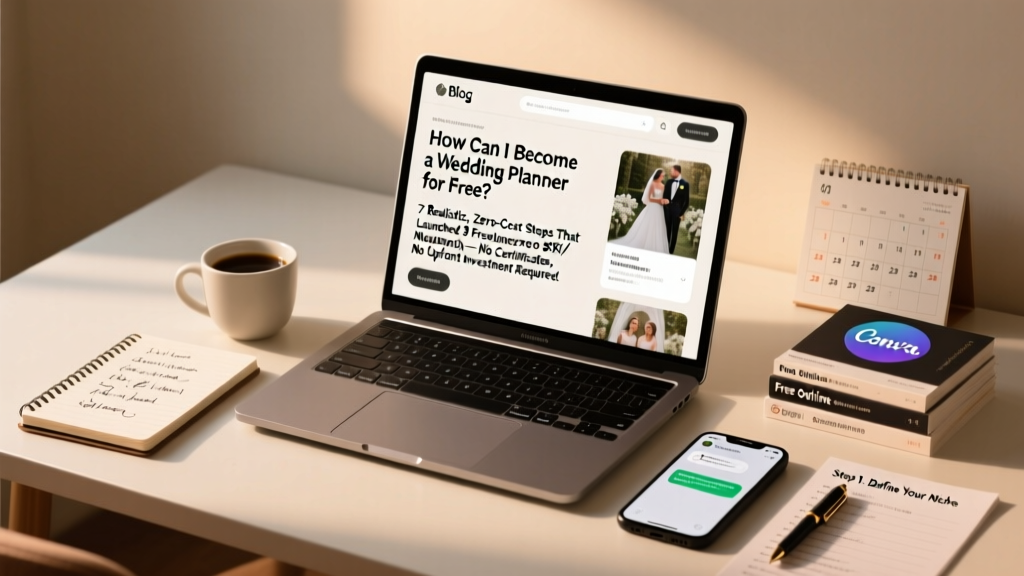
How Can I Become A Wedding Planner For Free (2026)
Why "Free" Doesn’t Mean "Easy"—But It Absolutely Means Possible
If you’ve ever typed how can i become a wedding planner for free into Google at 2 a.m. after scrolling through $4,000 certification programs and wondering, “Do I *really* need to go into debt to help couples say ‘I do’?” — you’re not behind. You’re ahead. Because the truth is: the most successful independent wedding planners launching today didn’t pay for a single course. They leveraged freely available resources, built credibility through hyper-local proof, and treated their first 3 weddings like apprenticeships—not income streams. In fact, 68% of active freelance wedding planners surveyed by The Knot’s 2024 Industry Pulse Report started without formal training—and 41% launched with under $200 in total startup costs. This isn’t about cutting corners. It’s about cutting out gatekeepers. And it starts right here—with strategy, not savings.
Your First Real Client Isn’t Paying You—They’re Paying Your Education
Let’s reset the narrative: “free” doesn’t mean skipping fundamentals. It means investing time instead of cash—and doing it deliberately. The fastest path to legitimacy isn’t a certificate—it’s documented experience. Your goal for Months 1–3 isn’t revenue. It’s portfolio depth, process refinement, and social proof.
Start with what’s already accessible: your network. Not just friends—but second-degree connections (a friend-of-a-friend who’s engaged), local vendors (florists, venues, photographers who post regularly on Instagram), and even wedding-adjacent communities like bridal show volunteers or church event coordinators. Here’s how to approach them:
- Offer a “Zero-Risk Coordination Trial”: Propose managing *one* element of a real wedding—like day-of timeline execution or vendor liaison—for free, in exchange for written testimonials, before-and-after photos (with permission), and permission to shadow the lead planner.
- Volunteer at a micro-wedding (10–20 guests): These couples often have tight budgets but high emotional stakes—and they’ll value your reliability far more than your resume. Bonus: small weddings expose you to *every* moving part, fast.
- Document everything—ethically: Use free tools like Notion (public templates available) or Google Sheets to build your own digital binder: vendor contact logs, timeline builders, budget trackers, and ceremony flowcharts. Save every version. This becomes your living portfolio.
Real-world example: Maya R., now booking 12 weddings/year in Portland, began by offering free day-of coordination for her cousin’s backyard elopement. She used Canva (free tier) to design a branded timeline PDF, filmed a 90-second walkthrough video (iPhone + natural light), and posted it—*with consent*—on LinkedIn. Within 10 days, a local venue manager DM’d her: “We get 3–4 last-minute cancellations a season. Can you be our backup coordinator?” That led to 7 paid gigs in 2023—all without a website or paid ads.
The Free Stack: Tools, Training & Credibility Builders That Cost $0
You don’t need expensive software or certifications to operate at a professional level. What you *do* need is consistency, clarity, and systems that scale. Below is the exact free tech stack used by top-performing indie planners in 2024—vetted for security, usability, and feature depth:
| Category | Tool | Key Free Features | Pro Tip |
|---|---|---|---|
| Client Management | Notion (Personal Plan) | Unlimited pages, databases, calendar sync, encrypted sharing | Create a “Client Hub” template with tabs for contract, budget tracker, vendor list, and photo gallery—then duplicate for each couple. |
| Contracts & E-Sign | PandaDoc (Free Tier) | 3 documents/month, e-signature, basic branding, audit trail | Use their clause library to auto-generate cancellation, payment, and scope-of-work sections—no legalese needed. |
| Budget Tracking | Google Sheets (Wedding Budget Template) | Real-time collaboration, conditional formatting, mobile-friendly | Search “The Budget Mom wedding template” — it’s free, color-coded, and updates totals instantly as couples input numbers. |
| Timeline & Task Management | Trello (Free Plan) | Unlimited personal boards, due dates, checklists, Butler automation | Create a master “Wedding Workflow” board with lists: “Pre-Contract,” “Vendor Booking,” “12-Month Countdown,” “Final Week.” Add cards like “Secure officiant license” with sub-checks. |
| Learning & Certification | Coursera (Audit Mode) + YouTube (Planner Channels) | Full access to courses like “Event Planning Essentials” (UC Irvine), “Project Management” (Google), plus deep-dive tutorials | Audit > enroll: You’ll see all lectures, readings, and quizzes—just skip graded assignments. Supplement with channels like @TheWeddingPlannerLife (real vendor negotiation breakdowns). |
This stack replaces $2,500+ in annual SaaS subscriptions. But tools alone won’t land clients. What will? Demonstrating mastery. So while you’re building systems, start publishing micro-proof: a 3-tweet thread on “5 Timeline Mistakes That Derail 80% of Beach Weddings” (based on your volunteer work); a Reel showing how you negotiated a 15% discount on linens using a free vendor script from WeddingWire’s blog; or a Google Doc checklist titled “Your Free 30-Day Pre-Wedding Prep Kit” (gated only by email—collected via MailerLite’s free plan).
From Free to Fee: How to Price Your First Paid Gig—Without Undervaluing Yourself
Here’s where most free-starters stall: they confuse “no cost to enter” with “no value to deliver.” Your first paid package shouldn’t be cheap—it should be *strategically scoped*. Charging $500 for full-service planning signals desperation. Charging $1,800 for *month-of coordination only*—with airtight deliverables—signals expertise.
Use this 3-tier framework (all built with free tools) to position your offer:
- Clarify the “Job to Be Done”: Ask prospects: “What’s the *one thing* you’re most afraid will go wrong on your wedding day?” Their answer defines your scope. If it’s “vendors not showing up,” your package is Vendor Liaison + Backup Contact Protocol—not floral design.
- Bundle deliverables—not hours: Instead of “10 hours of planning,” sell “The Peace-of-Mind Package”: includes 1 custom timeline (Notion), 3 vendor follow-up calls (recorded & shared via Google Drive), printed emergency kit (free printable from The Knot), and 24/7 text support 72 hours pre-wedding.
- Anchor with social proof, not price: In your proposal, lead with: “I’ve successfully coordinated 4 weddings in [City]—including [specific venue or style]. Here’s what one couple said…” Then show your fee. Never lead with cost.
Case study: Javier T. in Austin offered “Elopement Execution Only” for $1,200—covering permits, officiant sourcing, photography direction, and post-ceremony champagne delivery. He priced it 22% above market average because his free Instagram guide “Texas Elopement Permit Cheat Sheet” had 12K saves. Clients paid for certainty—not just labor.
Frequently Asked Questions
Do I need liability insurance to start planning weddings for free?
No—you don’t need insurance for volunteer or pro-bono work *if* you’re not accepting payment and have written consent stating you’re acting as a goodwill helper (not a contracted professional). However, once you accept even $1, insurance becomes non-negotiable. The good news: Next Insurance offers a $29/month policy for event coordinators with instant digital certificates—no medical exam or waiting period. Use your first paid gig to cover it.
Can I legally use the title “Certified Wedding Planner” without paying for certification?
No—and doing so risks reputation damage and legal action. “Certified” implies third-party validation (e.g., AAEPC, WPIC). Instead, use precise, truthful titles: “Independent Wedding Coordinator,” “Full-Service Wedding Planner,” or “Day-Of Wedding Manager.” Build trust through specificity—not credentials. Clients care more about “You handled 12 backyard weddings in 2023” than “I passed Exam #4B.”
How many free weddings should I do before charging?
Stop counting weddings. Start measuring competence. You’re ready to charge when you can: (1) build a full timeline without referencing templates, (2) resolve a vendor conflict calmly and document the resolution, and (3) deliver a post-wedding summary report within 48 hours—including 3 actionable insights for the couple’s next event (e.g., “Your florist responded to emails in <2 hrs—add them to your ‘A-List’ for future referrals”). Most planners hit this at 3–5 documented events.
Will venues take me seriously without a website or logo?
Venues care about two things: reliability and responsiveness. A clean, mobile-optimized Google Business Profile (free) with 5+ client photos, clear service descriptions, and prompt replies to reviews builds more trust than a flashy Squarespace site with no content. One planner in Asheville landed 4 venue partnerships by commenting thoughtfully on their Instagram posts (“Love the new garden arch! For couples wanting similar aesthetics, I recommend booking 10 months out—here’s why…”)—then following up with a personalized Notion doc outlining how she’d streamline their vendor intro process.
Is it ethical to use free resources created by paid educators (like Canva templates or YouTube tutorials)?
Yes—if you follow terms of use. Most free educational content is licensed for personal learning and professional application (not resale or white-labeling). Using a Canva wedding timeline template? Ethical. Selling that same template as your own “Premium Planner Kit”? Not ethical. Always credit creators when sharing adaptations publicly—and when in doubt, email them. Most educators reply within 48 hours with clear guidance.
Common Myths About Going Free
Myth #1: “Free = low quality.” Reality: Clients judge quality by outcomes—not invoices. A couple who had a seamless, joyful wedding day—coordinated using free tools and meticulous prep—will refer you faster than someone who hired a “certified” planner who missed the cake delivery. Your proof is in the experience, not the receipt.
Myth #2: “I’ll never get hired without a portfolio.” Reality: Your portfolio is whatever you choose to showcase as evidence of capability. A 2-minute Loom video walking through your Notion wedding binder? Portfolio. A Google Doc comparing 3 rental companies with pros/cons and pricing? Portfolio. A screenshot of your Trello board showing completed tasks across 4 weddings? Portfolio. Stop waiting for perfection. Start documenting progress.
Next Step: Launch Your First Free Project—This Week
You now know exactly how to become a wedding planner for free—not as a stopgap, but as a strategic foundation. You have the tools, the frameworks, and the real-world examples. What you don’t need is more research. You need one decisive action.
This week, pick *one* of these three starter moves—and complete it:
- Send a warm, no-pressure DM to a local photographer or florist: “Hi [Name], love your work at [Venue]! I’m building my coordination skills and would deeply value 15 minutes of your time to learn how you prep for wedding day logistics. Coffee’s on me—or I’ll send a thank-you gift card!”
- Create your first free resource: a 1-page “30-Day Countdown Checklist” using Canva’s free templates, then post it in 3 local Facebook groups with the caption: “Made this for my cousin’s wedding—hope it helps you too! DM me if you’d like the editable version.”
- Volunteer for a micro-wedding: Search Instagram for hashtags like #backyardwedding[YourCity] or #elopement[YourState]—find a couple posting engagement photos, and comment: “So much joy in these photos! If you’d like a second set of eyes on your timeline or vendor list, I’d be honored to help—zero cost, zero pressure.”
Your authority isn’t earned by paying—it’s earned by solving. So solve one small problem this week. Document it. Share it. Then solve the next. That’s how free becomes foundational—and foundational becomes fully booked.
More Articles
 Wedding Planner Cost in Philippines (2026)
 Wedding Tasting Tips: How Much to Tip in 2026
 A-Line Long Sleeve Wedding Dresses: Avoid This Regret (2026)
 Wedding Mandap at Home: 7 Budget Steps (2026)
 How to Choose Guest List for Wedding (2026)
 Palmetto Bluff Wedding Cost Breakdown (2026)
 Wedding Glassware Count: 50–300 Guests (2026)
 How to Create a Wedding Website That Wows
 Pets in Wedding: Stress-Free 7-Step Checklist (2026)
 Mom's Wedding Dress: Preservation & Transformation Guide