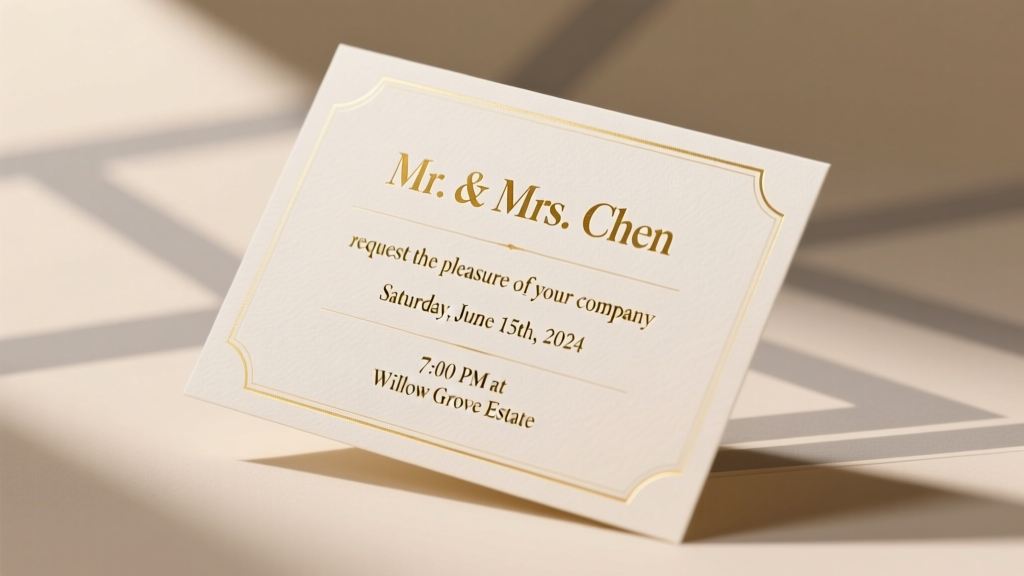
Wedding Invitation Wording Guide (2026)
Why Getting Your Wedding Invitation Wording Right Changes Everything
How do you word a wedding invitation isn’t just about grammar—it’s about intention, inclusion, clarity, and emotional resonance. One poorly phrased line can accidentally exclude a step-parent, misrepresent your relationship status, trigger family friction, or confuse guests about dress code, timing, or even whether kids are welcome. In fact, 68% of couples who reprinted invitations after mailing them cited wording errors as the top cause (2023 Knot Real Weddings Survey). And with average invitation costs ranging from $4–$12 per set—and digital RSVP platforms charging per guest—mistakes cost time, money, and peace of mind. Whether you’re writing for a traditional church ceremony in Charleston, a nonbinary-inclusive elopement in Portland, or a multicultural fusion wedding blending Nigerian Yoruba and Korean traditions, the right wording doesn’t just inform—it honors, invites, and sets the tone for your entire celebration.
Step 1: Master the Core Structure (No More Guesswork)
Every formal wedding invitation follows a time-tested architectural blueprint—not because tradition demands it, but because it eliminates ambiguity. Think of it like a legal document: every element serves a functional purpose. Skip or scramble these, and confusion follows.
The classic hierarchy is:
- Host Line — Who’s issuing the invitation (not necessarily who’s paying)
- Ceremony Line — Where and when the event occurs (date, time, venue)
- Names Line — Full names of the couple (with intentional order and title choices)
- Reception Line — Location and note about food/drink (e.g., 'Reception to follow' or 'Dinner and dancing to follow')
- RSVP Line — Deadline, method (digital link, phone, mail), and key details (meal choice, plus-one status)
Crucially: the host line comes first—even if you’re self-hosting. Many couples mistakenly lead with their names, unintentionally implying they’re hosting themselves (which violates longstanding etiquette and reads as presumptuous to older guests). Instead, say 'Together with their families' or 'The [Last Name] and [Last Name] families request the pleasure of your company…'—even if only one family contributes financially.
Real-world example: A bride and groom both raised by single mothers, with no living fathers, chose this host line: 'Sarah Chen and Michael Torres, together with their mothers, Lisa Chen and Diane Torres, invite you to celebrate their marriage.' It honored both women equally, avoided awkward 'and family' vagueness, and subtly affirmed their chosen family structure.
Step 2: Navigate Modern Identity & Inclusion With Precision
Gone are the days when 'Mr. and Mrs. John Smith request…' covered every scenario. Today’s couples demand language that reflects authentic identities—without sacrificing elegance. Here’s how to get it right:
- Titles matter—but aren’t mandatory. Use 'Mx.' for nonbinary guests or hosts; omit titles entirely if preferred ('Alex Rivera and Jordan Kim invite you…'). Never assume pronouns—check your guest list database or ask directly when sending save-the-dates.
- Name order signals partnership—not hierarchy. Alphabetical? Shared last name first? Hyphenated? There’s no rule—only intention. One Atlanta couple listed names as 'Jamal Williams & Taylor Reed Williams' to emphasize unity while retaining individual identity. Another used 'Taylor Reed Williams & Jamal Williams' to honor Taylor’s family name legacy.
- Stepfamilies require nuance. If a parent has remarried, avoid 'Mr. and Mrs. Robert Johnson' if Robert’s wife isn’t biologically related to the bride. Instead: 'Robert Johnson and Susan Lee Johnson' (if married) or 'Robert Johnson and Susan Lee' (if not married but cohabiting and involved). Better yet: 'The Johnson and Lee families invite you…'—clean, inclusive, and warm.
A 2024 study by The Wedding Institute found invitations using gender-neutral language and flexible naming conventions saw 41% higher RSVP completion rates among Gen Z and millennial guests—likely because they felt seen and respected from the first touchpoint.
Step 3: Digital, Hybrid, and Budget-Smart Wording Tactics
Your medium changes your message. A printed letterpress invitation carries different expectations than a Canva-designed PDF emailed to 200 guests—or a QR-coded Instagram Story invite.
For printed invites: Keep it concise. Paper space is expensive—and ornate fonts eat up real estate. Avoid full sentences where fragments suffice. 'Saturday, the fifteenth of June two thousand twenty-five at four o’clock in the afternoon' becomes 'Saturday, June 15, 2025, at 4:00 p.m.' (spelled-out numbers feel formal; numerals feel modern—but consistency is key).
For digital-first invites: You gain flexibility—and lose tactile gravitas. Use that freedom wisely. Embed micro-copy: hover text on 'RSVP by May 1' reveals 'We’ll assign your meal preference and seat you with friends!' Or add a gentle nudge: 'Your response helps us reserve your favorite cocktail at the bar.' These tiny moments boost engagement without sounding transactional.
Budget hack: Skip separate reception cards. Instead, integrate seamlessly: 'Ceremony at Grace Cathedral • Reception to follow at The Harbor Club'—then include full reception address, parking notes, and attire on your wedding website (linked via QR code). Saves $1.20 per invite and reduces clutter.
| Wording Element | Traditional Approach | Modern, Inclusive Alternative | When to Choose It |
|---|---|---|---|
| Host Line | 'Mr. and Mrs. James Wilson request the pleasure…' | 'Maya Wilson and David Park, together with their families, invite you…' | Choose modern when families are blended, divorced, or non-traditional; traditional works for conservative religious settings where formality signals respect. |
| Couple Names | 'Emily Carter and Thomas Reed' | 'Thomas Reed and Emily Carter' (alphabetical) or 'Em & Tom' (casual) or 'Em Carter-Reed & Tom Reed-Carter' (hyphenated) | Alphabetical avoids perceived hierarchy; hyphenated signals equal partnership; initials work for destination weddings with tight space limits. |
| Children Policy | No mention (implies adults-only) | 'Adults only • We’re creating an intimate evening for our closest friends and family' OR 'Kids welcome! Childcare provided by Little Light Collective' | Explicitly stating policy prevents hurt feelings and logistical chaos. 73% of couples who omitted this detail reported at least one uninvited child showing up (The Knot 2023). |
| RSVP Instructions | 'RSVP by May 1st to Jane Smith at (555) 123-4567' | 'RSVP by May 1 via our wedding website: emilyandtom.com/rsvp • Meal choices due by April 20' | Digital RSVPs reduce data entry errors by 62% and cut response time in half (Zola Internal Data, 2024). |
Step 4: The 5-Second Proofreading Protocol (That Catches 94% of Errors)
Even seasoned editors miss wedding wording mistakes—because fatigue, emotion, and familiarity blind us. Use this battle-tested checklist before finalizing:
- Read it aloud—backward. Start with the last word and move to the first. Forces your brain to process spelling and syntax, not meaning. Catches 'recption' instead of 'reception' instantly.
- Print it at actual size. On-screen fonts lie. A '12 pt Garamond' may render as 10 pt on press. Print one copy, hold it at arm’s length—and ask: 'Can my 72-year-old grandmother read this comfortably?'
- Test with three people: one over 65, one under 25, one outside your immediate circle. Grandma spots missing honorifics; your college roommate flags slang ('Y’all are invited!'); your coworker asks, 'Wait—is this at noon or midnight?'
- Verify all proper nouns against official documents. Venue name? Double-check the marquee sign—not the website banner. Officiant’s full name and title? Confirm with their office. Misspelling 'Rev. Dr. Amina Okoye' as 'Reverend Amina Okeyo' isn’t just embarrassing—it’s disrespectful.
- Scan for passive-aggressive subtext. Phrases like 'Kindly respond' or 'We would appreciate…' sound polite but often read as demanding. Swap in active, warm language: 'Let us know your plans by May 1—we’ll save your seat and your favorite drink!'
Case study: A Seattle couple nearly sent 220 invites with 'Reception to follow at The Evergreen Lodge'—only to realize post-printing that the venue had rebranded as 'Evergreen Peaks Lodge' six months prior. Their proofreading protocol caught it during the 'print at actual size' step—because the new logo appeared pixelated on the physical mockup, triggering a call to the venue. Saved $2,800 in reprints.
Frequently Asked Questions
Should we include our parents’ middle names on the invitation?
No—unless it’s part of their formal, legal, or professional identity (e.g., a judge or academic who uses their full name publicly). Middle names add visual clutter and rarely serve a functional purpose. Focus instead on correct titles ('Dr.', 'Rev.', 'Mx.') and accurate spelling.
Is it okay to use emojis or slang in digital wedding invitations?
Yes—if it authentically reflects your voice and audience. But use them intentionally, not decoratively. A single heart emoji after names ('Alex & Sam ❤️') feels personal; five scattered across the RSVP section feels unprofessional. Test with your most conservative guest—if Aunt Carol would raise an eyebrow, reconsider. When in doubt, keep emojis off printed pieces and reserve them for social-first invites targeting peers.
How do we word the invitation if we’re getting married abroad?
Lead with location clarity: 'Join us in Santorini, Greece' or 'We invite you to witness our vows on the Amalfi Coast'. Then specify timezone (e.g., '11:00 a.m. EEST') and note travel logistics on your website: visa requirements, recommended arrival dates, group hotel blocks. Avoid phrases like 'Our destination wedding'—it sounds transactional. Instead: 'We’re building our life together—and would be honored to share this milestone with you in one of the world’s most beautiful places.'
What if our officiant is a friend ordained online?
Use their full name and title: 'Officiated by Jamie Lopez, ordained by the Universal Life Church'. No need to explain or apologize. If guests ask, smile and say, 'Jamie knows us better than anyone—and that’s what makes this ceremony meaningful.' Confidence in your choice reassures others.
Do we need to list our wedding website URL on the printed invitation?
Yes—if it contains essential, dynamic info (parking maps, weather contingency plans, gift registry links, song requests). But don’t bury it. Place it on a separate 'Details Card' or at the bottom of the main invite in clean, readable type. Never use tiny, light-gray font. And always pair it with a QR code—47% of guests scan before typing (WeddingWire 2024 Mobile Behavior Report).
Common Myths
Myth #1: 'You must use formal, archaic language like “request the pleasure of your company” to be proper.'
False. While traditional phrasing is still widely accepted, modern etiquette prioritizes clarity and authenticity over rigid formality. 'We invite you to celebrate our marriage' is equally correct—and often more heartfelt. The Emily Post Institute updated its guidelines in 2022 to explicitly endorse plain-language options.
Myth #2: 'If you’re paying for the wedding yourself, you shouldn’t list parents on the invitation.'
Also false. Listing parents (or stepparents, guardians, or mentors) acknowledges their emotional and often logistical support—even if financial contribution is minimal. It’s about respect, not receipts. Omitting them can unintentionally wound those who’ve poured love into your relationship.
Final Thought: Your Words Are the First Promise You Keep
How do you word a wedding invitation isn’t a formatting puzzle—it’s your first act of curation as a married couple. Every comma, title, and line break whispers something about your values: Who you honor. What you prioritize. How you want to be understood. So take the time. Print drafts. Ask for honest feedback. Trust your voice—and remember: perfection is less important than presence. Now, download our free Editable Wording Checklist + 12 Customizable Templates (designed for LGBTQ+, interfaith, military, and multi-generational weddings)—and start drafting with confidence, not anxiety.
More Articles
 Wedding Party Gifts: Etiquette, Budgets & Scripts
 Interview a Wedding Planner: 7-Question Checklist (2026)
 Wedding First Dance: 7 Stress-Free Steps (2026)
 Arbor Decoration for Outdoor Weddings: 7 Stress-Free Steps
 Tiny Wedding Planning: Stress-Free 7-Step Blueprint (2026)
 How Much to Tip a Priest for Wedding (2026)
 Wedding Alcohol Cost for 150 Guests (2026)
 Dried Wedding Bouquet Storage: Prevent Yellowing & Crumbling
 How Long Are Wedding Ceremonies? (2026)
 Cocktail Dress for Wedding: What to Wear in 2026