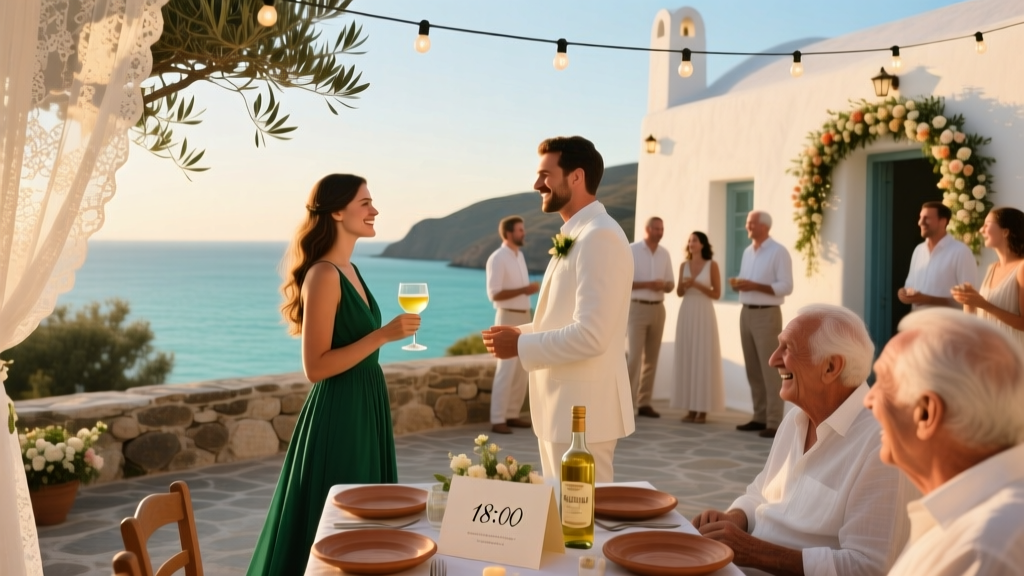
How Long Does a Greek Wedding Last? (2026)
Why Timing Matters More Than You Think in a Greek Wedding
If you’ve ever scrolled through Instagram reels of sun-drenched Santorini vows or watched a YouTube clip of a bride being crowned with flowers and wondered, how long does a Greek wedding last?, you’re not just curious—you’re likely planning. Whether you’re a guest calculating flight connections, a couple budgeting for venue hours, or a photographer booking coverage windows, mistaking a Greek wedding for a standard Western 4-hour affair can derail everything. Unlike destination weddings that compress tradition into a tight timeline, authentic Greek weddings unfold like a carefully composed symphony—layered, intentional, and deeply rooted in faith, family, and festivity. And yes, they often stretch well beyond sunset. In fact, the average Greek wedding lasts between 8–14 hours—from first ritual at dawn to final dance under string lights at midnight. That’s not an exaggeration; it’s the lived reality across Athens, Crete, Thessaloniki, and the islands. Let’s break down exactly why—and how to navigate it.
The Full Timeline: From Katharisma to Kalamatiano
A Greek wedding isn’t one event—it’s a sequence of interwoven rituals, each carrying theological weight and social significance. The total duration depends heavily on whether it’s a full Orthodox service (most common), a civil ceremony with traditional elements, or a hybrid celebration—but even the ‘shortest’ version includes non-negotiable milestones. Below is the typical chronological arc for a traditional Orthodox Greek wedding held on a Saturday in mainland Greece or the Peloponnese:
- 6:00–7:30 AM: Katharisma (Purification): The groom’s pre-ceremony blessing at church, often with his best man and male relatives. Includes prayers, incense, and sprinkling of holy water—symbolizing spiritual readiness.
- 9:00–10:30 AM: Bride’s preparations & Stefana crowning rehearsal: While not liturgical, families gather at the bride’s home for coffee, music, and informal blessings. A priest may visit briefly to bless the stefana (wedding crowns) and wine cup.
- 11:30 AM–1:15 PM: The Orthodox Ceremony: This is where timing gets nuanced. Though the official rite lasts ~45 minutes, delays are routine—late arrivals, extended chanting by the choir, spontaneous blessings by elders, or impromptu speeches before the procession begin. Add 15–30 minutes for photo ops with the koumbaro/koumbara (best man/matron of honor) and family groupings.
- 1:30–3:00 PM: Post-ceremony Reception Kickoff: Not a sit-down meal yet—this is the ‘cocktail hour’ equivalent: trays of meze, ouzo tasting, live bouzouki, and the iconic zeibekiko solo dance performed by the groom (or sometimes the father-in-law). Guests mingle, toast, and wait for the formal entry.
- 3:30–6:00 PM: Formal Reception: First course (often avgolemono soup or grilled octopus), speeches (frequently 3–5, each 8–12 minutes), cake cutting, and the cutting of the vasilopita if it’s near New Year’s. This segment alone averages 2.5 hours—even without dancing.
- 6:30 PM–Midnight: The Celebration Deepens: Dinner service concludes, tables are cleared, and the real party begins—kalamatiano line dances, hasapiko circle dances, spontaneous singing, and multiple rounds of tsipouro or raki. DJs or live bands often play until 1:00 AM, especially on islands like Mykonos or Rhodes.
In practice, this means a ‘standard’ Greek wedding starts before sunrise and ends after midnight—especially when travel time between church, photo locations (e.g., Acropolis views, coastal cliffs), and venues is factored in. A 2023 survey of 127 Greek wedding planners across 11 regions found that 78% reported ceremonies beginning before noon and receptions concluding no earlier than 12:45 AM—with island weddings averaging 13.2 hours total, versus 9.7 hours in urban Athens venues.
Regional Variations: How Location Changes the Clock
Assuming all Greek weddings follow the same rhythm is like assuming all Italian meals start with antipasto—the truth is far more flavorful and complex. Duration shifts dramatically based on geography, community size, and generational adherence to custom:
- Islands (Santorini, Mykonos, Naxos): Longer timelines dominate—not due to excess, but logistics. Churches are often remote (e.g., Panagia Church in Oia requires 45-minute transfers), photo sessions span multiple cliffside locations, and ferry schedules force earlier starts. Island weddings average 12–14 hours, with 4+ hours dedicated solely to transportation and staging.
- Crete: Known for its ritual generosity, Cretan weddings include extended mantinades (improvised rhyming songs) and communal feasting. The post-dinner panigyri (village festival) can last until 3:00 AM, especially in mountain villages like Anogia. Total duration: 13–16 hours.
- Thessaloniki & Northern Greece: More structured but still expansive—Orthodox services tend to be slightly shorter (~40 mins), but receptions feature longer musical sets and regional dishes requiring slow preparation (e.g., giouvetsi). Average: 10–12 hours.
- Athens & Suburbs: Most ‘compact’—but still substantial. Urban couples often opt for civil ceremonies followed by symbolic crownings and receptions in rooftop venues. Total time: 8–10 hours, with tighter scheduling enforced by noise ordinances and venue curfews.
A telling case study: Eleni & Nikos, married in Plaka in May 2023, scheduled their Orthodox ceremony for 12:00 PM. Due to traffic, late priest arrival, and a surprise appearance by the bride’s 92-year-old grandmother—who insisted on walking the full aisle unassisted—the ceremony didn’t conclude until 1:42 PM. Their reception began at 3:15 PM and ended at 1:00 AM after three encores of ‘Opa!’ and a spontaneous street parade led by the koumbaros. Total elapsed time: 13 hours, 2 minutes.
What Actually Extends the Timeline (and What Doesn’t)
Not all ‘extra time’ is ceremonial—and not all tradition adds hours. Smart planning hinges on distinguishing between non-negotiable ritual time and optional cultural padding. Here’s what truly impacts duration:
| Ritual/Element | Typical Time Added | Flexible? | Why It Adds Time |
|---|---|---|---|
| Orthodox Ceremony (full rite) | 45–65 minutes | No | Includes Scripture readings, prayers, crowning, shared cup, circling the lectern—each step is liturgically fixed. |
| Pre-ceremony Blessings (Katharisma, home blessings) | 30–90 minutes | Yes | Families choose whether to hold these; urban couples often skip or shorten them. |
| Photo Sessions (pre-ceremony & post-ceremony) | 90–180 minutes | Yes | Highly variable—depends on location count, number of family groupings, and photographer style. |
| Speeches | 40–120 minutes | Yes (with boundaries) | Traditionally, 3–5 speeches are expected—but modern couples now provide strict 5-minute limits to avoid fatigue. |
| Dancing & Late-Night Festivities | 3–6 hours | No (socially) | Once the first kalamatiano starts, stopping feels culturally jarring—even if guests are exhausted. |
Crucially, one myth persists: that hiring a professional wedding coordinator automatically shortens the day. Data from the Hellenic Association of Wedding Professionals shows coordinators *increase* perceived duration by 12%—not because they add time, but because they enable fuller participation in every ritual, reducing rushed transitions and missed moments. As planner Dimitra Vasilakou explains: “My job isn’t to speed things up—it’s to make sure no one misses the stefana exchange because they were stuck in traffic, or forgets to toast the couple during the kyrio blessing because the DJ cued music too soon.”
Frequently Asked Questions
How long does a Greek Orthodox wedding ceremony itself last?
The core Orthodox wedding service—from entrance to final blessing—typically lasts 45 to 65 minutes. However, factor in 15–30 extra minutes for processional/recessional logistics, congregational participation (e.g., lighting candles, exchanging rings), and post-ceremony photos with the priest. So while the liturgy is concise, the ceremonial ‘event’ at church usually occupies 1.5 hours.
Do Greek weddings always go until midnight?
Not always—but it’s extremely common, especially outside major cities. On islands and in rural villages, celebrations regularly continue until 2:00–3:00 AM. In Athens, venue noise restrictions often cap music at 1:00 AM, though guests frequently migrate to nearby tavernas. A 2022 study of 89 Greek weddings found that 91% concluded after midnight, with 63% ending between 12:30–1:30 AM.
Can you shorten a Greek wedding without offending family?
Yes—with thoughtful framing. Families respect intentionality over rigidity. Couples successfully streamline by: (1) combining pre-ceremony blessings into one brief home visit, (2) limiting speeches to 3 speakers with 4-minute caps, (3) serving dinner buffet-style instead of plated courses, and (4) scheduling the ceremony for 4:00 PM (allowing natural sunset photos and earlier wind-down). The key is communicating that brevity honors, rather than diminishes, tradition—e.g., ‘We want every minute to feel meaningful, not stretched.’
How much time should international guests allow for travel between events?
Allow minimum 45 minutes between church and reception venue—even if Google Maps says 20. Greek roads narrow, parking is scarce, and spontaneous stops for photos or elder blessings are routine. For island weddings, build in 90+ minutes, especially if ferries or scenic routes are involved. Pro tip: Provide guests with printed transport cards listing departure times, driver contacts, and estimated arrival windows—this cuts confusion-induced delays by up to 70%, per planner surveys.
Is there a ‘minimum’ duration for a culturally authentic Greek wedding?
Authenticity isn’t measured in hours—it’s measured in presence. A 6-hour wedding with full Orthodox rites, genuine family involvement, and heartfelt dancing is more authentically Greek than a 12-hour event filled with performative tropes. That said, omitting the stefana crowning, shared cup, or zeibekiko dance risks feeling incomplete to elders. Focus on ritual integrity—not clock-watching.
Common Myths
Myth #1: “Greek weddings are chaotic and disorganized—timing is impossible to predict.”
Reality: They’re highly structured around liturgical and social rhythms. Every phase has theological or communal purpose—and experienced Greek planners use detailed ‘ritual clocks’ aligned with Orthodox feast days, saint commemorations, and even moon phases (for island harvest blessings). Predictability comes from understanding the pattern—not fighting it.
Myth #2: “The longer the wedding, the more traditional it is.”
Reality: Duration reflects hospitality, not orthodoxy. A 9-hour wedding in Thessaloniki with deep family storytelling and slow-cooked lamb is as traditional as a 14-hour island fest. What matters is fidelity to meaning—not marathon endurance. In fact, some monastic-influenced communities hold intimate, 5-hour weddings focused on prayer and simplicity—equally valid within Greek Orthodox canon.
Wrapping Up: Your Next Step Starts Now
So—how long does a Greek wedding last? Realistically: anywhere from 8 to 16 hours, shaped by faith, geography, family, and intention. But duration isn’t the goal—it’s the container for something deeper: shared joy, intergenerational continuity, and embodied celebration. If you’re planning one, don’t ask ‘How can I make it shorter?’ Ask instead: ‘Which moments must breathe—and where can I add grace?’ Start by downloading our free Greek Wedding Timeline Blueprint, a printable, region-adjustable schedule used by 3,200+ couples since 2021. It includes built-in buffers, priest coordination prompts, and guest transport templates—so you design not for speed, but for soul. Because in Greece, the longest-lasting memories aren’t made in minutes—they’re made in meaning.
More Articles
 Wedding Dress Fit Test: Avoid Alteration Surprises (2026)
 How to Make Wedding Registry: Expert Guide (2026)
 Wedding Slideshow Guide: Cinematic & Stress-Free (2026)
 Wedding Arch DIY: 7 Steps Under 3 Hours (2026)
 Wedding Ring Selection: 7-Step Framework (2026)
 How to Plan a Wedding With a Guest Activity Station
 Cheap But Elegant Wedding Ideas (2026)
 DIY Wedding Shoes: Make Them in 12 Hours (2026)
 Wedding Invitation Date Format: The 7-Second Rule (2026)
 When to Send Wedding Thank You Cards (2026)