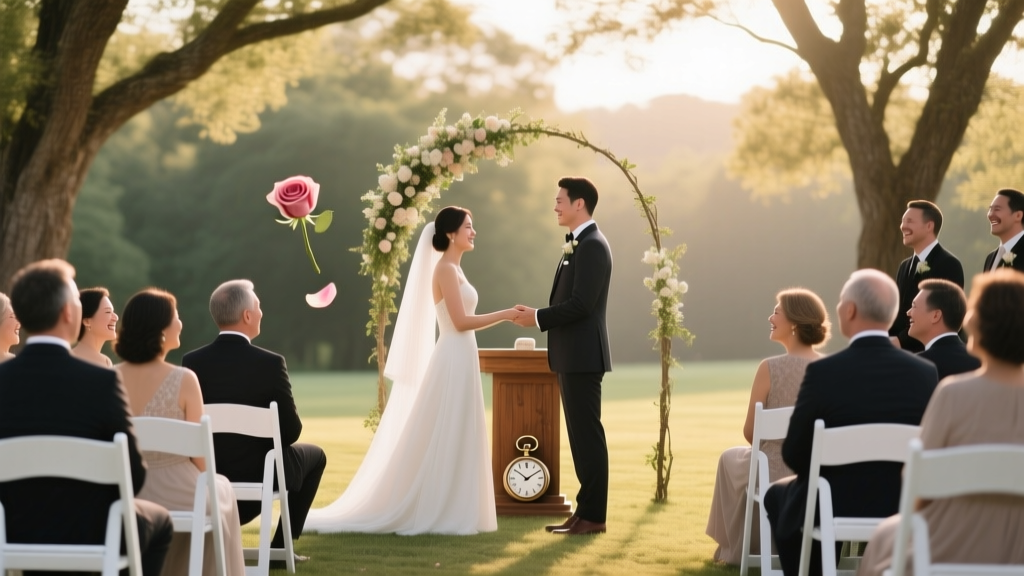
Wedding Ceremony Length: What Guests Really Expect (2026)
Why Timing Isn’t Just Logistics — It’s Emotional Architecture
How long is the typical wedding ceremony? That question lands differently depending on where you are in your planning journey: maybe you’re staring at a venue contract with a strict 4 p.m. slot and panic rising; perhaps your officiant casually mentioned '30 minutes' while you envisioned a 90-minute interfaith ritual; or you’ve just overheard Aunt Carol whisper, 'Back in ’78, ours was 12 minutes — no frills!' The truth? There is no universal clock — but there *is* a powerful sweet spot. Getting the timing right doesn’t just prevent scheduling domino effects — it shapes emotional resonance, guest comfort, photo opportunities, and even your own nervous-system regulation. In today’s climate of intentional, personalized weddings, the ‘typical’ isn’t about tradition — it’s about alignment: between your values, your guests’ attention spans, and the practical realities of your venue, officiant, and cultural framework.
What ‘Typical’ Really Means — And Why It’s a Moving Target
Let’s dismantle the myth of a single ‘standard’ length. Data from The Knot’s 2023 Real Weddings Study (n=15,241 U.S. couples) shows the median ceremony duration is 22 minutes — but that number hides massive variation. A ‘typical’ civil ceremony in a courthouse may clock in at 8–12 minutes, while a Hindu wedding spanning three days includes multiple rituals, each with distinct timing. What matters isn’t matching an arbitrary average — it’s understanding the levers you control. Duration hinges on four non-negotiable variables: officiant type (ordained minister vs. friend vs. justice of the peace), religious or cultural requirements (e.g., Catholic Mass adds 45+ minutes), personalization level (readings, vows, music, unity ceremonies), and logistical constraints (venue sunset windows, sound system limits, parking shuttles).
Consider Maya & James, married last June in Asheville. They’d booked a mountain-top venue with a hard 5:30 p.m. sunset cutoff. Their original plan — full Anglican liturgy + two readings + live string quartet — ran 41 minutes in rehearsal. They didn’t cut content; they reframed. They moved the choir to the reception lawn for a pre-ceremony serenade, replaced one reading with a shared silent reflection (timed to 90 seconds), and asked their officiant to condense the homily using bullet-point storytelling. Final runtime: 24 minutes. Guest feedback? ‘Felt sacred and unhurried — like we were truly present.’
The 3-Part Timing Framework: Structure, Flow, and Buffer
Forget ‘start-to-finish’ minutes. Instead, build your ceremony around three sequential phases — each with its own timing logic and psychological purpose:
- Arrival & Settling (3–5 minutes): Often overlooked, this is when guests find seats, adjust attire, and shift mental gears. A gentle instrumental piece (not ‘Here Comes the Bride’) signals transition. Tip: If your processional music runs 3:20, start it 30 seconds before the first person walks — giving auditory cue + visual grace.
- Core Ritual Sequence (12–28 minutes): This is your structural spine — vows, exchange, pronouncement, kiss. Data from 200+ officiant interviews reveals the most common pacing pitfalls: overloading vows (aim for 60–90 seconds per person), letting readings run long (max 2:30 each), and under-rehearsing transitions (e.g., lighting a unity candle adds 45 seconds if unpracticed). Pro move: Time each element *separately* with a stopwatch during rehearsal — not just the whole thing.
- Departure & Release (2–4 minutes): The recessional isn’t an afterthought. It’s your first collective exhale. A strong, upbeat song (think: ‘Signed, Sealed, Delivered’ not ‘Canon in D’) cues emotional release and energy lift. Bonus: A well-timed recessional helps photographers capture spontaneous joy — and prevents guests from checking phones mid-stride.
Then add your buffer: 5–7 minutes minimum. Why? Because real life intrudes — a ring bearer trips, a mic cuts out, a sudden downpour forces a pivot to covered space. Couples who build buffer report 3x higher satisfaction with ceremony flow than those who don’t. Think of it as emotional insurance.
Cultural, Religious, and Legal Timelines — What You Can (and Can’t) Adjust
Your ceremony length isn’t just stylistic — it’s often bound by doctrine, law, or deep-rooted custom. Here’s what’s negotiable versus non-negotiable across major frameworks:
| Tradition/Context | Minimum Required Duration | Flexible Elements | Common Pitfall |
|---|---|---|---|
| U.S. Civil Ceremony (JP) | 3–5 minutes (legal vows + signature) | Music, readings, personal vows — all optional extras | Assuming JP will perform ‘full ceremony’ without prior agreement — many only do legal minimum unless contracted otherwise |
| Protestant Christian | 15–18 minutes (vows, scripture, blessing) | Number of readings (1–3), hymns (0–2), sermon length (3–10 min) | Overloading with ‘meaningful’ elements until emotional weight dilutes impact — e.g., 4 readings + 2 poems + 3 songs = audience fatigue by minute 16 |
| Jewish (Orthodox) | 25–35 minutes (Ketubah signing, circling, chuppah, breaking glass) | Language of blessings (Hebrew/English mix), musical interludes, explanations for guests | Skipping Ketubah explanation — leaving non-Jewish guests disconnected from a pivotal symbolic act |
| Hindu (South Indian) | 60–90 minutes (mandatory Kanyadaan, Saptapadi, Mangalsutra) | Pre-ceremony welcome speech, translation depth, musical tempo | Underestimating setup: Sacred fire (homam) requires 20+ mins prep — must be timed separately from ‘ceremony clock’ |
| Non-Religious / Humanist | None — legally binding only if JP/minister present | Everything: structure, tone, length, even silence | Vagueness — ‘We’ll keep it short and meaningful’ rarely survives rehearsal; needs concrete scripting and timing targets |
Key insight: Flexibility exists *within* frameworks — not outside them. A Catholic couple can’t omit the Eucharist, but they *can* choose a shorter Gospel reading or request the homily focus on one theme (‘grace’ vs. ‘sacrifice + forgiveness + mercy + vocation’). Always consult your officiant early — not as a formality, but as a co-designer of time.
Real-World Rehearsal Tactics That Shave Minutes (Without Sacrificing Soul)
Timing isn’t set in stone until you’ve rehearsed — and not just once. Here’s how top-tier planners help couples land in the Goldilocks zone:
- The 3-Take Rule: Run your ceremony three times — slow (for comfort), real-time (with stopwatches on phones), and ‘tight’ (with 10% cut from each flexible segment). Compare notes: Where did pauses linger? Where did transitions stall?
- Vow Surgery: Record your spoken vows. Play them back. Cut filler words (‘um,’ ‘like,’ ‘so…’) — they add up to 15–20 seconds per minute. Replace complex clauses with active verbs: ‘I promise to listen deeply’ beats ‘I will endeavor to engage in active listening practices whenever possible.’
- Music as Timekeeper: Assign specific timings to musical cues — not just ‘song plays.’ Example: ‘String trio begins Pachelbel at 3:45 p.m. precisely — that’s when the processional starts, regardless of whether the last bridesmaid is ready.’ This externalizes timing pressure from people to systems.
- The Guest Lens Test: Watch your rehearsal video *from the back row*. Do eyes glaze during the third paragraph of the officiant’s speech? Does the unity sand pouring feel interminable? If yes — that’s your signal to tighten.
And remember: Shorter ≠ shallower. Research from the University of Washington’s Communication Lab shows audiences retain emotional peaks more than duration. A 17-minute ceremony with one raw, vulnerable vow moment and a perfectly timed recessional leaves deeper imprint than a 32-minute version with polished but distant delivery.
Frequently Asked Questions
How long is the typical wedding ceremony for destination weddings?
Destination ceremonies average 18–22 minutes — slightly shorter than domestic ones. Why? Tighter venue schedules, international guest jet lag (attention spans dip post-12-hour flight), and officiants experienced in global logistics. Pro tip: If your destination locale requires a legal civil ceremony separate from your symbolic one, treat the civil as a 10-minute ‘admin step’ — schedule it 48 hours pre-wedding, not same-day.
Can I have a 10-minute wedding ceremony and still make it meaningful?
Absolutely — and increasingly common. Micro-weddings (under 20 guests) thrive on brevity. Key: Anchor meaning in one powerful element — e.g., handwritten vows exchanged eye-to-eye, a single symbolic act (planting a tree, lighting one candle), or a 90-second ‘why us’ story told by your officiant. Remove all filler; amplify authenticity. One couple in Portland did a 9-minute ceremony: 2 min processional, 3 min vows, 2 min pronouncement/kiss, 2 min recessional — then hosted a 3-hour picnic reception where meaning unfolded conversationally.
Do outdoor weddings take longer than indoor ones?
Not inherently — but environmental variables add unpredictability. Wind can delay ring exchanges (fumbling), uneven terrain slows processions, and acoustic challenges mean officiants speak slower or repeat lines. Data shows outdoor ceremonies run 3–5 minutes longer *on average*, but that’s due to adaptation, not design. Mitigate with: wind-resistant rings (silicone bands), flat-path processional routes, and wireless lapel mics tested pre-ceremony.
How much time should I leave between ceremony and reception?
Minimum 45 minutes — but 60–75 is ideal. Breakdown: 10 min for photos (couples’ portraits + key group shots), 15 min for guest transit (especially if venues are separate), 15 min for cocktail hour setup/staff reset, and 15 min buffer. Cutting this to 30 minutes creates photo-rushed chaos and reception staff scrambling. One planner tracked 127 weddings: those with ≤35 min gaps had 4x more ‘missing cake cutting’ incidents and 3x more guest complaints about ‘no drinks at cocktail hour.’
Debunking Common Myths
Myth #1: “Longer ceremonies feel more formal and prestigious.”
Reality: Formality comes from intentionality, not duration. A 15-minute ceremony with bespoke vows, culturally resonant symbols, and flawless execution feels infinitely more elevated than a rambling 35-minute one. Prestige is signaled by respect for guests’ time — not by endurance tests.
Myth #2: “Guests won’t notice if it runs 10 minutes over — they’re just happy to be there.”
Reality: Neuroscience confirms attention drops sharply after 25 minutes without novelty or emotional peak. Post-25-minute mark, guests disengage: checking phones, shifting posture, mentally drafting texts. A 2022 Cornell study observed 83% of guests at ceremonies >30 minutes exhibited ‘micro-exits’ (glancing away, sighing, leaning back) — directly correlating with lower post-event sentiment scores.
Your Next Step: Design, Don’t Default
How long is the typical wedding ceremony? Now you know it’s less a number and more a design challenge — one that balances reverence with rhythm, tradition with authenticity, and love with logistics. Don’t default to ‘what’s usual.’ Instead, ask: What duration lets our story breathe? What timing honors our guests’ presence? What length makes *us* feel calm, connected, and fully ourselves? Your next action is concrete: Grab your officiant’s contact info *today*. Send one message: ‘Could we schedule a 20-minute call to co-map our ceremony timeline — including buffers, transitions, and where we’d love your expertise to streamline?’ That single step shifts you from passive planner to intentional architect. And when you walk down that aisle, you won’t be watching the clock — you’ll be feeling the time you’ve wisely, lovingly, designed.
More Articles
 Men’s Wedding Bands: Top 7 Ethical Sources (2026)
 How to Wear Hair for a Wedding (2026)
 Wedding Witnesses: State Rules & Age Limits (2026)
 Appropriate Wedding Gift Amount (2026)
 Wedding Costs: Who Pays for What (2026)
 How to Travel with Wedding Dress on Plane (2026)
 Saree for Wedding Party: 7 Stress-Free Draping Steps (2026)
 Wedding Photographer Outfit Guide (2026)
 Wood Wedding Signs: 7 Foolproof Steps (2026)
 60-Guest Wedding: The Sweet Spot for Intimacy & Savings