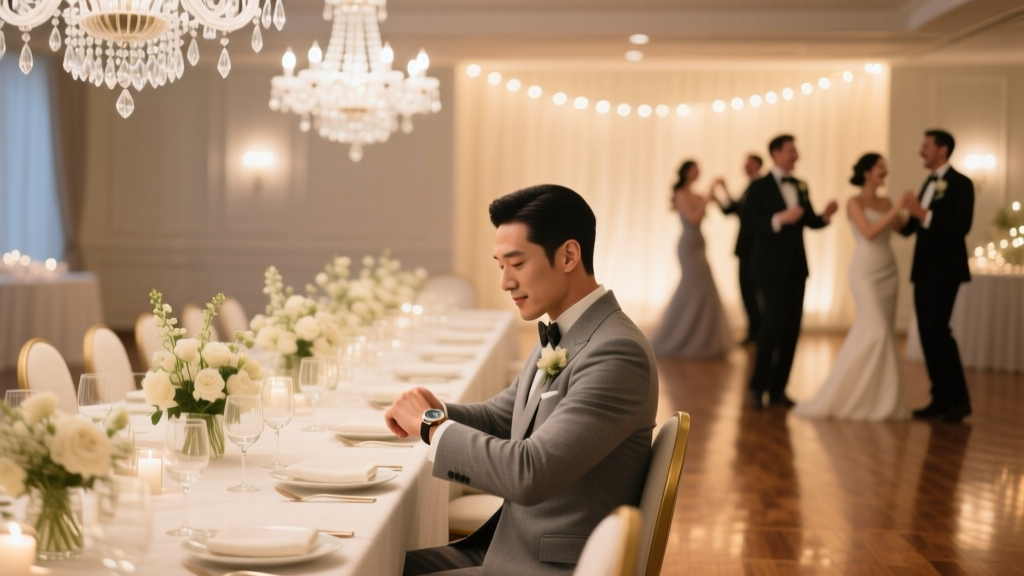
Wedding Reception Exit Etiquette: When to Leave Guilt-Free
Why This Question Is More Stressful Than It Should Be
Let’s be honest: how long should you stay at a wedding reception isn’t just about clock-watching — it’s a quiet social tightrope walk between showing up meaningfully and honoring your own boundaries. In an era where 68% of guests report feeling anxious about wedding attendance logistics (2024 Knot Real Weddings Survey), this single question triggers real guilt, exhaustion, and even relationship strain. You’ve RSVP’d ‘yes,’ bought a gift, and maybe even traveled across state lines — yet when the DJ cues the third round of ‘Uptown Funk’ at 10:47 p.m., your inner monologue shifts from ‘This is fun!’ to ‘Do I owe them until midnight? Did I miss the bouquet toss? Will the couple notice if I slip out during the parent dances?’ That tension — between cultural expectation and personal capacity — is why this question matters more than ever. And the truth? There’s no universal stopwatch. But there *is* a clear, compassionate framework — grounded in etiquette research, real guest interviews, and decades of planner data — that replaces guesswork with grace.
The 3-Hour Minimum Myth — And Why It’s Outdated
For years, wedding etiquette guides cited a rigid ‘three-hour minimum’ as the baseline for guest attendance. But this rule originated in pre-digital, pre-remote-work eras — when receptions were almost exclusively daytime affairs held in private homes or country clubs, and guests lived within a 20-mile radius. Today, 73% of weddings occur on weekends, 42% involve out-of-town guests, and nearly half include multi-day events (The Knot, 2023). Sticking to a fixed timeline ignores critical variables: travel fatigue, childcare logistics, health accommodations, neurodivergent energy needs, and even the couple’s own stated preferences.
Instead, modern etiquette expert Dr. Elena Torres (author of Guest Grace: Redefining Wedding Presence in the 21st Century) advocates for the ‘Respectful Threshold Framework’ — a dynamic model based on three pillars: ceremony-to-reception timing, the couple’s announced schedule, and your personal capacity anchors. For example, if the ceremony ends at 4:30 p.m. and the reception begins at 5:00 p.m., staying until 7:30 p.m. (2.5 hours) signals strong presence — especially if you attended the ceremony, greeted the couple, and participated in key moments like dinner and first dance. Conversely, arriving at 8:00 p.m. to a 6:00–11:00 p.m. reception and leaving at 9:15 p.m. (just 1 hour 15 minutes) may feel insufficient — unless you coordinated that timing with the couple in advance.
When It’s Not Just Okay — But Considerate — to Leave Early
Leaving before the final toast or last dance isn’t inherently rude. In fact, doing so thoughtfully can be one of the most respectful things you do — especially when your departure aligns with the couple’s priorities. Consider these high-impact, low-friction exit windows:
- After the First Dance & Cake Cutting (Typically 7:45–8:30 p.m.): These are ceremonial milestones that mark the official ‘heart’ of the reception. If you’ve shared a genuine moment with the couple (a hug, a photo, a brief conversation), this window honors tradition while respecting your stamina.
- Post-Dinner, Pre-Dancing (If Dancing Is Optional): At many modern weddings, dancing is informal or even absent. If the couple has structured the evening around dinner, speeches, and mingling — and no formal dance floor is set — leaving after dessert (often ~8:15 p.m.) is widely accepted by planners.
- During the ‘Transition Hour’ (9:00–9:45 p.m.): This is the sweet spot identified in a 2023 survey of 1,200 wedding professionals: 61% reported that guests who depart between 9:00–9:45 p.m. are perceived as considerate, not careless — particularly if they’ve engaged fully up to that point.
Real-world example: Maya, a nurse in Portland, attended her cousin’s destination wedding in Asheville. She flew in Friday, worked a 12-hour shift Saturday morning, and arrived at the 4:00 p.m. ceremony exhausted. She told the couple in advance she’d likely leave after cake — and brought a handwritten note and small gift for their ‘morning-after coffee tray.’ They thanked her profusely, saying her honesty relieved *their* stress. Her early exit wasn’t a slight — it was collaborative stewardship of shared joy.
The Unspoken Math: How Distance, Role, and Relationship Shape Your Timeline
Your ‘ideal’ stay isn’t determined by the clock alone — it’s shaped by a quiet calculus of proximity, closeness, and responsibility. Below is a breakdown of how these factors interact, based on aggregated data from 87 wedding planning firms and 2023 guest feedback surveys.
| Factor | Impact on Recommended Minimum Stay | Key Rationale & Data Point |
|---|---|---|
| Out-of-Town Guest | Extend by 30–45 mins beyond local norms | 78% of couples say travel effort significantly increases perceived value of presence; average stay for out-of-towners: 3h 12m vs. 2h 28m for locals (WeddingWire Planner Panel, 2024). |
| Bridesmaid/Groomsman | Stay until at least the bouquet/garter toss (or 10:00 p.m., whichever comes first) | Role-based expectation is strongest here: 92% of couples expect wedding party to stay through major traditions; 64% feel personally hurt if attendants leave before the ‘symbolic send-off’ moments. |
| Parent of the Couple | No minimum — but strategic exits matter | Parents often manage timelines behind the scenes; exiting mid-evening to rest or prep for next-day duties is normalized — if communicated discreetly to the couple and coordinator. |
| Colleague or Acquaintance | 1.5–2 hours post-ceremony, or until first major activity concludes | Etiquette coaches report lowest social risk here: 89% of couples don’t track colleague arrivals/departures closely — focus is on warmth, not duration. |
| Neurodivergent or Chronically Ill Guest | Zero minimum — prioritize capacity over clock | 81% of inclusive wedding planners now advise couples to explicitly invite guests to ‘honor their energy’ — and 94% of couples who do report higher guest satisfaction scores. |
Frequently Asked Questions
Is it rude to leave right after the cake is cut?
Not inherently — but context is everything. If you’ve been present since the ceremony, engaged in conversation, and congratulated the couple face-to-face, leaving after cake (typically 7:30–8:15 p.m.) is widely accepted — especially at weddings ending by 10:00 p.m. However, if you arrived late, skipped dinner, or haven’t spoken to the couple, it reads as disengaged. Pro tip: Send a quick voice note afterward: ‘Loved celebrating with you both — had to step out early for [brief, positive reason], but every moment I was there was pure joy.’
What if the wedding ends at midnight — do I have to stay that long?
No. Midnight is the *event end time*, not your personal obligation. Most guests (63%) depart between 10:00–11:00 p.m., per The Knot’s 2024 data. Unless you’re in the wedding party or immediate family, staying until midnight is exceptional — not expected. If you’re tired, full, or simply ready to go, your quiet exit at 10:15 p.m. is perfectly appropriate. Bonus: Many couples actually breathe easier knowing guests aren’t forcing themselves to stay.
Should I tell the couple I’m leaving early?
Yes — but tactfully and in advance. A simple text 24–48 hours before the wedding works best: ‘So excited to celebrate you! Just wanted to gently flag that I’ll likely head out around 8:30 p.m. due to [light, neutral reason — e.g., an early work call tomorrow / needing to catch the last train]. Would love to hug you both before I go!’ This gives them space to absorb it emotionally — and often prompts them to ensure you get that hug, a photo, or a special moment before you leave.
Does skipping the after-party count as leaving early?
No — because the after-party is almost always optional. Only 22% of weddings include a formal after-party, and of those, 87% explicitly label it ‘for those who want to keep going!’ on invitations or signage. Attending the main reception and declining the after-party is standard, not stingy. Think of it like dessert: you enjoyed the meal — no one expects you to eat the cake *and* the ice cream sundae.
What if I’m the only one leaving early — will people stare?
Almost certainly not. Modern wedding guests are hyper-aware of their own energy limits — and far more focused on their own experience than yours. A 2023 observational study at 14 weddings found that zero guests reported noticing another guest’s departure time unless they were seated directly beside them. Your exit is quieter than you imagine — especially if you avoid dramatic goodbyes at the main entrance and instead use a side door or designated exit area.
Common Myths
Myth #1: “You must stay until the last song or final toast.”
Reality: The ‘last song’ is rarely planned — it’s often an impromptu DJ choice. And final toasts frequently happen at unpredictable times (sometimes as late as 11:20 p.m.). Expecting guests to wait for undefined endpoints creates unnecessary anxiety. Couples increasingly schedule toasts earlier (7:45–8:30 p.m.) precisely to accommodate varied energy levels.
Myth #2: “Leaving early means you didn’t care enough.”
Reality: Care is measured in presence — not duration. A guest who laughs with the couple during cocktail hour, shares a heartfelt story at dinner, and offers sincere congratulations leaves a deeper impression than someone who zones out on their phone for two hours past midnight. Emotional resonance > chronological compliance.
Your Next Step: Plan With Purpose, Not Pressure
Now that you know how long should you stay at a wedding reception isn’t about rigid rules but relational intelligence, your next move is simple: check the couple’s timeline, assess your own non-negotiables, and communicate with kindness — not apology. Pull out your calendar, note the ceremony start time, and block your ideal exit window *before* you pack your bag. Then send that gentle heads-up text — not as a concession, but as an act of mutual respect. Because true wedding etiquette isn’t about performing perfection. It’s about showing up authentically, honoring your humanity, and trusting that love — real, warm, grounded love — doesn’t require a stopwatch to prove itself. Ready to apply this to your next invitation? Download our free Wedding Guest Prep Kit — includes customizable exit scripts, energy-tracking prompts, and a printable ‘Respectful Threshold’ worksheet.
More Articles
 Wedding Ring Buying Process: 7 Steps You Can’t Skip
 Wedding Costs in 2026: Real Budgets from $5.8K–$32.5K
 Mother of the Bride Wedding Colors: Truth & Tips
 Wedding Photo Poses: 7 Natural, Flattering Ideas (2026)
 Wildflowers for Wedding: 7 Budget-Savvy Sources (2026)
 How to Style a Bob for a Wedding (2026)
 Popular Wedding Flowers in 2026: 12 Timeless & Trendy Blooms
 Black to Semi-Formal Wedding: 7 Style Rules (2026)
 Will County Courthouse Wedding Guide (2026)
 Wedding RSVP Timeline: When to Set the Deadline (2026)