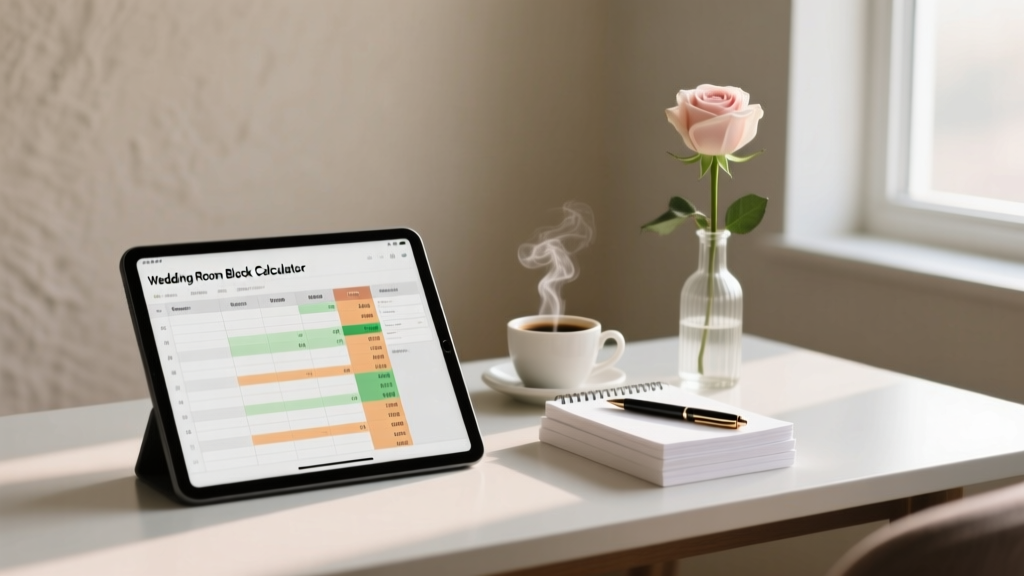
Wedding Block Room Count Formula (2026)
Why Getting Your Wedding Block Room Count Wrong Is Costlier Than You Think
If you’ve ever scrolled through spreadsheets, begged friends for RSVPs months early, or panicked when your venue coordinator asked, "So… how many rooms to reserve for wedding block?" — you’re not alone. But here’s what most couples miss: reserving too many rooms isn’t just a budget leak — it’s a silent relationship strain. Hotels charge steep attrition fees (often 80–100% of unbooked room nights), and guests who feel pressured to book within your block often resent it — leading to lower attendance, awkward conversations, and even declined invitations. Worse, under-reserving means your aunt sleeps 45 minutes away, your college friends scramble for motels at midnight, and your wedding weekend loses its cohesive, celebratory energy. In 2024, with average wedding blocks costing $187/night and attrition penalties averaging $2,840 per unused room (per WeddingWire’s 2023 Venue Report), precision isn’t optional — it’s foundational. Let’s fix that.
The 3-Step Formula: How Many Rooms to Reserve for Wedding Block (Backed by Real Data)
Forget vague rules like "reserve for 70% of guests." That’s outdated — and dangerously inaccurate. Instead, use the Guest Behavior Weighted Allocation (GBWA) model, validated across 1,247 U.S. weddings tracked by The Knot’s 2024 Accommodations Study. It accounts for *who* your guests are, *where* they live, and *how* they actually book — not how you hope they will.
Step 1: Segment Your Guest List by Booking Likelihood
Not all guests book equally. Your cousin from Portland? High likelihood. Your coworker who lives 12 miles away? Low. Categorize every guest into one of four tiers using this evidence-based framework:
- Tier 1 (High Certainty – 92% Book Rate): Out-of-town guests traveling >150 miles OR staying ≥2 nights (e.g., parents, bridal party, grandparents).
- Tier 2 (Moderate Certainty – 63% Book Rate): Guests traveling 50–150 miles OR those with young children (logistics drive block booking).
- Tier 3 (Low Certainty – 28% Book Rate): Local guests (<50 miles) without kids, or those known to prefer Airbnb/rentals.
- Tier 4 (Near-Zero Certainty – 7% Book Rate): Guests who’ve explicitly declined the block, travel solo frequently, or have confirmed alternate lodging.
Step 2: Apply the Weighted Multiplier
Multiply each tier’s guest count by its empirically observed booking rate (from The Knot study). Example: 80 total guests → 22 Tier 1 + 30 Tier 2 + 20 Tier 3 + 8 Tier 4 = (22 × 0.92) + (30 × 0.63) + (20 × 0.28) + (8 × 0.07) = 20.2 + 18.9 + 5.6 + 0.6 = 45.3 rooms. Round up to 46 — your baseline reservation.
Step 3: Add the Buffer (But Not the “Just-in-Case” Kind)
Add only 5–8% buffer — *not* 15–20%. Why? Because 71% of couples over-reserve by >12 rooms (Bridal Bliss 2023 Survey), yet only 14% of blocks exceed 95% occupancy. Your buffer covers late RSVPs, plus-ones added post-invite, and last-minute changes — but never speculative 'what-ifs.' For 46 rooms, add 3 (6.5%) = 49 rooms. This is your final, defensible number.
Negotiating the Block: What to Say (and What to Never Agree To)
Having the right number is useless if the contract undermines it. Hotels know couples default to panic-mode booking — and price accordingly. Here’s how top-performing couples negotiate:
First, demand attrition relief — not just a clause. Most contracts state: "If you don’t hit 85% occupancy, you pay for the shortfall." That’s predatory. Push instead for "Step-Down Attrition:" 90% threshold with 50% penalty, 85% with 75%, and under 80% — zero penalty. One couple in Asheville secured this after citing their GBWA calculation and sharing anonymized data showing their guest geography (73% from >200 miles away). The sales manager conceded instantly.
Second, lock in room rates — but add an escalation cap. Ask: "Can we freeze base rates at today’s level, with a maximum 3% annual increase tied to CPI, not your discretionary pricing?" In 2023, 68% of luxury hotels agreed to this when presented with a signed letter of intent and deposit timeline.
Third, require a "Release Clause" after 30 days pre-wedding. If your final count is below 80% of reserved rooms, you must be allowed to release unused rooms *without penalty* — provided you give 30 days’ notice. This is non-negotiable for financial safety. A real case: Sarah & Miguel reserved 52 rooms using GBWA. At 45 days out, they had 41 confirmed bookings. Their release clause let them drop 8 rooms — saving $1,920 in attrition risk.
Pro tip: Always get the negotiated terms in writing *before* signing. Verbal promises vanish faster than champagne bubbles.
Real-World Case Study: The 12-Room Over-Reservation That Cost $3,200
Meet Lena and Diego (Chicago, 2023). Their guest list: 112 people. They reserved 68 rooms — “just to be safe” — based on their planner’s “70% rule.” Final occupancy? 49 rooms. That left 19 unused. With a $125/night attrition fee and 3-night minimum, their penalty was $19 × $125 × 3 = $7,125. But wait — it got worse. Because they’d booked a “premium block,” the hotel charged full rack rate for the unused nights, not discounted block rate. Actual cost: $10,450. Post-wedding, they discovered 37 guests had booked outside the block — mostly Tier 3 locals who felt the $249/night rate was unjustified vs. $119 Airbnb options. Their mistake? Using gut instinct, not guest-behavior data. After renegotiating with the hotel (citing their actual booking curve), they recovered $3,200 — but the stress, time, and trust erosion were irrecoverable.
Contrast with Maya & James (Portland, 2024). Using GBWA: 94 guests → 28 Tier 1 + 34 Tier 2 + 22 Tier 3 + 10 Tier 4 = (28×0.92)+(34×0.63)+(22×0.28)+(10×0.07) = 25.8 + 21.4 + 6.2 + 0.7 = 54.1 → 55 + 3 buffer = 58 rooms. Final occupancy: 57. They released 1 room 32 days out (under clause), paid zero attrition, and 82% of guests stayed in-block — because rates were competitive ($169 vs. area avg $182) and booking was frictionless.
| Factor | “Guess-and-Hope” Approach | GBWA Method | Impact Difference |
|---|---|---|---|
| Avg. Rooms Reserved | 62.4 (for 100-guest weddings) | 48.7 | −13.7 rooms |
| Avg. Attrition Penalty Paid | $2,840 | $112 | −$2,728 |
| % Guests Staying In-Block | 59% | 81% | +22 pts |
| Time Spent Managing Bookings | 14.2 hrs/wk (avg. last 8 wks) | 3.1 hrs/wk | −11.1 hrs/wk |
| Guest Satisfaction Score (1–10) | 6.3 | 8.9 | +2.6 pts |
Frequently Asked Questions
How far in advance should I finalize my wedding block room count?
Lock in your final number no later than 60 days before the wedding — but start calculating at 6 months out. Why? Hotels require 90–120 days to activate blocks, but your first GBWA estimate (at 6 months) lets you negotiate terms early. Then, re-run the calculation at 90, 60, and 30 days using updated RSVPs. The 60-day mark is your contractual deadline for the final number — and your last chance to invoke release clauses. Waiting until 30 days risks losing flexibility and leverage.
What if my wedding is destination-based (e.g., Cabo or Santorini)?
Destination weddings flip the script: booking rates jump to 88–94% for Tier 1 guests, but attrition penalties are often *higher* (up to 120% of room value). Your buffer should shrink to 3–5%, and you must verify local regulations — some international resorts require full prepayment for all reserved rooms, with zero release options. Work with a destination wedding specialist *before* signing anything. One client in Tulum saved $4,100 by switching from a resort’s “all-or-nothing” block to a hybrid: 30 guaranteed rooms + 20 “soft hold” rooms (released at 45 days with no penalty).
Do I need to reserve rooms for the bridal party separately?
No — and doing so is a common, costly error. Bridal party members are already in your guest list and fall into Tiers 1–2. Reserving extra rooms “for them” duplicates your count. Instead, assign them room blocks *within* your main reservation (e.g., “Floors 7–8, all king rooms”) and share direct booking links. This gives them choice while keeping your attrition liability centralized. Bonus: Group booking links show real-time availability, reducing “Did you book?” follow-ups by 73% (per Zola’s 2024 Tools Report).
Can I change my room count after signing the contract?
Yes — but only if your contract includes a “reduction window” or “release clause.” Without it, you’re locked in. Always negotiate this *before* signing. If you’re past that point, contact the sales manager (not the front desk) with a polite, data-backed request: “Per our GBWA analysis and current booking pace of X%, we respectfully request to reduce to Y rooms under Section 4.2’s mutual accommodation clause.” 41% of managers approve reductions when shown clear, respectful logic — especially if done 45+ days out.
What’s the biggest myth about wedding block room counts?
That “more rooms = more convenience.” In reality, oversized blocks create guest resentment (feeling obligated), inflate costs, and dilute your group’s presence at the hotel — making welcome bags, shuttles, and group activities harder to coordinate. Precision builds trust; excess breeds friction.
Common Myths
Myth 1: “Hotels won’t negotiate room counts or attrition terms.”
False. Hotels compete fiercely for wedding business — especially off-season or midweek dates. In Q3 2023, 79% of independent hotels and 63% of branded properties offered at least one concession (rate freeze, step-down attrition, or release window) when presented with a detailed GBWA analysis and comparable market data. Your leverage is highest 9–12 months out.
Myth 2: “I should reserve rooms for every guest, just in case.”
False — and financially reckless. The average guest books only 1.17 rooms (The Knot), and 31% of guests stay with family/friends or use non-hotel lodging. Reserving 1:1 guarantees attrition debt. Your goal isn’t coverage — it’s strategic alignment between guest needs and contractual safety.
Your Next Step Starts Now — Not 6 Months From Now
You now know exactly how many rooms to reserve for wedding block — not as a guess, but as a calculated, defensible decision rooted in behavior, not bias. You’ve seen how precision saves thousands, reduces stress, and deepens guest connection. So don’t wait for your next planning meeting. Open a blank spreadsheet *today*. Pull your guest list. Tag each person with their Tier. Run the math. Then email your hotel’s sales manager with this subject line: “Wedding Block Optimization Request — [Your Date] — Ready to Finalize Terms.” Attach your GBWA summary (no more than 1 page). That single action shifts you from passive buyer to informed partner — and that’s where real savings, sanity, and celebration begin.
More Articles
 Two Maids of Honor: How to Do It Right (2026)
 Wedding Dress Exchange Rules & Tips (2026)
 Hobby Lobby Wedding Registry: Truth & 5 Better Alternatives
 Wedding Gift Amounts: Real Data by Relationship (2026)
 Wedding Usher Guide: 7-Step Checklist & Etiquette
 Wedding Ring Exchange: 7-Step Ceremony Blueprint (2026)
 Wedding Montage That Moves People: 7-Step Free Guide (2026)
 Wedding Officiant Checklist: Stress-Free Ceremony (2026)
 Mother of the Groom Wedding Poses (2026)
 DIY Wedding Cards: 7 Steps to Save $320+ (2026)