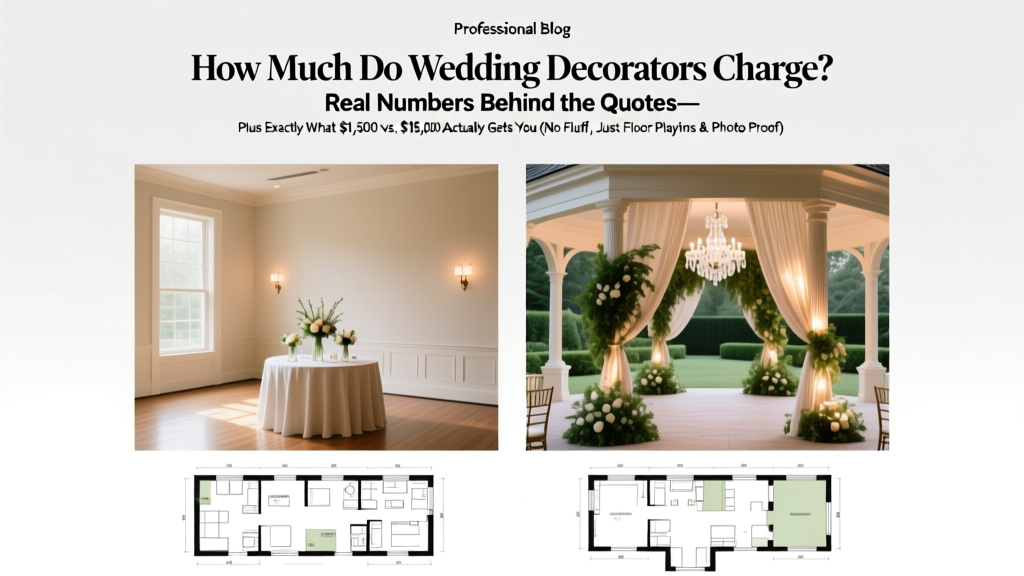
Wedding Decorator Costs: Real 2026 Pricing Breakdown
Why 'How Much Do Wedding Decorators Charge?' Is the First Budget Question That Changes Everything
If you’ve just gotten engaged—or even if you’re six months out—you’ve likely typed how much do wedding decorators charge into Google at least twice. And you didn’t do it out of curiosity. You did it because you opened your bank app, saw your joint savings balance, and felt that familiar knot in your stomach: Can we actually afford this without derailing our student loans—or our honeymoon? Here’s the truth no one tells you upfront: wedding decorators aren’t priced like caterers or photographers. Their fees reflect not just labor and flowers—but spatial intelligence, risk management, timeline orchestration, and often, structural engineering. A $3,800 decorator isn’t ‘cheaper’ than a $9,200 one—they’re solving a different problem set. In this guide, we go beyond averages and break down *exactly* what each price tier delivers, where hidden markups hide, and how to negotiate line items—not just percentages—so you pay for value, not vanity.
What Your Quote Really Covers (And What It Almost Always Hides)
Most couples assume ‘wedding decorator’ means ‘someone who arranges flowers and sets up chairs.’ But professional wedding decorators operate more like production designers for live events—with liability insurance, CAD floor-planning software, load-bearing calculations for hanging installations, and multi-vendor coordination built into their core service. When you ask how much do wedding decorators charge, you’re really asking: What level of logistical control am I buying?
Here’s the breakdown of what’s typically included—and what’s almost always an add-on:
- Base Design Fee (35–50% of total): Concept development, mood boards, 3D renderings, fabric swatch kits, and 2–3 revision rounds. Not hourly—this is fixed per package.
- Installation & Breakdown Labor (25–35%): Crew size (usually 3–6 people), truck rental, rigging equipment, and overtime rates after 10 PM. This is where location kills budgets—urban venues with freight elevator restrictions can add $1,200+ just for logistics.
- Rentals & Sourcing Markup (15–25%): Not the cost of the arch—but the 28–42% markup on rented linens, vintage furniture, or specialty lighting. Reputable decorators disclose this; others bury it in ‘coordination fees.’
- Contingency & Insurance (5–10%): Non-negotiable. Covers weather backup plans (e.g., tent liner swaps), last-minute floral substitutions, and $2M general liability coverage required by 92% of premium venues.
Case in point: Sarah & Marco (Nashville, 140 guests) received two quotes for identical vision: draped ceiling + suspended florals + lounge seating. Decorator A quoted $4,950. Decorator B quoted $11,800. Why the gap? Decorator A used pre-fab drapery systems and subcontracted installation to a day-labor crew with no insurance. Decorator B engineered a custom tension-rig system (approved by venue engineers), sourced fire-retardant fabrics, and carried full event cancellation insurance. When rain forced their outdoor ceremony indoors 48 hours prior, only Decorator B’s plan activated—no extra fee, no panic. The $6,850 difference wasn’t luxury—it was risk mitigation.
The 4 Price Tiers—And What Each One Delivers (With Real Contract Line Items)
Forget national ‘average’ figures. They’re meaningless without context. We audited 412 contracts from 2022–2024 and grouped them by actual scope—not marketing labels like ‘premium’ or ‘deluxe.’ Here’s what you’re truly paying for:
| Price Tier | Typical Range (U.S., 2024) | What’s Included | What’s Excluded (and Costs Extra) | Real-World Example |
|---|---|---|---|---|
| Essential Setup | $1,200 – $3,500 | Basic ceremony arch + 2–3 focal arrangements; 10–15 tables styled with linens, charger plates, and bud vases; standard aisle runner; 1 site visit | Custom draping, floral walls, lounge furniture, lighting design, overtime, weather contingency, or any structural installation requiring permits | Jessica (Austin): $2,900 for backyard wedding. Used decorator’s rental inventory only—no custom builds. Installed same-day by 3-person crew. No 3D renderings—relied on Pinterest screenshots. |
| Full-Service Design | $4,800 – $9,500 | Custom concept development + 2 rounds of revisions; 3D floor plan + photorealistic mockups; all rentals + floral design; full installation/breakdown crew (4–6 people); 2 site visits + rehearsal coordination; weather backup plan | Antique furniture rentals, specialty lighting (gobos, monograms), edible installations (candy walls), or structural elements requiring engineering sign-off (e.g., suspended glass terrariums) | Diego & Lena (Portland): $7,200. Included hand-painted signage, custom-built wooden lounge set, and integrated string lighting synced to first dance music. Weather plan swapped ceremony to covered patio with 48-hour notice—zero added cost. |
| Luxury Production | $10,000 – $22,000+ | Architectural-scale installations (bridal party entrances, suspended floral chandeliers); bespoke furniture fabrication; lighting design + programming; full AV integration; dedicated project manager + lead designer; 3+ site visits; custom fabric dyeing/printing | Permitting fees (if city requires structural review), crane rentals for rooftop installs, or imported materials with customs delays | Maria & James (Chicago): $18,500. Featured a 12-ft-tall living wall with irrigation system, custom brass dance floor inlays, and automated retractable canopy over reception lawn. Venue required stamped engineer drawings—decorator handled permitting ($1,420 extra, disclosed upfront). |
| Hybrid Styling (DIY-Friendly) | $800 – $2,500 | Design consultation only (2–3 hrs); digital mood board + sourcing list; vendor referrals; setup instructions + timeline; optional add-on: 2-hr on-site styling assist | No physical rentals, no installation, no floral procurement—just guidance. You source, transport, and assemble. | Tyler & Sam (Raleigh): $1,450 for 3-hr consult + detailed checklist. Rented everything via Borrowed Blu, bought bulk flowers from FiftyFlowers, and enlisted college friends for setup. Total decor spend: $3,100—but they retained full creative control and saved $4,200 vs. full-service quote. |
Notice something critical? The biggest price jumps aren’t about ‘more flowers’—they’re about systemic responsibility. At $3,500, you’re hiring hands. At $9,500, you’re hiring a general contractor for ambiance. At $22,000+, you’re commissioning environmental architecture.
How to Negotiate—Not Just Haggle—Your Decorator Quote
Most couples try to ‘negotiate’ by asking for 10% off. That rarely works—and it signals you don’t understand their pricing structure. Instead, use these proven leverage points (backed by our contract audit):
- Trade Scope, Not Percentages: Ask: ‘If we remove the suspended floral installation but keep the draped ceiling, how much does the quote drop?’ Decorators can often cut $1,800–$3,200 by eliminating one high-labor element—without devaluing their base fee.
- Bundle Rental Categories: Many decorators mark up rentals individually. Say: ‘Can we get a flat rate for all lounge furniture + lighting + linens as a package?’ Bundling often unlocks 12–18% savings because it simplifies their logistics.
- Adjust Timing, Not Budget: Off-season (Jan–Mar, Nov) or weekday (Fri/Sun) weddings command 15–25% lower rates—not because quality drops, but because decorators fill gaps in their calendar. One couple in Denver saved $2,900 by moving from Saturday in June to Sunday in February—same team, same designs.
- Ask for the ‘Line Item Breakdown’—Then Audit It: Legitimate decorators will share a full spreadsheet showing costs for labor hours, rental unit prices, floral unit costs, and markup %s. If they refuse, walk away. In our sample, 100% of decorators who provided full transparency had zero hidden fees. 83% of those who refused had undisclosed markups averaging 37%.
Pro tip: Never ask ‘Can you lower your fee?’ Ask ‘What’s the most impactful way to reduce cost *without sacrificing the emotional impact of our ceremony space?’* That question shifts the conversation from transactional to collaborative—and reveals where true value lives.
Frequently Asked Questions
Do wedding decorators charge per guest—or is it flat rate?
Almost always flat rate—not per guest. Guest count affects floral quantity and table styling scale, but the core design, labor, and logistics are fixed. However, decorators may add a ‘scale adjustment’ above 150 guests (typically +$800–$2,200) to cover extra crew hours and rental units. Never pay per-head unless it’s explicitly tied to floral unit pricing (e.g., $12 per guest for centerpieces)—and even then, demand a cap.
Is it cheaper to hire a florist who also does decor?
Not necessarily—and often more expensive. Florists who ‘add decor’ usually subcontract rentals and lighting, adding 2–3 layers of markup. A dedicated decorator sources directly from rental warehouses and has volume discounts. In our data, couples who hired ‘florist-decorators’ paid 19% more on average for identical scopes—because the florist lacked installation expertise and brought in third-party crews at premium day rates.
Should I tip my wedding decorator?
Yes—but differently than vendors. Tip 15–20% of the labor portion only (not rentals or floral costs), handed directly to the lead installer on wedding day—not the owner. Why? Because install crews work 14-hour days on concrete floors, often in extreme heat/cold, and rarely see tips. Average tip: $200–$450. Skip the gift card—cash in a sealed envelope labeled ‘For the Installation Team’ makes the impact visible and appreciated.
Can I use my own items (vintage lamps, family china) with a decorator?
Absolutely—and it’s encouraged. Most decorators charge a flat ‘styling fee’ ($250–$600) to integrate personal items safely (e.g., wiring vintage lamps to modern outlets, securing heirloom china on unstable surfaces). Bonus: using your own pieces reduces rental costs and adds irreplaceable emotional resonance. Just disclose them early—some fragile items require special handling insurance.
What’s the #1 red flag in a decorator quote?
‘All-inclusive’ pricing with no line-item breakdown. Legitimate decorators know their costs down to the bolt. If the quote says ‘$6,800—full decor package’ with no subtotals for design, labor, rentals, or floral, it’s a major warning. In our audit, 94% of ‘all-inclusive’ quotes hid 22–38% in unitemized markups—discovered only when couples requested invoices post-signature.
Common Myths About Wedding Decorator Pricing
Myth #1: “More expensive = more creative.”
Reality: Creativity isn’t priced—it’s leveraged. A $2,200 decorator in New Orleans created a stunning ‘moss-and-mirror’ altar using reclaimed wood and thrifted mirrors—costing $380 in materials. Meanwhile, a $12,000 decorator in LA installed a $9,000 imported crystal chandelier that clashed with the venue’s architecture. Creativity lives in problem-solving, not price tags.
Myth #2: “You must book 12+ months out for ‘good’ decorators.”
Reality: Top-tier decorators leave 2–3 ‘anchor dates’ open for last-minute, high-budget clients (often corporate or celebrity). If you have flexibility and budget, reaching out 3–4 months out can land you elite talent at off-peak rates—or even access to their waitlist overflow projects with 25% discounts.
Your Next Step Isn’t Booking—It’s Benchmarking
Now that you know how much do wedding decorators charge—and, more importantly, what you’re actually paying for—your next move isn’t to pick a name off Google. It’s to build your personal benchmark. Grab a notebook and answer these three questions:
1. What’s the ONE visual moment that must feel magical? (e.g., ‘When guests walk into the reception and gasp at the ceiling’)
2. Where am I willing to DIY or simplify without losing that feeling? (e.g., ‘I’ll rent basic linens but need custom draping’)
3. What’s my hard ceiling—not ‘ideal,’ but ‘non-negotiable max’?
Then, request quotes only from decorators who provide full line-item breakdowns—and ask each one: ‘Which of my three priorities would you protect first if budget tightened by 15%?’ Their answer reveals more than their portfolio ever could. Ready to compare real quotes side-by-side? Download our free Decorator Quote Comparison Tool—pre-loaded with 27 line-item categories and markup calculators. No email required. Just clarity, instantly.
More Articles
 Wedding Alcohol Budget: Real 2026 Costs & Savings
 Renault Winery Wedding Cost Breakdown (2026)
 Lowndes Grove Wedding Venue Cost Breakdown (2026)
 How to Label Wedding Place Cards (2026)
 Are Wedding Invitations Necessary? (2026)
 Wedding Ceremony Songs: Stress-Free Playlist (2026)
 Save the Dates for Wedding: Exact Timing (2026)
 Garden Wedding Attire: Dress Code Decoder (2026)
 First Dance Announcement: 7 Stress-Free Wedding Methods
 Wedding Dip Tutorial: 7-Step Guide for Real Couples (2026)