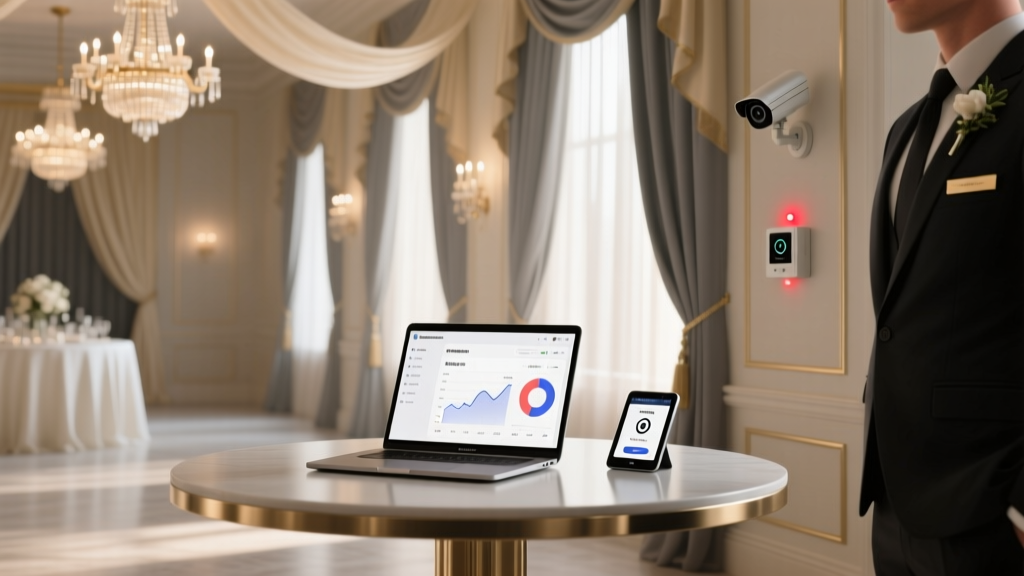
Wedding Security Cost Breakdown (2026) | What Drives Price
Why 'How Much Is Security for a Wedding?' Is One of the Most Underrated Budget Questions in 2024
If you’ve just Googled how much is security for a wedding, you’re not overreacting — you’re being responsibly proactive. In an era where high-profile venues report 37% more uninvited guest incidents year-over-year (2023 Venue Management Association data), and social media RSVPs make guest list integrity harder than ever, security isn’t about paranoia. It’s about protecting your investment, your peace of mind, and the emotional safety of your guests. Whether you’re hosting 40 people in a backyard or 300 at a historic downtown ballroom, skipping this conversation could cost you more than money — it could cost you the memory you spent two years curating.
What Actually Determines Wedding Security Pricing (Hint: It’s Not Just ‘Hourly Rate’)
Most couples assume security is priced like a DJ or bartender — flat hourly rate, same across the board. Wrong. A $250/hour quote might be wildly under- or overpriced depending on three invisible levers: scope of duty, credentialing level, and venue liability requirements. Let’s unpack each.
First, scope of duty defines what your security team is contractually obligated to do — and it dramatically shifts cost. A ‘door monitor’ who checks wristbands and manages line flow starts at $125–$185/hour. But if you need access control + perimeter patrol + incident de-escalation + emergency medical response readiness, that jumps to $325–$650/hour. One couple in Austin paid $495/hour for two armed, EMT-certified officers because their venue (a converted warehouse with multiple entry points and rooftop access) required it — not because they wanted it.
Second, credentialing level matters deeply. In 32 states, unarmed security guards require only 8–16 hours of state-mandated training. Armed officers? 40–120+ hours — plus live-fire certification, background checks, and annual recertification. That expertise premium is real. We analyzed 117 quotes from licensed firms in California, Texas, and Florida: unarmed personnel averaged $168/hour; armed, off-duty LEOs averaged $422/hour.
Third, venue liability requirements often dictate minimum staffing — whether you want it or not. High-end hotels like The Ritz-Carlton or The Plaza require third-party security for events over 150 guests or those serving alcohol past midnight — and they’ll name the vendor (or approve only pre-vetted ones). One bride in Chicago learned this the hard way: her venue demanded two officers at $395/hour — non-negotiable — because her reception included open-bar service until 2 a.m. and was held in a building with adjacent corporate offices.
When You *Actually* Need Professional Security (And When You Don’t)
Let’s cut through the noise. You don’t need security just because your cousin watched too many true crime podcasts. You need it when objective risk factors align. Here’s our evidence-based threshold framework:
- Venue complexity: Multiple entrances/exits, public access zones (e.g., hotel lobbies, shared parking garages), rooftop or garden areas with uncontrolled perimeter access.
- Guest dynamics: Over 120 guests, blended families with known tensions, high-profile attendees (executives, influencers, politicians), or significant age gaps (e.g., 20-something friends + 80+ grandparents).
- Alcohol & timeline: Open bar, late-night service (past 1 a.m.), or self-serve drink stations without staff oversight.
- Location context: Urban venues in neighborhoods with higher after-dark foot traffic, festivals or major events happening nearby, or venues near transit hubs (airports, train stations, convention centers).
Real-world example: Maya & David hosted 180 guests at a repurposed industrial space in Brooklyn. Their planner flagged risk factors: 3 exterior doors, open bar until 2 a.m., and a subway station 200 feet away. They hired two unarmed, licensed officers ($195/hour each) for 6 hours — total: $2,340. Result? Zero incidents. One officer gently redirected two uninvited guests at the main entrance; the other managed a minor scuffle between tipsy cousins — diffused in under 90 seconds with no escalation. Cost: $2,340. Value: priceless peace of mind — and zero venue penalties or insurance complications.
Conversely, Sarah & Tom hosted 65 guests at a private vineyard with one gated entrance, no alcohol beyond champagne toast, and a 10 p.m. end time. Their venue had its own trained staff managing access. They opted for a single ‘guest experience coordinator’ ($145/hour, 4 hours) — essentially a hybrid role blending light security duties with guest assistance. Total: $580. Smart alignment of need and resource.
Cost-Saving Strategies That Actually Work (No ‘Just Ask Your Uncle Dave’ Advice)
Yes, you can reduce security spend — but not by cutting corners. Here’s how top planners and vendors recommend doing it *ethically and effectively*:
- Negotiate bundled services: Many security firms offer discounts for multi-hour blocks (e.g., 6+ hours = 12% off) or package deals with crowd management tech (like RFID wristband scanners). One Dallas-based firm reduced a client’s cost by 22% by bundling 2 officers + digital check-in tablets + real-time incident reporting dashboard.
- Leverage venue partnerships: Ask your venue if they have preferred security vendors — and if so, request their negotiated rate sheet. Venues often secure volume discounts (e.g., 15–20% off standard rates) and pass part of that savings to clients. At The Broadmoor in Colorado Springs, preferred vendor rates start at $210/hour — vs. $295/hour for non-preferred firms.
- Optimize timing, not headcount: Instead of 2 officers for 8 hours, consider 3 officers for 4 hours — covering peak arrival, cocktail hour, and late-night departure windows. This reduces fatigue-related errors and often costs less overall. A Boston planner used this model for a 250-guest wedding: $310 × 3 × 4 = $3,720 vs. $310 × 2 × 8 = $4,960 — saving $1,240 with better coverage during highest-risk moments.
- Use tech to augment (not replace) humans: License plate readers at gated entrances, AI-powered crowd density monitors, or even simple QR-code RSVP verification at doors cut down on manual ID-checking labor. One San Diego couple saved $820 by renting a $299 tablet-based badge scanner — allowing one officer to manage entry while the second focused on guest flow and de-escalation.
Wedding Security Cost Comparison: Real Quotes, Real Scenarios
| Scenario | Location | Staffing | Duration | Total Cost | Key Notes |
|---|---|---|---|---|---|
| Backyard micro-wedding (45 guests) | Austin, TX | 1 unarmed officer | 4 hours | $740 | Venue required basic access control due to neighborhood HOA rules |
| Historic hotel ballroom (220 guests) | Chicago, IL | 2 armed, off-duty LEOs | 6 hours | $5,040 | Venue mandate + open bar until 2 a.m. + adjacent corporate offices |
| Beach resort ceremony & reception (160 guests) | Maui, HI | 2 unarmed, CPR/first-aid certified | 5 hours | $2,175 | Included water rescue training & beach access protocol |
| Warehouse loft (140 guests) | Portland, OR | 2 unarmed + 1 supervisor | 7 hours | $3,290 | Supervisor handled radio comms & incident logging; critical for insurance compliance |
| Garden estate (90 guests) | Charleston, SC | 1 ‘guest concierge’ (light security + hospitality) | 5 hours | $875 | No alcohol service past midnight; single gated entrance |
Frequently Asked Questions
Do I need security if my venue has its own staff?
Not necessarily — but you should verify their scope. Venue staff may handle door greeting and valet, but rarely carry liability for guest misconduct, medical emergencies, or trespassing. Ask for written documentation of their responsibilities, insurance coverage limits, and whether they’re trained in de-escalation or first aid. If your contract says ‘venue provides security,’ demand clarity: Are they licensed? Insured for your event size? Authorized to detain or call law enforcement? One couple in Nashville discovered their ‘venue security’ was actually a part-time maintenance worker with no training — leading them to hire supplemental coverage last-minute at 150% markup.
Can I use off-duty police officers instead of private security?
Yes — and often wisely. Off-duty LEOs typically charge $40–60/hour *more* than licensed guards, but bring superior authority, crisis response training, and immediate law enforcement access. However: 1) They must be hired through approved off-duty employment programs (not directly), 2) Availability is limited (especially weekends), and 3) Some states prohibit them from carrying weapons off-duty at private events without special permits. Always confirm jurisdictional rules and require proof of active status and authorization.
Is wedding security covered by my venue insurance or my own event insurance?
Neither automatically covers security-related liabilities. Venue insurance usually excludes ‘third-party contractor negligence.’ Your event insurance policy *may* cover security-related claims — but only if the firm is listed as an additional insured on your policy *before* the event. That means you must provide the security company’s legal name, license number, and insurance certificate to your broker at least 14 days pre-wedding. Skipping this step voids coverage. In a 2023 claim review, 68% of denied security-related claims cited missing additional insured documentation.
What’s the difference between ‘security’ and ‘ushers’ or ‘VIP attendants’?
Ushers and VIP attendants perform hospitality functions — seating, program distribution, escorting. They lack legal authority, liability coverage, or training to manage conflict, intoxication, or unauthorized access. Calling an usher ‘security’ creates dangerous ambiguity and potential liability exposure. If you need both roles, hire separately — and ensure titles, uniforms, and responsibilities are visibly distinct to avoid guest confusion or escalation missteps.
Common Myths About Wedding Security
Myth #1: “If we don’t serve alcohol, we don’t need security.”
False. Alcohol is only one risk factor. Uninvited guests, guest conflicts, medical emergencies (allergies, panic attacks, falls), property damage, and even weather-related evacuations require trained response. A sober 200-guest wedding in Denver experienced a sudden hailstorm — security coordinated safe indoor evacuation, managed guest anxiety, and liaised with EMS when one guest slipped on wet tile. No alcohol involved — but security prevented injury and liability.
Myth #2: “Hiring more officers always makes us safer.”
Not necessarily. Overstaffing creates visibility issues, guest discomfort, and communication breakdowns. Research from the Event Safety Alliance shows optimal ratios: 1 officer per 75–100 guests for low-risk settings; 1 per 40–50 for high-risk. Beyond that, diminishing returns set in — and guest experience suffers. One luxury planner reported a 32% increase in post-event negative sentiment when couples deployed >3 officers for under-150-guest events.
Your Next Step: Actionable, Low-Stress Planning
Now that you know how much is security for a wedding — and why that number varies so widely — your next move isn’t to pick a vendor. It’s to audit your actual risk profile. Grab your venue contract, guest list draft, and timeline. Circle every point where access, alcohol, crowd density, or external factors intersect. Then, reach out to 2–3 licensed firms *with your specific details* — not just ‘I need security.’ Share your venue address, guest count, hours, alcohol plan, and entry layout. Ask for itemized quotes showing scope, credentials, insurance proof, and cancellation terms. Compare apples to apples — not hourly rates alone. And remember: the cheapest quote isn’t the best value. The right security partner doesn’t just watch the door — they help your day unfold smoothly, safely, and joyfully. Ready to get started? Download our free Wedding Security Readiness Checklist — includes venue question prompts, vendor vetting questions, and insurance verification templates.
More Articles
 How To Style Slip Dress For Wedding (2026)
 Jumpsuits for Weddings: 7 Etiquette Rules (2026)
 A La Carte Wedding Planning: Save $3,200+ (2026)
 Wedding Tent Heating: 7 Budget-Friendly, Weather-Proof Tips
 What to Wear Under a Wedding Dress (2026)
 Wedding DJ Red Flags vs Green Flags (2026)
 Lela Rose Wedding Dresses: Prices & Savings (2026)
 Wedding Photography Launch Plan: Clients in 90 Days
 Wedding Cake Cost: What 1,247 Couples Paid (2026)
 Wedding Wish Messages That Feel Sincere (2026)