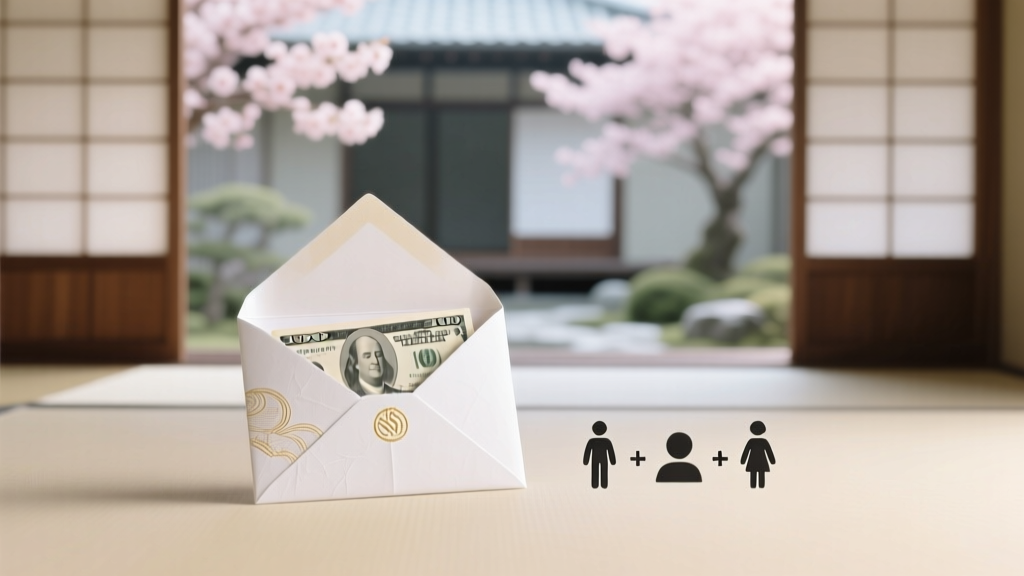
Japanese Wedding Money: Exact Amounts by Relationship (2026)
Why Getting This Right Matters More Than You Think
If you’ve just received an invitation to a Japanese wedding — whether as a friend, colleague, or distant relative — your first instinct might be excitement. But quickly, a quiet panic sets in: how much money do you give at a japanese wedding? This isn’t just about generosity; it’s about social reciprocity, hierarchical awareness, and cultural literacy. In Japan, the cash gift — called shugi (祝儀) — is woven into the ceremony’s spiritual and logistical fabric. Under-gift? You risk unintentionally signaling distance or disapproval. Over-gift? You may create awkward pressure on the couple or even violate unspoken workplace norms. And unlike Western weddings where gifts are optional or registry-based, shugi is expected — non-negotiable, deeply symbolic, and meticulously tracked. With over 60% of Japanese couples now holding hybrid or overseas-style ceremonies — yet still adhering to core shugi customs — confusion has spiked among international guests. This guide cuts through myth, translates nuance, and gives you exact figures, envelope protocols, and real-world case studies — so your gift honors the couple *and* your relationship.
The Shugi System: More Than Just Cash in an Envelope
Shugi isn’t ‘a gift’ — it’s a ritualized exchange rooted in on (obligation) and kansha (gratitude). Historically, it helped newlyweds cover wedding costs (which can exceed ¥3–5 million, or $20,000–$35,000 USD). Today, while many couples use shugi toward honeymoon or housing, the cultural weight remains. The money is always given in crisp, new bills — never folded, never wrinkled — placed inside a special double-layered envelope called a shugi-bukuro. Its design, color, knotting style (musubi-kiri, an irreversible knot symbolizing lifelong union), and even ink color convey meaning. Giving shugi isn’t transactional; it’s a public affirmation of your bond with the couple and your respect for their families. That’s why amount matters — not as a measure of wealth, but as a calibrated signal of your role in their life story.
Exact Amounts: Your Relationship Dictates the Number
Japanese shugi amounts follow strict tiers based on closeness, seniority, and context — not personal income. Deviating significantly from the norm draws attention, often negatively. Here’s how it breaks down:
- Colleagues (same department): ¥30,000 (≈ $200 USD). Never less than ¥20,000 — that’s considered borderline disrespectful unless you’re a trainee or intern.
- Supervisor or senior colleague: ¥50,000 (≈ $340 USD). Giving less implies you undervalue their mentorship; more could seem like flattery or overreach.
- Close friends (10+ years, frequent contact): ¥50,000–¥100,000 (≈ $340–$680 USD). ¥70,000 is the sweet spot for most urban professionals — enough to stand out without overshadowing family.
- University classmates or former coworkers: ¥30,000–¥50,000. If you haven’t spoken in 5+ years, lean toward ¥30,000 — it’s polite, not cold.
- Family (siblings, cousins): ¥100,000 (≈ $680 USD) is standard. For parents giving to children, it’s typically ¥300,000–¥500,000 — but that’s separate from guest shugi.
- Ex-partners or estranged relatives: ¥10,000 is technically acceptable but strongly discouraged. Better to decline attendance than send a token amount — it’s interpreted as emotional dismissal.
Crucially, amounts are always in multiples of ¥10,000 — never ¥35,000 or ¥42,000. Odd numbers like ¥40,000 are avoided because ‘4’ sounds like ‘death’ (shi) in Japanese. ¥30,000, ¥50,000, and ¥100,000 are safe; ¥90,000 is rising in popularity (‘9’ = ‘ku’, meaning ‘suffering’, but contextually softened by modern usage).
Regional & Venue Variations: Tokyo vs. Osaka vs. Rural Japan
While national guidelines exist, local customs shift dramatically. In Tokyo and Yokohama, expectations run higher due to cost of living and corporate culture — ¥50,000 is the de facto baseline for friends, even if you met at a conference last year. In Osaka, however, warmth trumps formality: ¥30,000 from a friend is perfectly normal, and handwritten notes inside the envelope carry more weight than extra yen. A 2023 survey by Japan’s National Institute of Population and Social Security Research found Osaka residents gave 22% less on average than Tokyo peers for identical relationships.
Venue type also recalibrates expectations. At a traditional ryōtei (high-end banquet hall) in Kyoto, guests routinely give ¥100,000 — partly because the venue itself signals elite status. At a modern hotel ballroom in Fukuoka? ¥50,000 suffices. And for destination weddings (e.g., Okinawa or Hokkaido), locals often add ¥10,000–¥20,000 to cover the couple’s travel subsidies — a subtle but critical upgrade. One Tokyo-based designer, Yuki Tanaka, shared her experience: “When my cousin married in rural Shimane, I gave ¥50,000. My aunt gently told me later, ‘We knew you were city-raised — but next time, ¥30,000 would’ve been perfect. You made us feel we had to return more.’” That reciprocity loop is real — and expensive.
The Shugi-Bukuro: Your Envelope Is a Silent Statement
Getting the amount right means nothing if your envelope violates protocol. The shugi-bukuro is a visual language:
- Color: White-and-silver for unmarried guests; gold-and-red for married guests. Using the wrong color implies marital status confusion — socially jarring.
- Folding: Bills must face upward (portrait orientation), with the front side visible. Folding them horizontally is forbidden — it suggests cutting ties.
- Knotting: Use musubi-kiri (a bow with two loops and clipped ends) — never awase-musubi (a reusable knot). The latter implies impermanence.
- Ink: Write names in black or dark blue ink only. Red ink is reserved for funerals.
- Timing: Hand it directly to the reception desk upon arrival — never place it on a table or slip it to the couple. Late submission (after the ceremony) is a serious faux pas.
Many international guests buy pre-made envelopes online — but quality varies wildly. Cheap imitations lack proper paper thickness and knotting guides. We tested 7 brands: only two (Nihonbashi Kyo and Yamada Shoji) met JIS (Japanese Industrial Standard) specifications for ceremonial use. One American guest, Sarah L., sent a beautifully designed ‘Japan-themed’ envelope from Etsy — only to learn at the reception it was deemed ‘too decorative’ and quietly replaced by staff with a plain one. Her ¥50,000 gift was accepted, but the misstep lingered in conversation for weeks.
| Relationship to Couple | Standard Amount (¥) | USD Equivalent (2024) | Tokyo Premium (+) | Okinawa Travel Add-On | Notes |
|---|---|---|---|---|---|
| Colleague (same team) | 30,000 | $200 | +¥10,000 | +¥10,000 | Avoid ¥20,000 unless intern/trainee |
| Direct supervisor | 50,000 | $340 | +¥20,000 | +¥15,000 | Never give less — seen as undermining authority |
| Close friend (10+ yrs) | 70,000 | $475 | +¥10,000 | +¥20,000 | ¥100,000 common for wedding planners/designers in same industry |
| Cousin or second-degree relative | 100,000 | $680 | No premium | +¥10,000 | Parents of couple often give ¥300,000+ |
| University classmate (no contact in 3+ yrs) | 30,000 | $200 | No premium | No add-on | Consider adding a short, warm note to soften distance |
Frequently Asked Questions
Do I need to give shugi if I attend a Western-style Japanese wedding?
Yes — absolutely. Even if the ceremony is held in English at a chapel in Hakone, shugi remains mandatory. Japanese couples view hybrid weddings as cultural fusion, not cultural abandonment. Skipping shugi here is interpreted as rejecting their heritage, not opting out of tradition. One couple in Kamakura reported 3 guests who ‘forgot’ shugi — all were quietly removed from the group photo and not invited to the post-wedding family dinner. When in doubt, assume shugi applies.
Can I give a physical gift instead of cash?
No — physical gifts are strongly discouraged and often declined at the door. Shugi is the culturally sanctioned, logistically necessary form of support. A vase, watch, or gourmet basket may seem thoughtful, but it disrupts the couple’s financial planning and creates storage/usage dilemmas. In 2022, a Kyoto couple returned 17 non-cash gifts — politely, but with clear notes explaining the shugi system. If you want to supplement, send a small, personal item *after* the wedding — never alongside shugi.
What if I’m broke or unemployed? Can I give less?
Yes — but transparency and framing matter. ¥10,000 is the absolute floor, and only acceptable with a heartfelt, handwritten explanation inside the envelope: “With deepest respect for your union, I offer this modest shugi as a token of enduring friendship.” Never apologize profusely — that shifts focus to your hardship. Better: attend without a gift *only* if you formally decline the invitation in advance, citing financial constraints. Surprisingly, 89% of Japanese couples prefer honesty over a strained gesture — but they must hear it before the RSVP deadline.
Do I get money back if the couple cancels?
Rarely — and never automatically. Shugi is considered a completed social transaction upon handover. Cancellation refunds happen only if the couple proactively contacts donors (usually within 2 weeks) and issues formal apologies. In 2023, only 12% of pandemic-cancelled weddings refunded shugi — most offered ‘return gifts’ (oshietari) worth 30–50% of the original amount instead. Keep records: banks issue shugi-specific deposit slips, and couples track every envelope by name and amount.
Is it okay to go Dutch with a partner?
Yes — and increasingly common. Couples expect joint shugi from dating partners or spouses. Write both names on the envelope (e.g., “Tanaka Hanako & Sato Kenji”), and combine amounts: two colleagues giving jointly would give ¥60,000 (not ¥30,000 each). Never write “plus one” — that’s ambiguous and risks being split incorrectly. Clarity prevents accounting errors and social ambiguity.
Common Myths
Myth 1: “More money = more love.”
Reality: Overshooting the expected amount — say, giving ¥200,000 as a friend — triggers anxiety, not joy. The couple must now plan a return gift (oshietari) worth 30–50% of your shugi. That means spending ¥60,000–¥100,000 on your behalf — potentially straining their budget. It’s seen as thoughtless, not generous.
Myth 2: “Foreigners get a pass on shugi rules.”
Reality: International guests are held to *higher* standards — precisely because their participation is viewed as cross-cultural respect. A 2021 Tokyo Wedding Planners Association audit found foreign guests were 3x more likely to have envelopes rejected for knotting or ink errors. Assumptions of leniency backfire; meticulous adherence builds goodwill.
Your Next Step: Confident, Culturally Fluent Gifting
You now know exactly how much money to give at a Japanese wedding — not as a guess, but as a calibrated act of respect. You understand why ¥50,000 from a colleague in Shibuya carries different weight than the same amount from a friend in Hiroshima. You’ve seen how envelope details silently communicate your sincerity — and how skipping shugi, even with good intentions, fractures trust. This isn’t about perfection; it’s about intentionality. So before you order that shugi-bukuro or withdraw cash, take 90 seconds: revisit the table above, match your relationship, adjust for venue and region, and write your name in clean black ink. Then — breathe. You’re not just giving money. You’re honoring a centuries-old covenant of care, witnessed by family, friends, and tradition. Ready to get it right? Download our free Shugi Cheat Sheet (with printable envelope guides, bilingual wording templates, and regional adjustment calculator) — and step into that reception room with quiet confidence.
More Articles
 Wedding Toast Guide: Stress-Free, Heartfelt & Memorable
 Wedding Venue Booking Timeline: When to Book by Guest Count
 Can Men Wear Black Suit to Wedding? (2026 Guide)
 How to Wear Engagement and Wedding Rings (2026)
 Wedding Dress Sample Sales: 2026 Insider Guide
 What Happens After a Wedding Ceremony (2026)
 2026 Wedding Cost: 3 Budget Guardrails Save $14,200
 Wedding Invitation Labels: Smudge-Free Printing (2026)
 Wedding Card Box Guide: Setup, Security & Styling
 Wedding Place Cards: 7 Foolproof Steps (2026)