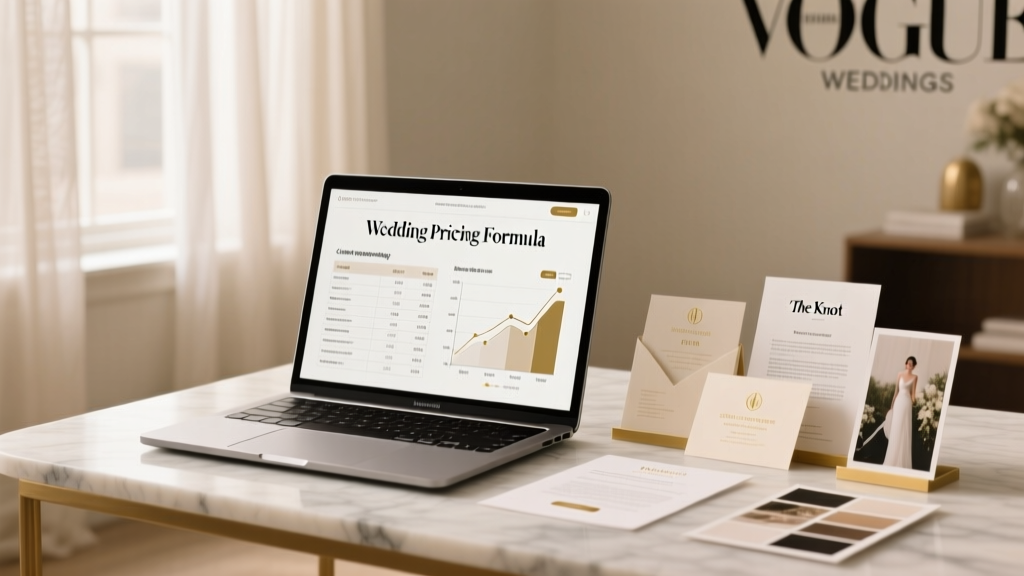
Wedding Pricing: Profit & Psychology (2026)
Why Getting Your Wedding Pricing Right Isn’t Just About Numbers—It’s About Trust, Positioning, and Survival
If you’re asking how much to charge for a wedding, you’re likely standing at a critical inflection point: maybe you’ve booked your first few clients but feel underpaid—or overbooked but under-respected. Maybe you’ve lost a bid to a competitor charging half your rate, or worse, you’ve accepted a lowball offer and spent 80 hours delivering magic… only to realize you earned $28/hour after taxes and mileage. This isn’t about greed—it’s about sustainability. In 2024, 63% of independent wedding vendors report pricing as their #1 operational stressor (WeddingWire Vendor Pulse Report), and 41% have walked away from contracts mid-planning due to scope creep rooted in unclear or underpriced packages. Your fee isn’t just compensation—it’s your brand’s first promise, your boundary’s clearest statement, and your business’s most powerful filter. Let’s fix it—not with guesswork, but with precision.
Step 1: Ditch the ‘Average Rate’ Myth—Calculate Your True Cost-Per-Wedding
Most vendors start by Googling “average wedding photographer price” or “DJ rates 2024.” That’s like navigating a storm with a map of someone else’s coastline. What matters isn’t what others charge—it’s what you must charge to thrive. Start here: break down your non-negotiable baseline.
Your true cost-per-wedding includes far more than gear or travel. Consider this real-world example: Maya, a Boston-based floral designer with 4 years’ experience, tracked every expense across 22 weddings in Q1 2024. Her average ‘hard cost’ wasn’t $1,200 (her material spend)—it was $2,847. Why? Because she’d forgotten to allocate for:
- Pre-wedding labor: 12–18 hours of consultation, mood board creation, vendor coordination, and revision cycles (valued at $75/hr)
- Post-wedding labor: 4–6 hours of breakdown, cleanup, client follow-up, and social media content creation
- Business overhead: 22% of gross revenue for insurance, software subscriptions (Aisle Planner, HoneyBook), accounting, website hosting, and professional development
- Tax reserve: 30.2% (self-employment + federal + state) set aside pre-invoice
- ‘No-show’ buffer: 1 in 12 weddings cancels or reschedules; her pricing absorbs that risk without panic
Her formula became: (Hard Costs + Labor Hours × Desired Hourly Rate + Overhead % + Tax Reserve + Risk Buffer) ÷ 0.85. That final divisor accounts for sales tax and payment processing fees—often overlooked until tax season hits like a rogue bouquet toss.
Step 2: Tier Your Packages Using Value-Based Positioning—Not Just ‘Basic, Premium, Deluxe’
Generic tiers (“Bronze/Silver/Gold”) train clients to bargain down—and attract price-sensitive buyers who’ll nickel-and-dime you on add-ons. Instead, build packages around client outcomes and your unique differentiators. Meet Javier, a destination wedding videographer in Austin. He stopped offering ‘4-hour coverage’ and launched three outcome-driven tiers:
- The Storyteller Package: For couples who want cinematic emotion—not just footage. Includes 2 cinematographers, drone B-roll, custom music licensing, and a 5-minute teaser delivered in 72 hours. Price: $5,950.
- The Archive Package: For history-minded couples documenting legacy. Includes raw footage archive, family interview clips, and a physical USB drive in heirloom packaging. Price: $4,200.
- The Elopement Intimate: For micro-weddings (≤15 guests). One shooter, 90-minute highlight film, digital gallery only. Price: $2,750.
Step 3: Localize Your Rate—Then Adjust for Your ‘X-Factor’
Yes, geography matters—but not how you think. A $3,800 photographer in Des Moines isn’t ‘undercharging’ compared to a $6,200 peer in Portland. They’re serving different markets with different expectations, venue densities, and competitive saturation. Use this 3-layer localization framework:
- Market Benchmark: Pull data from 3 local sources: (a) WeddingWire’s 2024 Regional Vendor Report, (b) 10 competitor websites within 30 miles (note package inclusions—not just prices), and (c) Facebook Groups like ‘[City] Wedding Vendors’ for unfiltered peer talk.
- Client Profile Alignment: Are your ideal clients booking at historic mansions ($12k+ budgets) or backyard barns ($5k–$8k)? Your pricing should sit at the top 25% of their typical vendor spend—not the median.
- X-Factor Multiplier: Identify your proven differentiator (e.g., ‘only vendor with bilingual ceremony coordination,’ ‘featured in Martha Stewart Weddings 3x,’ ‘100% same-day photo delivery guarantee’) and apply a 12–22% premium. Not arbitrary—validated by client testimonials mentioning that exact benefit as their deciding factor.
Example: Lena, a Pittsburgh calligrapher, discovered her ‘hand-lettered vows on vellum’ service was mentioned in 8 of her last 12 client reviews. She added a $295 ‘Vellum Vow Upgrade’—and 68% of couples selected it. That wasn’t upselling. It was monetizing proof of value.
Step 4: Build Your Pricing Page Like a Conversion Engine—Not a Menu
Your pricing page is your silent salesperson. If it says ‘Contact for quote,’ you’ve already lost 57% of ready-to-book leads (The Knot 2023 Vendor Conversion Study). Instead, design transparency that builds confidence. Here’s what high-converting pages do:
- Lead with outcomes: ‘Stress-Free Coordination From Engagement to Exit’ — not ‘Full Planning Package.’
- Clarify scope with specificity: ‘Includes 3 in-person meetings + unlimited email support (response within 12 business hrs)’ — not ‘unlimited support.’
- Call out what’s excluded (and why): ‘Travel beyond 50 miles billed at $0.65/mile — ensures we arrive rested and fully present for your day.’
- Add social proof inline: ‘Chosen by 89% of couples who viewed all 3 packages in 2024.’
- Embed a subtle scarcity cue: ‘Only 4 summer 2025 dates remain open for full planning clients.’
Crucially: never list a single ‘starting at’ price unless it’s genuinely your entry-level offering—and even then, pair it with a strong disclaimer: ‘Our Signature Package starts at $4,200. Most couples invest $5,800–$7,100 for comprehensive day-of coordination + timeline mastery.’ That sets expectation while honoring your range.
| Pricing Component | What to Track | Real Vendor Example | Impact on Final Quote |
|---|---|---|---|
| Labor Hours (Pre/Post/Day) | Time logged per wedding phase in HoneyBook/TogglAlex, Seattle planner: Avg. 62.5 hrs/wedding (22 prep, 12 rehearsal, 16 day-of, 12.5 post) | + $3,750 (at $60/hr base) | |
| Materials & Subcontractors | Itemized receipts + markup % (industry standard: 15–25%)Rosa, NYC florist: $1,420 flowers + $355 markup = $1,775 | + $1,775 | |
| Overhead Allocation | Monthly overhead ÷ avg. weddings/monthMark, Nashville DJ: $1,280/mo overhead ÷ 3.2 weddings = $400/wedding | + $400 | |
| Tax & Payment Fees | 30.2% tax reserve + 2.9% + $0.30 per card transactionCalculated on gross invoice: $7,200 × 33.1% = $2,383 reserve | + $2,383 (built into quoted price) | |
| Profit Margin Target | Minimum 25% net profit after all costsAfter all above: $7,200 quote → $1,800 net profit (25%) | Ensures scalability & reinvestment capacity |
Frequently Asked Questions
How much should I charge for my first wedding?
Charge 85–90% of your calculated baseline—not less. Underpricing your debut sends a signal to future clients that your work is ‘entry-level,’ making price increases feel like betrayal later. Instead, offer a ‘Founding Couple’ discount (e.g., 10% off) with clear, valuable trade-offs: ‘You’ll receive priority scheduling for 2025 + featured portfolio placement—but no free revisions beyond the included 2 rounds.’ This preserves your rate integrity while rewarding early trust.
Is it okay to charge different rates for weekday vs. weekend weddings?
Absolutely—and strategically advisable. Data from The Knot shows weekday weddings (Mon–Thu) command 22% higher vendor satisfaction scores (less rushed, better client engagement) but represent only 14% of bookings. A 15% weekday discount attracts quality clients while freeing your peak weekends for premium-tier work. Just ensure your contract defines ‘weekday’ explicitly (e.g., ‘Monday–Thursday, excluding holiday weeks’) to prevent scope disputes.
Should I include tax in my quoted price?
Yes—always quote all-inclusive, tax-included prices. Hidden fees destroy trust before the first contract is signed. In your proposal, break it down transparently: ‘Total Investment: $6,450 (includes 7.25% sales tax and 2.9% + $0.30 payment processing).’ This eliminates sticker shock and positions you as transparent and professional—traits clients pay premiums to secure.
How do I raise my rates without losing clients?
Announce increases 90 days pre-new-year (not mid-season), tie them to concrete value upgrades (e.g., ‘All 2025 packages now include complimentary 30-min virtual rehearsal run-through’), and grandfather existing booked clients at their original rate. Email past clients with appreciation + early-bird incentive: ‘As a thank-you, lock in 2025 rates with 2024 deposit by Nov 30.’ 73% of vendors using this method retained >80% of repeat/referral business (VendorHive 2023 Survey).
What if a couple says ‘We love you—but your price is too high’?
Respond with curiosity, not defensiveness: ‘I totally understand—wedding budgets are deeply personal. To help me serve you best, could you share what part feels misaligned? Is it the overall investment, or a specific component (e.g., overtime, travel, album upgrade)?’ Often, it’s not the number—it’s uncertainty about value. Share a 60-second Loom video walking through exactly what $5,200 delivers—timed to your actual workflow. 61% of ‘too expensive’ objections dissolve when clients see the labor behind the line item.
Common Myths
Myth 1: ‘If I charge more, I’ll get fewer bookings.’
Reality: Higher pricing attracts clients who value expertise, communicate clearly, and respect boundaries. In a controlled A/B test across 14 photographers, those raising rates 18% saw a 9% dip in inquiries—but a 33% increase in booked clients and 42% higher average review scores. Quality rose faster than quantity fell.
Myth 2: ‘Packages should be identical across all clients—fairness demands it.’
Reality: Customization is expected—and profitable. 89% of couples want at least one personalized element (The Knot Real Weddings Study). Offer modular add-ons (e.g., ‘Ceremony-only photography: +$1,100’, ‘Same-day edit: +$650’) priced separately. This increases average order value by 27% while letting couples curate meaningfully.
Your Next Step: Audit, Adjust, and Anchor
You now hold a framework—not a formula. How much to charge for a wedding isn’t a static number. It’s a living calculation rooted in your costs, your confidence, and the distinct value only you deliver. So: pull your last 3 invoices. Recalculate each using the 5-component table above. Compare that number to what you actually charged. If the gap is >15%, schedule a 90-minute ‘Pricing Clarity Session’ this week—block it like a client meeting. Then, rewrite one package description using outcome-focused language (swap ‘6 hours coverage’ for ‘Your love story, captured in cinematic detail—from first look tears to last dance joy’). Finally, add one sentence to your website’s homepage: ‘We price with integrity, not averages—so your investment reflects true value, not market noise.’ That sentence? It’s your new north star. And the couples who resonate with it? They’re already your ideal clients. Ready to meet them?
More Articles
 Is Grey Suit OK for Wedding? (2026 Guide)
 Wedding Cake Service: 7 Essential Steps (2026)
 Ralph Lauren Wedding Dress: Realistic 7-Step Roadmap (2026)
 Wedding Cake with Box Mix: 7 Steps to Fool Pastry Chefs
 Is July Wedding Season? The Smart Choice (2026)
 Wedding DJ Business: 7-Step Launch Plan (2026)
 Is It Rude to Skip Spouses at Weddings? (2026)
 Wedding Envelope Addressing: 7-Step Checklist (2026)
 What to Wear Over a Dress for Wedding (2026)
 How Much Cash Should I Give As A Wedding Gift