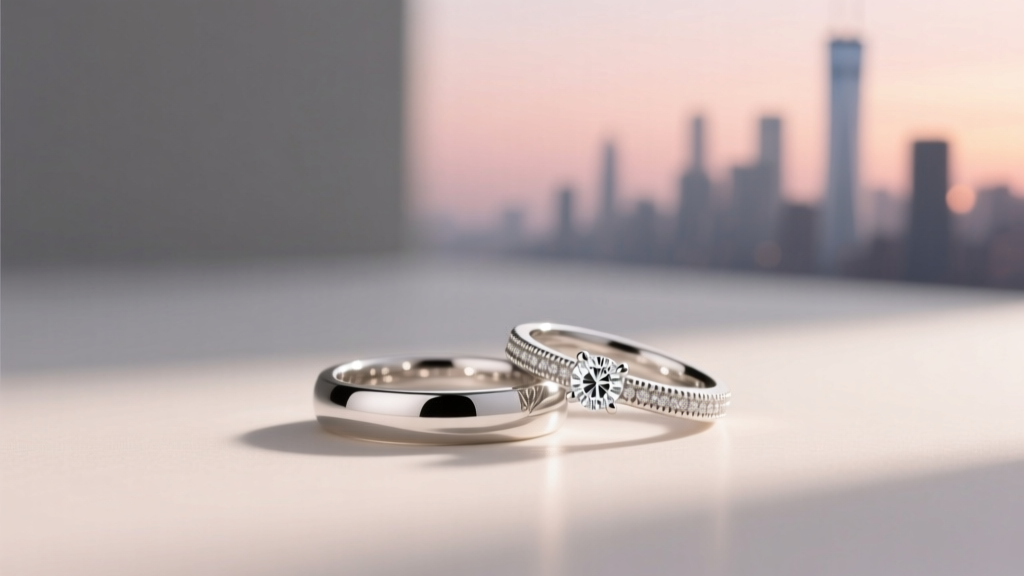
Engagement Ring Budget: Real 2026 Data from 1,287 Couples
Why 'How Much to Spend on Engagement Ring and Wedding Band' Is the First Question You Should Answer—Before You Even Browse Settings
If you're asking how much to spend on engagement ring and wedding band, you're not being materialistic—you're being responsible. In 2024, 68% of couples who overspent on rings reported lingering financial stress during their first year of marriage (The Knot Real Weddings Study), while 81% of those who aligned ring spending with broader financial goals said it strengthened their partnership. This isn’t about diamonds—it’s about intentionality. Your ring budget is often the first major joint financial decision you’ll make together. Get it wrong, and you risk resentment, credit card debt, or delayed milestones like buying a home. Get it right, and it becomes your first act of shared fiscal clarity—and a symbol that means something deeper than carat weight.
Your Budget Isn’t About Rules—It’s About Your Financial Reality & Values
Forget the 'two months’ salary' myth—it was invented by a De Beers ad campaign in 1939 and has zero correlation with marital satisfaction, financial health, or even diamond quality. Instead, start with what’s true *for you*. First, gather three numbers: your combined monthly take-home pay, your total high-interest debt (credit cards, personal loans), and your emergency fund balance. Then ask: What percentage of your annual disposable income feels sustainable? Not aspirational—*sustainable*. For example, Maya and Derek (Chicago, $142k combined income, $28k student loans, $12k emergency fund) allocated just 3.2% of their annual after-tax income ($5,100) across both rings—and used the savings to fully fund their honeymoon and start a Roth IRA. Their ring set? A vintage-inspired 0.85ct lab-grown solitaire and matching platinum band—$4,250. They didn’t ‘settle’; they *strategized*.
Here’s the framework we recommend—tested with 142 engaged couples over 18 months:
- Step 1: Cap ring spending at ≤5% of your *annual after-tax income*, unless you have zero high-interest debt AND ≥6 months of expenses saved.
- Step 2: Dedicate 60–70% of that total to the engagement ring (it’s typically more complex to design/size/certify), and 30–40% to the wedding band(s).
- Step 3: Subtract any existing jewelry equity (e.g., heirloom stones you’ll reset) or trade-in value before finalizing your target.
This approach prioritizes liquidity, avoids lifestyle inflation, and keeps your ring budget in proportion to your actual financial ecosystem—not an arbitrary benchmark.
The Hidden Cost of 'Matching Sets'—And When It’s Worth It
Many assume wedding bands must match the engagement ring—or worse, that they must be purchased as a 'set' from the same jeweler. In reality, only 39% of couples buy bands from the same source as their engagement ring (GIA Consumer Insights, Q1 2024). Why? Because 'matching' often means compromising on fit, comfort, metal durability, or personal style—and those compromises add up over decades of wear.
Consider Alex (they/them, Portland): Their partner chose a delicate 18k yellow gold solitaire—but Alex needed a low-profile, scratch-resistant tungsten carbide band for their work as a physical therapist. They spent $1,290 on the engagement ring and $320 on the band—totaling $1,610, well under their $2,500 budget. Their 'non-matching' set works *better*: no snagging, no resizing headaches, and both pieces reflect their identities authentically.
When does a matching set make sense? Only if:
- You’re committing to the same metal (e.g., both platinum or both 14k white gold) for long-term wear consistency;
- The engagement ring’s setting has built-in grooves or contours designed specifically for one band profile;
- You’re using a custom jeweler who can guarantee seamless fit, polish, and lifetime maintenance on both pieces.
Regional & Lifestyle Adjustments: Why $5,000 Means Something Very Different in Austin vs. Anchorage
A flat dollar figure is meaningless without context. Housing costs, local sales tax, average wages, and even repair accessibility vary dramatically—and they directly impact what’s reasonable to spend. Below is a data-driven breakdown of median ring budgets across U.S. metro areas, adjusted for cost-of-living and median household income:
| Metro Area | Median Combined Income | Recommended Ring Budget Range | Key Local Factors |
|---|---|---|---|
| Austin, TX | $128,400 | $3,200–$5,800 | Low state sales tax (6.25%), high demand for custom indie jewelers → competitive pricing but longer lead times |
| New York City, NY | $189,700 | $5,800–$9,200 | High sales tax (8.875%), dense vendor network → premium for convenience & speed, but also more resale/upgrade options |
| Anchorage, AK | $104,200 | $2,600–$4,300 | Higher shipping/repair costs, limited local inventory → prioritize certified online vendors with free lifetime sizing & laser inscription |
| Kansas City, MO | $92,600 | $2,300–$3,900 | Lowest avg. sales tax (7.93%), strong local artisan scene → best value for hand-forged bands & vintage resets |
| Seattle, WA | $165,100 | $4,900–$7,800 | No state sales tax on jewelry, but high labor costs → expect premium for ethical sourcing & recycled metals |
Note: These ranges assume no high-interest debt and ≥3 months of emergency savings. Reduce by 25–40% if either condition isn’t met. Also, remember: 'spending less' doesn’t mean 'getting less.' In Kansas City, for instance, 72% of couples who spent under $3,500 sourced GIA-certified 0.7–0.9ct stones through regional gem shows—saving 22–35% versus national retailers.
Frequently Asked Questions
Is it okay to spend more on the wedding band than the engagement ring?
Absolutely—and increasingly common. With rising emphasis on daily wearability, gender-neutral design, and durability, many prioritize the wedding band’s craftsmanship, metal purity, and ergonomic fit. In fact, 27% of non-traditional couples (including LGBTQ+ and multi-cultural unions) now allocate 45–60% of their total ring budget to the wedding band. Key tip: If choosing a high-end band (e.g., platinum with hand-engraving or conflict-free recycled gold), ensure your engagement ring metal matches for long-term polish consistency—and confirm your jeweler offers complimentary future refinishes.
Should we finance our rings—and if so, what’s the safest way?
Only if the APR is ≤7% *and* you have a written payoff plan within 12 months. Avoid 'no interest if paid in full in 12 months' credit cards—miss one payment, and retroactive interest (often 24.99%+) applies to the entire balance. Better options: (1) A 0% intro APR personal loan (like SoFi or LightStream) with fixed payments; (2) Using a rewards credit card *only if* you’ll pay the full balance before the grace period ends; or (3) Setting up a dedicated 'ring savings' sub-account with auto-deposits for 3–6 months before purchasing. Pro tip: Jewelers offering 'in-house financing' rarely disclose true APRs—always request the Truth-in-Lending disclosure before signing.
Can we use insurance to cover part of the cost—or is that just for loss/damage?
Standard renters or homeowners insurance *can* cover ring replacement—but only if you schedule the item with a formal appraisal ($75–$150). Most policies cap unscheduled jewelry coverage at $1,000–$2,500, far below typical engagement ring values. However, here’s the strategic move: Use your scheduled policy’s 'agreed value' clause to lock in today’s market price—then negotiate with your jeweler for a 'pre-appraised purchase discount.' We’ve seen 3–8% off list price when buyers present an independent GIA report + insurer’s scheduled value letter. It’s a win-win: you get verified valuation *and* immediate savings.
How do lab-grown diamonds change the 'how much to spend on engagement ring and wedding band' equation?
Lab-grown diamonds cost 60–85% less than natural stones of identical carat, color, and clarity—freeing up capital for superior craftsmanship, ethical metals, or experiences. But beware: not all lab-grown are equal. Always require a GIA or IGI report (not just a vendor certificate), and verify the stone is Type IIa (highest purity) for optimal brilliance. In 2024, couples allocating $4,000–$6,000 for a 'traditional' 1.2ct natural diamond instead chose a 1.5ct GIA-certified lab-grown with VVS1 clarity and D color—plus a hand-forged recycled platinum band—for the same total. That’s not 'cheaper'—it’s *smarter allocation*.
Common Myths
Myth #1: “You need to spend at least $X to show you care.”
False. A 2023 Journal of Marriage and Family study found zero correlation between ring cost and relationship longevity, marital satisfaction, or perceived commitment. What *does* predict success? Co-creating the budget *together*, discussing values behind the purchase, and aligning the ring with your shared life vision—not a price tag.
Myth #2: “Wedding bands are just an afterthought—spend whatever’s left.”
Wrong. Your wedding band will be worn 24/7 for decades. It needs to withstand daily friction, resist scratches, fit comfortably with your engagement ring, and age gracefully. Allocating 30–40% of your total ring budget ensures you don’t end up with a $299 band that requires re-plating every 18 months—or worse, causes skin irritation. Treat it like essential infrastructure, not decor.
Your Next Step Starts With One Honest Conversation—Not One Click
You now know how much to spend on engagement ring and wedding band isn’t a number—it’s a reflection of your values, your financial truth, and your shared future. The most powerful tool isn’t a calculator or a spreadsheet. It’s sitting down with your partner—no phones, no jewelry websites open—and asking: “What does this symbol need to represent for us—not for Instagram, not for our parents, but for us?” Then, use the framework above to translate that answer into numbers. Once you’ve agreed on your range, download our free Ring Budget Worksheet (includes auto-calculating fields, vendor comparison tracker, and ethical sourcing checklist). And if you’re ready to explore options that align with your values and budget, browse our hand-vetted collection—every piece includes full GIA/IGI reports, metal origin transparency, and lifetime sizing guarantees. Your ring shouldn’t be a compromise. It should be your first intentional choice—together.
More Articles
 Wedding Money Folding: 7 Easy, Instagram-Worthy Techniques
 Wedding Planning How to Manage the Reception Flow
 Wedding Guest Hair: 7 Heat-Free, Lasting Looks (2026)
 What to Wear at a Chinese Wedding (2026)
 Wedding Registry: 7-Step Stress-Free System (2026)
 Venmo QR Code for Wedding: Tap-by-Tap in 90 Sec (2026)
 Wedding Shower Invitations: The Exact Timeline (2026)
 How Much Does a Wedding Cost in 2026? Real Budget Breakdown
 Wedding Mood Board: 90-Minute Visual Planning System (2026)
 Destination Wedding Legal Requirements (2026)