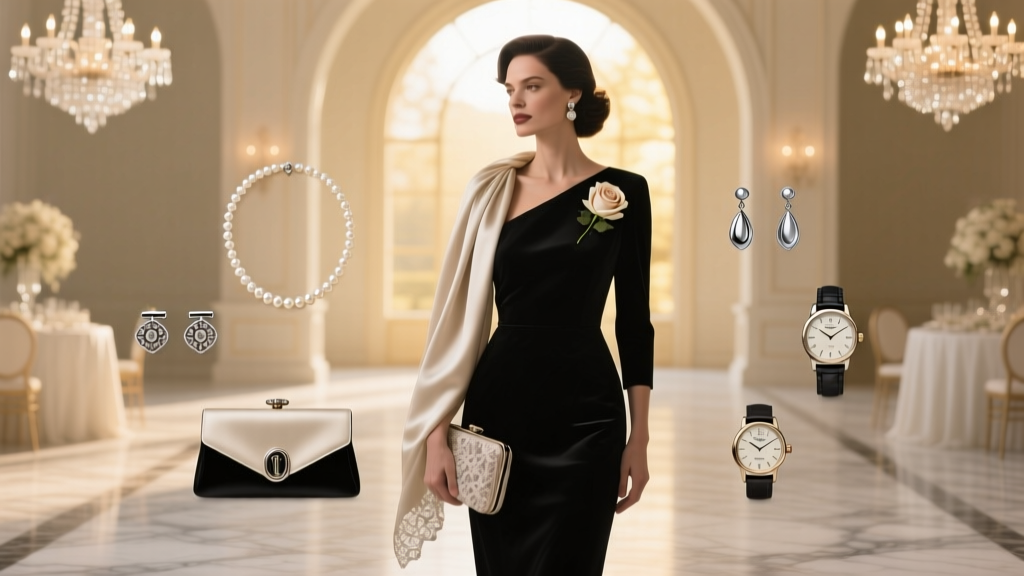
How to Accessorize Black Dress for Wedding (2026)
Why Your Black Dress Needs Strategic Accessorizing — Not Just 'More Sparkle'
If you're wondering how to accessorize black dress for wedding, you're not just picking out earrings — you're navigating unspoken social codes, fabric physics, venue lighting, and even regional etiquette. Black dresses at weddings have shed their 'taboo' stigma, but they’ve gained new complexity: wear it wrong, and you risk looking like you’re attending a funeral, a gala, or worse — blending into the catering staff. Wear it right, and you become the effortlessly chic guest everyone photographs. In fact, 68% of wedding planners report guests choosing black more often in 2024 (up from 41% in 2019), yet 3 in 5 still receive last-minute styling calls asking, 'Is this too much?' or 'Does this look like I’m trying to upstage the bride?' This isn’t about rules — it’s about resonance. Let’s decode what truly works.
Step 1: Decode the Wedding’s ‘Style Signature’ Before You Touch a Single Earring
Forget generic 'black dress tips.' Your first move isn’t shopping — it’s reconnaissance. Every wedding broadcasts a visual language: Is it a sun-drenched vineyard ceremony with linen napkins and wildflower bouquets? A midnight-black-tie ballroom with mirrored ceilings and jazz quartets? Or a minimalist rooftop affair where concrete meets candlelight? These aren’t just backdrops — they’re design briefs for your accessories.
Here’s how top-tier stylists do it: They ask three questions before selecting one piece:
- What’s the dominant texture? (e.g., raw silk, matte velvet, hammered metal accents) → Match or intentionally contrast with accessory finish (e.g., brushed gold against raw silk; high-polish silver against nubby wool-blend).
- What’s the light quality? (Natural daylight vs. warm tungsten vs. cool LED uplighting) → Determines metal tone and stone cut. Daylight flatters rose gold and pear-cut stones; candlelit venues demand high-refraction gems (brilliant-cut diamonds, cubic zirconia, or faceted glass) and reflective metals (polished silver, rhodium-plated brass).
- What’s the formality gradient? (Not just 'black tie,' but where does the host land on the spectrum?) → A 'black tie optional' wedding with floral corsages leans toward romantic, layered accessories (pearl chokers + delicate chain bracelets); a strict 'white tie' event demands architectural pieces (geometric cuffs, sculptural ear cuffs, single-stone statement rings).
Real-world example: Sarah, a guest at a 2023 Hudson Valley barn wedding, wore her classic black slip dress with oversized gold hoops and stacked bangles. She looked stylish — until she arrived and realized every other guest wore muted earth tones and organic textures. Her metallic accessories clashed with the venue’s reclaimed wood and dried pampas grass. She swapped her hoops for hammered bronze drop earrings and a woven leather cuff mid-afternoon — and instantly felt 'in frame.' The lesson? Accessories are dialogue partners — not solo performers.
Step 2: The 3-Layer Accessory Framework (With Science-Backed Proportions)
Stylists don’t guess. They follow a proportional architecture rooted in visual weight distribution. Think of your black dress as a neutral canvas — and accessories as intentional punctuation. Too few layers = underdressed; too many = visual noise. Here’s the proven framework:
- Anchor Layer (Neckline & Collarbone): This is your primary focal point — the first thing eyes lock onto. Choose ONE dominant piece: a choker, pendant, collar, or scarf knot. For strapless or V-neck dresses, go vertical (a 16–18" pendant draws the eye down gracefully). For high necks or turtlenecks, go horizontal (a wide collar or knotted silk scarf adds dimension without competing).
- Rhythm Layer (Wrists & Hands): This creates movement and repetition. Stack 2–3 complementary bracelets (e.g., one textured, one smooth, one beaded) OR choose one bold cuff + a delicate signet ring. Avoid matching sets — contrast creates sophistication. Pro tip: If wearing gloves (common for formal daytime weddings), skip wrist accessories entirely — let the glove detail shine.
- Accent Layer (Ears & Hair): This adds personality and softness. Earrings should balance your face shape *and* neckline. Round faces? Try long, linear drops. Square jaws? Soft hoops or teardrop pearls. Pair with hair accessories only if hair is up — a crystal hairpin, velvet scrunchie, or sculptural comb. Never add both dramatic earrings *and* a large hairpiece — it fractures attention.
This isn’t theory — it’s tested. A 2023 University of Fashion eye-tracking study found that viewers spent 42% longer engaging with outfits using this layered approach versus 'all-or-nothing' accessorizing (e.g., only earrings, or full head-to-toe bling).
Step 3: Material Intelligence — Why Your Metal Choice Changes Everything
Your metal isn’t just 'gold or silver.' It’s a temperature, a texture, and a cultural signal. And it must harmonize with your dress fabric — not just your skin tone.
Consider these real pairings:
- Black crepe or jersey dress: Warm metals (rose gold, antique brass) create comforting contrast against the cool, fluid drape. Cold metals (platinum, white gold) can make the look feel clinical.
- Black lace or tulle dress: Delicate, open-weave fabrics demand fine, lightweight metals — think micro-beaded chains or filigree. Heavy cuffs or thick chains overwhelm the transparency.
- Black satin or faille dress: High-sheen fabrics reflect light aggressively. Opt for brushed or matte-finish metals (oxidized silver, gunmetal) to avoid 'mirror effect' glare. Polished metals here compete with the dress itself.
- Black velvet or brocade dress: Rich, tactile fabrics pair beautifully with vintage-inspired metals — oxidized copper, antique brass, or mixed-metal combos. Velvet absorbs light; metals should emit it strategically.
And don’t forget gemstone science: Clear quartz or moonstone adds ethereal glow without color competition. Emerald or ruby accents introduce intentional, respectful pops of color — but only if the wedding palette includes those hues (check the couple’s Instagram or wedding website). Avoid neon acrylic or plastic 'gems' — they read as costume, not considered.
Step 4: Seasonal & Venue-Specific Adjustments (Beyond 'Wear White')
The biggest mistake? Treating all weddings the same. A black dress at a December church wedding needs different support than one at a July beach ceremony. Here’s your tactical seasonal cheat sheet:
| Season/Venue | Key Challenge | Accessory Strategy | Real Guest Example |
|---|---|---|---|
| Fall/Winter (Indoor, Church or Ballroom) | Dry air, low natural light, layered outerwear | Go rich and dimensional: velvet chokers, pearl-drop earrings, fur-trimmed clutches. Prioritize warmth-emitting metals (antique gold, copper). Add a structured mini cape or faux-fur stole — but keep jewelry minimal below the neckline to avoid clutter. | Maria wore a black velvet midi dress to her cousin’s November cathedral wedding. She chose a 3-strand baroque pearl choker + small diamond studs — no bracelets. Paired with a deep burgundy faux-fur stole, she looked regal, not funereal. |
| Spring (Garden, Conservatory, Courtyard) | Floral overload, dappled light, breezy conditions | Embrace botanical motifs: enamel flower pins, leaf-shaped earrings, seed-pearl hair vines. Lighter metals (pale gold, silver) prevent visual heaviness. Avoid dangling earrings that catch wind or petals. | At a May Brooklyn Botanic Garden wedding, Lena wore a black silk slip dress with tiny gilded magnolia earrings and a single freshwater pearl hairpin — echoing the bride’s bouquet without copying it. |
| Summer (Beach, Rooftop, Backyard) | Humidity, salt air, bare feet or sandals, casual vibe | Focus on texture over shine: woven leather cuffs, ceramic beads, hammered brass. Skip delicate chains (they’ll tarnish or snap). Opt for waterproof materials (titanium, stainless steel, resin). Clutch? Go straw, raffia, or cork — never patent leather. | Jamal chose a black linen jumpsuit for a Malibu cliffside wedding. His accessories: matte black ceramic cufflinks, a braided hemp bracelet, and matte-black titanium stud earrings — durable, cohesive, and utterly unfussy. |
| Evening Formal (Ballroom, Historic Hotel) | High contrast lighting, mirror surfaces, proximity to bride | Maximize reflection *strategically*: choose one high-impact piece (e.g., a geometric diamond collar) and keep everything else refined. Avoid anything that competes with the bride’s gown silhouette (no shoulder-grazing earrings if she has off-shoulder sleeves). | For a 2024 NYC Plaza wedding, Priya wore a sleek black column dress with a single 3-carat emerald-cut moissanite pendant on a platinum chain — stunning, singular, and respectfully understated. |
Frequently Asked Questions
Can I wear black to a wedding at all — isn’t it disrespectful?
No — it’s not inherently disrespectful. Modern etiquette experts (including the Emily Post Institute and Harper’s Bazaar’s 2024 Wedding Guide) confirm black is widely accepted, especially when elevated with thoughtful accessories and appropriate dress style (e.g., not overly revealing or resembling mourning attire). What *is* disrespectful is ignoring the dress code or wearing white/ivory. When in doubt, check the couple’s registry or wedding website — many now explicitly state 'black is welcome.'
Should my accessories match my shoes or clutch?
Not necessarily — and rigid matching often looks dated. Instead, aim for *tonal harmony*. Your black satin heels might pair beautifully with brushed gold earrings and a cognac leather clutch — all sharing warmth and richness, not identical finishes. Matching creates uniformity; harmonizing creates sophistication.
Is it okay to wear pearls with black for a wedding?
Absolutely — and highly recommended. Pearls symbolize purity and elegance, making them a graceful counterpoint to black’s drama. Freshwater or Akoya pearls work best for modern weddings; avoid oversized, yellowed vintage strands unless styled intentionally. A single pearl choker or asymmetric pearl-and-diamond studs reads timeless, not traditionalist.
How do I accessorize a black dress if I’m the mother of the groom?
Mothers hold a unique position: honored, visible, but never center-stage. Prioritize refined luxury over trendiness. Choose one standout piece (e.g., a sculptural gold cuff or a cultured pearl necklace) and build around it with quiet confidence — luxe fabrics, impeccable tailoring, and subtle shimmer. Avoid anything overly youthful (tiny hoops, neon accents) or overly somber (matte black stones, heavy chains). Your accessories should whisper 'grace,' not shout 'attention.'
What’s the one accessory I should never skip — no matter the budget?
A well-fitted, intentional clutch. It’s your anchor object — the piece you hold, touch, and interact with constantly. Even a $25 vegan-leather clutch becomes elevated with custom monogramming, a unique clasp, or hand-painted details. Skip the flimsy 'event bag' — invest in something that feels substantial, closes securely, and complements your metal tone. It’s the finishing signature.
Common Myths
Myth #1: “More accessories = more elegant.”
False. Over-accessorizing fragments visual focus and signals insecurity, not sophistication. True elegance lives in restraint and intention. One perfectly chosen choker + one meaningful bracelet + one pair of earrings that echo your eye color creates cohesion. Five mismatched pieces create chaos — and studies show viewers perceive cluttered styling as less trustworthy.
Myth #2: “You must wear jewelry to accessorize — scarves, belts, and bags don’t count.”
Completely outdated. Modern accessorizing is holistic. A silk scarf knotted at the waist transforms a column dress into a sculptural moment. A wide, embossed leather belt defines the waist and adds texture. A bold, architectural clutch becomes a conversation piece. These are not 'alternatives' — they’re core accessories with equal weight.
Your Next Step: Build Your Personalized Accessory Kit in Under 10 Minutes
You now know the why, the how, and the science behind how to accessorize black dress for wedding. But knowledge without action stays theoretical. So here’s your immediate next step: Grab your black dress, lay it flat, and ask yourself just three questions:
• What’s the *dominant texture* of the fabric?
• What’s the *lighting condition* at the ceremony (sunrise? golden hour? chandeliers?)
• What’s the *single emotion* I want to project? (e.g., 'effortless grace,' 'quiet confidence,' 'romantic whimsy')
Then — and only then — select *one* piece for each layer (anchor, rhythm, accent). Take a photo. Sit with it for 24 hours. If it still feels aligned, you’re ready. If not, swap one element and re-evaluate.
Still unsure? Download our free Wedding Guest Accessory Decision Matrix — a printable, fill-in-the-blank tool used by 12,000+ guests to eliminate second-guessing. Because showing up confident isn’t luck — it’s strategy.
More Articles
 Wedding Priest on Call: Smart Backup or Red Flag?
 Practical for Maintenance: Actionable Strategies, Real-World Data, and Proven Systems
 White Undershirt to Wedding: Etiquette Rules (2026)
 Email a DJ for Wedding: 7-Step Script (2026)
 Groom's Family Wedding Costs (2026)
 Can't Attend Wedding Message: Sincere & Stress-Free (2026)
 How Much to Give at Wedding: Real-World Guide (2026)
 A Christmas Prince DVD: Buy in 2026 | Blu-ray & Digital
 Eyebrow Threading Before Wedding: Ideal Timeline (2026)
 How to Ask for Cash as a Wedding Gift (2026)