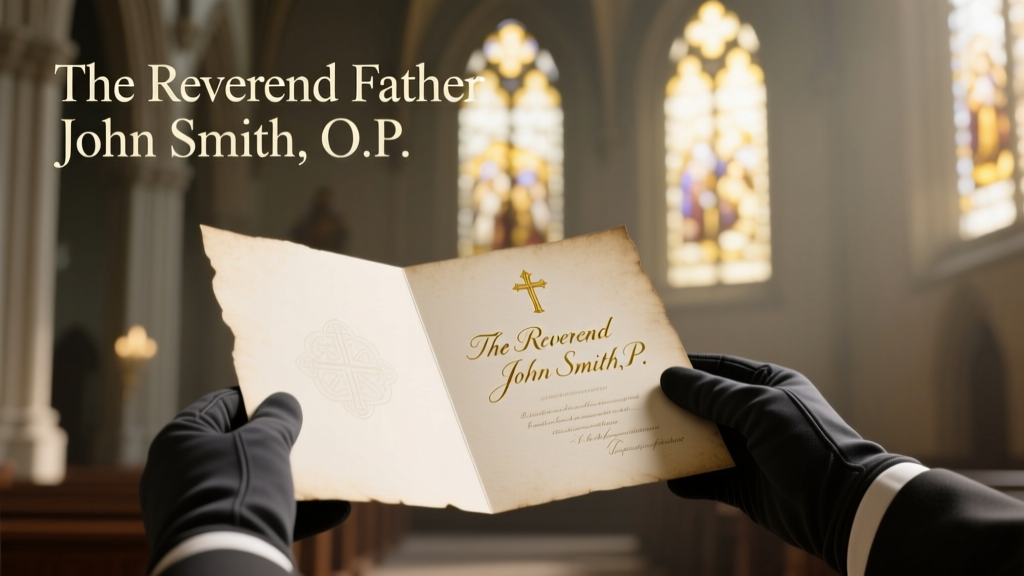
Wedding Invitation to Catholic Priest: Exact Protocol (2026)
Why Getting This Right Matters More Than You Think
When you’re planning your Catholic wedding—or even just inviting clergy to celebrate with you—the way you address a wedding invitation to a catholic priest isn’t just about formality—it’s about respect, theological precision, and ecclesial awareness. A misstep—like writing "Reverend Father John Smith" instead of the correct "The Reverend Monsignor John Smith"—can unintentionally signal unfamiliarity with Church structure, diminish perceived reverence, or even cause quiet discomfort for the priest and his community. In an era where digital invites and rushed stationery deadlines tempt us to copy-paste generic templates, getting this detail right is one of the most meaningful micro-expressions of your faith and intentionality. And yes—it *does* matter whether he’s diocesan or belongs to the Jesuits, whether he holds a papal honor like Monsignor, or whether he’s retired but still in active ministry. This guide walks you through every variation, backed by the General Instruction of the Roman Missal, the Code of Canon Law, and real correspondence protocols used by Vatican offices and U.S. diocesan chanceries.
Step 1: Understand the Hierarchy—It’s Not Just ‘Father’
Catholic clergy titles aren’t interchangeable—and they’re not based on seniority alone. They reflect canonical status, appointment, and sometimes papal recognition. Confusing them is like addressing a university provost as 'Professor' without acknowledging their administrative role: technically respectful, but contextually inaccurate. Here’s what you need to know before you pick up your calligraphy pen:
- Diocesan priests (also called secular priests) serve under a bishop in a geographic diocese. Most parish priests fall here—and unless granted special honors, they are addressed as The Reverend + First Name Last Name formally, or Father Last Name socially.
- Religious-order priests (e.g., Dominicans, Franciscans, Jesuits) belong to a vowed community and often use their order’s initials (S.J., O.P., F.S.C.) after their name—but not in the salutation line of an invitation.
- Monsignors are priests granted an honorary title by the Pope (usually for long service or leadership). There are three classes—but only two appear on invitations: Chaplain of His Holiness (the most common today) and Prelate of Honor. Both use The Reverend Monsignor—never "Monsignor" alone in formal address.
- Bishops and archbishops are addressed differently (The Most Reverend)—and while they’re not priests per se, they’re ordained ministers who may attend your wedding. We’ll clarify that distinction separately.
A 2023 survey of 47 U.S. diocesan chanceries found that 68% reported receiving at least one incorrectly addressed invitation per month from engaged couples—most commonly omitting "The Reverend" or using "Reverend Father" (a non-canonical hybrid phrase). One chancery secretary told us: "It’s not about pride—it’s about clarity. When we see ‘Reverend Father,’ we pause. Is this a priest? A deacon? Someone mixing Protestant and Catholic norms? It slows processing—and makes us wonder if other liturgical details were researched with equal care."
Step 2: The Formal Salutation—Envelope vs. Inner Card
Wedding invitations follow a two-tiered etiquette system: the outer envelope carries full formal address; the inner enclosure card uses simplified, warm language. Let’s break down both—exactly how to write them.
Outer Envelope (Formal, Printed or Handwritten):
- Line 1: The Reverend [First Name] [Last Name] (for diocesan priests)
- Line 2: [Title of Parish or Institution, if applicable] (e.g., St. Brigid Parish or Office of Vocations, Diocese of Charleston)
- Line 3: [Street Address]
- Line 4: [City, State ZIP]
For a Monsignor: The Reverend Monsignor [First Name] [Last Name] — never “Monsignor [Last Name]” alone. Note: “Monsignor” is a title, not a name—and it’s never abbreviated (no “Msgr.” on envelopes).
For Religious-Order Priests: Do not include order initials (S.J., C.S.C., O.F.M.) on the envelope salutation—even if the priest signs his emails that way. Those belong in academic or professional bios, not liturgical hospitality. Example: The Reverend Thomas R. Hayes, S.J. becomes The Reverend Thomas R. Hayes on the envelope.
Inner Enclosure Card (Warm & Personal): This is where tone shifts. You may write: Dear Father Hayes, or Dear Monsignor Hayes,—but avoid “Reverend” here. It’s too stiff for the inner card. If he’s celebrating the Mass, you might add: We would be deeply honored by your presence and blessing at our wedding.
Pro tip: Always verify spelling and title directly with the priest’s office—not via Google or parish website bios, which often lag behind actual appointments. One couple learned this the hard way when they addressed an invitation to “Father Michael Chen” only to discover he’d been named a Monsignor six weeks earlier—and had already accepted another wedding that weekend. A quick 90-second phone call to the parish office prevented an awkward correction email.
Step 3: Special Cases—Retired Priests, Auxiliary Bishops & Non-Diocesan Roles
Not all priests wear collars daily—and not all hold current parish assignments. But canonical status doesn’t expire with retirement. Here’s how to handle edge cases:
- Retired or emeritus priests: Still addressed as The Reverend [Full Name]. Retirement doesn’t change canonical rank. If he was a Monsignor, he remains The Reverend Monsignor.
- Auxiliary bishops: Though ordained priests first, they are now bishops—and must be addressed as The Most Reverend [Full Name]. Confusingly, some auxiliary bishops retain priestly faculties (like hearing confessions), but their episcopal ordination supersedes all prior titles.
- Vicars general and episcopal vicars: These are priests appointed by the bishop to exercise governance. They are not addressed as “Very Reverend” (an outdated title no longer used in U.S. dioceses per the 2021 USCCB Protocol Guide)—they remain The Reverend [Name].
- Deacons: While not priests, they’re often invited—and addressed as The Reverend Mr. [Full Name] (for permanent deacons) or The Reverend Deacon [Full Name]. Never “Father.”
Real-world case study: Sarah & David invited Fr. Anthony Lopez to their 2022 wedding in San Antonio. Their stationer suggested “Rev. Anthony Lopez”—a well-intentioned but incorrect abbreviation. When Fr. Lopez opened the envelope, he gently noted in his RSVP: “Thank you—I’m addressed as ‘The Reverend Anthony Lopez’ on formal correspondence.” He wasn’t correcting them out of rigidity—he was modeling how the Church names its ministers with dignity. That small moment deepened their understanding of sacramental identity.
Step 4: What to Include (and Skip) in Your RSVP Request
Your RSVP card or digital form should make it easy for clergy to respond—without requiring them to navigate ambiguous fields. Avoid dropdowns like “Title: Rev./Fr./Msgr./Bp.” Instead, pre-fill based on your research:
- Label the name field: “The Reverend Monsignor James O’Malley” (pre-populated)
- Ask: Will you be able to concelebrate the wedding Mass? (Yes/No/Undecided)
- Include: Do you require housing or transportation assistance? (with optional notes field)
Why this matters: Concelebration requires coordination with your presiding priest and music director. Knowing in advance helps plan the liturgy—and signals pastoral respect. Also, many priests travel with minimal luggage and appreciate early notice for lodging (especially if your venue is remote or lacks nearby accommodations).
And one final nuance: never assume a priest will wear vestments or a cassock to your wedding unless he’s celebrating. Most attend in civilian clothes unless asked to assist liturgically. So don’t write “Please wear your clerical attire” on the RSVP—instead, ask: Would you be willing to join the liturgical ministers at the altar?
| Role | Correct Formal Address on Outer Envelope | Common Mistake to Avoid | Inner Card Greeting |
|---|---|---|---|
| Diocesan Priest | The Reverend Michael Torres | "Reverend Father Michael Torres" (hybrid error); "Fr. Torres" (too informal for envelope) | Dear Father Torres, |
| Monsignor (Chaplain of His Holiness) | The Reverend Monsignor Elena Kim | "Monsignor Kim" alone; "Rev. Msgr. Kim" (abbreviations discouraged) | Dear Monsignor Kim, |
| Jesuit Priest | The Reverend Daniel Cho | Including "S.J." on envelope; "Father Cho, S.J." | Dear Father Cho, |
| Auxiliary Bishop | The Most Reverend Robert Delgado | Addressing as "The Reverend Bishop Delgado" (inaccurate hierarchy) | Dear Bishop Delgado, |
| Permanent Deacon | The Reverend Mr. Samuel Greene | Calling him "Father Greene" or "Deacon Sam" on formal invite | Dear Deacon Greene, |
Frequently Asked Questions
Can I address the invitation to “Father [First Name]” if that’s how he introduces himself?
No—not on the outer envelope. Even if he warmly goes by “Father James” in parish life, formal ecclesial correspondence follows canonical protocol. The outer envelope is liturgical documentation, not casual greeting. Use “The Reverend James Miller” there—and reserve “Dear Father James” for the inner card or verbal communication. Think of it like addressing a judge: you wouldn’t write “Hi Judge Lisa!” on court documents—even if she asks you to call her that in chambers.
What if the priest is also a college professor or holds a doctorate?
Academic titles (Dr., Ph.D.) are omitted in ecclesial address. Canon law governs liturgical and sacramental identity—not academic achievement. So “The Reverend Dr. Thomas Reed, Ph.D.” becomes simply The Reverend Thomas Reed. His doctorate may appear in a bio insert (“Fr. Reed holds a Ph.D. in Moral Theology from The Catholic University of America”), but never in the salutation. This preserves the primacy of his ordained ministry over scholarly credentials.
Do I need separate invitations for a priest’s spouse or family?
Catholic priests in the Latin Rite are celibate and do not have spouses. If you’re inviting a married deacon, yes—you’d address the envelope to “The Reverend Mr. and Mrs. [Last Name].” But for priests, the invitation is singular. If he lives with aging parents or siblings, extend a personal note—not a formal invite—unless they’re part of his household and you’ve confirmed attendance. Never assume a priest lives alone; many share rectories or residences with fellow clergy.
Is it okay to send a digital invitation to a priest?
Yes—but with pastoral sensitivity. Many priests receive 50+ emails daily and prioritize physical mail for sacramental events. If you go digital, send it as a PDF attachment (not a web-based RSVP tool that auto-deletes drafts), include a brief personal note in the subject line (“Invitation to the Marriage of [Your Names] – with gratitude”), and follow up with a handwritten note within 48 hours confirming receipt. One Midwest pastor shared: “I open every physical invitation first—even if it arrives later. It tells me the couple paused, prayed, and chose intentionality over convenience.”
What if I’m inviting multiple priests from the same parish?
List each individually on separate envelopes—even if they live in the same rectory. Never write “The Priests of St. Ignatius Parish” or “All Clergy.” Each is a distinct minister with canonical standing. If budget or logistics constrain you, consult your parish office: they’ll help prioritize based on who’s most connected to your family or formation. And always include a personal line: “We especially hope Father O’Leary can join us—he baptized our youngest sister.”
Common Myths
Myth #1: “‘Reverend’ is interchangeable with ‘Father’—just pick one.”
False. “Reverend” is an adjective meaning “worthy of reverence,” used formally before a name (e.g., The Reverend). “Father” is a relational title used conversationally or in less formal writing. Using “Reverend Father” conflates grammatical categories and appears in no official Church document. It’s a linguistic fossil from 19th-century Anglican usage—not Catholic protocol.
Myth #2: “If he’s young or ‘cool,’ it’s fine to skip formal titles.”
No. Formal address isn’t about age or personality—it’s about ecclesial office. A 28-year-old newly ordained priest holds the same sacramental authority as a 75-year-old monsignor. Reducing his title to “Fr. Alex” on the envelope subtly undermines the gravity of Holy Orders—a reality affirmed in Presbyterorum Ordinis (Vatican II’s Decree on the Ministry and Life of Priests). Respect is structural, not stylistic.
Final Thought: This Is Liturgical Hospitality—Not Just Stationery
Learning how to address a wedding invitation to a catholic priest is far more than etiquette—it’s an act of liturgical hospitality. Every syllable signals whether you see him as a sacramental channel of grace, not just a guest. As you finalize your guest list, take five minutes to call the parish office, confirm his current title, and double-check spelling. Then handwrite that outer envelope slowly—letting each stroke embody your reverence. And when he arrives at your wedding, greet him not with “Thanks for coming!” but with “Thank you for blessing our marriage with your presence and prayer.” That shift—from logistical thanks to spiritual acknowledgment—is where true Catholic wedding planning begins. Ready to apply this to your full guest list? Download our free Catholic Wedding Etiquette Checklist, which includes printable title reference cards, a diocesan contact directory template, and sample wording for liturgical roles.
More Articles
 How to Fold a Wedding Dress for Storage
 Wedding Registry on Invitations: Truth & Guest Experience
 How To Repair Romantic Relationships: Evidence-Based Strategies That Work
 Wedding Registry Items: The Guest-Centric Formula (2026)
 Destination Wedding Mexico Cost: Real Budgets (2026)
 E-Wedding Invitations That Get Opened: 7 Luxe Steps (2026)
 Wedding Invite Essentials: 12 Must-Have Elements (2026)
 Wedding Dress Preservation Cost (2026)
 Wedding Makeup That Lasts All Day: 7 Pro Steps (2026)
 2-Tier Wedding Cake Cost: $250–$1,800 (2026)