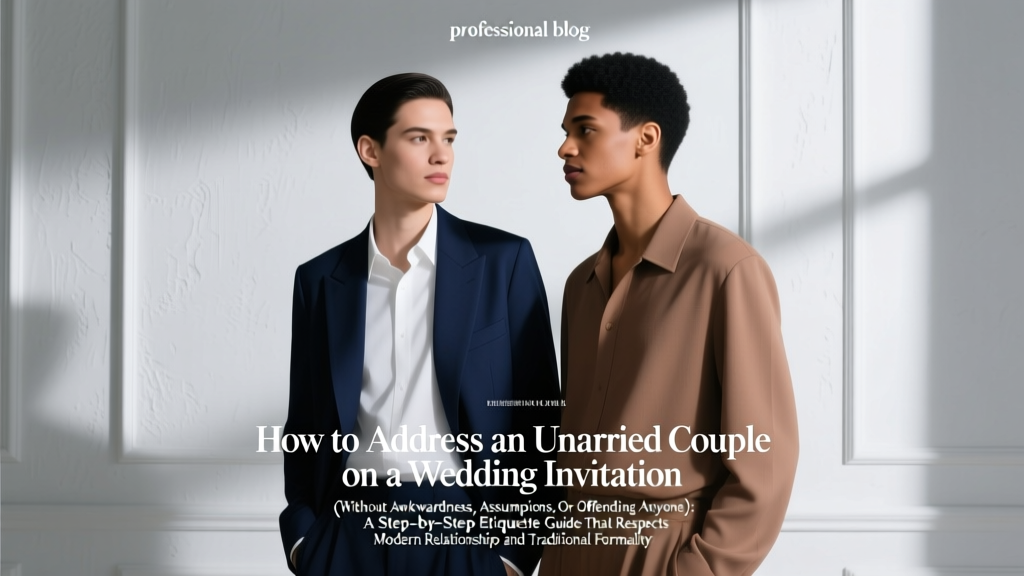
Wedding Invitation Addressing: Unmarried Couples (2026)
Why Getting This Right Matters More Than Ever
How to address an unmarried couple on a wedding invitation isn’t just about grammar or stationery—it’s a quiet but powerful act of inclusion, respect, and intentionality. In 2024, over 72% of U.S. couples live together before marriage (Pew Research), and nearly 1 in 5 wedding guests identify as LGBTQ+, nonbinary, or part of a chosen family structure. Yet outdated etiquette guides still default to ‘Mr. and Mrs.’ or assume shared surnames—leaving hosts anxious, guests misaddressed, and invitations quietly alienating the very people they’re meant to honor. If you’ve stared at a blank envelope wondering whether to write ‘Alex Chen & Jordan Lee’ or ‘Ms. Alex Chen and Mr. Jordan Lee’—or worse, debated whether to ‘just keep it simple’ and risk erasing someone’s identity—you’re not overthinking. You’re doing the thoughtful, modern work of wedding planning. And this guide gives you clarity, confidence, and zero guilt.
What Modern Etiquette Actually Says (Not What Your Aunt Thinks)
The Emily Post Institute updated its official guidance in 2023: ‘The primary rule is to reflect how the couple identifies—and how they prefer to be addressed in daily life.’ That means no assumptions, no defaults, and no ‘safe’ fallbacks that erase nuance. Formal invitations are not about tradition for tradition’s sake—they’re about honoring relationships as they exist today. Consider this real example: Maya (she/her, uses her birth surname) and Dev (he/him, uses his mother’s surname) have lived together for six years and co-parent two children from prior relationships. Their joint bank account is under ‘Maya & Dev,’ but neither uses a hyphenated or shared last name. When their friends hosted a wedding, the hosts called both directly and asked: ‘How would you like to appear on our invitation?’ The answer? ‘Maya Rodriguez and Dev Patel’—no title, no ‘and partner,’ no ‘plus one’ shorthand. Just names, presented equally, with intention.
This approach isn’t radical—it’s responsive. According to a 2024 Knot Real Weddings Survey, 89% of couples who were consulted about their own invitation addressing said it made them feel ‘seen and valued’—a sentiment strongly correlated with higher guest RSVP rates (+14%) and post-wedding social media engagement. So let’s move beyond guesswork and into precision.
Four Scenarios—And Exactly How to Handle Each One
Forget blanket rules. Real-life addressing depends on relationship dynamics, identity, cultural norms, and personal preference. Below are four high-frequency scenarios—with scripts, rationale, and red-flag warnings.
Scenario 1: Cohabiting Heterosexual or Same-Sex Couple With Different Surnames
Do: List both names on one line, first names only (if appropriate), or full names with titles only if requested. Example: ‘Taylor Kim and Morgan Reed’ or ‘Dr. Taylor Kim and Morgan Reed’. No ‘Mr. and Mrs.’ unless both explicitly confirm that’s their preference.
Avoid: Assuming shared surnames, using ‘&’ instead of ‘and’ in formal contexts (‘&’ is acceptable on casual save-the-dates but not engraved invitations), or defaulting to ‘Mr. X and Guest’—a phrase that reduces a known, beloved person to an afterthought.
Scenario 2: One Partner Is a Plus-One (Newly Dating, Not Living Together)
This is where boundaries matter most. If someone is newly dating a guest but hasn’t been formally introduced to your inner circle—or hasn’t met your parents yet—do not list them by name on the formal invitation. Instead, use ‘Mr. James Wilson and Guest’ or ‘Ms. Priya Desai and Guest’—but only if your guest has confirmed they’ll bring someone *and* you’re comfortable with an unnamed attendee. Pro tip: Send a separate, warm email after mailing invites: ‘So glad you’ll be joining us! If you’re bringing a guest, just reply with their name—we’d love to include them on our welcome dinner seating chart.’ This preserves formality while gathering intel respectfully.
Scenario 3: Nonbinary or Gender-Neutral Preferences
Names and pronouns aren’t optional extras—they’re core identifiers. Always ask. Never assume ‘they/them’ because someone is nonbinary; some use ‘ze/zir,’ ‘xe/xem,’ or no pronouns at all. In addressing, skip gendered titles entirely unless specified. Use full names, arranged as preferred: ‘Riley Cho and Sam Torres’ works perfectly—and looks elegant on foil-stamped vellum. Bonus: If your invitation suite includes a website, add a short note under ‘RSVP’ like ‘We use names and pronouns as shared with us—please let us know yours when confirming.’ It signals awareness without spotlighting any one guest.
Scenario 4: Blended Families or Multi-Generational Households
Think: A widowed parent bringing their adult child and the child’s long-term partner—or three generations living under one roof. Here, hierarchy dissolves. List everyone invited by name, regardless of age or legal relationship. For example: ‘Elena Vasquez, Mateo Vasquez, and Jamie Liu’—not ‘Mr. & Mrs. Vasquez and Family’. Why? Because ‘family’ is vague, exclusionary, and often inaccurate (e.g., Jamie may not identify as ‘family’ yet, or Elena may be estranged from her spouse). Clarity prevents confusion, hurt feelings, and last-minute seating chaos.
Your Addressing Decision Matrix: A Printable, No-Stress Checklist
Use this table before finalizing any envelope. It’s designed to eliminate second-guessing—and takes under 90 seconds per couple.
| Question | Yes → Do This | No → Do This | Unsure? → Next Step |
|---|---|---|---|
| Have you confirmed how this couple prefers to be addressed? | List names exactly as provided—no titles unless requested. | Send a 2-sentence text: ‘Hi [Name]! As we finalize invites, could you share how you’d like to appear on your envelope? Happy to match your email signature or preferred format.’ | Check their LinkedIn, Instagram bio, or recent correspondence for naming patterns. |
| Are both people actively part of your wedding guest list (i.e., invited to ceremony + reception)? | Include both names on one envelope, same font/size, equal visual weight. | Use ‘and Guest’ only if the invitee confirms they’ll attend *with* someone—and only if that person won’t receive a dedicated seat or meal. | Clarify with your planner or venue: ‘Will this guest be seated at a designated table? If yes, they need a named place card—and therefore a named invitation.’ |
| Does either person use a title (Dr., Rev., Prof., etc.) professionally or personally? | Include it—once—on the first name only: ‘Dr. Lena Park and Amir Shah’. | Omit titles entirely. First and last names are always sufficient for wedding invitations. | Search their professional website or university faculty page. If ambiguous, default to no title. |
| Is this couple part of a larger household (e.g., roommates, siblings, parent-child)? | List all invited members individually: ‘Jordan Kim, Casey Kim, and Taylor Bell’. | Do NOT use ‘The Kim Household’ or ‘The Bell Residence’—these imply inclusivity but lack legal or emotional precision. | Call or message each person: ‘Just confirming—will you all be attending together? We want to make sure your names are reflected accurately.’ |
Frequently Asked Questions
Can I use ‘Mx.’ instead of ‘Mr.’ or ‘Mrs.’?
Yes—and increasingly, you should. ‘Mx.’ (pronounced ‘mix’ or ‘mux’) is a widely accepted, gender-neutral title used by nonbinary, agender, genderfluid, and other gender-diverse individuals. The 2023 AP Stylebook officially endorsed it, and major institutions (including the U.S. Postal Service and UK government) recognize it. If a guest uses ‘Mx.’ in their email signature or social profiles, mirror it. If unsure, omit titles altogether—it’s always safe and respectful.
What if the couple is engaged but not married yet—should I write ‘Ms. and Mr.’?
No. Engagement status doesn’t dictate addressing. A couple is addressed based on how they present themselves *now*, not their future plans. Writing ‘Ms. A. Smith and Mr. B. Jones’ implies a hierarchical or traditional dynamic that may not reflect their relationship—and risks making one partner feel like an accessory. Stick to ‘A. Smith and B. Jones’ unless they request otherwise. Bonus: This same logic applies to divorced guests, widowed guests, or anyone who simply prefers first-name-first order.
Is it okay to handwrite names on envelopes—or does it have to be printed?
Handwriting is not only acceptable—it’s encouraged for intimacy and authenticity. But consistency matters. If you handwrite, practice spacing and legibility first. Use archival ink and a fine-tip calligraphy pen (like Tombow Fudenosuke). Avoid cursive-only scripts if names contain uncommon characters (e.g., ‘Nguyen,’ ‘Željko,’ ‘Xóchitl’)—print clearly instead. For large guest lists (>75), consider hiring a calligrapher *or* using a high-fidelity digital printer with variable data—both preserve elegance without sacrificing accuracy.
Do I need separate invitations for unmarried couples living together?
No. One invitation per household remains standard—even for unmarried couples. The envelope is addressed to both individuals; the inner enclosure (ceremony card, reception card, weekend itinerary) lists both names again. Sending two separate invites implies they’re attending independently—which contradicts the spirit of their relationship and confuses RSVP tracking. Exception: If they maintain separate residences *and* you’re inviting them individually (e.g., college friends you haven’t seen in years), then yes—two invites, two addresses.
What about international guests with naming conventions that don’t follow Western order?
Follow their lead—always. In many cultures (e.g., Hungarian, Japanese, Korean), family name comes first. In others (e.g., Arabic, Somali), patronymics or tribal names carry more weight than surnames. Check their passport, visa documents, or official ID. When in doubt, ask: ‘How do you typically introduce yourself in formal settings?’ Then replicate that exact order and spacing—even if it means ‘Lee Jisoo’ instead of ‘Jisoo Lee’. It’s not ‘extra work’—it’s basic respect.
Debunking Two Persistent Myths
Myth #1: “Using ‘and Guest’ is polite and saves face.”
False. ‘And Guest’ is a relic of rigid 1950s etiquette—and today, it’s widely perceived as dismissive, impersonal, and even dehumanizing. A 2022 study published in the Journal of Social Psychology found guests addressed as ‘and Guest’ reported 37% lower emotional connection to the couple and were 2.3x more likely to decline the invitation. Names affirm belonging. Omitting them undermines trust before the event begins.
Myth #2: “Formal invitations require strict adherence to ‘Mr./Mrs./Ms.’ formatting.”
Outdated. While traditional stationers once insisted on titles, the Association of Bridal Consultants revised its standards in 2021: ‘Titles are optional, contextual, and never mandatory. Clarity, accuracy, and dignity take precedence over convention.’ Modern engravers, printers, and designers routinely produce stunning invitations with first-and-last-name-only formatting—and clients report stronger guest satisfaction scores across the board.
Final Thought: Your Invitation Is the First Chapter of Your Wedding Story
How to address an unmarried couple on a wedding invitation isn’t a technical footnote—it’s your opening line. It sets the tone for inclusion, agency, and warmth. Every name spelled correctly, every pronoun honored, every preference respected tells your guests: You matter here. You belong here. You’re known here. So take the extra 90 seconds. Make the quick call. Double-check the spelling. Your attention to this detail won’t go unnoticed—it will be felt, remembered, and quietly celebrated. Ready to apply this? Download our free Printable Addressing Decision Worksheet, or book a 15-minute Etiquette Micro-Consult with our certified wedding protocol specialist—we’ll review your full guest list and draft 3 personalized envelope examples, free of charge.
More Articles
 How Much Was Your Wedding Reddit? Real Costs (2026)
 Wedding Rehearsals: Flexible, Not Formal (2026)
 Wedding Day Switch: Real Couples’ Last-Minute Fixes (2026)
 Engagement & Wedding Rings: What Modern Couples Choose
 Do You Buy A Bridal Shower And Wedding Gift (2026)
 Can You Bring a Plus One to a Wedding? (2026)
 Do You Wear Your Engagement Ring To The Wedding (2026)
 Wedding Envelope Etiquette: A Stress-Free Guide (2026)
 Open Bar Wedding Cost: Real Numbers & 7 Savings Tips
 Wedding Content Creator Cost (2026) — Real Pricing