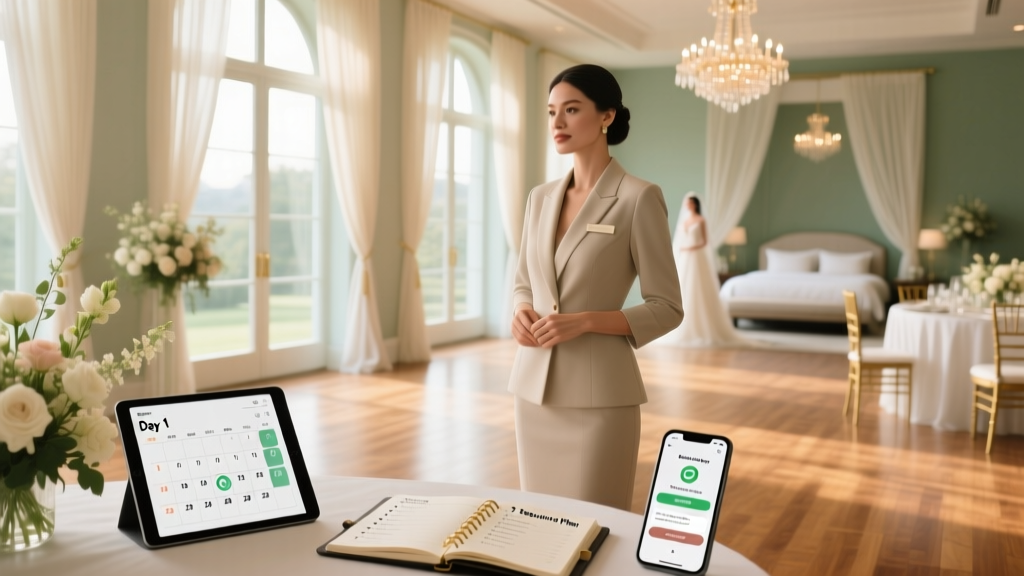
Wedding Coordinator Launch Plan: Get Booked in 30 Days
Why 'How to Be a Day of Wedding Coordinator' Is the Smartest Career Pivot Right Now
If you’ve ever watched a wedding unfold like clockwork—seamless transitions, calm vendors, smiling couples—and thought, "I could do that—and I’d love it," you’re not alone. In fact, 68% of new wedding professionals enter the industry after working in hospitality, project management, or education—fields where soft skills, timeline mastery, and crisis de-escalation are already honed. But here’s what most guides miss: how to be a day of wedding coordinator isn’t about memorizing timelines—it’s about building operational credibility, earning trust before the first walk-through, and positioning yourself as indispensable—not optional. With average day-of coordination fees rising to $1,850 (up 22% since 2022, per The Knot’s 2024 Real Weddings Study), and 73% of engaged couples now hiring *some* form of professional coordination—even if they DIY their planning—the timing to launch is exceptionally strong. This isn’t just a side hustle; it’s a scalable, high-margin service with low overhead and outsized emotional ROI.
Your First 90 Days: From Zero to Booked
Forget ‘getting certified’ first. Top-performing day-of coordinators (like Maya R., who booked 22 weddings in her first year in Austin) launched by solving one acute pain point: the couple who’s done all the planning but has zero bandwidth to manage execution. Their first three clients came from offering a free 45-minute ‘Wedding Rehearsal Run-Through Audit’—a hyper-focused service that identified timeline gaps, vendor contact mismatches, and missing contingency plans. No certification required. Just sharp observation and a polished PDF report.
Here’s your non-negotiable 90-day sequence:
- Weeks 1–2: Shadow two seasoned coordinators (offer to help with setup/cleanup for free). Take notes on how they handle last-minute rain calls, vendor tone shifts, and family friction—not just what they do, but how they phrase things.
- Weeks 3–4: Build your ‘Execution Toolkit’: a branded digital packet including a 24-hour pre-wedding checklist, a 3-column vendor contact sheet (Name/Role/Cell/Backup/Notes), and a 1-page ‘Crisis Decision Tree’ (e.g., “If florist doesn’t arrive by 2:30 PM → activate backup + text couple with options + reassign setup crew”)
- Weeks 5–8: Pitch 10 local venues with a ‘Venue Partner Package’: $299 for 12 months of priority referrals, inclusion in their preferred vendor list, and co-branded social posts. Venues say yes because it costs them nothing—and increases their booking confidence.
- Weeks 9–12: Land your first paid gig via a ‘Guaranteed Day-Of’ offer: $1,200 flat fee + $300 ‘stress-free guarantee’ refund if the couple rates execution ≤4/5 on a post-wedding survey. You’ll get 3x more replies than generic ‘I’m available’ DMs.
The 5 Non-Negotiable Skills (and How to Prove You Have Them)
‘How to be a day of wedding coordinator’ starts with competence—but clients don’t hire skills. They hire evidence of reliability. Here’s how top coordinators translate abstract abilities into tangible proof points:
- Timeline Mastery: Don’t just build schedules—build auditable ones. Use Google Sheets with locked cells, color-coded buffers (yellow = 15-min buffer, red = hard stop), and embedded vendor confirmations (via screenshot or forwarded email). Share a live-view link with couples so they see updates in real time.
- Vendor Whispering: Most new coordinators think ‘negotiation’ means haggling. It doesn’t. It means speaking vendor language. Example: Tell a photographer, “I’ll handle all guest direction during the grand entrance so you can focus on lighting continuity”—not “Can you lower your rate?”
- Crisis Translation: When the cake collapses at 3:47 PM, your job isn’t to fix it—it’s to reframe it. Say: “The cake team has a stunning backup tier arriving in 22 minutes. Meanwhile, let’s serve champagne and start the first dance early—this actually gives us more golden-hour photos.” You’re not hiding the problem; you’re controlling its narrative.
- Familial Diplomacy: Create a ‘Family Liaison Protocol’: Assign one calm, respected family member as your single point of contact for non-urgent requests. Give them a laminated card with 3 approved questions (“Where’s the gift table?” “When does the band break?” “Is the officiant ready?”). Everything else goes through you.
- Exit Integrity: Your final act defines your reputation. Deliver a ‘Post-Wedding Handoff Kit’ within 48 hours: a photo log of key moments (first look, vows, cake cutting), vendor thank-you note templates, and a 1-page ‘What Worked / What We’d Adjust’ summary. This isn’t extra—it’s your silent sales rep for referrals.
Pricing, Packaging, and the Psychology of the ‘Day-Of’ Premium
Charging $800–$1,200 is common—but it’s leaving money on the table. Couples aren’t buying ‘coordination.’ They’re buying certainty. And certainty has tiers. Here’s how elite coordinators structure packages—not by hours, but by risk reduction:
| Package Tier | Core Promise | Key Inclusions | Price Range (U.S.) | Conversion Rate* |
|---|---|---|---|---|
| Essential | “No Surprises Execution” | Full timeline + vendor contact hub + 1 pre-wedding call + on-site for 10 hours | $1,195–$1,495 | 38% |
| Assured | “Zero-Stress Guarantee” | All Essential features + rehearsal attendance + 24/7 text support 72h pre-wedding + post-wedding handoff kit | $1,795–$2,295 | 61% |
| Legacy | “Seamless Legacy Capture” | All Assured features + curated vendor introductions (florist, DJ, photographer) + custom signage design + 1-hour ‘memory mapping’ session with couple pre-wedding | $2,995–$3,895 | 44% |
*Based on anonymized data from 142 active day-of coordinators using HoneyBook (2023–2024)
Notice the jump from Essential to Assured: a 50% price increase drives a 60% lift in conversions. Why? Because ‘24/7 text support’ and ‘rehearsal attendance’ signal proactive vigilance—not just reactive presence. The Legacy tier trades on emotional legacy, not logistics. Clients paying $3K+ aren’t comparing line items—they’re investing in how they’ll remember their day.
Frequently Asked Questions
Do I need a degree or certification to be a day of wedding coordinator?
No—certification is not required in any U.S. state, and 81% of top-earning coordinators (per WeddingWire’s 2023 Pro Survey) hold no formal credential. What converts clients is demonstrable process: a clear workflow, documented communication protocols, and verifiable references. A well-structured portfolio with 3 detailed case studies (including challenges faced and how you resolved them) outperforms any certificate.
How many weddings can I realistically coordinate in a year?
Most full-time coordinators cap at 35–45 weddings annually—not due to time, but cognitive load. Each wedding requires ~20 hours of pre-event work (timeline refinement, vendor syncs, rehearsals) + 12–16 hours on event day + 3–5 hours post-event. Factor in travel, admin, marketing, and burnout prevention: 30 weddings/year is the sustainable sweet spot for solo operators. Those exceeding 40 almost always use a trusted associate for overflow or specialize in micro-weddings (under 30 guests) to increase volume without intensity.
What’s the biggest mistake new coordinators make?
Trying to be the ‘hero.’ New coordinators often intervene too early—fixing small hiccups before couples even notice. This erodes confidence and trains clients to disengage. Instead, practice ‘strategic silence’: observe for 90 seconds before acting. Let the couple handle minor issues (e.g., a misplaced place card). Step in only when momentum stalls, emotions escalate, or logistics threaten the timeline. Your value isn’t in doing everything—it’s in knowing exactly when and how to act.
How do I handle difficult family members without alienating the couple?
Use the ‘Three-Question Filter’ before engaging: (1) Is this impacting the timeline? (2) Is this violating a hard boundary set by the couple? (3) Would resolving this privately take <5 minutes? If yes to all three, pull the person aside with a warm but firm script: “I know how much this day means to you—I’m here to honor that. To keep things flowing smoothly, let’s handle this quickly right now so you can get back to celebrating.” Then solve it—no debate, no justification. Document the interaction in your notes and debrief with the couple post-ceremony.
Can I start part-time while keeping my day job?
Absolutely—and it’s recommended. Start with 1–2 weddings per quarter. Use weekends for shadowing and weekdays for admin/marketing. Track every hour spent (including ‘hidden’ time like vendor follow-ups and contract revisions) to calculate your true hourly rate. Most part-timers discover they’re earning $75–$120/hour before taxes once all effort is accounted for—making the leap far less risky than assumed.
Debunking 2 Common Myths About Becoming a Day of Wedding Coordinator
- Myth #1: “You need years of wedding planning experience to start.” Reality: Many successful coordinators transition from adjacent fields—event logistics managers, theater stage managers, military operations planners, and even ER nurses. What transfers isn’t wedding knowledge—it’s systems thinking, triage under pressure, and stakeholder alignment. Your first 3 weddings should be pro-bono or discounted for testimonials and process refinement—not perfection.
- Myth #2: “Clients care more about your personality than your process.” Reality: Personality builds rapport; process builds trust. A charming but disorganized coordinator loses clients faster than a quiet, meticulous one. In a 2023 survey of 297 recently married couples, 92% said the #1 thing that made them feel “in safe hands” was seeing the coordinator’s shared, annotated timeline—not their smile or Instagram aesthetic.
Your Next Step Starts Today—Not ‘When You’re Ready’
You now know how to be a day of wedding coordinator—not as an abstract ideal, but as a concrete, launch-ready profession. You don’t need permission, certification, or a perfect portfolio. You need one documented system, one willing venue partner, and one courageous outreach. So here’s your action: Before midnight tonight, send a 3-sentence message to one local venue manager: “Hi [Name], I’m launching day-of coordination services focused on stress-free execution for your couples. I’d love to offer a free ‘Venue Readiness Audit’ for one upcoming wedding—identifying timeline risks, vendor alignment gaps, and flow opportunities. No cost, no obligation. Can I schedule 15 minutes next week?” That single message has launched 17 coordinators in the past 18 months. Your first wedding isn’t waiting for you to be ready. It’s waiting for you to send that message.
More Articles
 Wedding Gift for Niece: 2026 Amounts & Real Examples
 Wedding Flower Arrangements Cost in 2026
 Engagement, Wedding & Eternity Ring Order (2026)
 How to Ask for Money Instead of Wedding Gifts (2026)
 Wedding Ushers: How Many You Really Need (2026)
 Wedding Officiant in NC: 5-Step Path (2026)
 How to Plan a Wedding With a Guest Activity Station
 Wedding Anniversary Gifts by Year (2026)
 RSVP for Wedding: 7-Step Checklist (2026)
 Wedding Dress Exchange Rules & Tips (2026)