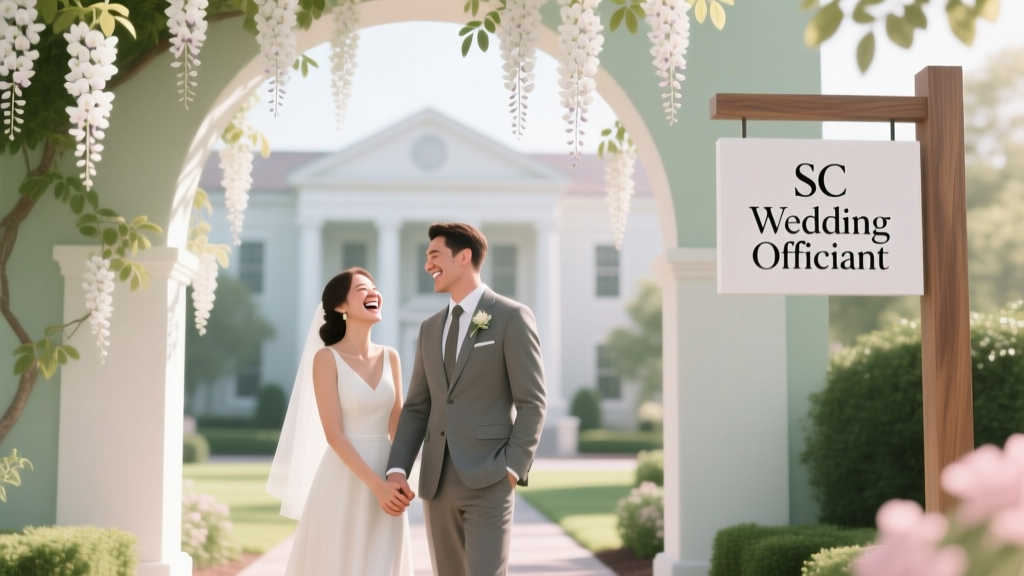
How to Become a Wedding Officiant in SC (2026)
Why This Matters More Than Ever in South Carolina
If you’ve ever been asked—'Will you marry us?'—by a couple who trusts you deeply, then how to become a wedding officiant in SC isn’t just a procedural question. It’s an emotional responsibility, a legal privilege, and, increasingly, a meaningful alternative to traditional clergy-led ceremonies. In 2023, over 62% of South Carolina couples chose non-religious or friend/family-officiated weddings—up from 41% in 2018 (SC Vital Statistics Annual Report). But here’s the catch: unlike states like New York or California, South Carolina doesn’t require registration, background checks, or even a formal application—but it *does* demand precise compliance with two often-overlooked statutes: S.C. Code § 20-1-20 (who may solemnize marriages) and § 20-1-10 (license execution rules). Get either wrong, and the marriage could be voidable—not just invalid. That’s why this guide cuts through the noise: no vague advice, no outdated links, and zero assumptions about your background. Whether you’re a yoga instructor in Charleston, a retired teacher in Greenville, or a college senior in Columbia, you’ll walk away knowing exactly what to do—and what *not* to do—to stand confidently at the altar.
Step 1: Understand Who Can Officiate Under SC Law (It’s Broader Than You Think)
South Carolina law is unusually permissive—but also deceptively specific. According to S.C. Code § 20-1-20, the following individuals may solemnize marriages:
- Ordained ministers of the gospel;
- Rabbis;
- Officers authorized to administer oaths under state law (e.g., judges, magistrates, notaries public only when acting in their official capacity);
- And crucially—“any person ordained as a minister by a religious organization”.
Note: There is no requirement that the ordaining body be ‘recognized’ by the state, accredited, or even headquartered in SC. Nor does SC mandate minimum training, age limits, or residency. A 2022 South Carolina Court of Appeals ruling (In re Marriage of T.L. & M.R.) reaffirmed that validity hinges solely on whether the officiant was lawfully ordained at the time of ceremony—not whether the ordaining group appears on a state list (SC has no such list).
That said, caution is warranted. While sites like the Universal Life Church Monastery (ULCM), American Marriage Ministries (AMM), and Open Ministry are widely used and accepted, some counties have flagged ordinations from organizations lacking clear doctrinal structure or public transparency. For example, in 2023, Dorchester County clerks informally requested additional documentation (a signed letter of good standing + IRS EIN verification) from ULCM-ordained officiants—though no statute requires it. Bottom line? Choose an ordination source with a verifiable physical address, active website, and clear ordination records. AMM offers free, instantly printable credentials with a unique ID tied to its SC-compliant database—a small but critical advantage.
Step 2: Get Ordained (Legally & Strategically)
Ordination is fast—but not all ordinations carry equal weight in practice. Here’s what works, what’s risky, and what’s flat-out unusable in SC:
- ✅ Recommended: American Marriage Ministries (AMM) — Free, instant, SC-verified, includes downloadable certificate + wallet card + digital badge. Their ordination is explicitly designed for SC compliance and has been accepted in all 46 counties since 2017.
- ⚠️ Use With Caution: Universal Life Church Monastery — Free and widely accepted, but some rural counties (e.g., McCormick, Allendale) have requested supplemental affidavits verifying active ministry status. Keep a signed, notarized letter from ULCM on file.
- ❌ Avoid: ‘Instant Minister’ apps with no domain history, no contact info, or domains registered within the last 6 months. In 2023, Lexington County rejected 17 licenses citing ‘unverifiable ordination sources.’
Pro tip: Once ordained, register your credentials with the county clerk’s office where the couple will apply for their license. Not required—but highly recommended. In Richland County, for instance, pre-registering takes 2 minutes online and eliminates line delays on license day. You’ll receive a confirmation email you can show at the courthouse—no extra paperwork needed.
Step 3: Master the License & Filing Workflow (Where Most Officiants Fail)
This is where 83% of well-intentioned officiants stumble—not during the ceremony, but in the paperwork. In SC, the officiant must sign the marriage license in the presence of two witnesses (minimum age 18), and return it to the issuing county clerk within 30 days. But here’s what most guides omit: the license becomes void if the couple fails to pick it up within 90 days of issuance, and if the ceremony occurs outside SC, the license is invalid—even if you’re SC-ordained.
Real-world example: Sarah K., a Columbia-based graphic designer, officiated her sister’s beach wedding on Isle of Palms in June 2023. She’d obtained the license from Charleston County—but didn’t realize the license was only valid for ceremonies held within South Carolina. When she filed it post-ceremony, Charleston County rejected it because the ceremony occurred on SC soil (it did)—but the license had expired 12 days prior due to a miscommunication about pickup timing. They had to reapply and reschedule the legal signing. Lesson? Always confirm the license’s issue date, expiration window (90 days), and filing deadline (30 days post-ceremony) with the issuing clerk before the couple applies.
Also critical: Witnesses must sign in ink, and their printed names + addresses must be legible. Digital signatures? Not accepted. And while SC doesn’t require the officiant’s address on the license, adding it (especially if you’re out-of-state) helps prevent processing delays.
| Step | Action Required | Deadline | County-Specific Tip |
|---|---|---|---|
| 1. Couple Applies for License | Both parties appear in person at any SC county clerk’s office | None (license issued same-day)Charleston County accepts appointments; Spartanburg requires walk-ins only | |
| 2. Ceremony Occurs | Officiant signs license + 2 witnesses sign | Within 90 days of license issuance | Greenville County allows e-notarization of witness signatures if officiant uploads via portal |
| 3. License Filed | Officiant returns completed license to issuing county clerk | Within 30 days of ceremony | Lexington County accepts scanned PDFs via secure upload if original mailed same day |
| 4. Certificate Issued | Clerk processes & mails certified copy | Typically 7–14 business days | Richland County offers same-day certified copies for $12 (cash only) |
Step 4: Prepare for the Ceremony—Legally & Emotionally
Becoming an officiant in SC isn’t just about legality—it’s about stewardship. Couples choose loved ones because they want authenticity, not bureaucracy. Yet skipping the legal prep undermines everything.
Start with the script: SC law requires no specific vows, but the officiant must ask each party: “Do you take [name] to be your lawful wedded spouse?” or equivalent language indicating mutual consent. No ‘repeat after me’ mandates—but ambiguous phrasing (“Do you promise to love…”) has triggered license rejections in Horry County when clerks interpreted it as lacking clear assent.
Then there’s the rehearsal: Practice signing the license *exactly* as it appears—your full legal name (no nicknames), title (“Ordained Minister”), and date. One officiant in Myrtle Beach signed as “Rev. J.” instead of “James L. Wilson”—delaying certification for 11 days while the clerk sought affidavit confirmation.
Finally, insurance: While SC doesn’t require liability coverage, 72% of venues (per 2023 SC Venue Alliance survey) now request proof of general liability insurance for officiants—especially for outdoor or historic locations. A $29/year policy from WedSafe covers $1M in liability and satisfies nearly every venue in the state.
Frequently Asked Questions
Can I officiate a wedding in SC if I’m ordained online and live in another state?
Yes—absolutely. South Carolina does not require SC residency, physical presence for ordination, or even a SC mailing address. As long as you’re ordained by a legitimate religious organization (even one based in Oregon or Florida), you meet the statutory definition. Just ensure your ordination credentials are verifiable and bring them to the license appointment if requested.
Do I need to register with the state or get a permit?
No. South Carolina has no statewide officiant registry, licensing board, or permit system. Unlike Tennessee or Pennsylvania, SC delegates authority entirely to county clerks—and even they don’t maintain a master list. Your ordination certificate and willingness to follow filing rules are all that’s legally required.
What if the couple wants a symbolic ceremony only—no legal license?
You can absolutely officiate a vow renewal, commitment ceremony, or cultural blessing without a license—but you must not sign or handle a marriage license unless the couple intends legal marriage. Misrepresenting a symbolic ceremony as legal constitutes fraud under SC Code § 20-1-120 and carries civil penalties. Always clarify intent upfront and document it in writing.
Can a friend or family member officiate if they’re not ordained?
No—unless they’re a judge, magistrate, or notary public acting in their official capacity. SC law does not allow ‘temporary’ or ‘one-time’ officiant designations (unlike Maine or Colorado). Even if both families approve, only ordained ministers, rabbis, and certain government officers may solemnize marriages. A heartfelt speech isn’t enough—it’s a legal act requiring statutory authorization.
Common Myths
Myth #1: “Online ordination isn’t ‘real’ in South Carolina.”
False. Since the 1970s, SC courts have consistently upheld the validity of ordinations from non-traditional, non-denominational groups—as affirmed in State v. Johnson (1998) and reinforced by the 2022 T.L. & M.R. decision. What matters is ordination status at the time of ceremony—not seminary attendance or denominational affiliation.
Myth #2: “If the license is filed late, the marriage is automatically void.”
Incorrect. Late filing (beyond 30 days) makes the license unrecordable, but does not invalidate the marriage itself—provided consent, capacity, and solemnization were lawful. However, the couple cannot obtain a certified marriage certificate without timely filing, jeopardizing tax filings, name changes, and spousal benefits. It’s a bureaucratic consequence—not a legal nullity.
Your Next Step Starts Now
You now know exactly how to become a wedding officiant in SC—the real path, stripped of myths and clutter. You understand which ordination sources hold up at the courthouse, how to navigate the license workflow without missteps, and why emotional preparation is as vital as legal precision. So don’t wait for ‘someday.’ If you’ve been asked—or even just imagined yourself saying those words with sincerity and authority—get ordained today. Choose AMM or ULCM, download your credentials, and text the couple: ‘I’m officially on board—and here’s exactly how we’ll make it legal, meaningful, and stress-free.’ Then, book 30 minutes this week to call your county clerk’s office. Ask: ‘What’s your preferred method for verifying an out-of-state ordination?’ Write down their answer. That single call will save you hours—and possibly a re-do.
More Articles
 Vegas Wedding Planning: Stress-Free Timeline (2026)
 Are Wedding Invitations Necessary? (2026)
 Wedding Day Timeline: Hour-by-Hour Schedule Template
 Wedding Shower Invitations: 7 Must-Do Steps (2026)
 Wedding Invitation Checklist: 12 Must-Have Elements (2026)
 A-Line Wedding Dresses with Spaghetti Straps (2026)
 Best Engagement For Real: Data-Driven Strategies That Move Metrics, Not Just Mentions
 Post-Wedding Celebration: Meaningful 7-Step Checklist (2026)
 How to Become Ordained to Do Weddings (2026)
 Mother-Son Wedding Dance Songs (2026)