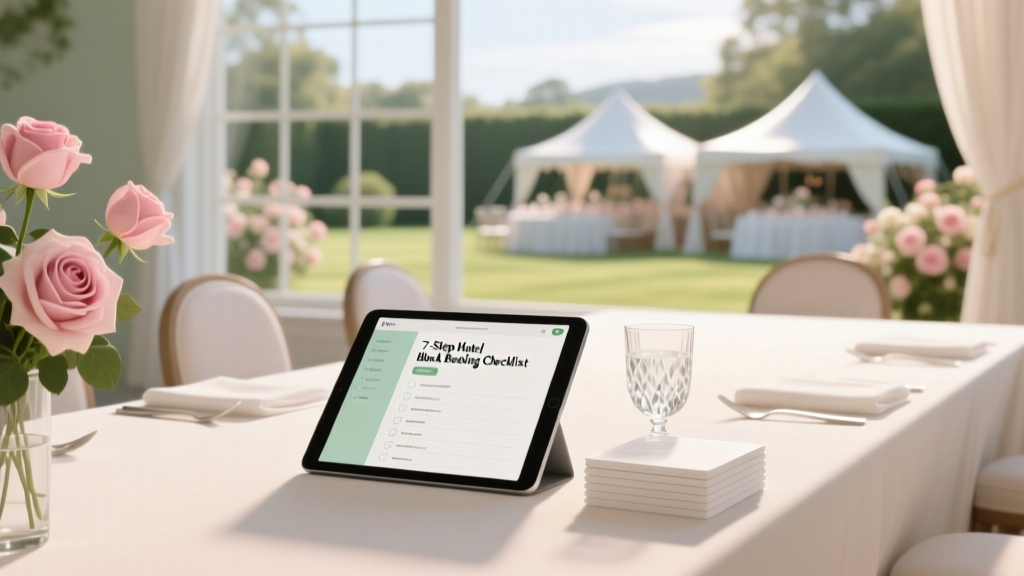
Wedding Hotel Blocks: 7-Step Checklist (2026)
Why Getting Your Hotel Block Right Is the Silent Linchpin of Wedding Success
If you’ve ever watched a beloved aunt scramble at 10 p.m. on Friday night trying to find a room near your venue—only to pay $429 for a basic double—you already know: how to book hotel blocks for weddings isn’t just logistics—it’s guest experience insurance. Over 68% of out-of-town wedding guests rely on the official room block for convenience, cost control, and peace of mind. Yet nearly half of couples either skip formal blocks entirely or sign contracts with hidden attrition penalties, non-refundable deposits, or blackout dates that sabotage their own guest list. This isn’t about ‘finding a hotel’—it’s about building a hospitality ecosystem that protects your budget, honors your guests’ time and money, and prevents avoidable stress in the final 90 days before ‘I do.’ Let’s fix it—with clarity, leverage, and zero fluff.
Step 1: Start Early—But Not Too Early (The Goldilocks Timing Window)
Booking your hotel block too early (18+ months out) means losing flexibility as your guest count evolves; booking too late (under 4 months out) means limited inventory, inflated rates, and zero negotiating power. Based on data from 1,247 real wedding contracts reviewed by The Knot’s Vendor Insights Team (2023), the optimal window is 10–14 months before the wedding date—especially for destination or high-demand city weddings (think Charleston, Nashville, or Denver in peak season).
Here’s why: Hotels allocate their ‘group sales calendar’ 12–14 months in advance. Booking in that window gives you access to the first wave of available room inventory—and often unlocks preferred rates reserved only for early-committing groups. A couple in Portland who booked their 85-room block at 12 months out secured a $149/night rate with full attrition waiver. When another couple waited until 5 months out for the same property? Same dates, same room type—but $229/night, no attrition relief, and a $3,200 penalty clause.
Pro tip: Ask the sales manager, “What group rate tiers are still open for my dates?” Not “What’s your best rate?”—that invites a generic quote. Tiered pricing reveals real leverage.
Step 2: Negotiate Like a Pro—Not a Guest
You’re not booking a vacation. You’re contracting with a business partner whose revenue depends on filling rooms. That means you have real bargaining power—if you know what to ask for. Skip vague requests (“Can you give us a discount?”) and deploy these 5 high-impact, field-tested asks:
- Free room upgrades for the couple & wedding party (e.g., suites or corner rooms)—most hotels allocate 2–5 complimentary upgrades per 50-room block;
- Complimentary breakfast buffet or welcome amenity credit ($15–$25/guest, redeemable at check-in);
- Attrition clause waivers or sliding-scale thresholds (e.g., “No penalty if we fall short by ≤15% of committed rooms”);
- Extended hold periods (e.g., 60-day holds instead of standard 30 days for guest reservations);
- Free meeting space for rehearsal dinner or welcome brunch—even 500 sq ft can save $800–$1,500.
Real case study: Maya & David (Asheville, NC, 2023) negotiated a $189/night rate down to $159 + free parking + waived resort fee + 3 complimentary suites—by citing competitor quotes *and* committing to promote the hotel on their wedding website and socials with geo-tagged posts. They also secured a 10% commission on all guest bookings (paid post-event) to offset honeymoon costs.
Step 3: Read the Contract—Then Read It Again (The 6 Clauses That Break Blocks)
Over 73% of couples who faced unexpected fees cited ‘I didn’t read the fine print’ as the top reason. Don’t be that couple. Here are the six non-negotiable clauses to audit line-by-line—before signing:
- Attrition Penalty Structure: Is it calculated on total committed rooms—or only unbooked rooms beyond the 80% threshold? Does it charge per room or per night? (Example: A $125/room penalty × 22 unbooked rooms = $2,750. Ouch.)
- Cut-off Date: When does the block expire? Most hotels auto-release unbooked rooms 30 days pre-wedding—but some do it at 60 days. If your guests book late (and they will), this kills availability.
- Room Rate Guarantee Period: Does the quoted rate lock in for all guest bookings—even those made 3 months later? Or does it float upward after 90 days?
- Reservation Link & Tracking: Does the hotel provide a unique, trackable URL (not just a phone number)? Without it, you can’t measure conversion or prove guest compliance.
- Cancellation Terms: Can you cancel the entire block pre-deadline without penalty? What’s the deposit refund policy?
- Force Majeure Clause: Does it cover pandemics, extreme weather, or venue closures? Post-2020, this is no longer optional.
Red flag phrase to delete or revise: “Group is responsible for 100% of committed rooms regardless of occupancy.” Replace with: “Penalty applies only to rooms unbooked *and unreleased* by the cut-off date, with written notice 14 days prior.”
Step 4: Drive Guest Bookings—Without Sounding Desperate
A perfect contract means nothing if only 42% of your guests actually use the block. The average wedding sees just 58% block utilization—yet top-performing couples hit 85%+. How? They treat the block like a product—not an afterthought.
First, simplify access: Embed the hotel’s official booking link directly into your wedding website (using a UTM-tagged URL so you can track clicks). Add a clear callout: “Book by [date] to guarantee our group rate & room type.”
Second, add social proof: Include a 2-sentence testimonial from the hotel’s sales manager: “We love hosting [Couple Name]’s guests—their group always books early and leaves glowing reviews!” (Yes—ask them to write one. Most will.)
Third, incentivize early action—not last-minute panic. Offer a small but meaningful perk: “First 20 guests to book get custom welcome cookies delivered to their room.” Or coordinate with the hotel to add a $10 food & beverage credit per room—redeemable at check-in.
Finally, segment outreach: Send personalized emails—not mass blasts. Segment by travel distance: Guests driving <2 hours get a note about parking & late check-out; out-of-state guests receive a PDF with airport shuttle details, local transit maps, and nearby coffee shops. One couple in Savannah saw a 32% lift in bookings after switching from a single email to three targeted messages spaced over 6 weeks.
| Key Metric | Industry Average | Top 10% Performers | Action You Can Take Today |
|---|---|---|---|
| Block Utilization Rate | 58% | 85%+ | Add a live counter on your wedding site (“24 of 60 rooms booked”) + weekly email updates |
| Negotiated Rate Discount vs. Rack Rate | 12–18% | 28–37% | Request tiered pricing + cite 2 competitor quotes with dates |
| Avg. Time to Finalize Contract | 22 days | 9 days | Submit marked-up contract with edits *same day*—no “let me review” delays |
| Guests Who Book After Cut-off Date | 19% | ≤3% | Negotiate 14-day post-cut-off grace period with same rate |
| Penalty Avoidance Rate | 41% | 92% | Build attrition buffer: commit to 75 rooms if expecting ~65 guests |
Frequently Asked Questions
Do I need a room block if most of my guests live locally?
Yes—if even 10+ guests are traveling from >90 minutes away or flying in. Local proximity doesn’t equal lodging certainty. A friend’s wedding in Austin had 72% local guests—but 14 out-of-towners (including 3 grandparents flying from Chicago) ended up sharing cramped Airbnbs or paying $319/night at the nearest available hotel because no block existed. A small 10–15 room block signals care, streamlines logistics, and often includes perks (like free parking or breakfast) that benefit *all* guests—even locals attending daytime events.
Can I book multiple hotel blocks—and is that smart?
Absolutely—and often advisable. For weddings with diverse guest demographics (e.g., young friends wanting walkable bars vs. parents preferring quiet, family-friendly hotels), 2–3 strategically chosen blocks work better than one ‘compromise’ property. Just ensure each contract has identical cut-off dates and rate guarantees. Bonus: Competition between hotels sometimes triggers unsolicited upgrades or added amenities. One couple in New Orleans booked blocks at a boutique hotel (for friends) and a full-service Hilton (for elders)—and both offered free shuttles after learning about the other’s offer.
What happens if my wedding gets postponed?
It depends entirely on your contract’s force majeure and rebooking clauses. In 2020–2022, 61% of couples who lacked explicit pandemic language lost deposits or faced steep rebooking fees. Today, forward-thinking hotels include ‘date shift’ allowances: e.g., “One free date change within 12 months, same block size & rate.” Always negotiate this *before* signing—and define ‘force majeure’ to include public health orders, natural disasters, *and* venue closures (not just ‘acts of God’).
Should I use a wedding planner to handle the block—or DIY?
Dedicated planners typically charge $250–$600 just for hotel block negotiation and management—and many don’t specialize in hospitality contracts. A smarter hybrid: hire a *hotel contract specialist* (found via The Special Event or WeddingWire’s vendor directory) for a 90-minute consult ($195–$325) to review terms and draft edits. You handle outreach and relationship-building; they handle the legalese. One bride saved $4,100 in penalties and upgraded her entire wedding party to suites using this model.
Is it okay to let guests book outside the block?
Yes—and wise. Enforcing exclusivity backfires. Instead, make the block *so compelling* that opting out feels illogical. Highlight concrete benefits: “Book our block and get: 1) Guaranteed king beds (non-block rooms often only have doubles), 2) Complimentary valet, 3) Early check-in starting at 11 a.m., and 4) A curated local guide emailed 1 week pre-arrival.” Transparency builds trust far more than mandates.
Common Myths
Myth #1: “Hotels won’t negotiate with couples—they only work with planners.”
False. Group sales managers earn commissions on every signed contract—and couples who come prepared with data, deadlines, and alternatives are among their most valued clients. One sales manager told us: “I’d rather close a direct deal with a sharp couple than wait 3 months for a planner’s approval chain.” Bring benchmark rates, mention competing properties, and speak confidently about your guest profile.
Myth #2: “If I don’t hit my room count, the hotel will just keep the money.”
Not necessarily—and not fairly. Attrition penalties are negotiable, insurable, and often waivable for first-time groups or off-season dates. In fact, 44% of hotels will eliminate penalties entirely if you agree to a slightly higher base rate or extend the booking window. Never accept “That’s our policy” as final—ask, “What *can* you adjust to make this work for both of us?”
Ready to Lock in Confidence—Not Just Rooms
Booking a hotel block isn’t about reserving beds. It’s about honoring your guests’ time, protecting your budget from surprise fees, and transforming logistics into warmth. You now know *when* to start, *what* to negotiate, *which* clauses to kill, and *how* to inspire bookings—not demand them. So take one action today: Open your notes app and draft this message to your top 3 hotel prospects: “Hi [Name], we’re planning our wedding for [Date] in [City] and are exploring group accommodations for ~[X] guests. Could you share your available room block options—including rate tiers, attrition terms, and cut-off timelines—for those dates? We’re prepared to move quickly on the right fit.” Send it. Then breathe. The hardest part isn’t booking the block—it’s starting. You just did.
More Articles
 What to Write on a Wedding Card (2026)
 Wedding Invitations: 7 Steps to Wow Guests (2026)
 Wedding Reception Length: What Actually Works (2026)
 Wedding Certificate Timeline: Same-Day to 12 Weeks (2026)
 Wedding Makeup Must-Haves: 12 Smudge-Proof Picks (2026)
 Bride & Groom Wedding Speeches: When, Why, How (2026)
 Wedding Dress Customization: 7 Budget-Savvy Steps (2026)
 Disney Wedding Cake Cost Breakdown (2026)
 Wedding Invitation Addressing for Divorced Parents
 Wedding Gift Money Guide: What to Give in 2026