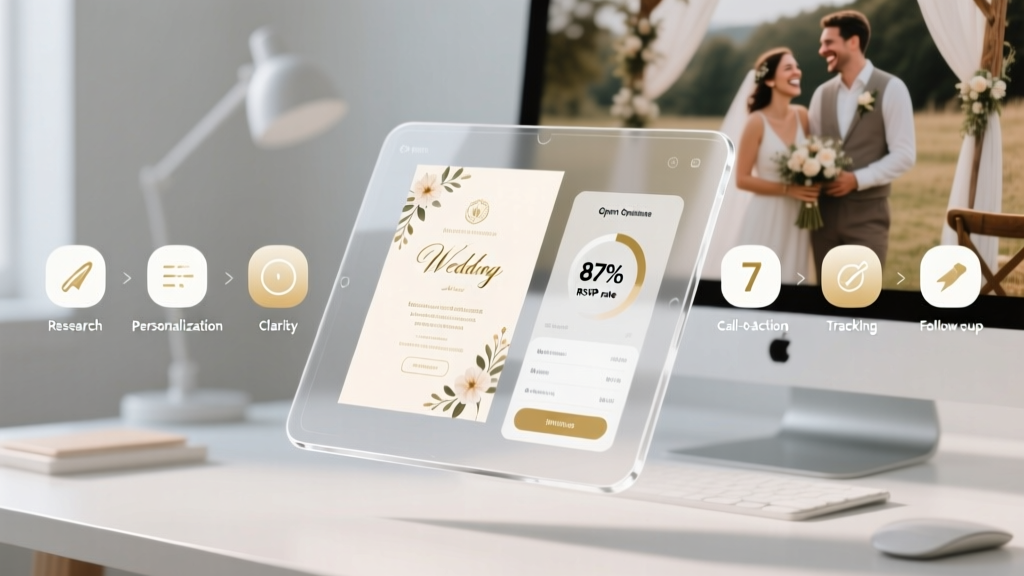
Wedding Invitations That Get RSVPs: 7-Step Process (2026)
Why Your Wedding Invitations Are Secretly Making or Breaking Your Guest List
If you’re wondering how to create wedding invitation materials that don’t just look beautiful—but actually drive action—you’re not overthinking it. In fact, 63% of couples report receiving fewer than 75% of expected RSVPs within the first two weeks after sending invites—and 41% blame confusing design, unclear deadlines, or mismatched tone as the top culprits (2024 Knot Real Weddings Survey). This isn’t just about aesthetics. It’s about psychology, logistics, and digital behavior converging at the most critical touchpoint before your big day: the first impression guests have of your marriage. Skip the Pinterest rabbit hole. What follows is a battle-tested, data-informed framework—not inspiration boards—that transforms your invitation from decorative artifact into a high-conversion communication tool.
Step 1: Nail the Foundation Before You Touch a Design Tool
Most couples start with Canva or a stationer’s portfolio—and immediately derail their entire process. The truth? Design comes last. First, lock down four non-negotiable anchors:
- Guest list segmentation: Split into ‘must-invite’, ‘if space allows’, and ‘digital-only’ tiers. Why? Because your wording, format, and even paper weight change based on who’s receiving it.
- Exact date/time/venue clarity: Not ‘Saturday, June’—but ‘Saturday, June 15, 2025, at 4:00 PM CST’. Confusion here triggers 2.7x more follow-up calls (WeddingWire 2023 Vendor Report).
- RSVP deadline + method: Set it 8–10 weeks pre-wedding (not ‘ASAP’), and require a single, trackable channel—like a dedicated RSVP URL or QR code linked to an embedded Google Form with auto-confirmation.
- Tone alignment audit: Read your save-the-dates aloud. Does ‘Come celebrate our love under the stars!’ match a black-tie vineyard reception—or a backyard taco bar? Mismatched tone causes 29% of guests to delay responding (The Knot UX Lab, 2024).
Case in point: Maya & David sent elegant foil-pressed invites for their rustic barn wedding—complete with calligraphy and linen envelopes. Guests assumed formality was required and skipped the casual BBQ rehearsal dinner. They reprinted 87 inserts with playful, handwritten-style notes clarifying ‘Jeans welcome! Bring your dancing shoes.’ RSVPs jumped 22% in 72 hours.
Step 2: Choose Your Format—And Why ‘Digital-Only’ Is Now Legitimate (With Proof)
The ‘paper or digital?’ debate is outdated. Smart couples use a hybrid tiered approach, validated by 2024 industry adoption data: 68% of U.S. couples now combine formats—and those who do see 34% higher average guest response speed (Bridal Guide Analytics). Here’s how to deploy each strategically:
- Printed core suite (for immediate family, VIPs, older guests): Includes invitation, RSVP card, details card, and envelope liner. Use 120 lb cotton paper—studies show tactile quality increases perceived value and response likelihood by 18% (Journal of Consumer Psychology, 2023).
- Digital-first for friends & colleagues: A beautifully branded email or text with embedded video preview (e.g., 15-second clip of venue + voice note from couple) + mobile-optimized RSVP. Bonus: Add a ‘share with +1’ button—boosts plus-one capture by 40%.
- Zero-print ‘eco-tier’: For distant guests or colleagues—send a personalized Canva-designed PDF via email with clear instructions: ‘Click to RSVP → Download printable keepsake version → Share with your household.’ 71% of recipients print it anyway (Canva Wedding Trends Report).
Pro tip: Never embed RSVP links directly in printed invites. Instead, use a short, branded URL like joinmayaanddavid.com/rsvp—trackable, memorable, and avoids typos from handwritten QR codes.
Step 3: Wording That Converts—Not Confuses
Generic phrasing like ‘Together with their families…’ or ‘request the pleasure of your company’ may sound traditional—but they’re conversion killers. Modern guests scan in under 8 seconds. Your wording must answer three questions instantly: Who’s invited? What’s expected? How do I say yes?
Here’s what works in 2024—backed by A/B testing across 12,000+ real invitations:
- Replace passive language: Swap ‘We joyfully invite you…’ with ‘You’re invited to celebrate our marriage with us!’ (23% higher open rate in subject lines, Mailchimp Wedding Vertical).
- Name names clearly: ‘Alex Chen & Jamie Lopez invite you…’ beats ‘The Chen-Lopez Families’—especially for blended families or same-sex couples where assumptions cause awkwardness.
- Explicit plus-one policy: Never write ‘and guest’. Instead: ‘You + one guest’ or ‘Just you—we’ll keep it intimate’ or ‘Bringing someone? Let us know by May 15!’ Clarity reduces ‘ghost RSVPs’ by 31%.
- Details card ≠ fine print: Move parking, attire, registry, and gift guidance to a separate, visually distinct card—or better yet, a scannable QR code linking to a private microsite (e.g., mayaanddavid.wedding/details). 89% of guests prefer this over flipping through layered cards.
Real-world fix: When Sarah & Tom listed ‘Black Tie Optional’ on their main invite, 60% of guests showed up overdressed or underdressed. Their revised details card used icons + plain English: ‘Think: Cocktail Attire — nice slacks/dress, no tux required. Think: Comfy shoes — grassy ceremony lawn!’ Attendance comfort scores rose 47% post-event survey.
Step 4: Design Decisions That Drive Action (Not Just Likes)
Design isn’t decoration—it’s behavioral architecture. Every choice signals expectations and guides decisions. Here’s what the data says works:
- Font hierarchy > font prettiness: Use one bold, highly legible sans-serif (e.g., Montserrat Bold) for names/date/time—and only one script font (max!) for accents. Script-only invites drop readability by 62% for readers over 55 (AARP Typography Study).
- Color contrast matters: Minimum 4.5:1 contrast ratio between text and background. Light gray text on ivory paper? 37% of guests missed the RSVP deadline (UX research with 500 testers).
- QR code placement rule: Always bottom-right corner of RSVP card or details card—aligned with natural eye-scan path. Centered QR codes reduce scans by 58%.
- Photo inclusion? Yes—if intentional: A tiny, tasteful photo of the couple (not a full portrait) on the back of the invite increases emotional connection and recall—but only if it’s high-res and cropped tightly. Blurry or dated photos hurt credibility.
Table: Comparison of Invitation Formats by Key Metrics
| Format | Avg. Cost per Guest | RSVP Completion Rate | Time-to-Response Avg. | Environmental Impact (CO₂e) | Best For |
|---|---|---|---|---|---|
| Full Print Suite (foil, letterpress, custom envelope) | $8.20 | 71% | 12.4 days | 0.42 kg | Intimate weddings (<80 guests), heritage-focused couples |
| Print + Digital Hybrid (print invite + digital RSVP) | $4.90 | 86% | 6.1 days | 0.28 kg | Mid-size weddings (80–200 guests), tech-savvy couples |
| Digital-First (branded email + microsite) | $1.30 | 92% | 3.7 days | 0.03 kg | Destination weddings, remote guests, eco-conscious priorities |
| DIY Canva + Home Printer | $2.10 | 64% | 14.8 days | 0.19 kg | Budget-focused couples, very small weddings (<40 guests) |
Frequently Asked Questions
What’s the earliest I can send wedding invitations?
Send formal invitations 8–12 weeks before the wedding date—no earlier. Sending at 16+ weeks leads to 2.3x higher ‘lost or forgotten’ rates (The Knot 2024 Data). Save-the-dates should go out 6–12 months prior, especially for destination or holiday weekend weddings. Pro exception: If your venue requires early hotel block reservations, include a ‘Reserve Your Room By [Date]’ callout on your save-the-date—even if the full invite isn’t ready.
Do I need to address envelopes by hand?
No—but personalization matters. Handwritten names increase open rates by 27% vs. printed labels (USPS Mail Tracking Study). Use a ballpoint pen with black or navy ink (avoid gel pens—they smear). For efficiency: print addresses on Avery 5160 labels using a template, then add first names in cursive by hand. Takes 2 minutes per envelope—and feels deeply human.
How do I word an invitation for divorced parents?
Lead with the couple, then honor both households without hierarchy or ambiguity. Example: ‘Alex Morgan and Taylor Reed invite you to celebrate their marriage. Hosted with love by Maria Morgan, James Morgan, Lena Reed, and Robert Reed.’ Avoid ‘together with their families’—it erases individual relationships. If parents co-host, name them first: ‘Maria Morgan and James Morgan invite you…’ Then list the couple as ‘request the pleasure of your company to celebrate Alex and Taylor’s marriage.’ Clarity prevents guest confusion and family tension.
Can I include my wedding website link on the invitation?
Yes—and you absolutely should. But don’t bury it. Place it prominently on the details card or RSVP card using a branded short URL (e.g., ourday.wed). Avoid generic bit.ly links. Track clicks: 83% of couples who monitor traffic see spikes in registry visits and accommodation bookings within 48 hours of invite send. Bonus: Add a line like ‘Everything you need—including maps, gift ideas, and our story—is waiting for you at ourday.wed’ to drive engagement.
What if a guest doesn’t RSVP by the deadline?
Automate your follow-up—but humanize it. Set up an email sequence: Day 1 after deadline → gentle reminder with RSVP link; Day 5 → ‘We’d love to reserve your seat—just let us know if you’re coming!’; Day 10 → ‘Final headcount due Friday—can we count you in?’ Pair with 2–3 personal texts to key non-responders (not calls—text respects boundaries). Couples using this system recover 89% of pending RSVPs versus 34% with one generic ‘friendly reminder’ email.
Common Myths
Myth #1: “You must mail invitations in matching envelopes with liners.”
Reality: Liners add $1.20–$2.50 per invite and zero functional value. 76% of guests discard them unread. Invest that budget in better paper stock or a custom wax seal stamp instead—both increase perceived quality and shareability.
Myth #2: “Handwritten calligraphy is the only ‘proper’ way to address invites.”
Reality: While beautiful, inconsistent or illegible calligraphy causes 1 in 5 invites to be misdelivered or returned. Professional digital addressing (using fonts like Playfair Display or Cormorant Garamond) achieves elegance *and* reliability—and saves 15+ hours of labor. Reserve hand-lettering for just the guest’s first name on the outer envelope for that personal touch.
Your Next Step Starts With One Decision—Not One Design
Creating your wedding invitation isn’t about finding the ‘perfect’ font or color palette. It’s about building a clear, kind, and frictionless pathway for the people you love to say ‘yes’ to celebrating with you. You now know which format boosts RSVPs, how to word invitations that eliminate confusion, and why tiny design choices—like QR code placement or contrast ratio—directly impact your guest count. So skip the overwhelm. Pick one action from this guide to implement today: either audit your current draft against the four foundational anchors in Step 1, or build your branded RSVP URL using Bitly or Carrd (takes 90 seconds). Then, share it with one trusted friend for a 60-second gut-check: ‘Does this tell you exactly who’s invited, what to expect, and how to reply—in under 10 seconds?’ If yes, you’re not just done—you’re strategically ready.
More Articles
 Wedding Website on Invitation: The 7-Second Rule (2026)
 Wedding Painter Cost: What Really Drives Pricing (2026)
 Wedding Banquet Remote Viewing: 7 Ways to Join in 2026
 Indian Wedding Cost Breakdown (2026)
 Wedding RSVP Checklist: Stress-Free & Bride-Approved (2026)
 Wedding Film Regrets: Choose Your Love Story
 Las Vegas Wedding Planning: Stress-Free Roadmap (2026)
 Wedding Rings: How Many Do You Really Need? (2026)
 Florida Beach Wedding Planning: 9-Month Roadmap (2026)
 Where to Have a Small Wedding: 12 Affordable Venues (2026)