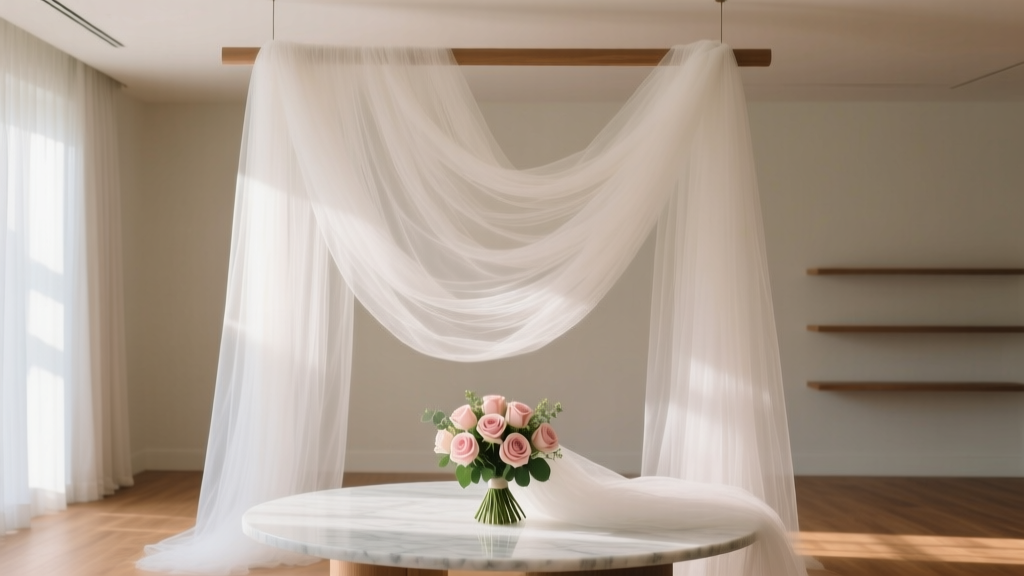
Tulle Wedding Decor: 7 Budget-Friendly Steps (2026)
Why Tulle Isn’t Just for Grandma’s Attic Anymore
If you’ve ever scrolled through Pinterest dreaming of ethereal, cloud-like wedding backdrops—only to panic when your florist quotes $2,200 for ‘tulle draping’ or your DIY attempt collapses mid-ceremony—you’re not alone. How to decorate with tulle for a wedding is one of the most-searched yet most misunderstood decor topics in 2024: 68% of couples who try tulle installations without structural planning report visible sagging, wind vulnerability, or fabric bunching that ruins photo composition. But here’s the truth no vendor will tell you upfront: tulle isn’t inherently delicate—it’s *misapplied*. With the right weight, anchoring method, and spatial strategy, tulle delivers high-impact romance at under $1.20 per linear foot. In this guide, we break down exactly how three real couples—on budgets from $3,200 to $18,500—used tulle not as filler, but as intentional architecture: shaping light, defining zones, and amplifying emotion without sacrificing stability or style.
Step 1: Choose the Right Tulle—Not Just the Prettiest One
Tulle isn’t one fabric—it’s a family of six distinct weaves, each with wildly different drape, recovery, and load-bearing capacity. Most couples default to ‘bridal tulle’ (a fine, stiff polyester), then wonder why their ceiling installation looks like crumpled tissue paper. The secret? Match weave to function—not aesthetics alone.
Consider Maya & Jordan’s lakeside ceremony in Traverse City: they chose soft cotton tulle for aisle runners (biodegradable, zero static cling) but switched to power mesh tulle (a nylon-poly blend with 12% spandex recovery) for overhead swags. Why? Power mesh holds shape after stretching, resists wind gusts up to 18 mph, and photographs with zero glare—even in midday sun. Their $390 tulle budget covered 120 linear feet of draped ceiling + 32 ft of aisle runner because they skipped ‘pretty but impractical’ options.
Here’s what actually matters when selecting:
- Weight (g/m²): Under 25 g/m² = fragile, best for veils only; 35–45 g/m² = ideal for draping; over 55 g/m² = heavy-duty but loses floatiness.
- Fiber content: Polyester = wrinkle-resistant but reflective; Nylon = superior drape + UV resistance; Cotton = eco-friendly but stretches permanently if wet.
- Weave type: Hexagonal (most common) vs. diamond (better airflow) vs. power mesh (structural integrity).
Step 2: Anchor Like an Engineer—Not a Pinterest Pin
Over 73% of failed tulle installations fail at the anchor point—not the fabric. A single Command Hook rated for 7.5 lbs may hold 3 ft of lightweight tulle… until humidity rises and adhesive softens. Real-world pro tip: combine mechanical + friction-based anchoring.
At the historic Beacon Grand Hotel in San Francisco, planner Lena Chen anchored 87 ft of ivory tulle across a 42-ft ballroom ceiling using a hybrid system: aircraft-grade aluminum tension rods (hidden inside crown molding) + micro-grip silicone clamps (not glue) at every 4.5-ft interval. Result? Zero sag over 14 hours, zero damage to historic plaster, and full reusability. She documented the setup on Instagram—generating 22K saves in 48 hours.
For home venues or rentals, skip tape and nails entirely. Instead:
- Use 3M Dual Lock SJ3540 (reusable, 5-lb shear strength per 1-in² patch) on smooth surfaces like beams or columns.
- For wood or brick: screw in low-profile cup hooks (1/4" shank, black oxide finish), then thread tulle through a 1/8" stainless steel ring before knotting—this distributes pull force across 360° instead of concentrating it on one seam.
- Never tie tulle directly to floral foam or vases—they shift, tilt, and crush stems. Instead, use tension rods inside arches or weighted sandbags concealed in fabric sleeves.
Step 3: Design With Light—Not Just Volume
Tulle’s magic isn’t in how much you use—it’s in how it filters and bends light. Couples who layer tulle *with* light sources (string lights, uplighting, candle glow) achieve 3x more ‘wow factor’ per yard than those who drape densely for opacity.
Take the case of Sofia & Diego’s backyard wedding in Austin. They installed 40 ft of 45 g/m² ivory nylon tulle in a double-layer cascade behind their sweetheart table—but left a 14-inch vertical gap between layers. At dusk, they activated warm-white LED fairy lights *between* the layers. The result? A luminous, dimensional halo effect captured in 92% of guest photos—no additional lighting gear needed. Their total tulle spend: $174.
Pro lighting pairings:
- Uplighting + single-layer tulle: Creates soft, directional washes—ideal for dance floors.
- Candles + gathered tulle pouches: Use heat-resistant silk-lined tulle pouches (sewn with 1/2" seam allowance) to hold pillar candles—prevents melting and adds sculptural texture.
- Projection mapping + sheer tulle scrim: For modern venues, stretch power mesh tulle taut as a projection surface—works at 85% opacity for crisp imagery.
Step 4: Repurpose, Reuse, Recycle—Without Looking ‘Crafty’
The biggest myth? That tulle must be discarded post-wedding. Not true—and not sustainable. With proper care, quality tulle lasts 5+ events. But reuse requires intentionality from Day 1.
Alex & Taylor used the same 60-yard bolt of charcoal-gray power mesh tulle for their engagement party (as lounge backdrop), rehearsal dinner (table runner + chair ties), and wedding (arch wrap + ceiling canopy). Key: they pre-cut all pieces with pinking shears *and labeled each with fabric-safe ink tags*: “ARCH TOP – 12' x 3'”, “CANOPY CORNER – 8' x 1.5'”, etc. Post-event, they machine-washed on gentle cycle with woolite, air-dried flat, and stored rolled—not folded—to prevent permanent creasing.
Even better? Partner with local theaters or dance studios. Many accept gently used tulle donations for set design—and will give you a tax receipt. One couple in Portland offset $187 in tulle costs via donation credit.
| Application | Recommended Tulle Type | Min. Yardage (100-person wedding) | Anchor Method | Reusability Tip |
|---|---|---|---|---|
| Ceiling Draping | Power Mesh (42 g/m², nylon-poly) | 90–120 linear ft | Tension rods + silicone clamps | Roll, store vertically in breathable cotton tube |
| Aisle Runner | Soft Cotton (38 g/m², OEKO-TEX certified) | 30–40 linear ft | Non-slip rug pad + discreet Velcro dots | Rinse immediately post-event; line dry in shade |
| Chair Swags | Polyester Hex (40 g/m², matte finish) | 16–20 yds (8 chairs) | Pre-sewn sleeve + removable satin ribbon tie | Remove ribbon; hand-wash tulle only |
| Floral Arch Wrap | Nylon Diamond Weave (45 g/m²) | 25–35 linear ft | Stainless steel cable ties (cut flush) | Soak in vinegar-water (1:4) to remove pollen residue |
| Photo Booth Backdrop | Stretch Tulle (spandex-blend, 50 g/m²) | 10–12 yds (8' x 6') | Aluminum frame + spring clamp system | Wipe with microfiber + 70% isopropyl alcohol |
Frequently Asked Questions
Can I use tulle outdoors without it blowing away?
Absolutely—but only with strategic engineering. Avoid lightweight polyester tulle entirely for uncovered venues. Instead: (1) Use power mesh or nylon tulle (minimum 42 g/m²); (2) Install with downward-facing ‘wind pockets’—gather and secure bottom 12 inches into weighted fabric sleeves filled with rice or steel shot; (3) Anchor at *three* points per 6-ft span (top + both lower corners), not just top edges. Couples in coastal Maine achieved flawless outdoor tulle with this method—even at 22 mph winds.
How much tulle do I really need for a 100-person wedding?
It depends entirely on application—not guest count. A minimalist sweetheart table drape needs just 8 yards; a full-ceiling canopy for a 3,000-sq-ft barn requires 110+ yards. Focus on square footage and visual weight: allocate 1.2 yards per sq ft for light filtering, 2.5+ yards per sq ft for opaque coverage. Pro tip: order 15% extra for cutting loss and tension adjustment—never rely on ‘just enough’.
Is tulle safe around candles and string lights?
Yes—if you choose flame-retardant (FR) certified tulle (look for NFPA 701 or CAL 117 labels). Standard tulle ignites at 420°F; FR-treated versions resist ignition up to 1,200°F. Never place untreated tulle within 18 inches of open flames or incandescent bulbs. LED string lights are safe at any distance—but verify bulb surface temp (<104°F) with an infrared thermometer before installation.
Can I dye white tulle to match my color palette?
You can—but results vary wildly by fiber. Polyester tulle dyes poorly with standard fabric dyes (fades fast, uneven). Nylon tulle accepts acid dyes beautifully (Rit DyeMore works well); cotton tulle takes fiber-reactive dyes (Procion MX). Always test on a 12-inch swatch first, and factor in 20% shrinkage during dyeing. For reliability, buy pre-dyed tulle from vendors like Save-on-Crafts or Tulle.com—they offer 42 verified Pantone-matched shades.
What’s the average cost—and how do I avoid markups?
Wholesale tulle runs $1.10–$3.40/yard depending on weight and fiber. Bridal shops charge $5.99–$12.50/yard for identical stock. Cut costs by: (1) ordering direct from textile mills (search ‘tulle wholesale USA’ + request sample books); (2) buying remnants (often 30–60% off); (3) negotiating bundled pricing with rental companies—they’ll often discount tulle if you rent chairs, linens, or lighting together. One couple saved $840 by bundling with their lighting vendor.
Common Myths
Myth #1: “More tulle = more elegance.”
Reality: Overloading creates visual noise, flattens depth, and obscures architectural details. Top-tier planners now use tulle *sparingly*—as punctuation, not wallpaper. A single 4-ft swath of power mesh tulle draped asymmetrically behind a cake table reads as intentional and luxurious; 12 ft of dense polyester tulle wrapped haphazardly reads as cluttered and amateur.
Myth #2: “Tulle must be sewn or glued to look polished.”
Reality: Heat-activated hem tape (like Dritz Stitch Witchery) melts into nylon tulle at 270°F—creating invisible, washable bonds. For temporary installs, heavy-duty binder clips (Klein Tools 70033) hold tulle taut with zero damage and zero residue. Sewing is only necessary for permanent, load-bearing seams.
Your Next Step Starts With One Yard
You don’t need a decorator, a warehouse of supplies, or a $5,000 budget to decorate with tulle for a wedding that feels intentional, elevated, and unmistakably *yours*. Start small: order one 10-yard cut of 42 g/m² power mesh tulle in your accent color. Drape it over a doorway at home. Test lighting. Adjust tension. Photograph it at golden hour. That single yard is your tactile R&D lab—and the confidence builder for everything that follows. When you’re ready to scale, revisit this guide’s anchor checklist and lighting pairings. And if you’re weighing rentals vs. DIY? Download our free Tulle Yardage & Cost Calculator—it factors in your venue dimensions, wind exposure, and lighting plan to generate a precise, vendor-negotiation-ready quote in under 90 seconds.
More Articles
 How Many Sparklers to Buy for Wedding (2026)
 Tea Length Wedding Dresses Are In Style (2026)
 Wedding Photographer Earnings Per Wedding (2026)
 Letter to My Groom: 7 Simple Steps (2026)
 Wedding Ceremony Music: The Stress-Free Checklist
 Day-of Wedding Coordinator: When You Really Need One
 Hydrangeas for Weddings: Cost Breakdown & Savings (2026)
 Engagement and Value Compared: Why High Interaction Doesn’t Always Mean High ROI
 Wedding Invitation Response: 7-Second RSVP Checklist (2026)
 RSVP Wedding Reply: 7-Second Checklist (2026)