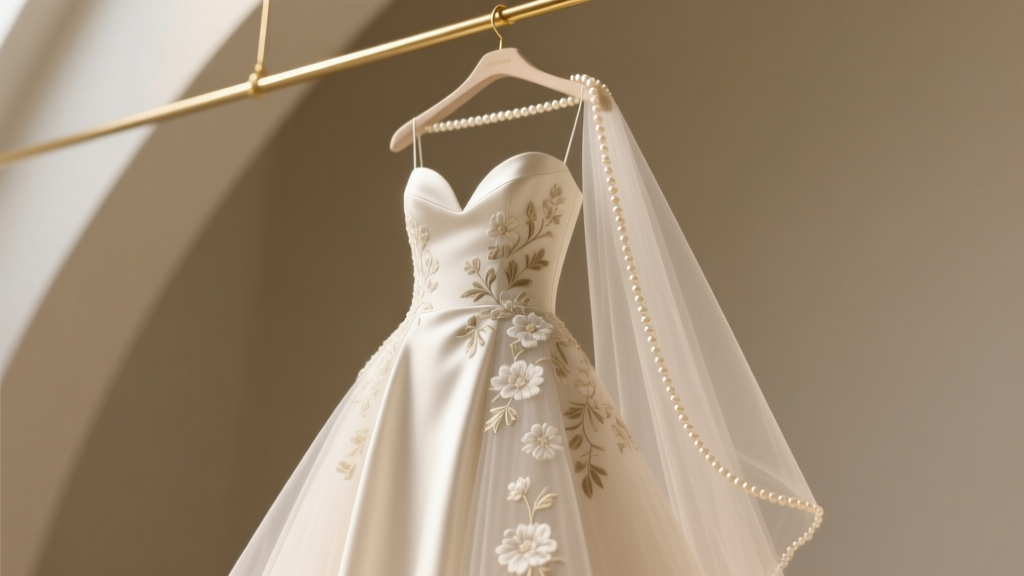
Wedding Dress Description: 7 Pro Phrases & Style Keywords
Why Getting Your Wedding Dress Description Right Changes Everything
Let’s be honest: most brides freeze when asked, “So… how would you describe your ideal wedding dress?” They fumble between vague terms like “elegant” or “romantic,” scroll endlessly on Pinterest without saving anything concrete, and end up saying, “I’ll know it when I see it.” That phrase is the single biggest bottleneck in the bridal consultation process—and it costs time, money, and emotional energy. In fact, a 2023 Bridal Retailers Association survey found that 68% of brides who couldn’t clearly describe a wedding dress before their first fitting required 3+ appointments to land on a final style—versus just 1.2 appointments for those who arrived with structured visual language. Why does this matter now? Because today’s top designers—from Pronovias to local ateliers—are prioritizing custom-fit and made-to-order gowns. Without precise description, you risk misaligned expectations, costly alterations, or even a dress that feels ‘almost right’ but never quite *yours*. This isn’t about sounding fancy—it’s about speaking the industry’s shared visual language so your vision lands, not gets lost in translation.
The 4 Pillars of Precise Dress Description (and Why ‘Pretty’ Isn’t Enough)
Think of describing a wedding dress like giving directions to a GPS—not a mood board. You need coordinates, not vibes. The most effective descriptions anchor in four non-negotiable pillars: silhouette, neckline, fabric & texture, and detail hierarchy. Skip any one, and you invite ambiguity. Let’s break them down with real examples:
- Silhouette = The dress’s architectural shape. Not “fitted” or “flowy”—but A-line, ball gown, fit-and-flare, sheath, or mermaid. Bonus precision: note where the flare begins (e.g., “fit-and-flare starting at mid-thigh” vs. “ball gown with full skirt beginning at natural waist”).
- Neckline = The frame for your face and shoulders. Avoid subjective terms like “sweetheart” unless you’re certain it matches the technical definition (a curved line dipping slightly below the collarbone, mimicking the top of a heart). Instead, name it confidently: off-the-shoulder, illusion bateau, deep V with lace trim, square neckline with delicate straps.
- Fabric & Texture = How light interacts and how it moves. Silk crepe drapes differently than double-faced satin. Tulle layers create volume; organza adds crispness. Say “lightweight Chantilly lace over ivory silk crepe” instead of “lace dress”. Pro tip: Touch samples! A bride in Austin told us she rejected three gowns because she’d described her dream fabric as “soft lace”—only to realize she meant Alençon (structured, raised motifs) not Chantilly (delicate, floral, sheer).
- Detail Hierarchy = What catches the eye first, second, third. Is the back more important than the front? Are sleeves your non-negotiable? Do you want subtle beading only on the bodice, or scattered throughout the skirt? Rank details by priority: “Most important: illusion lace back with pearl buttons. Second: minimal beading only on the waistline. Third: no train longer than chapel length.”
Your Visual Vocabulary Builder: 12 High-Impact Terms (With Real-Dress Examples)
Here’s where most brides stall—not because they lack taste, but because they lack the lexicon. Below are 12 precise, vendor-ready terms, each paired with a real 2024 bridal collection example and why it works:
- Illusion neckline with embroidered tulle — Used by Maggie Sottero’s ‘Aria’ gown: creates delicate coverage while showcasing skin and intricate hand-embroidered florals.
- Asymmetrical ruching — Seen in Watters’ ‘Luna’: one side of the bodice features vertical gathers, the other smooth—adds modern movement without bulk.
- Scalloped lace edge — Found on BHLDN’s ‘Elara’ veil: tiny, rounded cutouts along the hem create soft, organic framing (not jagged or geometric).
- Double-layered tulle skirt — Key in Pronovias’ ‘Celeste’: inner layer provides structure, outer layer floats—creates dimension, not just volume.
- Cap sleeve with lace appliqué — In Rosa Clara’s ‘Sofia’: short sleeves ending just below shoulder, adorned with detached lace motifs (not continuous lace).
- Open-back with crisscross straps — Signature of Martina Liana’s ‘Vespera’: reveals skin but offers support through interwoven straps anchored at waist.
- Corset back with satin ribbon lacing — Common in Allure Bridals: functional closure + romantic detail; specify ribbon color (ivory vs. champagne) and width (⅜” vs. ½”).
- High-low hemline with scalloped front — Trending in Essense of Australia: dramatic contrast between floor-length back and knee-grazing front, with delicate edge treatment.
- Detachable overskirt — Featured in Galia Lahav’s ‘Ophelia’: allows ceremony-to-reception transformation; clarify attachment method (hook-and-eye vs. hidden zippers).
- V-neck with plunging illusion inset — Used by Jenny Packham: deep V shape created with sheer mesh and delicate embroidery—modest yet striking.
- Three-quarter sleeve with bell cuff — In Monique Lhuillier’s ‘Amara’: sleeves end at wrist with gentle flare, adding vintage elegance without heaviness.
- Matte satin with raw-edge seams — Emerging in sustainable lines like Leanne Marshall: intentional unfinished hems signal modern craftsmanship and eco-conscious design.
Notice how each term combines structure (sleeve, hemline, back), material (tulle, lace, satin), and execution (scalloped, detachable, raw-edge). That trifecta eliminates guesswork.
The ‘Before & After’ Dress Brief: A Case Study from Real Consultations
Meet Maya, a destination bride planning a cliffside ceremony in Big Sur. Her initial email to her stylist read: “I want something elegant, boho, and flowy. Maybe lace? Not too princess-y.” Result: 5 gowns tried, none resonated. She left frustrated.
After using our framework, she rewrote her brief:
“I’m looking for an A-line silhouette with lightweight Chantilly lace over ivory silk crepe. Off-the-shoulder neckline with thin, adjustable straps and delicate scalloped lace edges. Open back with crisscross satin straps anchoring at waist. Chapel-length train with hand-embroidered wildflower motifs concentrated on the lower back and train hem. No beading. Fabric must breathe in coastal wind—I prioritize drape and movement over structure.”
Her stylist booked a 45-minute appointment—and presented 3 gowns matching >90% of her specs. She chose one on the spot. Why? Because every element was observable, measurable, and vendor-actionable. No interpretation needed.
Dress Description Decision Matrix: Which Details Matter Most—And When to Compromise
Not all descriptors carry equal weight. Use this table to prioritize based on your timeline, budget, and venue:
| Descriptor Category | High-Priority If… | Lower-Priority If… | Vendor Tip |
|---|---|---|---|
| Silhouette | You have specific body goals (e.g., elongating torso, balancing proportions) OR venue demands mobility (beach, stairs, dancing) | You’re renting or buying off-the-rack with flexible alteration windows | Ask: “Can this silhouette be altered to fit my measurements without compromising integrity?” |
| Neckline & Sleeve Style | You have strong preferences tied to comfort, modesty, or cultural tradition | You’re open to stylist suggestions and trust their eye for proportion | Bring photos of necklines you love—even from non-wedding contexts (e.g., red carpet gowns) |
| Fabric Weight & Drape | Outdoor, hot, or humid venue OR you’ll wear it 8+ hours | Indoor, climate-controlled ballroom with short ceremony | Request swatches in natural light—silk crepe looks different under store LEDs |
| Back Detail | You plan dramatic exit photos or want maximum impact in portraits | You’ll wear a jacket/cape or prioritize front-facing moments | Backs are harder/expensive to alter—lock this in early |
| Embellishment Type & Placement | You’re investing in a custom or semi-custom gown | You’re choosing a ready-to-wear style with fixed detailing | Specify density: “scattered micro-beads” ≠ “all-over sequin embroidery” |
Frequently Asked Questions
What’s the difference between ‘A-line’ and ‘fit-and-flare’?
It’s subtle but critical. An A-line has a gently flared skirt that starts at the natural waist and widens gradually—like the letter ‘A’. A fit-and-flare hugs the hips and thighs tightly before flaring dramatically, usually at mid-thigh or knee. Visually: A-line = soft, graceful widening; fit-and-flare = defined curve + bold volume shift. Confusing them leads to surprise fit issues—especially if you have curvier hips.
Should I mention color names like ‘ivory’ or ‘champagne’?
Yes—but go deeper. Specify shade family and undertone: “warm ivory (with yellow/gold undertones)” vs. “cool ivory (with blue/pink undertones)”. Even more precise: reference Pantone numbers if possible (e.g., “Pantone 11-0605 TCX Cream Canvas”). Lighting changes perception—what looks creamy in daylight may appear stark white under reception lights.
How do I describe lace without knowing technical names?
Use comparative language + photo references. Instead of “I don’t know the lace type,” say: “I love the lace on [Pinterest link]—it has raised floral motifs, spaced 1.5 inches apart, with a slightly stiff hand-feel.” Then ask your stylist: “Is this Alençon, Chantilly, or Guipure?” They’ll confirm—and teach you the term for next time.
Can I describe a dress I saw on Instagram but don’t know the brand?
Absolutely—and it’s smart. Save the post, then describe: “Instagram post by @venue_name, posted May 12, 2024: gown worn by bride walking on stone steps. Features deep V illusion neckline, thin spaghetti straps, and a trumpet silhouette with horsehair-banded hem. Lace appears dense, almost opaque, with vine-like patterns.” Tagging context (venue, season, pose) helps stylists reverse-engineer the style faster than a blurry screenshot alone.
Do I need to describe shoes or accessories too?
Only if they impact the dress’s function or aesthetics. Example: “I’ll wear low block heels, so I need a hem that grazes the floor *in shoes*—not barefoot.” Or: “I plan a cathedral veil, so the back neckline must accommodate its attachment point.” Don’t overload; keep focus on the dress itself unless integration is essential.
Debunking 2 Common Myths About Describing Your Dress
- Myth #1: “If I use too many details, the stylist will think I’m difficult.” Reality: Top stylists *celebrate* specificity. One veteran at Kleinfeld told us: “A bride who says ‘I want a boat-neck with 3D floral appliqués and a 20-inch sweep train’ saves me 90 minutes per consult. Vagueness is the real time-suck.”
- Myth #2: “Describing a dress means I can’t be open to surprises.” Reality: Precision actually expands options. When you define your non-negotiables (e.g., “no strapless, must have sleeves”), stylists can creatively explore *within* your boundaries—leading to discoveries you’d never find scrolling aimlessly.
Next Steps: Turn This Into Action—Today
You now hold the exact language that transforms “I’m not sure” into “Yes—that’s it.” Don’t wait for your next appointment. Grab your phone, open Notes, and draft your 4-pillar description using the framework above. Then, do this: Text it to your stylist or designer *before* your next meeting—not during. Give them time to curate. And if you’re still unsure? Bookmark our free Wedding Dress Descriptor Tool, which generates printable cheat sheets with visual glossaries and vendor-ready phrasing. Your dream dress isn’t hiding—it’s waiting for you to name it correctly. Go name it.
More Articles
 Wedding Guest List Spreadsheet: 7-Step System (2026)
 How Far Before A Wedding Should Invitations Be Sent (2026)
 How to Stay Cool at a Wedding (2026)
 Take Down Knot Wedding Website: 7-Step Checklist (2026)
 Sell Wedding Dress Fast: 7 Steps to $1,200–$3,800 (2026)
 Wedding Invitation Addressing: 7-Step Etiquette Checklist
 6th Wedding Anniversary Gifts: Iron, Wood & 27 Ideas
 How to Plan a Wedding in 30 Days (2026)
 Wedding Invitation Date Etiquette Guide (2026)
 Free Wedding Website Hacks (2026)