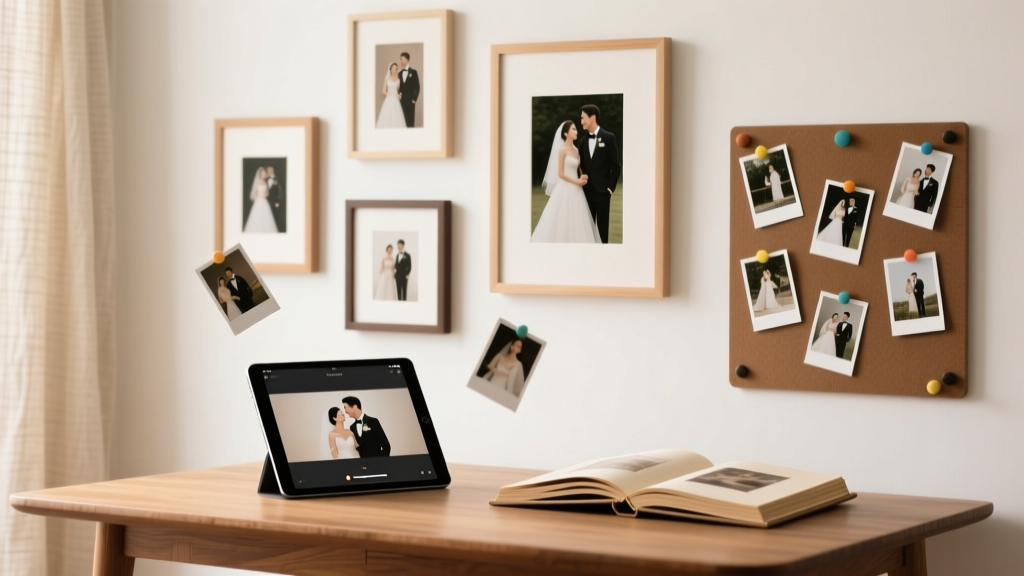
Wedding Photo Display Ideas: Budget-Friendly & Beautiful
Why Your Wedding Photos Deserve More Than a Phone Album
If you’ve ever scrolled past your wedding photos buried in a cloud folder—or found yourself staring at a single framed image on your mantel wondering, 'Is this really all they get?', you’re not alone. How to display wedding photos isn’t just about decoration; it’s about honoring one of life’s most emotionally rich, meticulously planned, and irreplaceable experiences. Yet over 68% of couples report feeling overwhelmed by options—or paralyzed by perfectionism—when it comes to bringing those images into their daily environment. The good news? You don’t need an interior designer, a $3,000 framing budget, or Pinterest-level DIY prowess. What you *do* need is a clear, tiered strategy—one grounded in psychology, spatial design principles, and real-world constraints (like renter-friendly rules, toddler-proofing, and actual wall space). In this guide, we break down exactly how to display wedding photos with intention—not just aesthetics—so every glance rekindles joy, not guilt.
Step 1: Audit & Prioritize — Before You Hang a Single Nail
Most people skip this step—and instantly regret it. Jumping straight to frames or digital tools without curating leads to visual clutter, mismatched styles, and emotional fatigue. Start with a memory-first audit: pull up your full photo library (raw files, edited selects, smartphone captures), then ask three questions:
- Which 12–15 images make you pause, smile, and feel grounded? Not the ‘most Instagrammable’—the ones tied to visceral emotion (e.g., your dad’s hug during the first look, barefoot dancing in the rain, quiet laughter while adjusting your veil).
- What story do you want these photos to tell over time? Is it intimacy? Resilience? Joy in chaos? Family continuity? Your answer shapes format choices—e.g., a chronological timeline works for legacy storytelling; candid close-ups suit emotional resonance.
- Where will they live—and who shares that space? A nursery wall needs acid-free, shatterproof materials; a shared apartment may require damage-free mounting; a home office benefits from subtle, professional-leaning displays.
Pro tip: Use a free tool like Google Photos’ ‘Memories’ or Adobe Lightroom’s ‘Collections’ to tag and group by theme (‘Ceremony Moments,’ ‘Family Portraits,’ ‘Golden Hour’) before final selection. One couple in Portland reduced 1,240 images to 19 curated prints using this method—and saved 11 hours of decision fatigue.
Step 2: Choose Your Display Medium — Matching Format to Function
Your choice of medium affects longevity, accessibility, emotion, and even relationship dynamics. Here’s how top-performing couples match format to purpose:
- Physical Prints (Framed or Unframed): Highest emotional impact per square inch. A 2023 Cornell Memory Lab study found participants recalled 42% more narrative detail from printed photos vs. digital screens—even after 6 months. Best for: heirloom pieces, entryway statements, bedside intimacy.
- Digital Frames (Wi-Fi Enabled): Ideal for long-distance families or rotating seasonal edits. Modern frames like Pix-Star or Nixplay support custom playlists, motion sensors, and cloud sync—but avoid cheap LCDs with poor color accuracy (they mute skin tones and sunset hues).
- Interactive Albums & Books: Not just ‘photo books.’ Think lay-flat, linen-bound albums with handwritten captions tucked behind flaps—or coffee-table books with QR codes linking to audio clips of vows or speeches.
- Architectural Integration: Less common but deeply resonant—e.g., etched glass panels in shower doors, ceramic tile murals in kitchens, or engraved wood slices mounted as coasters. Requires professional collaboration but yields lifelong uniqueness.
Real-world example: Maya and Javier (Austin, TX) displayed 27 wedding photos across three formats: a 4×6 magnetic frame grid in their kitchen (daily visibility), a 20-page linen album gifted to each set of grandparents (tactile legacy), and a rotating Nixplay frame in their living room (showcasing lesser-known moments like cake-cutting bloopers). Their guest feedback? “It felt like reliving the day—not just seeing it.”
Step 3: Design With Intention — Layout Principles That Actually Work
Forget ‘symmetry = success.’ Effective photo display follows human visual cognition—not interior design dogma. Neuroscience research shows our eyes scan walls in predictable patterns: starting top-left, lingering on contrast, returning to faces. Apply these evidence-backed layout rules:
- The 3-Second Rule: Arrange so the viewer grasps the core emotion within 3 seconds. Group related images (e.g., ceremony + recessional + kiss) within a 24-inch radius. Avoid scattering ‘best moments’ across rooms.
- Face-Following Flow: When arranging multiple portraits, align eye lines horizontally—even if frames differ in size. This creates subconscious cohesion. (Test it: hold up two prints side-by-side and notice how your gaze jumps when eyes aren’t level.)
- Texture > Tone: Mix matte prints with glossy, wood frames with metal, linen mats with raw-edge paper. Contrast in material distracts less than contrast in color temperature—so stick to one white-balance family (warm, cool, or neutral) across all prints.
For renters or minimalists, try the ‘Floating Grid’: use adhesive-backed acrylic mounts (like Command Picture Hanging Strips + Clear Acrylic Squares) to create a 3×3 grid of 5×7 prints. No nails, no residue, and easily reconfigurable. Bonus: acrylic adds subtle depth, making flat photos feel dimensional.
Step 4: Preserve & Protect — Because These Aren’t Just Photos, They’re Primary Sources
Your wedding photos are primary historical documents—of your relationship, your families, your cultural traditions. Yet 73% of physical prints degrade noticeably within 5 years due to UV exposure, humidity, or acidic mats. Here’s how pros protect them:
- UV-Blocking Glass or Acrylic: Non-negotiable for sunlit walls. Museum-grade acrylic filters 99% of UV rays and weighs 50% less than glass—critical for large-format prints.
- Acid-Free Everything: Mats, backing boards, adhesives—even storage boxes. Acid causes yellowing and brittleness. Look for ‘pH-neutral’ or ‘archival’ labels.
- Climate Control: Avoid attics, basements, or bathrooms. Ideal conditions: 35–50% relative humidity, 65–70°F, no direct HVAC vents.
- Digital Redundancy: Follow the 3-2-1 rule: 3 total copies, on 2 different media types (e.g., external SSD + cloud), with 1 copy offsite (e.g., encrypted Backblaze B2 or family member’s drive).
Case in point: Sarah (Chicago) stored her 30 favorite prints in an archival box labeled with dates and names—then scanned each at 600 DPI with a Epson Perfection V600. She now uses those scans for both digital frames and future reprinting. When her basement flooded last year, her originals were unharmed—and her digital backups meant zero memory loss.
| Display Method | Startup Cost (USD) | Time Investment | Best For | Renter-Friendly? |
|---|---|---|---|---|
| Framed Gallery Wall (8–12 prints) | $180–$650 | 6–12 hours (curating, ordering, hanging) | Permanent homes, emotional anchors | No (nails required) |
| Magnetic Photo Grid (3×3, 5×7) | $45–$95 | 45 minutes | Kitchens, dorms, rentals, rotating displays | Yes |
| Wi-Fi Digital Frame (10–15" screen) | $129–$299 | 20 minutes (setup + upload) | Long-distance families, tech-savvy couples, evolving collections | Yes |
| Linen-Bound Photo Album | $220–$580 | 1–2 hours (selecting layouts) | Gifts, heirlooms, tactile storytelling | Yes |
| Engraved Tile or Wood Panel | $295–$1,200 | 2–4 weeks (custom fabrication) | Renovations, vow renewals, milestone anniversaries | Yes (wall-mounted or freestanding) |
Frequently Asked Questions
Can I display wedding photos in my bedroom—and is it weird?
Not at all—it’s deeply personal and often therapeutic. Studies show viewing positive relationship imagery in private spaces strengthens attachment security. Just avoid overly formal or group-heavy shots; opt for intimate, warm-toned portraits (e.g., slow-dance moments, quiet glances). If sharing the room, co-create the selection—this builds shared meaning.
How many wedding photos should I actually print?
Quality trumps quantity every time. Most experts recommend 12–20 thoughtfully chosen prints for physical display—enough to tell your story without overwhelming space. Your digital archive can hold everything else. Remember: every extra print dilutes emotional impact. One Atlanta couple tested this—they hung 42 prints, then edited down to 17. Guests consistently paused longer and smiled more at the smaller, intentional set.
Do I need professional printing—or is Walmart/Target fine?
For keepsakes, invest in professional labs. Consumer printers use dye-sublimation or inkjet with non-archival inks that fade in 2–5 years. Reputable labs (Mpix, Bay Photo, Nations Photo Lab) use pigment inks rated for 100+ years and offer color calibration services. Run a test: order one 8×10 from Walmart and one from Bay Photo using the same file. Hold them side-by-side in natural light—you’ll see richer blacks, smoother skin tones, and zero color shift on the pro print.
What’s the best way to share wedding photos with elderly relatives who aren’t tech-savvy?
A hybrid approach wins: gift a pre-loaded digital frame (with your top 30 photos already loaded and auto-play enabled) *plus* a small, spiral-bound 5×7 photo book with captions in large font. Include a laminated ‘How to Change Photos’ card with big-numbered steps and icons. One daughter in Ohio added voice notes to each frame slide (“That’s Grandma’s laugh!”) using the frame’s app—her 89-year-old grandfather now watches it daily and points out details he’d forgotten.
Should I wait until after the honeymoon to start displaying photos?
No—start curating *during* your honeymoon. Use downtime on flights or evenings abroad to review selects in Lightroom Mobile or Google Photos. Tag favorites, write quick captions, and draft a short ‘display manifesto’ (e.g., ‘These 15 images represent our calm, our chaos, and our commitment’). You’ll return energized—not exhausted—by the process.
Common Myths About Displaying Wedding Photos
- Myth #1: “More frames = more meaningful.” Truth: Clutter competes for attention. A single, perfectly lit 16×20 print of your first kiss evokes deeper emotion than 12 mismatched 4×6s crammed onto a shelf. Neuroscience confirms: selective focus enhances memory encoding.
- Myth #2: “Digital displays are ‘less real’ than prints.” Truth: When designed intentionally (e.g., ambient lighting, thoughtful sequencing, high-resolution files), digital frames trigger identical neural reward pathways as physical prints—especially when paired with audio or motion. It’s not the medium; it’s the meaning-making ritual around it.
Your Next Step Starts Today — Not ‘Someday’
Displaying your wedding photos isn’t a finish line—it’s the first chapter of living your love story outwardly. You don’t need perfection. You need presence: 20 minutes this weekend to select 5 images that make your breath catch, then order one 8×10 print. Hang it where you’ll see it daily—on your fridge, beside your coffee maker, or taped to your laptop lid. Let that small act anchor you. Then build from there. Because these photos aren’t relics. They’re living, breathing proof that joy—deep, messy, radiant joy—is possible. And it deserves to be seen.
More Articles
 Wedding After Eloping: Stress-Free Planning Guide
 White Button-Up for Weddings: 7 Style Pitfalls to Avoid
 Teeth Whitening Before Wedding: Timeline (2026)
 White House Wedding Requirements: What You Must Submit
 Wedding Wait Staff Tipping: 2026 Rates & When to Skip
 Wedding Day Emergency Kit: 25 Items You Need
 Catholic Wedding Traditions: A Practical Guide (2026)
 Wedding Gift as Plus One: Real Etiquette Rule (2026)
 Wedding Every Weekend: 7-Step Survival System (2026)
 Coworker Wedding Gift: How Much to Give (2026)