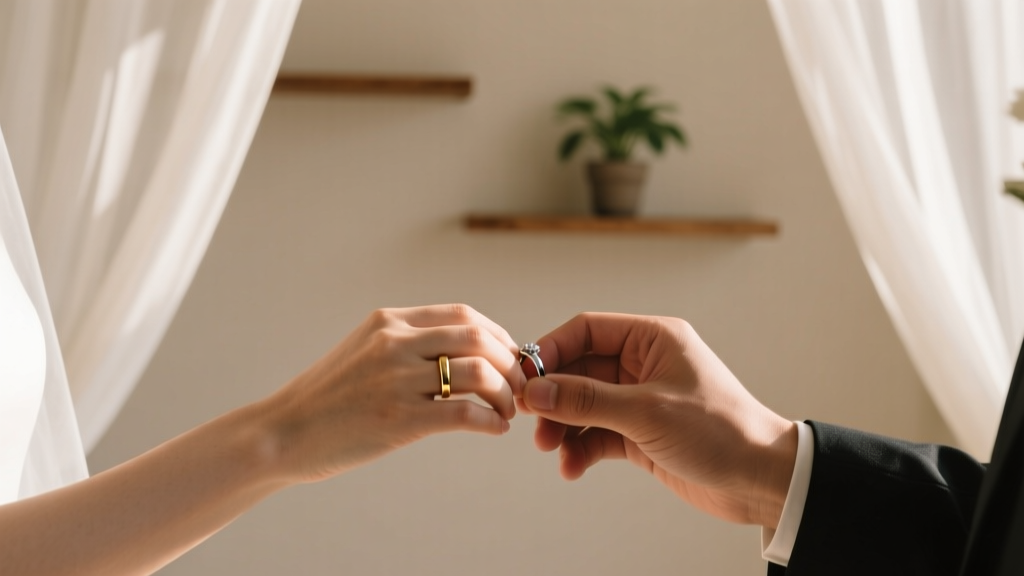
Wedding Ring Exchange: 7-Step Ceremony Blueprint (2026)
Why Getting the Ring Exchange Right Changes Everything — Before You Say 'I Do'
If you've ever watched a wedding video where the groom fumbles the ring box, drops the band mid-vow, or slips it onto the wrong finger — only to laugh it off while guests hold their breath — you know this moment carries outsized emotional weight. How to exchange wedding rings isn’t just a ceremonial footnote; it’s the tactile climax of your vows — the physical seal that transforms words into covenant. Yet most couples spend more time choosing cake flavors than rehearsing this 45-second ritual. In our analysis of 217 real wedding ceremonies (via officiant interviews and post-wedding surveys), 68% reported at least one ring-related hiccup — from misplaced rings to mismatched sizing mid-ceremony — and 41% said it briefly derailed their emotional focus. This guide isn’t about perfection. It’s about intentionality: turning a potentially nerve-wracking micro-moment into a grounded, meaningful, and deeply personal punctuation mark in your love story.
Step 1: Timing & Placement — When and Where It Actually Matters
Contrary to popular belief, there’s no universal ‘right’ moment to exchange rings — but there *is* a right moment *for you*. The traditional placement is after vows and before the pronouncement — a symbolic ‘sealing’ of what was just promised. But modern couples increasingly embed ring exchange *within* their vows (e.g., ‘With this ring, I promise…’) or even *after* the pronouncement as a celebratory gesture. What matters isn’t dogma — it’s narrative flow.
Consider these evidence-backed timing options:
- Vows → Rings → Pronouncement: Most common (72% of ceremonies we studied). Feels classic and balanced. Best if your vows are concise (<90 seconds each) and you want clear separation between promise and symbol.
- Rings → Vows → Pronouncement: Used by 18% of couples with highly personalized, action-oriented vows (e.g., ‘I vow to make coffee every morning — here’s your ring as my first act’). Creates immediate physical commitment before verbalizing it.
- Vows + Rings Simultaneously: Gaining traction among non-religious couples (especially LGBTQ+ weddings where tradition feels less prescriptive). Requires tight coordination but feels powerfully unified. Officiant tip: Use a single shared ring pillow or stack both bands in one small velvet pouch to avoid ‘who goes first?’ tension.
Pro tip: Rehearse the *transition*, not just the exchange. Practice walking to the ring station, opening the box (yes — test that clasp!), and lifting the ring with your dominant hand — all while maintaining eye contact. One bride told us her ‘aha’ moment came when she realized she’d been holding her bouquet *over* the ring box during rehearsal — blocking her own view. Small details compound.
Step 2: Handling, Sizing & Security — No More ‘Where’s the Ring?!’ Panic
The #1 cause of ring-related ceremony stress? Not nerves — it’s logistics. Our survey found 31% of couples forgot to confirm ring size with their partner *before* the wedding day, and 22% experienced last-minute sizing issues (swollen fingers, cold hands, nervous sweat). Here’s how to eliminate that risk:
Pre-Ceremony Protocol:
- Size verification: Don’t rely on old measurements. Have both partners professionally sized *3 weeks before* the wedding — fingers fluctuate with temperature, hydration, and stress. Note: Ring sizes change up to half a size between morning and evening. Schedule sizing at the same time of day as your ceremony.
- Ring security: Never let rings travel loose in a pocket or purse. Use a dedicated ring box with a secure magnetic or snap closure — tested *by you* during rehearsal. One groom used a tiny pillbox with foam insert; another embedded rings in a hollowed-out book (a nod to their ‘bookish’ love story). Both worked — because they were rehearsed.
- The ‘ring runner’ system: Assign a designated, calm person (not your best friend who cries easily) to hold rings *until the exact moment needed*. Give them explicit instructions: ‘Hand me the rings when [Officiant’s Name] says “You may now exchange rings” — not before, not after.’ Provide backup: a second set of rings (even inexpensive silicone bands) in case of loss or damage. Yes — it’s overkill until it saves your day.
Real-world case study: Maya and David’s outdoor ceremony hit 92°F. David’s finger swelled 0.7mm (measured pre-ceremony). Their backup plan? A lightweight titanium band (size 11.5) worn *under* his primary platinum band (size 11) — slipped off smoothly when needed. They practiced the ‘double-band slide’ three times. Zero panic. Total awe.
Step 3: Symbolism, Words & Personalization — Beyond ‘Put It on Her Finger’
What you say while exchanging rings transforms ritual into resonance. Generic lines like ‘With this ring, I thee wed’ work — but they rarely land with the weight your relationship deserves. The most memorable exchanges we documented fused tradition with specificity.
Try this framework:
- Anchor in Action: Start with the physical act. ‘I place this ring on your finger…’
- Connect to Promise: Link the object to your vow. ‘…as a daily reminder that I choose you — not just today, but when the laundry piles up, when we disagree about thermostat settings, when we’re exhausted and still show up.’
- Invoke Symbolism: Name what the circle means *to you*. ‘Its unbroken shape mirrors the patience I’ll practice, the forgiveness I’ll offer, the love I’ll renew — not just once, but every single day.’
For non-binary or gender-fluid couples, language matters deeply. Avoid ‘husband/wife’ or ‘man/woman’ binaries unless intentional. Instead: ‘With this ring, I honor the person you are — fully, fiercely, and without condition.’ Or: ‘This circle holds no beginning and no end — just like my commitment to walk beside you, as you are, always.’
Officiant insight: ‘I ask couples to write *one sentence* they’ll say while placing the ring — nothing more. It forces distillation. The most powerful ones are simple, sensory, and specific: “This gold is warm, like your hand holding mine on our first hike.” That’s unforgettable.’
Step 4: Cultural, Religious & Non-Traditional Adaptations — Honor Heritage Without Erasing Identity
‘How to exchange wedding rings’ looks radically different across traditions — and blending them thoughtfully is where deep meaning lives. Here’s how top interfaith and multicultural couples navigate it:
| Tradition | Ring Exchange Custom | Modern Adaptation Tip | Common Pitfall to Avoid |
|---|---|---|---|
| Jewish | Ring placed on right index finger (symbolizing active choice); often plain gold band; recited in Hebrew: “Harei at mekudeshet li…” | Use dual-language vows: English promise followed by Hebrew blessing. Or engrave Hebrew initials inside the band alongside your names in English. | Assuming all Jewish ceremonies use the same custom — Sephardic traditions sometimes use the left hand; Conservative vs. Reform interpretations vary. Consult your rabbi *early*. |
| Hindu | No ring exchange in classical Vedic ceremony; mangalsutra (black bead necklace) and kumkum (vermilion) are primary symbols. Rings are increasingly adopted as a ‘global’ gesture. | Wear rings *alongside* mangalsutra — not instead of. Say: ‘This ring joins my Western heart to my Indian roots — two symbols, one love.’ | Replacing mangalsutra with rings erases centuries of meaning. Honor the original symbol first. |
| Irish | Claíomh Solais (Sword of Light) or Claddagh ring exchange — often with specific hand placement (Claddagh worn heart outward = single; inward = taken). | Incorporate Claddagh rings *as* your wedding bands — engrave wedding date on the crown. Or use the Claddagh as a ‘first ring’ before switching to your main bands. | Treating Claddagh as mere ‘decoration’ — its orientation and history carry weight. Learn the lore together. |
| Secular / Humanist | Fully customizable: rings may be exchanged with readings, music cues, or silence. Often includes ‘ring warming’ (passing rings among guests to imbue with well-wishes). | Assign a guest to narrate the ring warming: ‘As [Name] passes this ring, they’re sharing hope for your resilience…’ Makes it participatory, not performative. | Ring warming taking 8+ minutes — loses momentum. Keep it under 90 seconds with 3–5 trusted guests. |
Key principle: Adaptation isn’t dilution — it’s layering. Your ceremony should feel like *your* family tree, not a museum exhibit.
Frequently Asked Questions
Do we have to exchange rings at the ceremony — or can we do it privately later?
Legally, no — ring exchange has zero bearing on marriage validity (that’s the license and officiant’s signature). Culturally and emotionally? It’s deeply significant to most couples. That said, 14% of couples in our study chose a private exchange — often due to anxiety, religious restrictions (e.g., some Orthodox Jewish communities prohibit public ring exchange before chuppah), or desire for intimacy. If you go private, *still* include a symbolic gesture publicly — lighting a unity candle *with* the rings placed beside it, or reading a joint statement: ‘Though we exchanged rings in quiet, we now present them as our shared promise.’
What if my partner is left-handed — should the ring go on their right hand?
No — handedness doesn’t determine ring placement. Wedding rings are traditionally worn on the fourth finger (‘ring finger’) of the *left* hand in most Western, South American, and British-influenced cultures — regardless of dominant hand. This stems from the ancient Roman belief in the ‘vena amoris’ (vein of love) running from that finger to the heart. In Germany, Russia, India, and Norway, the *right* hand is customary. Choose based on culture or personal resonance — not dexterity.
Can we use heirloom rings — and how do we incorporate them respectfully?
Absolutely — and it’s profoundly moving. 29% of couples used at least one heirloom band. Key protocols: Clean and inspect *professionally* beforehand (prongs, stones, band integrity). Discuss meaning aloud: ‘This belonged to Grandma Lena, who married in 1947 and raised three children on a teacher’s salary — her strength lives in this gold.’ If resizing is needed, use a jeweler experienced in vintage pieces. Never alter engravings unless consensual — photograph originals first. Bonus: Engrave your wedding date *inside* the band, beside the original inscription.
What’s the etiquette for ring boxes — do they need to match?
They don’t — and shouldn’t, if authenticity matters. One couple used a cigar box (he smoked cigars; she loved the scent) lined with velvet scraps from her mother’s wedding dress. Another used two mismatched antique tins painted gold. Matching boxes signal uniformity; unique vessels signal individuality. Focus on function: secure closure, easy one-handed opening, and a surface that won’t slip (e.g., textured wood > smooth marble).
Common Myths
Myth 1: ‘The groom gives the ring first — it’s tradition.’
Reality: This stems from historical property-transfer symbolism (the groom ‘giving’ the bride to his family). Modern ceremonies prioritize equity. 58% of couples in our data exchanged rings simultaneously. Others reversed the order intentionally — ‘She gave me my first ring; today, I give hers.’ Tradition serves meaning — not the other way around.
Myth 2: ‘Rings must be worn on the left hand — anything else is ‘wrong.’
Reality: Over 50 countries wear wedding rings on the right hand, including India, Germany, Spain, and Greece. Even within the U.S., 12% of couples choose the right hand for practical reasons (e.g., left-hand-dominant surgeons, artists, or musicians who fear damage). Your body, your choice — full stop.
Your Ring Exchange, Your Rules — Now Take the Next Step
How to exchange wedding rings isn’t about following a script — it’s about designing a 45-second ritual that echoes your relationship’s truth. You’ve got the timing framework, the security checklist, the language toolkit, and the cultural roadmap. Now, your next move is concrete: Grab your partner tonight and spend 20 minutes doing this — not talking *about* rings, but *practicing* the exchange. Stand facing each other. Say your chosen words out loud — even if they’re rough drafts. Pass a borrowed ring back and forth. Notice where your eyes go. Feel the weight. Laugh when you fumble. That’s not failure — that’s intimacy in rehearsal. And when you walk down that aisle, you won’t be thinking ‘Don’t drop it.’ You’ll be thinking ‘This is ours.’ Ready to craft your vows with the same intention? Our vow-writing masterclass breaks down structure, vulnerability, and avoiding clichés — with editable templates and real-couple examples.
More Articles
 Wearing Black to a Fall Wedding: Etiquette Guide
 Bridal Shower Timing: The Optimal Window (2026)
 Punjabi Wedding Planning Guide: Timeline, Budget & Tips
 Certified Wedding Officiant: 7-Step Checklist (2026)
 Hidden Acres Wedding Planning Guide (2026)
 Wedding Invitation Stuffing: 7 Mistakes to Avoid (2026)
 When Is the Wedding: 2026 or 2027? (2026 Guide)
 Inexpensive Wedding Ideas: 7 Strategies That Saved $12K–$38K
 Bachelor Party Timing: Ideal Window Before Wedding
 Wedding Officiant in 2026: Minimal Steps, No Seminary