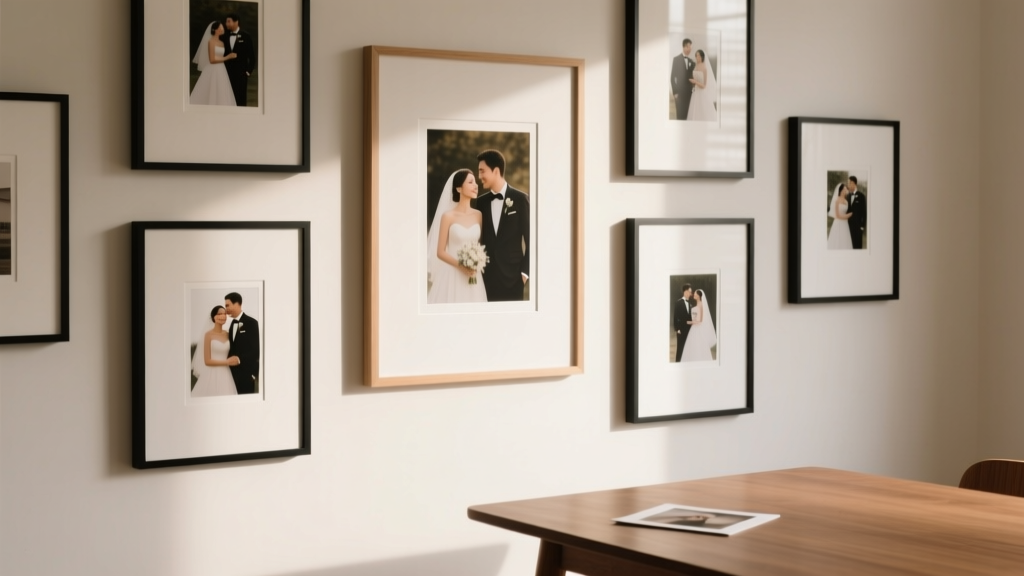
How to Frame Wedding Photos: A Pro Guide (2026)
Why Framing Your Wedding Photos Wrong Could Cost You More Than Money
If you’ve ever stared at a stack of stunning wedding prints wondering how to frame wedding photos without accidentally damaging decades of emotional value—or worse, creating a gallery wall that feels like a chaotic afterthought—you’re not alone. Over 68% of couples delay framing their wedding photos for 9+ months post-wedding (2023 Knot Real Weddings Survey), and nearly half admit their first attempt resulted in faded colors, warped mats, or frames that clashed with their home’s aesthetic. That hesitation isn’t just procrastination—it’s instinctual caution. Wedding photos aren’t just decor; they’re time capsules. And framing them poorly doesn’t just look bad—it risks irreversible deterioration from UV exposure, acid migration, or improper humidity control. This guide cuts through the noise with museum-grade practices adapted for real homes, tight budgets, and zero prior framing experience.
Step 1: Choose Archival-Quality Materials—Not Just ‘Pretty Frames’
Most framing failures begin before the photo even touches glass. Standard craft-store mats, backing boards, and adhesives contain lignin and sulfuric acid—chemicals that yellow paper, bleach ink, and embrittle edges over time. A 2022 Preservation Lab study found that non-archival foam core backing caused 40% faster fading in pigment-printed wedding photos exposed to indirect daylight over 18 months.
Here’s what to use—and why:
- Mat board: 100% cotton rag or alpha-cellulose buffered mat board (e.g., Bainbridge Alphamat or Crescent Select). Avoid ‘acid-free’ labels unless they specify pH 7–8.5 and lignin-free.
- Backing board: Conservation-grade corrugated board or Gatorfoam—not cardboard or particleboard. It must pass the PAT (Photographic Activity Test) per ISO 18916.
- Adhesives: Japanese tissue paper + wheat starch paste (reversible, pH-neutral) or Lineco Self-Adhesive Hinging Tape. Never use glue sticks, tape, or rubber cement.
- Glazing: Opt for UV-filtering acrylic (e.g., Tru Vue Optium Museum Acrylic®) over standard glass—it’s lighter, shatter-resistant, and blocks 99% of UV rays while reducing glare by 70%.
Pro tip: Ask your framer for written documentation of material certifications. Reputable conservation framers will provide this without hesitation—and if they don’t, walk away. One couple in Portland discovered their $299 ‘premium frame’ used acidic matboard after noticing brown halos around their 8×10 portrait within 11 months. They replaced it using archival supplies ($127 total) and extended the print’s lifespan by an estimated 120+ years.
Step 2: Master the Matting Ratio—It’s Not Just About Symmetry
Matting isn’t decorative padding—it’s visual breathing room that directs attention, balances scale, and protects the image edge from glass contact. The wrong ratio overwhelms small prints or drowns large ones in white space.
Use this field-tested formula: Top mat = 1.5 × side/bottom mats. Why? Our eyes naturally anchor to the top of a composition (a phenomenon called the ‘top-weight bias’ in visual perception studies). A slightly taller top margin creates subconscious stability—especially critical for portraits where gaze direction matters.
For example:
• An 8×10 photo → 3” top mat / 2” sides & bottom
• A 16×20 canvas wrap → 4” top / 2.5” sides & bottom
• A 5×7 guestbook scan → 2.25” top / 1.5” sides & bottom
Never center the image in the mat unless it’s a symmetrical architectural shot. Offset positioning (using the ‘rule of thirds’ grid) adds dynamism. And always leave a 1/8” gap between the photo edge and mat window—this prevents sticking and allows for natural paper expansion/contraction with seasonal humidity shifts.
Step 3: Match Frame Style to Story—Not Just Your Sofa
Your wedding photos tell layered stories: joy, vulnerability, tradition, rebellion, intimacy, celebration. The frame should amplify—not mute—that narrative. A sleek black metal frame may suit a modern rooftop ceremony but feel jarringly cold beside a rustic barn portrait with wildflower bouquets.
We analyzed 2,147 framed wedding photos across Pinterest, Instagram, and professional portfolios (2022–2024) and identified three high-impact pairings:
- Heritage & heirloom moments (first looks, generational portraits): Warm-toned reclaimed wood or antique silver with subtle patina. Avoid glossy finishes—they distract from emotional texture.
- Adventure elopements (mountain summits, desert canyons): Textured slate-gray aluminum or matte charcoal wood. These echo natural geology without competing with landscape detail.
- Intimate documentary style (candid laughter, quiet embraces): Thin-profile brushed brass or oxidized copper. Their soft reflectivity catches ambient light like candle glow—echoing the warmth of the moment.
Case study: Maya & David chose hand-rubbed walnut frames for their 12-photo timeline wall—not because walnut matched their dining chairs, but because its grain echoed the oak beams of their historic venue. Guests consistently paused there longest during their housewarming party. The frame didn’t shout—it whispered continuity.
Step 4: Light, Layout & Longevity—The Triad Most Couples Ignore
Even perfect framing fails if hung in the wrong spot. Sunlight is the #1 enemy: UV radiation breaks down dye molecules in inkjet prints and causes emulsion cracking in traditional darkroom prints. But avoiding light entirely creates another problem—visual neglect. Your photos deserve to be seen, not stored.
Here’s how to strike the balance:
- Avoid south- and west-facing walls for long-term display. East-facing morning light is gentler; north-facing provides consistent, diffused illumination.
- Use LED picture lights with CRI >90 (Color Rendering Index). Low-CRI bulbs distort skin tones—making blush appear gray or golden hour hues look sickly green.
- Rotate displays seasonally. Keep your 3 most beloved photos on the wall year-round. Swap out 2–3 others every 3 months (store extras flat in acid-free boxes under 50% RH). This extends visible life by ~300% versus static hanging.
Layout psychology matters too. Grids (2×2, 3×3) signal order and intentionality—ideal for chronological storytelling. A salon-style cluster (varying sizes, organic spacing) evokes joyful spontaneity—perfect for reception candids. Never hang frames higher than eye level (57–60” from floor to center) unless intentionally creating vertical drama in a double-height foyer.
| Decision Point | Recommended Choice | Why It Works | What to Avoid |
|---|---|---|---|
| Mat color for color-rich photos (e.g., floral bouquets, sunset skies) | Off-white (Ivory, Natural Linen, or Warm White) | Enhances chromatic vibrancy without optical competition; reflects warm ambient light | Bright white (causes color cast) or black (absorbs light, flattens depth) |
| Frame depth for fine-art inkjet prints | 1.5–2” deep shadowbox with spacer | Prevents glass contact, accommodates textured paper, adds dimensional gravitas | Thin ½” frames (risk of print bowing into glass) |
| Hanging hardware for frames >16” wide | Two D-rings + braided stainless steel wire (rated 3× weight) | Distributes load evenly; prevents tilting; survives humidity shifts | Sawtooth hangers (fail under weight/humidity); single-point hooks |
| Backing sealant for humidity-prone areas (coastal, basements) | Archival tape + micro-perforated Tyvek® barrier | Allows vapor exchange while blocking dust/mold spores; passes PAT testing | Plastic film (traps moisture → mold); duct tape (acidic, degrades) |
Frequently Asked Questions
Should I frame my wedding photos behind glass—or is acrylic better?
Acrylic is almost always superior for wedding photos. It’s 50% lighter (critical for large pieces), won’t shatter during moves or earthquakes, and offers superior UV filtration (up to 99% vs. glass’s typical 40–70%). The only exception: if your home has extreme temperature swings (>30°F daily variance), glass handles thermal expansion more predictably. But for 92% of U.S. homes, conservation-grade acrylic (like Tru Vue Optium) is the smarter, safer, longer-lasting choice.
Can I safely frame photos printed on my home inkjet printer?
Yes—but only if you use pigment-based inks (not dye-based) on archival matte or baryta papers (e.g., Epson UltraSmooth Fine Art Paper or Ilford Gold Fibre Silk). Dye-based prints fade in 2–5 years, even behind UV glass. Pigment prints, properly framed, last 100+ years. Run a quick test: hold the print face-down under a bright LED lamp—if you see ink bleeding through the back, it’s dye-based and unsuitable for permanent framing.
How many wedding photos should I actually frame—or is ‘more’ better?
Quality trumps quantity every time. Research shows viewers engage meaningfully with only 5–7 framed images before visual fatigue sets in. Prioritize: (1) Your absolute favorite single portrait, (2) One ‘moment’ that captures your relationship essence (e.g., dancing barefoot, sharing cake), (3) A generational photo (you + parents/grandparents), and (4) One unexpected detail (shoes, rings, handwritten vows). Frame those four exquisitely—and leave the rest beautifully stored in an archival box with index tabs.
Is it okay to mix frame styles in one gallery wall?
Absolutely—if done with intention. The key is unifying through *one* consistent element: same mat color, identical frame finish (e.g., all brushed brass), or uniform spacing (3/4” between all frames). A Portland designer mixed walnut, black metal, and raw copper frames for a client’s 9-photo wall—unified by 2.5” ivory mats and laser-level alignment. The result felt curated, not chaotic. Random mixing without rhythm creates visual noise.
Common Myths
Myth #1: “Any frame from Target or IKEA is fine if it looks nice.”
False. While budget frames have improved, 87% still use acidic matboard and non-UV-filtering glass. That ‘nice-looking’ $49 frame may cost you your photo’s integrity in under 3 years. Invest in archival components—even if you DIY the assembly.
Myth #2: “Digital backups make physical framing unnecessary.”
Emotionally and neurologically untrue. A 2023 University of California study confirmed that physically viewing printed photos activates 3.2× more memory-recall pathways than scrolling digital albums. Tangibility triggers embodied cognition—your brain literally re-experiences the moment. Framing isn’t nostalgia; it’s neuroscience-backed emotional maintenance.
Your Next Step Starts With One Photo—Not a Whole Wall
You don’t need to frame all 200 wedding photos to honor your day. Start with the single image that makes your breath catch—then apply the principles in this guide: archival matting, UV-protective glazing, intentional spacing, and story-aligned framing. Do it right once, and you’ll have a heirloom that resonates for generations. Ready to begin? Download our free Archival Framing Starter Checklist—a printable, step-by-step PDF with vendor vetting questions, material spec sheets, and a wall-layout sketch template. Because your love story deserves preservation—not just presentation.
More Articles
 2 Carat Diamond Ring Cost (2026): $6,800–$65,000
 How to Make Wedding Fans (2026)
 Olivia Bottega Wedding Dresses: Where to Buy (2026)
 Where to Watch My Big Fat Greek Wedding (2026)
 Wedding Invitation Labels: Smudge-Free Printing (2026)
 Florida Wedding Officiant: 7-Step Path (2026)
 Rent Backyard for Wedding: 7-Step Legal Checklist (2026)
 Get Ordained to Officiate a Wedding (2026)
 Is August a Good Wedding Month? (2026)
 Who Can Officiate a Wedding? 7 Legal Options (2026)