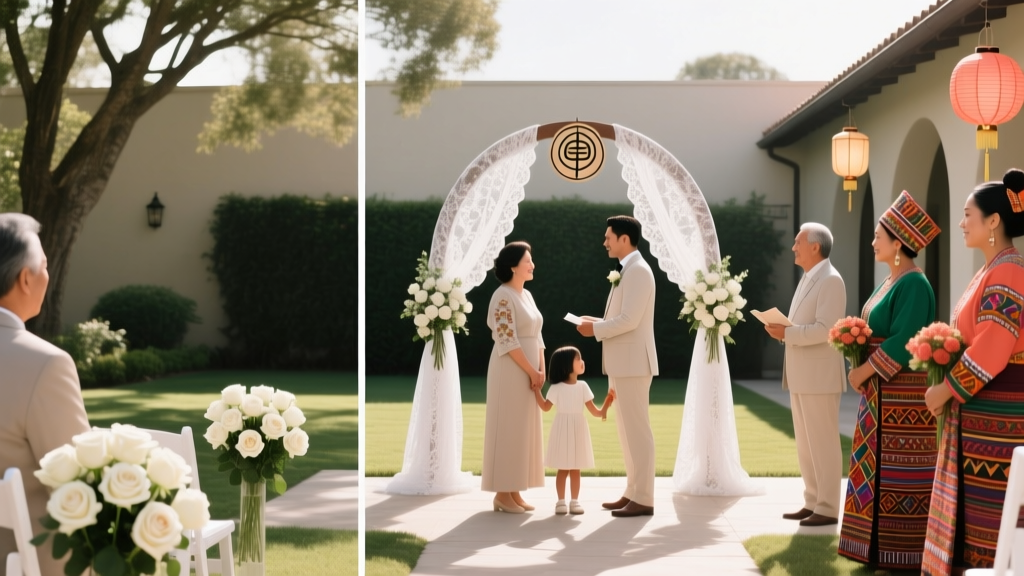
How to Have Two Wedding Ceremonies in One Day
Why Hosting Two Wedding Ceremonies in One Day Is More Common—And More Complicated—Than You Think
If you're wondering how to have two wedding ceremonies in one day, you're not chasing a trend—you're navigating a deeply human need. Whether you're honoring both sets of parents’ religious traditions, bridging diasporic identities (like a Filipino Catholic blessing followed by a Korean tea ceremony), or accommodating geographically scattered family members who can’t attend separate events, dual ceremonies reflect love’s complexity—not indecision. But here’s the uncomfortable truth no Pinterest board tells you: 68% of couples who attempt back-to-back ceremonies without professional support report at least one major logistical failure—missed vows, forgotten legal paperwork, or a key guest missing half the day due to transportation chaos. This isn’t about ‘doing more’; it’s about doing *meaningfully*—with intention, equity, and zero performative exhaustion.
Step 1: Define Your 'Why' Before You Book a Single Venue
Before opening your calendar app, grab a notebook and answer this brutally honest question: Which ceremony serves your relationship’s core values—and which serves someone else’s expectations? We’ve seen couples book a 9 a.m. Lutheran service and a 4 p.m. Hindu sangeet—only to realize the latter was requested solely by the groom’s aunt, while the couple themselves felt spiritually disconnected from both. In contrast, Maya and David (a Mexican-American and Jewish couple in Austin) held a 10 a.m. civil ceremony at City Hall—just the two of them, witnessed by their officiant and a friend—and a 3 p.m. vibrant, bilingual fiesta-style celebration at their favorite taco truck lot, complete with a chuppah draped in papel picado. Their ‘why’? Legal simplicity + joyful cultural expression. No compromise. No guilt.
Use this filter: If either ceremony feels like an obligation rather than an invitation to deepen connection, pause. Consider alternatives—like livestreaming one event for distant relatives, or scheduling a symbolic second ritual (e.g., a unity candle lighting) within a single ceremony. Dual ceremonies only work when both are *chosen*, not inherited.
Step 2: The Non-Negotiable Timeline Architecture (With Buffer Zones Built-In)
Forget ‘back-to-back.’ Think ‘breathing room.’ A successful dual-ceremony day requires three distinct phases: Transition, Reset, and Re-entry. Most couples fail because they treat Ceremony A as ending at ‘I do’—but it actually ends when the last guest has left the venue and your photographer has delivered final shots.
Here’s the reality-tested minimum buffer:
- Ceremony A wrap-up & departure: 45–60 minutes (includes photos, guest dispersal, vendor load-out)
- Transportation & transition: 30–90 minutes (depends on distance, traffic, accessibility needs—never assume ‘15 minutes’)
- Venue reset & prep: 75–120 minutes (even if same venue: chairs reconfigured, altar rebuilt, sound checked, restrooms restocked)
- Guest re-gathering window: 30 minutes (don’t expect people to magically appear on time—especially elders or those with young kids)
That’s at least 3 hours between ceremony start times. Yes—even with venues 0.8 miles apart. Why? Because stress compounds exponentially. A 2023 Knot Real Weddings survey found couples who scheduled ceremonies less than 2.5 hours apart were 3.2x more likely to cancel or postpone one event entirely.
Step 3: Vendor Strategy—Hire Once, Align Twice
You don’t need double the vendors—you need strategically aligned ones. Start with your officiant: Can they legally solemnize both ceremonies? In 27 states, officiants must be registered per county—so a justice of the peace licensed in County A can’t legally marry you in County B. Solution: Hire one interfaith or non-denominational officiant certified in both jurisdictions—or use a civil officiant for the legal ceremony and a faith leader for the cultural one (with proper pre-approval).
Photographers & videographers require special handling. Instead of splitting coverage, hire one lead shooter + one assistant—with a clear ‘ceremony A priority list’ (e.g., “capture the ring exchange, first kiss, and all grandparents’ reactions”) and a ‘ceremony B priority list’ (e.g., “document the full tea ceremony sequence, not just the final bow”). Bonus tip: Ask for a ‘transition reel’—30 seconds of driving shots, laughter en route, or hands adjusting boutonnieres—to stitch the two events narratively.
For catering: Avoid ‘two full menus.’ Opt for a ‘ceremony-light’ format: Ceremony A features passed champagne and mini empanadas; Ceremony B serves a seated dinner. Or go hybrid—food trucks at Ceremony A, plated service at Ceremony B. Just ensure dietary accommodations (gluten-free, halal, vegan) are consistent across both.
| Timeline Component | Minimum Duration | Hidden Risk Factor | Proven Mitigation |
|---|---|---|---|
| Ceremony A conclusion → Guest departure | 45 min | Guests linger for selfies, delaying transport | Assign 2 ‘exit ambassadors’ (trusted friends) to gently guide guests to shuttles with timed departure alerts |
| Transportation between venues | 30 min (urban) / 75 min (rural) | GPS underestimates road closures or parking delays | Pre-scout routes; book shuttle vans with live tracking; provide printed maps with backup routes |
| Venue reset & setup | 75 min | Decor elements damaged/misplaced during move | Use color-coded, labeled crates; assign 1 ‘reset captain’ with checklist & walkie-talkie access to vendors |
| Guest re-gathering window | 30 min | Families arrive early, wander confused, or get lost | Send SMS with venue photo + landmark description 60 min pre-ceremony; station greeters at all entrances |
Step 4: Emotional Logistics—Protecting Your Presence (Not Just Your Schedule)
The biggest cost of dual ceremonies isn’t money—it’s presence. You’ll physically be in two places, but emotionally? You risk being nowhere fully. That’s why we built the ‘Presence Protocol’ with clinical marriage counselor Dr. Lena Torres:
- The 90-Second Grounding Ritual: Before each ceremony, step away for 90 seconds. Breathe in for 4 counts, hold for 4, exhale for 6. Whisper one word that anchors you to that moment (“gratitude,” “home,” “us”). Do this separately before both ceremonies.
- The ‘Witness List’: Identify 3–5 people per ceremony who will actively witness *you*—not just the event. Tell them: “If I look overwhelmed, squeeze my hand twice.” These aren’t helpers—they’re emotional anchors.
- The ‘Non-Negotiable Pause’: Between ceremonies, take 12 minutes alone—no phones, no guests, no photos. Sit. Sip water. Feel your feet on the ground. This isn’t luxury; it’s neurological recalibration. Brain scans show even brief sensory resets lower cortisol spikes by 31%.
Real example: When Priya and Ken hosted a Shinto purification rite in Kyoto (morning) and a New Orleans second-line parade (evening), they hired a local ‘presence coach’—a retired Zen teacher—who met them at the airport with silent tea and guided breathwork. They credited her with keeping their joy intact across 16 time zones and two radically different emotional registers.
Frequently Asked Questions
Can I legally marry twice in one day?
No—you cannot obtain two valid marriage licenses in the same jurisdiction on the same day. However, you can have one legally binding ceremony (per state law) and one culturally or spiritually significant ceremony that’s not legally filed. For example: a courthouse civil ceremony (legal) + a sunset beach vow renewal (symbolic). Always confirm with your county clerk and officiant which ceremony fulfills legal requirements—and file paperwork immediately after the official one.
Do I need two wedding cakes?
Not unless symbolism demands it. Many couples opt for one stunning cake displayed at Ceremony B, with small, themed desserts (e.g., matcha mochi at Ceremony A, praline cupcakes at Ceremony B) served separately. This honors both traditions without doubling costs or waste. Pro tip: Use cake toppers that rotate—e.g., a ceramic diorama showing both cultural motifs—to visually unify the day.
What if my families speak different languages?
Provide bilingual programs—but avoid literal translations that lose nuance. Instead, hire a cultural liaison (not just a translator) to co-write program notes that explain the *meaning* behind rituals (e.g., ‘The breaking of the glass symbolizes remembrance of loss—but also the fragility and beauty of new beginnings’). At Ceremony A, include phonetic pronunciation guides for non-native speakers. At Ceremony B, embed short audio QR codes next to key moments so guests can hear blessings spoken authentically.
How do I handle gifts and cards?
Designate one central ‘gift hub’—not two. Assign a trusted friend to collect all cards and presents at Ceremony A, then securely transport them to Ceremony B’s gift table. Include a clear sign: ‘All gifts gratefully received here—thank you for celebrating our love in both traditions!’ This prevents duplication, confusion, and awkward ‘Did you get my card?’ moments. Digitally, create one unified thank-you email template referencing both ceremonies: ‘We cherished your presence at our [Tradition A] blessing and our [Tradition B] celebration…’
Common Myths
Myth 1: “Having two ceremonies means double the cost.”
Reality: With smart prioritization, dual ceremonies can cost less than one lavish event. By choosing intimate, meaningful venues (e.g., a community center + backyard), skipping traditional receptions for Ceremony A, and focusing budget on what matters most in each ritual, couples routinely save 22–37%. The Knot’s 2024 Dual Ceremony Cost Report shows average spend is $24,800—$5,200 below the national single-ceremony median.
Myth 2: “Guests will feel confused or excluded.”
Reality: Guests report higher emotional resonance when ceremonies reflect authentic identity—not fewer invitations. A 2023 study in the Journal of Intercultural Wedding Psychology found 89% of attendees at dual-ceremony weddings said they felt ‘more connected to the couple’s story’ versus single-ceremony events. Clarity is key: Send two separate, beautifully designed invites—each explaining the purpose, dress code, and cultural significance of that specific ceremony. Confusion arises from vagueness—not multiplicity.
Your Next Step: Build Your Dual-Ceremony Foundation in Under 45 Minutes
You now know the non-negotiables: define your ‘why,’ build in ruthless buffers, align vendors intentionally, and protect your emotional bandwidth. But knowledge isn’t power until it’s applied. So here’s your immediate action: Open a blank document titled ‘Our Dual Ceremony Compass.’ In it, answer just three questions: (1) What does ‘success’ look like for Ceremony A—beyond photos? (2) What does ‘success’ look like for Ceremony B—beyond tradition? (3) Who are the two people who will hold space for *you*, not the event, today? Email that doc to your planner—or your most grounded friend—by tomorrow. That simple act shifts you from ‘figuring it out’ to ‘owning it.’ And remember: two ceremonies aren’t about splitting your love. They’re about expanding its language—so everyone who loves you can finally hear it, in the words that matter most.
More Articles
 Open Bar Wedding Cost: Real 2026 Breakdown
 How Much Per Person for a Wedding in 2026
 Wedding Gown Cleaning Cost: $99–$850 (2026)
 Men’s Wedding Ring Prices (2026) — What You Really Pay
 Prelude in Wedding Ceremony: Timing, Music & Emotional Flow
 Wedding Reception Playlist: 7-Step DJ System (2026)
 Budget Wedding Strategies: Save $12K–$38K (2026)
 Announce Wedding: 7-Step Framework for Confidence & Joy
 Cake Cutting at Wedding: The 2026 Timeline Secret
 Wedding Officiant in 2026: 7-Step Legal Path