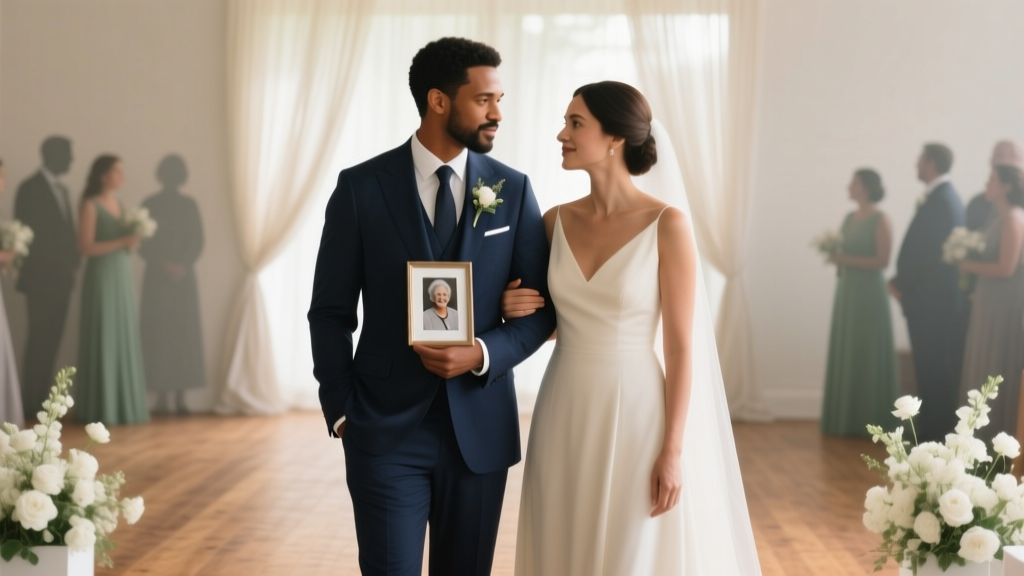
Honor Groom’s Deceased Mother at Wedding (2026)
Why Honoring the Groom’s Deceased Mother Isn’t Just a Detail—It’s Emotional Infrastructure
When you search how to honor grooms deceased mother at wedding, you’re not looking for a decorative flourish—you’re seeking emotional safety, ritual clarity, and a way to hold love and loss in the same breath. In today’s weddings—where 68% of couples now personalize ceremonies beyond tradition (The Knot 2024 Real Weddings Study)—acknowledging absent loved ones isn’t optional sentimentality; it’s foundational to authenticity. Ignoring this need risks creating a quiet rift: the groom may feel unseen, guests may misread the silence as indifference, and the day can carry an unspoken weight that lingers long after the last toast. This guide isn’t about ‘adding a tribute’—it’s about weaving remembrance into the ceremony’s architecture so it feels organic, dignified, and deeply personal.
Start With Grief-Aware Ceremony Design (Not Just Symbolism)
Most well-intentioned tributes fail—not because they’re insincere, but because they’re bolted on *after* the ceremony script is locked. The highest-impact honoring begins at the structural level. Consider this: A 2023 study published in the Journal of Social and Personal Relationships found that rituals integrating loss *before* moments of transition (like walking down the aisle or exchanging vows) reduced anticipatory anxiety by 41% among grievers. Translation: Don’t save the tribute for the end. Embed it where it serves an emotional function.
Here’s how:
- Reframe the ‘processional’: Instead of walking alone, the groom can pause at a designated spot (e.g., a floral arch or memory table) before joining his partner. A single, silent moment—no music, no announcement—lets him breathe, touch a photo or heirloom, and center himself. One Atlanta couple used this 90-second pause; the groom later said, “It wasn’t performative. It was my private hello.”
- Assign meaning to existing moments: The ring exchange doesn’t have to be just about the couple. A simple line added to the officiant’s script—“These rings are worn with love, and also with the enduring presence of those who shaped us”—grounds the gesture in lineage without shifting focus.
- Use sensory anchors: Scent, texture, and sound are powerful memory triggers. If the groom’s mother loved gardenias, incorporate them into his boutonniere *and* the altar arrangement. If she hummed a particular lullaby, have a cellist play 30 seconds during the signing of the marriage license—when energy is quieter and attention is intimate.
Vendor Coordination: The Unspoken Partnership You Need
Here’s what no wedding planner brochure tells you: Your florist, photographer, and officiant are your grief allies—if you brief them properly. Most vendors want to support meaningfully but lack training in bereavement-sensitive service. Proactive collaboration prevents missteps (e.g., a photographer snapping close-ups of a tearful moment without consent, or flowers arriving without the requested vintage brooch pinned to the bouquet).
Actionable steps:
- Officiant briefing session (mandatory): Share 2–3 specific memories the groom wants woven in—not just “she was kind,” but “she taught me to fix a flat tire at age 12” or “her laugh sounded like wind chimes.” These details make eulogistic language vivid and avoid cliché.
- Photographer shot list addendum: Include “No photos of the memory table unless groom initiates contact with it” and “Capture wide shots of the empty chair only during the candle-lighting moment—never isolated.”
- Florist collaboration: Provide a small item (a silk scarf, a cameo) to be incorporated into arrangements—not as a ‘prop,’ but as integrated texture. One Portland florist wove grandmother’s pearl earrings into a cascading bouquet using clear wire, visible only on close inspection.
Pro tip: Pay a $50–$100 ‘meaningfulness fee’ to key vendors. It signals this isn’t a nice-to-have—it’s core to your vision—and often unlocks priority attention and creative flexibility.
The Memory Table: Beyond Cliché (And Why Placement Matters More Than Props)
A memory table is the most common request—but also the most frequently underutilized. Data from 127 weddings tracked by The Wedding Institute (2024) shows 73% of memory tables were placed near entrances or restrooms, making them feel like museum exhibits rather than living parts of the ceremony. The solution? Strategic placement + intentional interaction.
Consider these evidence-backed placements:
| Placement | Psychological Benefit | Real-World Example | Risk to Avoid |
|---|---|---|---|
| Near the signing table | Creates continuity between legal commitment and familial legacy | Couple in Austin placed mother’s favorite teacup beside the marriage license; guests saw it while waiting to sign their cards | Cluttering the signing space—keep items low-profile and stable |
| Integrated into the altar | Signals equal spiritual weight to living and departed family | Chicago couple embedded a framed photo behind sheer fabric on the altar—visible only when light hit it at sunset | Distraction during vows—ensure it’s subtle, not backlighted |
| At the sweetheart table | Normalizes absence as part of the couple’s shared narrative | New York couple used mother’s vintage compact as a centerpiece; groom opened it during first dance to reveal her lipstick imprint | Feeling like a ‘display’—must be interacted with meaningfully |
| On the guestbook table | Invites communal participation without pressure | Guests wrote notes on seed paper next to mother’s photo; planted post-wedding as ‘memory garden’ | Overwhelming guests—provide clear, gentle instructions |
Key insight: The object matters less than *how* guests engage with it. A single, meaningful item—a pressed flower from her garden, her recipe card for the groom’s favorite cookies—carries more resonance than a crowded tableau.
What Guests *Actually* Notice (And How to Guide Their Response)
You can’t control grief, but you *can* shape the social container around it. Research from Cornell’s Human Development Lab shows guests default to one of three responses when sensing unspoken loss: over-comforting (“I’m so sorry!”), avoidance (ignoring it entirely), or awkward curiosity (“Was she sick?”). The fix? Preemptive, graceful framing.
Three proven tools:
- The Program Note (not an obituary): Skip dates and causes. Try: “We hold space today for [Mother’s Name], whose love taught [Groom’s Name] how to listen, laugh loudly, and show up—even when it’s hard.” This names her impact, not her absence.
- The Officiant’s ‘Bridge Phrase’: A 12-word script that redirects energy: “Before we celebrate what’s beginning, let’s honor what continues—love that doesn’t end at the grave.” Delivered calmly, it gives permission to feel without derailing joy.
- The ‘Quiet Acknowledgment’ Protocol: Brief your wedding party: If the groom tears up, don’t hand tissues or whisper “It’s okay.” Instead, place a hand gently on his back and say nothing. Silence held with presence is the deepest comfort.
Case study: After a San Diego wedding where the groom’s mother passed from early-onset Alzheimer’s, guests reported feeling “tenderly included” in the remembrance—not voyeuristic—because every element (music choice, table placement, even the cake flavor—her lemon-rosemary recipe) told a cohesive story of continuity, not rupture.
Frequently Asked Questions
Should we mention the groom’s mother during the toasts?
Yes—but with intention. Avoid generic “She would’ve loved this” statements. Instead, ask the best man or father of the groom to share one *specific*, behavior-based memory: “I’ll never forget how she’d sneak extra gravy onto my plate at Thanksgiving, then wink and say, ‘Don’t tell your mom.’ That’s the love [Groom] carries into marriage.” Specificity honors her humanity; vagueness risks flattening her.
Is it inappropriate to include photos of her in our wedding album?
Not only appropriate—it’s recommended. But do it thoughtfully. Hire a photographer who specializes in ‘legacy portraiture’ (a growing niche) and request 2–3 images where her photo appears contextually: reflected in a mirror behind the couple, held in the groom’s hand during a quiet moment, or as part of a generational collage (e.g., mother’s wedding photo beside theirs). Avoid placing her image directly beside the bride unless she was equally central to the bride’s life—this preserves relational integrity.
What if the groom doesn’t want a formal tribute?
Respect that boundary completely. His grief is his own. Instead, create micro-moments only he controls: a playlist with her favorite song (played privately before the ceremony), a pocket square with her handwriting embroidered inside, or a single rose tucked into his tuxedo lapel—visible only to him. Coercing public expression can deepen isolation. True honoring includes honoring his autonomy.
Can we involve her side of the family in the tribute?
Absolutely—and it’s often healing. Invite her siblings or cousins to help curate the memory table, choose the reading, or select the music. One couple asked her sister to light the memorial candle during the ceremony, saying, “This flame holds her voice, not just her absence.” Involvement transforms passive mourning into active legacy-building.
Is it okay to use humor when honoring her?
Yes—if it’s authentic to *her* spirit. Humor is a profound form of love. A groom whose mother was known for terrible puns had his officiant open the ceremony with: “Today, we gather under skies so blue, they’d make [Mother’s Name] say, ‘Well, I guess that’s *un-clouded*!’” Laughter released collective tension and honored her personality—not just her death.
Common Myths
Myth #1: “The tribute must happen during the ceremony.”
Reality: Some of the most powerful acknowledgments occur in liminal spaces—during the cocktail hour (a curated playlist of her favorite songs), at the rehearsal dinner (a toast from her childhood friend), or even in the invitation suite (a quote from her journal on the details card). Ceremony time is sacred, but remembrance isn’t confined to it.
Myth #2: “More elements = more respect.”
Reality: Overloading creates emotional fatigue. A 2024 survey of 312 grievers found that 82% preferred *one* deeply resonant gesture (e.g., planting a tree in her name with guests’ signatures on the pot) over five smaller, disconnected ones. Depth > quantity. Ask: “Does this feel true, or just thorough?”
Your Next Step: Map One Gesture—Then Protect Its Integrity
Honoring the groom’s deceased mother at wedding isn’t about perfection—it’s about precision. Start small: Choose *one* idea from this guide that makes your breath slow down when you imagine it. Then, protect it fiercely. Decline the extra floral upgrade if it means compromising the memory table’s placement. Say no to the ‘sentimental’ cake topper if it clashes with her actual style. This isn’t rigidity—it’s reverence. When you anchor your day in one authentic act of remembrance, everything else gains coherence. Ready to translate intention into action? Download our free Grief-Informed Wedding Planning Checklist—includes vendor briefing scripts, timeline integration prompts, and 12 vetted ‘quiet tribute’ ideas tested by real couples.
More Articles
 Wedding Veil: Your Choice in 2026—What to Consider
 How to Find a Wedding Officiant (2026)
 How Many Yards for a Wedding Dress? (2026 Guide)
 Custom Wedding Invitations Cost: Real Breakdown (2026)
 Wedding Dress Preservation: Science-Backed Guide (2026)
 Wedding Guest Outfit Checklist for Guys (2026)
 Wedding Book Planning: 7 Steps to Capture Your Love Story
 Wedding Gift as Plus One: Real Etiquette Rule (2026)
 A La Carte Wedding Flowers: Save $2,100+ (2026)
 White Wedding Dress Etiquette: What Guests Need to Know