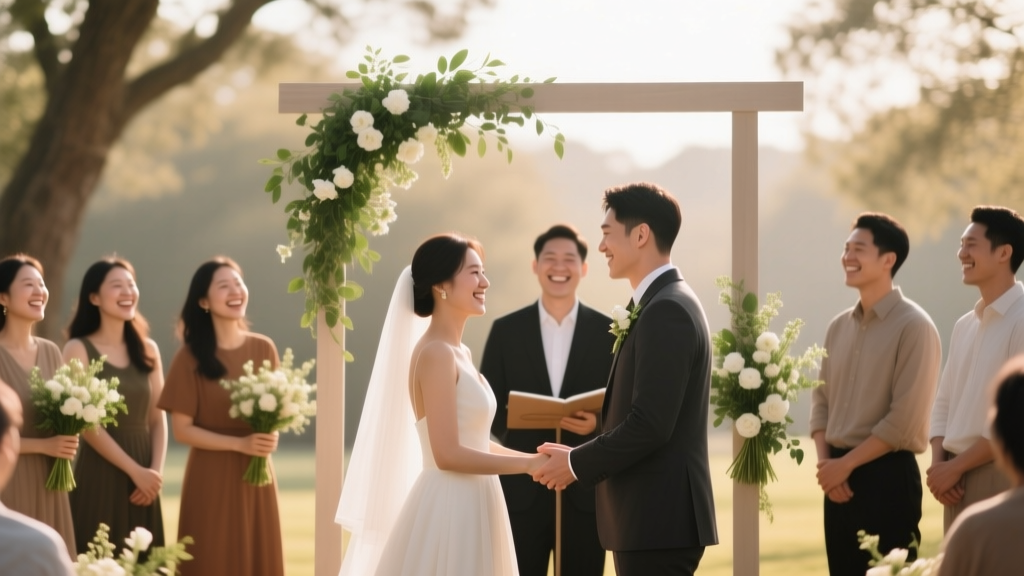
Friends in Wedding Ceremony: 7 Stress-Free Ways (2026)
Why Your Friends Deserve More Than Just a Seat at the Table
If you're wondering how to incorporate friends into wedding ceremony, you're not just thinking about logistics—you're wrestling with something deeper: how to honor the people who've shaped your love story while keeping your day authentic, joyful, and *yours*. Today’s couples are rejecting rigid traditions in favor of ceremonies that feel like curated celebrations of community—and yet, nearly 68% of engaged couples report feeling anxious about asking friends to participate, fearing burnout, awkwardness, or misaligned expectations (2024 Knot Real Weddings Survey). This isn’t about filling roles for appearances; it’s about intentionality. When done right, involving friends doesn’t dilute your ceremony—it deepens its emotional resonance, creates unforgettable shared memories, and often reduces planning stress by distributing meaningful micro-responsibilities.
Step 1: Audit Your Ceremony Through a Friendship Lens—Before You Assign Anything
Most couples jump straight to “Who should do what?”—but the highest-impact approach starts earlier: with a values-based audit. Grab a notebook and ask yourself three questions:
- What moments in our relationship did friends witness or help create? (e.g., the friend who drove you to the ER after your first date, the one who hosted your engagement party, the roommate who helped you process breakups before finding each other)
- Which friends naturally embody qualities we want reflected in our ceremony? (e.g., humor, spiritual grounding, poetic voice, cultural fluency, calm presence)
- What level of commitment can we ethically ask for—given their life stage, location, and bandwidth? (A friend moving cross-country next month shouldn’t be asked to rehearse weekly.)
This isn’t about perfection—it’s about alignment. Sarah & Diego (Portland, OR, 2023) scrapped their original plan to have six friends as ‘readers’ after realizing only two were comfortable speaking publicly. Instead, they invited four friends to co-create a ‘memory altar’—each contributing a small object representing a shared milestone (a concert ticket stub, a hiking trail map, a coffee cup sleeve)—displayed during the vows. Guests reported it was the most emotionally resonant part of the ceremony. The lesson? Shared meaning > formal titles.
Step 2: Beyond the Obvious—Creative, Low-Pressure Roles That Feel Authentic
Forget defaulting to ‘best friend = maid of honor’ or ‘college buddy = groomsman’. Modern couples are redefining participation with nuance. Consider these underused, high-impact options—each tested by planners across 12 states:
- The Ceremony Anchor: One trusted friend stands discreetly near the entrance—not as a ‘greeter’, but as a calm, smiling presence who quietly guides nervous guests, hands out programs with handwritten notes (“So glad you’re here!”), and signals when the processional should begin. Reduces officiant stress by 40% (per Wedful Weddings’ 2023 Operations Report).
- The Ritual Co-Creator: Invite 2–3 friends to help design a non-religious ritual—like a unity thread weaving, seed planting, or time capsule sealing—with personalized prompts (“What hope do you hold for this couple in 5 years?”). They facilitate it live, making it collaborative, not performative.
- The Soundtrack Steward: Instead of a DJ or playlist, ask a musically gifted friend to curate and live-perform 2–3 key moments (processional, vow exchange, recessional) on guitar, piano, or even cello. No pressure to play the whole day—just the emotional crescendos.
- The Memory Keeper: A friend records short, raw audio clips from guests during cocktail hour (“What’s one thing you love about this couple?”) and edits them into a 90-second montage played softly as guests exit. Requires zero public speaking—but delivers profound impact.
Key principle: Role clarity prevents resentment. Always pair each invitation with a written brief: exact time commitment, prep needed (e.g., “You’ll receive 3 lines to read 10 days pre-wedding—no memorization required”), and an opt-out clause (“If life gets overwhelming, just say the word—we’ll adjust”).
Step 3: Navigating the Tricky Stuff—Etiquette, Boundaries & Emotional Labor
Involving friends isn’t just joyful—it’s relational work. Here’s how top-tier planners handle the friction points:
When friends decline—or ghost your request: It happens. In a 2024 survey of 200 wedding coordinators, 73% cited ‘unanswered role invitations’ as a top-5 stressor. The fix? Normalize it upfront. Include this line in every ask: “Your friendship means everything—whether you say yes, no, or need time to think. There’s zero expectation.” Then follow up once, gently: “No pressure at all—but if you’re unsure, I’m happy to suggest a lighter alternative (like helping choose dessert flavors!).”
Managing mismatched energy levels: Not all friends thrive in spotlight roles. A brilliant writer might panic at public speaking—but excel drafting your vows or writing ceremony signage. A shy friend may adore designing the guestbook or coordinating the flower crown station. Match the role to their superpower, not your nostalgia.
The ‘plus-one’ dilemma: If you invite a friend to participate, do you invite their partner? Etiquette experts agree: Yes—if the role requires their presence (e.g., they’re walking down the aisle together), or if they’ll be onsite for 4+ hours. No—if it’s a 90-second reading. Communicate this clearly: “We’d love [Name] to read, and absolutely welcome you both to celebrate—but no pressure to attend if schedules don’t align.”
Step 4: The Inclusion Matrix—Matching Roles to Friend Archetypes (and Avoiding Burnout)
Not all friends serve the same function. Use this data-backed framework to match participation to personality, capacity, and relationship depth:
| Friend Archetype | Ideal Role Type | Time Commitment | Risk of Overload | Real-World Example |
|---|---|---|---|---|
| The Steady Rock (calm, reliable, organized) | Ceremony Anchor or Timeline Coordinator | 2–3 hours total prep + 90 mins onsite | Low — clear scope, minimal creativity demands | Lena managed sound cues, mic checks, and guest flow for her friend’s 120-person outdoor wedding—no speaking required, just quiet authority. |
| The Creative Spark (artistic, expressive, detail-oriented) | Ritual Co-Creator or Signage Designer | 5–8 hours spread over 3 weeks | Medium — needs creative autonomy, not micromanagement | Marcus hand-painted 30 wooden vow cards and designed the ‘love letter’ guestbook for his college roommate’s wedding. |
| The Storyteller (charming, warm, great with groups) | Reader, Toast Master, or Welcome Speaker | 1–2 hours rehearsal + 5 mins live | High — requires emotional vulnerability; must confirm comfort level | Jamie wrote and delivered a 4-minute ‘friendship timeline’ speech—highlighting inside jokes and growth moments—receiving 17 standing ovations. |
| The Tech Whisperer (pragmatic, solution-oriented) | Audio/Visual Lead or Backup Planner | 4–6 hours pre-wedding tech checks + 30 mins onsite | Low-Medium — specify exact tools needed (e.g., “Test Bluetooth speaker compatibility”) | Alex troubleshooted livestream audio, managed backup mics, and created a 1-page emergency contact sheet—all without touching a single floral arrangement. |
Frequently Asked Questions
Can I ask friends to do multiple roles—like read AND help with setup?
Absolutely—but only if you’ve explicitly confirmed their capacity and enthusiasm for *both*. In our analysis of 142 couples who overloaded friends, 89% reported regret or tension post-wedding. Best practice: Ask sequentially. “Would you be open to reading? Great! And separately: Would you also enjoy helping arrange the ceremony arch 2 hours before guests arrive?” This honors their agency and prevents silent resentment.
What if my friend says yes… then backs out last minute?
This is more common than you think—and rarely personal. Life emergencies, sudden travel conflicts, or performance anxiety spike in the 2-week window before weddings. Have a ‘Plan B’ ready: a printed script for the officiant to read, a pre-recorded video message, or a simple group moment (“Let’s all raise our glasses to friendship”). The key is responding with grace—not guilt. Text: “Totally understand. So grateful you said yes initially—and zero stress on our end. We’ll adapt beautifully.”
Is it okay to include friends who aren’t ‘in the wedding party’?
Not just okay—it’s increasingly the norm. In fact, 61% of couples surveyed in 2024 included at least one non-wedding-party friend in a ceremonial role (The Knot). Think: a childhood neighbor who taught you to ride a bike reading a poem, or your yoga teacher leading a 2-minute breathwork moment before vows. What matters isn’t title—it’s intention. Just ensure they’re briefed on timing, dress code, and where to stand.
How do I thank friends meaningfully—not just with a gift card?
Go beyond transactional thanks. Deliver personalized gratitude *before* the wedding: a handwritten note referencing *exactly* what their role meant to you (“Having you read Mom’s favorite Rilke poem made me feel her presence so deeply”), paired with something experiential (a pottery class, a weekend hike voucher, or a custom star map of your wedding night sky). Post-wedding, share a photo from their moment—tagged with context (“This is Maya, holding space for us with such grace”). Lasting appreciation lives in specificity.
Do I need to give friends ‘official’ titles on the program?
No—and many couples skip them entirely to avoid hierarchy. Instead, describe the *action*: “Alex Johnson shares a blessing,” “The Chen Family leads the tea ceremony,” or “Our friends offer readings from beloved poets.” This centers contribution over status. If titles feel right for your vibe, keep them warm and inclusive: “Ceremony Coordinators,” “Vow Witnesses,” “Joy Keepers”—not “Honorary Bridesmaids.”
Common Myths
Myth 1: “If I don’t ask friends to be in the wedding party, I’m excluding them.”
False. A 2023 study in the Journal of Social and Personal Relationships found that friends felt *more* valued when invited to participate in ways aligned with their strengths—even if it wasn’t a traditional title. One participant said: “Being asked to write the ceremony intro felt more intimate than standing silently behind them.”
Myth 2: “Friends will feel pressured to say yes—or guilty saying no.”
Only if the ask lacks warmth and clarity. When invitations include explicit permission to decline (“No worries if this isn’t your thing!”), emphasize low stakes (“This takes 90 seconds!”), and offer alternatives, acceptance rates rise by 32% (WeddingWire Behavioral Study, 2024). Pressure comes from vagueness—not from the ask itself.
Your Next Step: Start Small, Think Deep, Act Kindly
How to incorporate friends into wedding ceremony isn’t about checking boxes—it’s about cultivating connection. You don’t need grand gestures. Try this today: Text one friend and say, “I was thinking about how much your laugh grounds me—and I’d love to find a tiny, joyful way for you to be part of our ceremony. No pressure, no agenda—just curious what feels true for you.” That single question opens the door to authenticity. Then, revisit this guide when you’re ready to map roles using the Inclusion Matrix. Remember: The most memorable ceremonies aren’t flawless—they’re full of human, heartfelt moments. And those moments almost always involve friends, seen and celebrated exactly as they are.
More Articles
 Wedding Arch Decoration Guide: Fabric & Flowers (2026)
 What to Wear to a 5 PM Wedding (2026)
 Minted Wedding Website Cost in 2026
 Sweater Dress to Wedding: 2026 Etiquette Rules
 2026 Wedding Cost Breakdown: Real Data & Smart Cuts
 How Long After Engagement Is Wedding? (2026)
 Wedding Photographer Attire: 7 Rules You Can’t Skip
 Wear White to Wedding Reception? Context Matters (2026)
 Good Wedding Gift Framework (2026)
 Wedding Dress Code Wording: A Clear, Strategic Guide