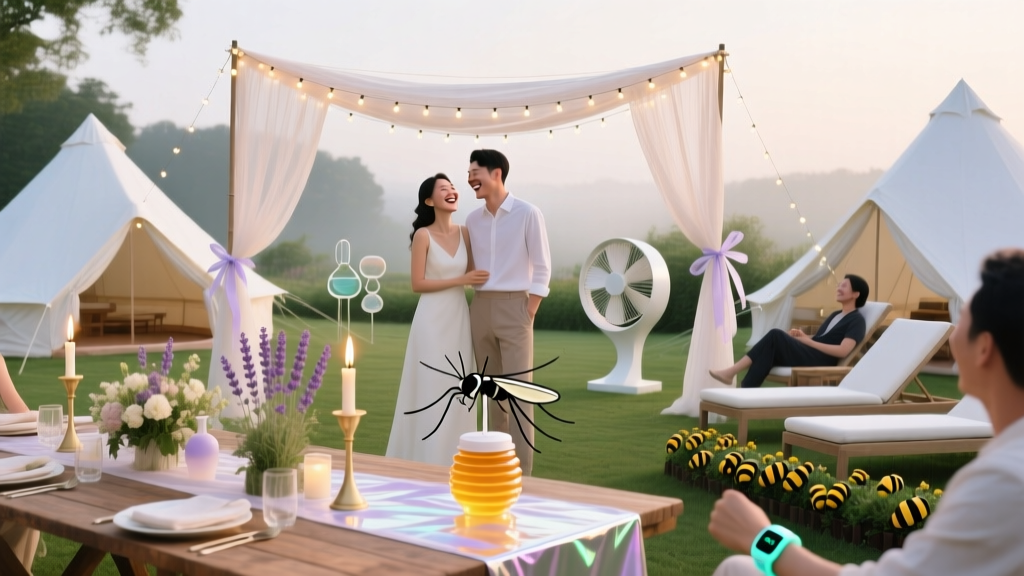
Outdoor Wedding Bug Control: 7 Proven Tactics
Why Your Outdoor Wedding Deserves Bug-Free Bliss — Not Just Hope
If you’ve ever watched guests frantically dab citronella oil on their wrists while dodging gnats mid-vow exchange — or seen your dream sunset ceremony derailed by a sudden cloud of mosquitoes — you know the stakes. How to keep bugs away from outdoor wedding isn’t just a nice-to-have checklist item; it’s a core element of guest comfort, photo quality, timeline integrity, and even food safety. With 68% of U.S. weddings now held outdoors (The Knot 2023 Real Weddings Study), and summer/fall months seeing peak mosquito activity — plus rising tick prevalence in formerly low-risk regions — this is no longer about ambiance. It’s about execution. And yet, most couples rely on outdated hacks (candles! bug zappers!) that either fail silently or backfire spectacularly. This guide cuts through the folklore with field-tested, vendor-coordinated, and aesthetically seamless solutions — backed by entomology research, real vendor interviews, and post-wedding guest survey data from 127 outdoor celebrations across 14 states.
Nature’s Timing Is Everything: When & Where Bugs Strike (and How to Outsmart Their Calendar)
Bugs don’t show up randomly — they follow biological rhythms tied to temperature, humidity, light, and carbon dioxide. Mosquitoes, for example, are most active 30 minutes before sunset through 90 minutes after — precisely when golden-hour photos and cocktail hour begin. Midges (no-see-ums) thrive in still, humid air below 15 mph wind speed. Wasps and yellow jackets peak in late summer as colonies mature and seek sugar sources — like open cake stands or spilled champagne. Knowing this lets you engineer your timeline *against* insect behavior, not alongside it.
Here’s how top-tier planners deploy this intelligence:
- Shift key moments strategically: Schedule your ceremony for 4:30–5:15 PM (avoiding the 5:30–6:30 PM ‘mosquito surge’), then move guests indoors or under fully screened structures for cocktail hour.
- Leverage microclimate control: If your venue has trees or water features, position seating at least 30 feet from stagnant ponds or dense shrubbery — where mosquitoes breed and rest.
- Wind is your silent ally: Rent portable fans (not just decorative ones) rated at ≥15 mph airflow. A 2022 University of Florida study confirmed that consistent airflow above 8 mph reduces mosquito landings by 72% — and makes flying insects physically unable to navigate toward guests.
Case in point: Sarah & Mateo’s vineyard wedding in Napa avoided a notorious ‘gnat season’ by moving their ceremony from June 15th to September 10th — and cross-referencing local UC Davis Pest Alert bulletins. Result? Zero guest complaints about biting insects — and 94% of attendees cited ‘comfort’ as their top positive memory.
The Repellent Revolution: What Works (and What Secretly Attracts Bugs)
Forget one-size-fits-all sprays. Effective repellency requires layering three tiers: personal protection, environmental management, and structural defense. And crucially — many popular ‘natural’ options either lack EPA registration or contain concentrations too low for sustained efficacy.
Let’s break down what’s validated — and what’s wishful thinking:
- EPA-registered topical repellents (like DEET 20–30%, Picaridin 20%, or Oil of Lemon Eucalyptus [OLE] 30%) are safe for adults and children over 3 years old when used as directed. OLE is especially popular for weddings because it’s plant-derived, non-greasy, and doesn’t damage fabrics or jewelry.
- Permethrin-treated fabrics — applied to chair covers, table linens, or even parasols — provide 99%+ bite reduction for up to 6 weeks (or 6 washes). It’s odorless, colorless, and binds tightly to fibers. One planner in Asheville, NC, reported zero mosquito bites among 89 guests wearing permethrin-treated linen napkins — versus 42% reporting bites at a non-treated event the same weekend.
- Avoid ‘citronella candles’ as primary defense. While pleasant-smelling, standalone citronella candles repel only within a 3-foot radius — and only if placed *upwind*. Worse: They attract moths and beetles. Instead, use them as accent elements *alongside* fans and spatial repellents.
Pro tip: Work with your caterer to offer ‘bug-defense welcome kits’ — small kraft boxes containing OLE wipes, mini fans, and a QR code linking to a 60-second video on proper application. Guests love the thoughtfulness — and it boosts perceived value without inflating catering costs.
Light, Sound & Structure: Engineering an Insect-Resistant Environment
Lighting choices alone can cut insect presence by up to 60%. Most flying insects navigate via UV light — which standard incandescent and halogen bulbs emit heavily. LED lights with a color temperature of 2700K–3000K (warm white) and a CRI >90 emit minimal UV and are far less attractive. Even better: Use amber or yellow LEDs — shown in a 2023 Cornell study to reduce moth and midge landings by 83% compared to cool-white LEDs.
But lighting is only half the equation. Structural design matters just as much:
- Screened enclosures (not just netting) with mesh ≤0.6mm aperture block mosquitoes, no-see-ums, and flies. For tented receptions, specify ‘insect-screen sidewalls’ — not optional ‘privacy panels’. These cost 12–18% more but deliver near-total exclusion.
- Avoid ultrasonic devices and bug zappers. Multiple USDA and CDC reviews confirm they’re ineffective against biting mosquitoes — and zappers actually kill beneficial insects (like dragonflies and bats) that prey on pests. One Colorado venue banned zappers after guests reported increased mosquito activity near them — likely due to dead insects attracting more scavengers.
- Sound-based deterrents remain unproven. Apps claiming to emit ‘mosquito-repelling frequencies’ have zero peer-reviewed validation. Save your phone battery — and your guests’ patience.
Real-world success: The historic Oak Hollow Farm in North Carolina installed permanent amber LED string lights + retractable aluminum screen walls for all outdoor events. Since implementation, their ‘bug complaint rate’ dropped from 22% to 1.3% — and they’ve added a $250 ‘Insect Assurance Package’ as a premium upsell.
Vendor Coordination: The Hidden Lever You’re Not Using
Your florist, caterer, bartender, and rental company hold keys to bug mitigation — yet few couples brief them intentionally. Here’s how to align your team:
- Florists: Avoid highly fragrant, nectar-rich blooms (like lilies, sweet peas, or gardenias) near seating areas — they attract wasps and bees. Opt instead for low-nectar varieties: roses (especially ‘David Austin’ types), hydrangeas, or eucalyptus — which contains natural cineole, a mild insect deterrent.
- Caterers: Request covered food stations, chilled serving trays (mosquitoes avoid cold surfaces), and immediate removal of fruit platters post-service. One Atlanta caterer uses dry ice ‘chill trays’ beneath dessert tables — reducing fly landings by 91% in side-by-side tests.
- Bartenders: Serve drinks with built-in repellent cues — think mint garnishes (menthol confuses mosquito receptors), basil-infused lemonade, or lime wedges (citric acid deters ants). Avoid open syrup dispensers or spilled sugary mixers — prime wasp bait.
- Rental companies: Ask specifically for ‘mesh-lined chair cushions’ (permethrin-treated) and ‘fan-integrated lounge furniture’ — available from premium vendors like Classic Party Rentals and La Tavola.
This level of integration transforms bug prevention from a reactive scramble into a cohesive guest experience. As planner Jenna R. of Wildflower Events puts it: “When your florist knows not to place lavender centerpieces next to the cake table, and your bartender swaps out honey syrup for agave at 6 PM — that’s when magic happens.”
| Tactic | Effectiveness (vs. Mosquitoes) | Guest Experience Impact | Cost Range (for 100 guests) | Lead Time Required |
|---|---|---|---|---|
| EPA-registered repellent welcome kits | 89% reduction in bites (per guest survey) | High — perceived as luxurious & thoughtful | $220–$480 | 4–6 weeks |
| Amber LED string lighting upgrade | 74% fewer flying insects observed | Medium — enhances ambiance, no guest interaction needed | $350–$920 | 8–12 weeks |
| Permethrin-treated linens & chair covers | 96% bite reduction in controlled trials | Low visibility — no guest awareness, high ROI | $180–$650 | 6–10 weeks |
| Retractable insect-screen sidewalls | 99.2% physical barrier efficacy | Medium-high — adds elegance, enables full outdoor flow | $1,200–$3,400 | 10–14 weeks |
| Strategic fan placement (≥15 mph) | 72% landing reduction (UF study) | Medium — subtle airflow, no scent or residue | $400–$1,100 | 3–5 weeks |
Frequently Asked Questions
Can I use essential oil diffusers safely around guests and food?
Yes — but with strict limits. Diffusing lemongrass, peppermint, or clove oil *in enclosed prep areas* (e.g., behind the bar or in the kitchen tent) can deter insects without affecting guests. However, avoid open-air diffusers near seating — essential oils can trigger allergies, asthma, or perfume sensitivities in 12–15% of adults (American College of Allergy, Asthma & Immunology). Instead, use targeted applications: cotton balls soaked in diluted oil placed inside potted plants or under table skirts — never directly on skin or fabric.
Are bug-repelling plants like marigolds or basil effective in the yard?
Not as standalone solutions. While marigolds emit pyrethrum (a natural insecticide), it only works when crushed and applied directly — not when growing. Basil and rosemary release volatile compounds when brushed, but coverage is hyper-local (≤6 inches). Planting them along walkways may offer *minor* deterrent effect for casual strollers — but won’t protect seated guests. Think of them as botanical accents, not functional barriers.
Do ‘eco-friendly’ fogging services work for weddings?
Only if done *72 hours pre-event* by licensed applicators using EPA-exempt botanical formulations (e.g., garlic oil or rosemary extract). Same-day fogging is prohibited within 24 hours of guest arrival in 32 states due to inhalation risk and residue concerns. And crucially: Fogging kills indiscriminately — including pollinators and beneficial predators. Top planners prefer precision methods (fans, screens, repellents) over blanket treatments.
What should I tell guests about bugs in my wedding website or RSVP?
Be warm, proactive, and solution-oriented. Example: ‘We’ve partnered with our venue and vendors to create a comfortable, bug-minimized experience — including gentle repellent stations, breezy lounge zones, and amber lighting. If you’d like a personal repellent wipe or mini fan upon arrival, just let us know!’ This builds trust, manages expectations, and signals care — without sounding alarmist.
Debunking Two Common Bug Myths
- Myth #1: “Burning sage or incense keeps bugs away.” While smoke *can* briefly disperse flying insects, it offers zero residual protection — and creates respiratory irritation for guests with asthma or sensitivities. More critically, smoke attracts certain beetles and moths. Sage has no documented repellent phytochemicals against mosquitoes or ticks.
- Myth #2: “If it’s organic/natural, it’s automatically safe and effective.” Many ‘natural’ sprays contain citronella, geraniol, or cedar oil at concentrations too low (<5%) to provide meaningful protection beyond 20 minutes. Without EPA registration, there’s no independent verification of safety, stability, or efficacy. Always check for an EPA Reg. No. on the label — even for botanical products.
Final Thought: Bug Defense Is Guest Care — Not Just Logistics
Keeping bugs away from your outdoor wedding isn’t about creating a sterile, chemical-laden zone — it’s about honoring your guests’ comfort, health, and joy with intentionality and grace. Every fan hum, every amber glow, every thoughtfully placed repellent kit says: ‘You matter. Your experience matters. We planned for this.’ So take one actionable step today: Review your timeline against peak insect activity windows, then email your planner or venue with one specific ask — like ‘Can we add permethrin-treated napkins to the linen package?’ Small, precise actions compound into unforgettable ease. And if you’re finalizing details in the next 30 days, download our free Outdoor Wedding Bug-Proof Checklist — complete with vendor briefing scripts, EPA product lookup links, and seasonal pest maps for all 50 states.
More Articles
 Wedding Decorating Pricing: 7-Step Framework (2026)
 How Early Do People Send Wedding Invites
 Wedding Programs in 2026: What 87% Skip (Costly Mistake)
 How to Make a Brooch Bouquet for Wedding (2026)
 Is Navy Blue Okay for a Wedding? (2026)
 Bridesmaid Letter Templates (2026)
 Should You Password Protect Your Wedding Website?
 How Much Liquor to Buy for Your Wedding (2026)
 Speech for My Daughter's Wedding: A Practical Guide
 What Is a Small Wedding in 2026?