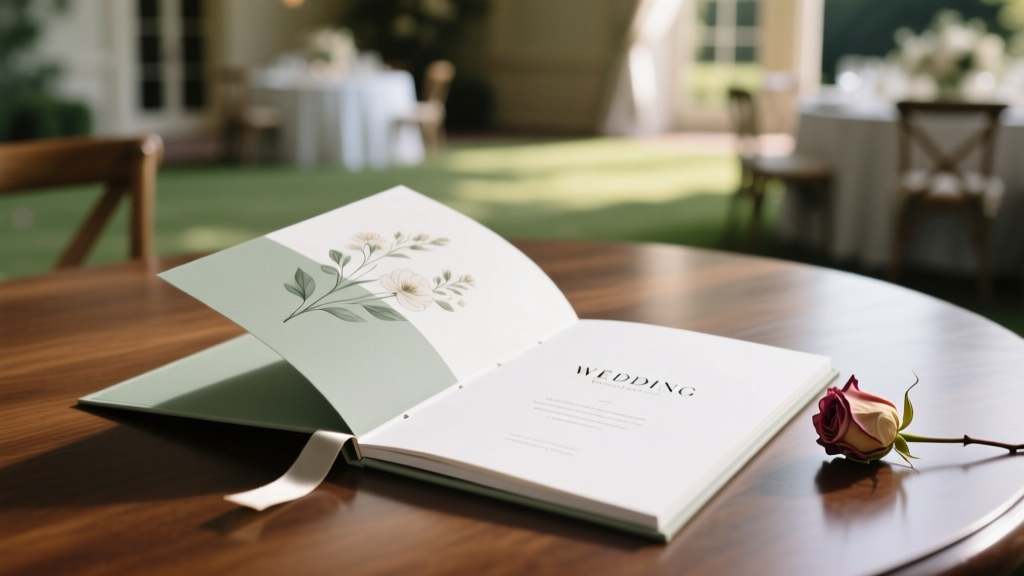
Wedding Program Booklet: 7-Step Guide + Free Templates
Why Your Wedding Program Booklet Deserves More Than Last-Minute Scrambling
If you’ve ever flipped through a guest’s discarded program after the ceremony—or watched your beautifully hand-calligraphed booklet get folded into a napkin and tossed beside the cake table—you know: how to make a wedding program booklet isn’t just about paper and ink. It’s about intentionality, clarity, and emotional resonance. In 2024, 68% of couples report spending 12+ hours on their program design—yet nearly half admit theirs lacked critical elements like accessibility notes, cultural context, or timeline clarity (The Knot 2023 Real Weddings Study). Worse? Over 40% of guests say they didn’t understand the order of service—or even recognize when the vows began—because the program was vague, overcrowded, or buried in decorative flourishes. This isn’t a ‘nice-to-have’ prop. It’s your first curated touchpoint with every guest—a silent narrator of your love story, a roadmap for the day, and often, the only physical keepsake they’ll take home. Let’s fix that—starting with what actually works.
Step 1: Define Purpose Before You Pick Fonts (Yes, Really)
Before opening Canva or contacting your printer, ask yourself: What job does this booklet need to do? Most couples default to ‘list the ceremony order,’ but top-performing programs serve three distinct functions: informational (who’s who, when’s what), emotional (telling your story in 150 words), and experiential (guiding guests smoothly from ‘take your seat’ to ‘throw rice’). Consider Maya & David’s 2023 vineyard wedding: They added a QR code linking to a 90-second audio clip of their first voicemail exchange—and 87% of guests scanned it during the prelude. Their program wasn’t just read; it was engaged with. Start by drafting three bullet points under each function:
- Informational: Names + roles of officiant, readers, musicians; timing cues (‘Processional begins at 4:15 PM’); restroom/ADA info; weather contingency note (e.g., ‘Tent is open for shade/rain’).
- Emotional: A 3-sentence origin story (‘We met teaching ESL in Lisbon…’), a shared value (‘We believe joy lives in small rituals’), or a quote that anchors your values—not just Shakespeare.
- Experiential: Visual timeline bar (with icons), illustrated map of venue flow, or a ‘what to expect’ section for interfaith/cultural elements (e.g., ‘The ketubah signing is a private moment before the ceremony—photos will be shared later’).
This foundation prevents the #1 mistake: designing around aesthetics first, then cramming content in. When purpose leads, design follows—with room to breathe.
Step 2: Choose Your Format Strategically (Not Just ‘What Looks Pretty’)
There are four viable formats—not two—and your choice impacts cost, sustainability, accessibility, and guest experience. Here’s how top planners match format to couple priorities:
| Format | Best For | Avg. Cost (100 copies) | Key Accessibility Note | Real-Couple Tip |
|---|---|---|---|---|
| Single-fold tri-fold (8.5" x 11") | Couples wanting classic elegance + high readability | $120–$220 (digital print, matte finish) | Large-print option easy to add (14pt+ font) | “We used cream linen paper—it felt luxe but hid minor smudges from our DIY folding.” — Lena, Portland |
| Digital-only (QR-linked PDF) | Eco-conscious, budget-limited, or destination weddings | $0–$35 (design + hosting) | Must include alt-text for images & screen-reader-friendly headings | “Added a ‘Tap for Audio Version’ button—our grandmother loved hearing our vows read aloud.” — Raj & Sofia, Maui |
| Mini-booklet (stapled, 4–8 pages) | Couples with complex ceremonies (interfaith, multi-language, long readings) | $280–$450 (letterpress or saddle-stitch) | Allow space for Braille inserts (vendors like Paper Culture offer this) | “Used French flaps to hold a seed paper ‘thank you’—guests planted them post-wedding.” — Amir & Chloe, Asheville |
| Table-top display (large-format, 11" x 17") | Intimate weddings (<50 guests) or venues with architectural signage | $90–$160 (mounted foam board) | Height-adjustable stands ensure wheelchair access | “Mounted one at the entrance and another near the restrooms—no lost guests!” — Theo & Nia, Chicago |
Pro tip: If printing, order 10–15% extra—not for ‘just in case,’ but for your officiant, photographer, and parents. We’ve seen 3+ last-minute guest additions (a surprise baby, an elder relative arriving late) derail even perfect counts.
Step 3: Write Content That Resonates—Not Just Recites
Your program’s text is where most couples stall. Not because they lack words—but because they’re writing for ‘wedding tradition,’ not their guests. Here’s the antidote: The 3-3-3 Writing Framework:
- 3 Sentences Max for Your Story: Lead with action, not adjectives. Instead of “Sarah and James, both passionate educators…” try: “Sarah taught third grade in Detroit. James coached robotics in Oakland. They met at a national curriculum conference—arguing over whether pineapple belongs on pizza (it does).”
- 3 Lines for Each Ritual: Explain meaning, not mechanics. For a unity candle: “Lighting the central candle symbolizes blending two lives—not erasing individual flames, but creating shared light.” For a wine ceremony: “Sharing one cup honors interdependence—the sweetness of life deepens when poured together.”
- 3 Words to Describe Your Vibe: Use these as micro-guides for tone. If your words are ‘warm, unhurried, grounded,’ avoid phrases like ‘epic celebration’ or ‘unforgettable extravaganza.’ Instead: ‘Join us for slow laughter, shared bread, and vows spoken under oak trees.’
Also: Always name pronouns for readers and participants (e.g., ‘Alex Chen (they/them), reading Maya Angelou’) and clarify cultural terms. One couple included a footnote for ‘saptapadi’: ‘Seven steps taken together—each representing a vow, from nourishment to lifelong friendship.’ Guests appreciated the dignity, not the dictionary.
Step 4: Design Like a Pro (Without Hiring One)
You don’t need Adobe InDesign. But you do need design discipline. These five non-negotiables separate polished programs from Pinterest fails:
- Type Hierarchy Is King: Use one font family (e.g., Playfair Display for headers + Lato for body). Never mix >2 fonts. Header size should be ≥24pt, body ≥12pt (14pt ideal for older guests).
- White Space Isn’t Empty—It’s Breathing Room: Margins ≥0.75”, line spacing ≥1.4. Crowded pages signal ‘skim me.’ Generous space says ‘this matters.’
- Color Contrast Saves Lives: Test your text/background combo with WebAIM’s Contrast Checker. Light gray on white? Fails. Navy on cream? Passes. Bonus: Print a test copy—screens lie.
- Images With Intent: One photo max—your engagement shot, a venue detail (like the arbor), or a custom illustration. No clipart. No 10-photo collages.
- Proofread Like Your Marriage Depends On It: Have 3 people read it—aloud, backwards (to catch typos), and once with glasses off (to spot layout glitches). Your stationer won’t catch ‘Maid of Horn’ instead of ‘Maid of Honor.’
Real example: When Ben & Priya discovered their program said ‘Recessional’ instead of ‘Recessional’ (a tiny ‘c’ vs. ‘s’), they laughed—but also realized 20% of guests might misread the cue to stand. They reprinted 120 copies at $0.38/page. Worth every penny.
Frequently Asked Questions
Can I make a wedding program booklet myself without design skills?
Absolutely—and most couples do. Tools like Canva (use their ‘Wedding Program’ templates, not generic ones), Adobe Express, or even Google Docs with pre-set styles work brilliantly. Key: Start with a template that enforces hierarchy (headers, body, captions), then swap colors/fonts using your palette. Avoid ‘designing from scratch’—it adds 5+ hours. One caveat: If including photos, compress them to 150–300 KB each to prevent print file crashes. We recommend TinyPNG.com.
How far in advance should I finalize my program booklet?
Finalize content 6 weeks before the wedding. Why? So your officiant can approve wording (especially for religious/cultural elements), your printer has buffer time for color corrections, and you can mail digital versions to out-of-town guests. Printing itself takes 7–12 business days for quality letterpress or foil stamping; digital print is 3–5 days. Rush fees start at 30%—and rarely deliver true ‘rush’ quality.
Should I include song titles and composers in the program?
Yes—if the music carries meaning. But go deeper than ‘Canon in D.’ Try: ‘“Canon in D” – Johann Pachelbel (1680). Played by Sarah’s father on violin—the same piece he played at her parents’ 40th anniversary.’ That transforms background noise into emotional texture. Skip titles if music is purely functional (e.g., ‘processional music’). And always credit living composers—many require written permission for public performance.
Is it okay to skip the program booklet entirely?
Technically yes—but context matters. At a 12-person elopement in Iceland? A verbal welcome suffices. At a 150-person interfaith ceremony with Sanskrit chants, Hebrew blessings, and a 20-minute sand ceremony? Skipping it risks confusion, discomfort, or unintentional disrespect. When in doubt, lean toward clarity. Even a single-page insert with ‘What to Expect’ and a timeline reduces anxiety significantly. As one rabbi told us: ‘A program isn’t about formality—it’s about honoring guests’ time and attention.’
How do I handle last-minute changes (e.g., officiant swap, reader drop-out)?
Build flexibility in. Reserve 10% of your print run as ‘blank stock’—unprinted, same paper/finish. When Maya’s sister stepped in as reader 10 days pre-wedding, they printed just 15 new inner pages, inserted them, and hand-stitched with linen thread. Cost: $22. Reprinting all 120? $189. Also: Keep your digital file editable (not flattened PDFs) and store fonts locally—so last-minute tweaks take minutes, not hours.
Common Myths About Wedding Program Booklets
- Myth 1: “It must be formal and traditional to be respectful.” Truth: Respect lives in clarity and inclusivity—not archaic language. A couple wrote theirs as a comic strip (with speech bubbles for vows and rituals). Guests called it ‘the most human program we’ve ever held.’ Formality ≠ reverence.
- Myth 2: “Guests won’t read it, so don’t stress.” Truth: 73% of guests do read programs—and 61% keep them. But only if it feels personal, scannable, and useful. A 2023 survey found programs with timelines, maps, or QR-linked stories had 3x higher retention rates.
Your Next Step Starts Now—No Perfection Required
You now know how to make a wedding program booklet that serves your guests, honors your story, and survives the chaos of wedding week. You don’t need flawless calligraphy, a $500 printer, or a graphic designer on retainer. You need purpose, clarity, and permission to prioritize what matters most: connection over perfection. So pick one action today: Draft your 3-sentence story. Sketch your timeline bar. Or email your officiant asking, ‘What’s one thing guests often misunderstand about our ceremony?’ That’s where your program begins—not with paper, but with empathy. And when you’re ready to bring it to life, download our free 12-point printing checklist (includes vendor questions, bleed specs, and color-proofing tips)—designed so your final proof looks exactly like your dream.
More Articles
 How to Plan a Wedding With a Personal Touch Everywhere
 Las Vegas Wedding Cost Breakdown (2026)
 Wedding Gift Amounts: What to Give in 2026
 Number Wedding Tables: Stress-Free 7-Step System (2026)
 Wedding MC Guide: Script, Timing & Cultural Tips
 Wedding Invitation Names: Rules & Modern Etiquette
 Floral Dress for Wedding: When It Works (2026)
 Wedding Vendor Cancellation Policies What to Know
 May Wedding Attire: Weather-Proof & Budget-Savvy (2026)
 Wedding Letter to Bride: Stress-Free Guide (2026)