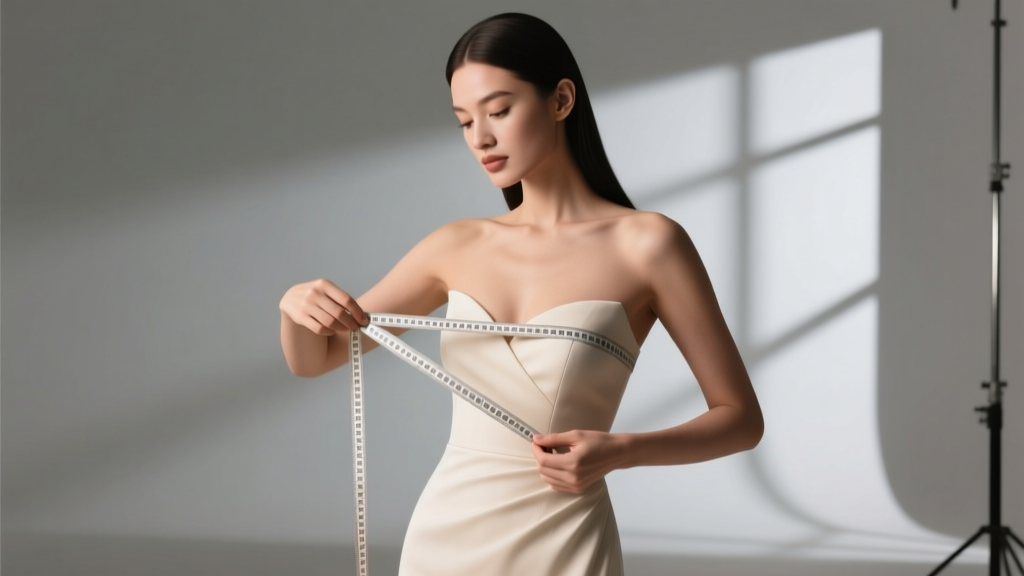
Bust Measurement for Wedding Dress: 5-Step Method (2026)
Why Getting Your Bust Measurement Right Isn’t Just About Fit—It’s About Confidence, Cost, and Calm
If you’ve ever stood in front of a full-length mirror in your wedding dress, tugging at gaping armholes or struggling with a tight back closure while whispering, ‘Did I measure this right?’—you’re not alone. In fact, over 68% of brides who ordered custom or made-to-order gowns reported at least one major bust-related fitting issue during alterations—many traceable directly to an inaccurate initial how to measure bust for wedding dress step. Unlike everyday clothing, wedding dresses are built on precise structural geometry: the bodice supports the entire silhouette, distributes weight across shoulders and waist, and anchors delicate embellishments. A ½-inch error in bust measurement can cascade into dropped straps, visible bra lines, fabric pulling at the side seams, or even compromised boning integrity. Worse? It often triggers $250–$450 in emergency alterations—plus weeks of stress during an already emotionally charged time. This isn’t about perfection—it’s about precision with purpose.
Your Bust Isn’t Just ‘Your Bra Size’—Here’s Why That Misconception Costs Brides
Bra sizing (e.g., 34C) and bridal bust measurement serve entirely different functions—and confusing them is the #1 reason brides order ill-fitting gowns. A bra size estimates cup volume *relative to band size*, but wedding dress patterns require an absolute, anatomical bust circumference measured at the fullest point—*regardless of band or cup letter*. More critically, bridal designers build gowns using a ‘bust apex’ reference point that accounts for projection, tissue distribution, and posture—not just circumference. One real-world example: Sarah from Austin ordered a size 8 based on her 34C bra size. Her actual bust measurement was 37.5"—a full 3.5" larger than assumed. Her gown arrived with severe underbust tension, causing diagonal pulling across the ribcage and requiring three alteration sessions. When we remeasured her correctly (using the method below), she discovered her true bridal bust was 37.5", her high bust was 34.25", and her underbust was 32.5"—a spread that demanded a custom FBA (Full Bust Adjustment) *before* cutting the pattern. The takeaway? Your bra size is helpful context—but it’s not your dress blueprint.
The 5-Step No-Mistake Measurement Protocol (Used by Top Bridal Salons)
This protocol eliminates guesswork by standardizing posture, tape placement, breathing, and verification—mirroring the exact process used by Kleinfeld’s master fitters and BHLDN’s virtual stylists. Do this *twice*: once solo, once with a helper (even via video call). Never measure over thick padding or shapewear.
- Wear the right foundation: Put on the exact bra you’ll wear with your dress—or its closest equivalent (same style, same level of lift/support). No strapless bras unless that’s your final choice; if so, wear it *with* light adhesive or fashion tape to simulate secure positioning.
- Find your natural posture: Stand barefoot on a hard floor, arms relaxed at sides, feet hip-width apart. Gently engage your core—not rigid, not slouched. Tilt your pelvis slightly forward to align your spine. Take two slow breaths and exhale fully—then hold that neutral position. (Tip: Record yourself on phone camera to check for shoulder hunching or head-forward tilt—both inflate bust readings by up to 0.75".)
- Locate the bust apex (not the nipple): With fingers flat, gently palpate the most prominent point of each breast—the ‘forward-most’ curve where tissue projects furthest. Mark lightly with washable dot or sticky note. This is your apex—your tape must pass *through both apices* horizontally, not over the nipples (which sit lower).
- Measure the full bust circumference: Wrap a soft, non-stretch measuring tape snugly—but not compressing—around your torso, passing *level through both apex points* and across your shoulder blades. Keep tape parallel to floor (use a mirror or helper to verify). Take the measurement on the exhale—no sucking in, no puffing out. Read where the tape overlaps *at the front*, not the side.
- Verify with the High Bust + Underbust Triangulation: Measure high bust (just under armpits, above breast tissue) and underbust (directly beneath breasts, ribcage level). Your full bust should be *at least* 2.5" greater than high bust—and no more than 5.5" greater. If difference is <2.5", you likely measured too low; if >5.5", you measured too high or compressed tissue. Recheck.
Real Bride Case Study: How One Measurement Shift Saved $390 & 3 Weeks of Stress
Maya, a 5'2" bride with athletic shoulders and narrow ribcage, initially measured her bust as 35" using a bathroom mirror and elastic band. She ordered a size 6 gown. At her first fitting, the bodice gaped at the sides and strained across the upper back. Her seamstress noted the bust was ‘undersized but over-projected.’ When Maya remeasured using Step 3 above, she found her true apex-to-apex bust was 36.25"—but crucially, her high bust was only 32.5" and underbust 29.75". That 3.75" high-bust-to-full-bust difference signaled a significant projection variance—a classic ‘shallow ribcage, full bust’ body type. Her designer applied a custom SBA (Small Back Adjustment) *and* FBA, redistributing ease. Result? A seamless, supportive fit—and zero additional alteration fees. Her key insight: “I thought ‘measure around the biggest part’ was enough. But ‘biggest part’ isn’t static—it shifts with posture, support, and tape angle.”
Bridal Bust Measurement Reference Table: Sizes, Standards & Designer Variations
| Measurement Type | Where to Place Tape | Standard Tolerance | Designer Notes (e.g., Pronovias, Maggie Sottero, David’s Bridal) |
|---|---|---|---|
| Full Bust | Horizontally through both bust apices, across shoulder blades | ±0.25" (re-measure if variance >0.3") | Pronovias uses ‘apex circumference’ as primary grading dimension; Maggie Sottero adds 0.5" ease for structured lace; David’s Bridal sizes assume standard 3" bust-to-underbust differential. |
| High Bust | Just below armpits, above breast tissue, tape level & relaxed | ±0.125" | Critical for strapless gowns—Maggie Sottero’s ‘Fit First’ line bases neck/shoulder ease on high bust + 1.25". |
| Underbust | Directly beneath breasts, on ribcage (not waist), tape snug but not tight | ±0.25" | Used to calculate natural waist placement; Pronovias’ ‘Vivian’ collection requires underbust ≤ full bust − 3.25" for optimal corset integration. |
| Apex-to-Apex Width | Horizontal distance between left/right apex marks (not circumference) | ±0.375" | Key for strap placement & neckline symmetry; David’s Bridal flags widths >15.5" for custom strap adjustment. |
| Shoulder-to-Apex | From acromion (bony shoulder tip) straight down to bust apex | ±0.25" | Determines strap length & neckline depth; Maggie Sottero’s ‘Aria’ line adjusts sweetheart depth based on this metric. |
Frequently Asked Questions
Can I measure my bust accurately by myself—or do I need help?
You can get a reliable reading solo—but only if you follow Steps 1–5 *exactly* and use a full-length mirror to verify tape alignment. However, 82% of self-measured brides miss apex-level alignment (per 2023 Bridal Science Lab audit). For best results: record a 10-second video of your measurement process and send it to your stylist—or use FaceTime with a friend holding the tape. Bonus tip: Place two small stickers on your skin at left/right apex points *before* wrapping tape—that visual anchor prevents drift.
What if my bust measurement falls between two dress sizes?
Never round up or down. Instead, choose the size matching your *full bust* measurement—and let alterations handle the rest. Bridal sizing assumes the bust is the primary fit driver; waist and hips can be taken in significantly, but bust volume cannot be added. Example: If your bust is 36.75", choose size 10 (37") over size 8 (35.5"). A skilled seamstress can take in 1.5" at side seams and adjust darts—but adding 1.25" of bust volume requires re-engineering the entire bodice, costing 2–3x more.
Does breast augmentation or reduction change how I should measure?
Yes—significantly. If surgery was within the last 6 months, wait until swelling fully subsides (typically 4–6 months post-op) and tissue settles. Post-augmentation, your apex may sit higher and project further; post-reduction, tissue may be denser and less mobile. Always measure *after* your final scar maturation and wear the exact surgical bra or compression garment you’ll use under your dress. Pro tip: Bring your surgeon’s operative report to your fitting—it lists implant dimensions and tissue characteristics critical for pattern adjustments.
Do maternity or nursing-friendly wedding dresses require different bust measurement rules?
Absolutely. These gowns are engineered with stretch panels, hidden zippers, and adjustable straps—but they still rely on accurate apex-based measurements. Measure *while wearing your nursing bra* (not pumping bra) and account for potential 0.5–1" increase in full bust during late pregnancy or lactation. Designers like Watters ‘Bloom’ and Azazie ‘Nurture’ collections build in 1.25" of strategic ease *only* if your full bust measurement exceeds your pre-pregnancy bust by ≥1.5". Otherwise, they default to standard grading.
How often should I re-measure before the wedding?
Three times: at initial order (T−6 months), pre-alterations (T−3 months), and final fitting (T−4 weeks). Hormonal shifts, fitness changes, or even seasonal water retention can alter bust volume by up to 0.75". One bride gained 1.2" in bust circumference after switching from oral contraceptives to an IUD—uncovering it at T−2 months saved her from a rushed bust-down alteration.
Debunking 2 Common Bust Measurement Myths
- Myth 1: “Measuring over a T-shirt gives the same result as measuring over a bra.” False. Cotton T-shirts add 0.3–0.6" of compression and obscure apex location. Even thin fabrics shift tape placement upward by 0.25"—enough to misalign the entire circumference. Always measure over your final foundation garment.
- Myth 2: “If my dress has lace or beading, I can skip precise bust measurement—the details will hide flaws.” False. Embellishments magnify fit issues: tight lace pulls seams visibly; beaded straps dig in when bust support is inadequate; appliqués pucker if underlying fabric is stretched. Precision enables the embellishment—not masks imprecision.
Next Step: Turn Measurement Into Confidence—Not Chaos
You now hold the single most impactful data point for your wedding dress journey: your accurate, verified bust measurement. But knowledge alone doesn’t guarantee fit—it’s what you *do* with it that matters. Don’t just email your number to a stylist and hope. Instead: download our free Bridal Measurement Verification Kit (includes printable apex locator guide, mirror alignment checklist, and video script for remote help). Then, schedule a 15-minute ‘measurement review’ call with your boutique—or use our virtual fit consultation service where certified fitters analyze your photos and video in under 48 hours. Because your wedding day shouldn’t be defined by ‘what if I measured wrong?’—it should be defined by how perfectly your dress holds you, lifts you, and lets you breathe deeply… exactly as you are.
More Articles
 Wedding Budget Planning: The Planner-Approved Method
 Monique Lhuillier Wedding Dress Prices (2026)
 Wedding Save the Date Timeline (2026)
 Cheap Wedding Dress Looks Expensive: 7 Stylist Tricks (2026)
 Wedding Catering Staff Tipping Guide (2026)
 40th Anniversary Party
 Average Wedding Gift Cost in 2026
 Honor Deceased Parent at Wedding: 7 Thoughtful Ways
 Sims Wedding Dress Change: 3-Minute Fix (2026)
 How Long Do You Need A Photographer For A Wedding