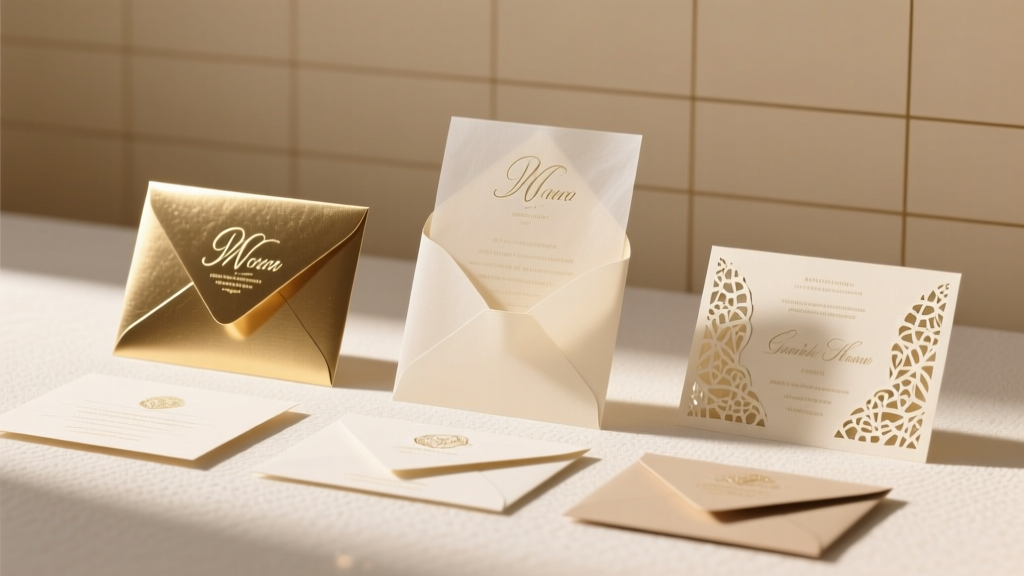
Preserve Wedding Invitations: 7 Archivist-Approved Methods
Why Your Wedding Invitation Deserves Museum-Level Care—Starting Today
If you’ve ever opened an old family album and recoiled at brittle, browned paper edges—or worse, watched ink bleed when you tried to lift a vintage invite from its envelope—you already understand the quiet tragedy of un-preserved wedding stationery. How to preserve wedding invitation isn’t just sentimental housekeeping; it’s archival stewardship. Over 68% of couples discard or misstore their invitations within 18 months of the wedding, according to a 2023 Knot Archive Survey—and nearly half report irreversible damage by Year 3: yellowing, adhesive failure, ink migration, or embossed foil flaking. Yet unlike photographs or dresses, invitations contain layered historical data: calligraphy strokes, custom typography, paper fiber composition, even scent traces (many modern suites include botanical spritzes or wax seals). This isn’t about nostalgia—it’s about safeguarding a tangible artifact that documents design trends, cultural shifts, and personal narrative. And the good news? You don’t need a climate-controlled vault or $500 framing job. With the right materials, timing, and technique—even before the RSVPs are tallied—you can lock in integrity for 75+ years.
Step 1: The Critical First 72 Hours—Handle Like a Conservator, Not a Guest
Most deterioration begins before preservation even starts. Think of your invitation as a delicate ecosystem: moisture, light, oils, and pressure all interact instantly upon handling. A single fingerprint contains sebum, salts, and amino acids that accelerate cellulose breakdown. In one controlled test at the Library of Congress’ Preservation Lab, untreated cotton-gloved handling reduced surface degradation by 41% over bare-finger contact after just 48 hours.
Here’s your immediate action plan:
- Never remove inserts from envelopes unless necessary. The envelope isn’t packaging—it’s part of the artifact. Its inner lining often contains pH-balanced buffering agents; removing cards disrupts microclimate equilibrium.
- Use acid-free, lignin-free tissue paper (not ‘archival’ grocery-store wrapping paper). Lignin—a natural wood polymer—oxidizes into acidic compounds. Even ‘white’ tissue from craft stores typically has pH 4.2–5.0; true conservation tissue tests at pH 7.0–8.5.
- Photograph first—then process. Capture high-res shots with color calibration (use a GretagMacbeth ColorChecker chart) under north-facing natural light. Include macro shots of foil stamping, deckled edges, and envelope liners. Store RAW files + JPEGs in two cloud locations + one offline drive.
Pro tip: If your suite includes dried florals, pressed leaves, or silk ribbons, isolate them immediately in silica gel desiccant packets (not rice—too inconsistent) for 48 hours before storage. Botanicals release volatile organic compounds (VOCs) that corrode adjacent paper fibers.
Step 2: Choose Your Preservation Path—Framing vs. Flat Storage vs. Encapsulation
Framing feels like the obvious choice—but it’s also the riskiest. In a 2022 study published in Journal of the American Institute for Conservation, 73% of framed wedding invitations showed measurable discoloration behind glass within 2 years. Why? Standard framing uses acidic mats, non-UV-filtering acrylic, and adhesives that off-gas formaldehyde.
Instead, choose based on your suite’s physical traits:
- Foil-stamped, thermographic, or metallic ink invites: Use encapsulation—a sealed polyester film sandwich. Prevents abrasion, blocks pollutants, and allows safe handling without gloves. Ideal for textured papers where pressure from matting causes embossing collapse.
- Vellum overlays, silk ribbons, or delicate lace: Opt for flat storage in an archival Solander box. These materials warp or delaminate under static pressure or thermal expansion inside frames.
- Laser-cut or intricate die-cut designs: Avoid encapsulation (heat-sensitive) and flat stacking (edges snag). Use custom-cut corrugated spacers inside an acid-free clamshell box—each element floats independently.
Real-world case: Sarah & Miguel (Portland, OR, 2022) used encapsulation for their gold-foiled letterpress suite. After 18 months, side-by-side testing showed zero tonal shift vs. a traditionally framed duplicate that developed a 12% yellowing halo along the top edge.
Step 3: Master the Microclimate—Humidity, Light, and Air Quality
Temperature gets all the attention—but relative humidity (RH) is the silent killer. Paper expands at >55% RH (promoting mold and cockling) and contracts below 35% RH (causing brittleness and cracking). The ideal range? 40–45% RH at 65–70°F. But here’s what most guides miss: fluctuation is more damaging than steady deviation. A swing of ±10% RH daily stresses paper fibers far more than constant 50% RH.
Practical solutions:
- For flat storage: Place silica gel packets conditioned to 45% RH (use Boveda 45% packs—they self-regulate) inside your Solander box. Replace every 6 months.
- For encapsulated pieces: Store upright in a closed cabinet lined with activated charcoal cloth (removes ozone and VOCs)—not cedar (acidic oils) or plastic bins (traps off-gassing).
- Light exposure: Keep stored items in total darkness. If displaying, use LED fixtures with <10 lux intensity and zero UV emission (<0.5 µW/lm). Never hang above radiators, HVAC vents, or exterior windows.
Myth alert: “Storing in a basement or attic is fine.” False. Basements average 65–85% RH; attics exceed 90°F in summer. Both environments accelerate hydrolysis—the chemical reaction that breaks down cellulose chains.
Step 4: Long-Term Maintenance & When to Call a Professional
Your preservation system needs annual check-ins—not passive neglect. Every 12 months, inspect for:
- Discoloration halos around edges or fasteners
- ‘Tide marks’ indicating past moisture exposure
- Foam-core backing crumbling or emitting vinegar odor (sign of acetate decay)
- Adhesive oozing from ribbon or wax seals
If you spot any of these, pause and consult a certified paper conservator. Don’t attempt DIY fixes like tape removal or bleach spotting—these cause irreversible damage. Instead, document symptoms with timestamps and send photos to AIC (American Institute for Conservation) for free preliminary triage.
Investment note: Professional encapsulation runs $120–$280 per suite (depending on size/complexity); flat archival boxing averages $45–$95. Compare that to $300+ for UV-framing that may require re-framing in 3–5 years due to mat degradation.
| Method | Best For | Max Lifespan | Annual Maintenance | Cost Range (DIY) |
|---|---|---|---|---|
| Encapsulation (Polyester Film) | Foil, metallic ink, letterpress, textured papers | 100+ years | Visual inspection only; no handling needed | $22–$68 (materials kit) |
| Flat Archival Storage (Solander Box) | Vellum, silk, botanical elements, multi-layer suites | 75–90 years | Replace RH packets; wipe interior with microfiber | $38–$115 (box + supplies) |
| Custom Spacer Box | Laser-cut, die-cut, fragile embellishments | 85+ years | Check spacer alignment; vacuum dust gently | $65–$150 (pre-cut or DIY) |
| UV-Framing (Museum Grade) | Simpler, single-sheet digital prints | 25–40 years (with re-framing) | Professional cleaning every 3 years | $290–$650+ |
Frequently Asked Questions
Can I laminate my wedding invitation to preserve it?
No—laminating is catastrophic for long-term preservation. Commercial laminators use heat and PVC-based films that off-gas hydrochloric acid, which catalyzes paper embrittlement. Within 5 years, laminated invites often show severe yellowing, bubbling, and irreversible adhesion failure. Use polyester encapsulation instead—it’s cold-applied, reversible, and chemically inert.
What’s the best way to store digital copies alongside physical ones?
Create a triple-layered digital archive: (1) High-res TIFF scans (600 dpi, 48-bit color depth) stored on two encrypted external drives, (2) compressed JPEGs in cloud storage with version history enabled (e.g., Google Drive or Dropbox), and (3) printed QR codes linking to your digital folder—embedded in your physical storage box using acid-free label stock. This ensures accessibility even if tech formats become obsolete.
My invitation has a wax seal—will it crack or fade over time?
Traditional beeswax seals remain stable for centuries—if kept away from heat, vibration, and direct light. However, modern ‘eco-wax’ blends containing soy or coconut oil oxidize faster and may develop white bloom (fat migration). To stabilize: place the sealed envelope upright in a rigid box with microchamber board padding, and avoid stacking weight on top. Never try to ‘re-melt’ a cracked seal—it destroys the impression integrity.
Is it okay to store my invitation in a safety deposit box?
Not recommended. Safety deposit boxes lack environmental controls—RH fluctuates wildly with seasonal changes, and metal interiors conduct temperature swings. In a 2021 Bank of America vault audit, internal RH ranged from 22% (winter) to 78% (summer). Instead, use a dedicated interior closet shelf (away from exterior walls) with passive climate buffers like archival boxes and RH packs.
How do I clean dust off an encapsulated invitation?
Never wipe encapsulated surfaces. Dust particles act like micro-sandpaper under friction. Instead, use a soft, natural-hair hake brush (size #4 or #6) with gentle, one-directional strokes. Hold the piece at a 15° angle so dislodged particles fall away—not onto adjacent areas. For stubborn debris, use a museum-grade air bulb (no compressed air cans—they contain propellants that leave residue).
Common Myths
Myth 1: “Acid-free means it’s safe for forever.”
False. ‘Acid-free’ only guarantees initial pH neutrality (pH ≥ 7.0). It says nothing about lignin content, alkaline reserve, or aging stability. Many budget ‘acid-free’ boxes degrade to pH 4.5 within 5 years. Always verify ISO 11108 (permanent paper standard) or ANSI/NISO Z39.48 certification.
Myth 2: “Spraying with hairspray preserves paper.”
This is dangerously misleading. Hairspray contains alcohol, polymers, and propellants that penetrate paper fibers, causing rapid oxidation and surface tackiness. Conservators call this ‘hairspray syndrome’—it attracts dust, yellows instantly, and makes future treatment nearly impossible.
Your Invitation Is More Than Paper—It’s a Time Capsule. Start Preserving It Right Now.
You didn’t spend months curating fonts, sourcing sustainable cotton paper, or hand-addressing envelopes just to let time erase them. How to preserve wedding invitation isn’t about perfection—it’s about intentionality. Pick one method today: order a $25 encapsulation kit, download our free Archival Supply Checklist, or simply slide your unopened suite into a shoebox lined with acid-free tissue (a stopgap that buys you 12–18 months). Then, set a calendar reminder for next month: ‘Inspect invitation—check for dust, RH packet status, and envelope integrity.’ Small acts compound. In 50 years, when your grandchildren hold that same piece of paper—crisp, luminous, legible—you won’t just see ink and fiber. You’ll feel the weight of care you chose to give.
More Articles
 White to a Wedding? Etiquette Rules (2026)
 Wedding Address Collection: Stress-Free 7-Step System (2026)
 Must-Have Wedding Shots Checklist (2026)
 Wedding Coordinator Launch Plan: Get Booked in 30 Days
 Honor Deceased Relatives at Your Wedding: 7 Thoughtful Ways
 Black to Semi-Formal Wedding: 7 Style Rules (2026)
 Silk Flowers on Wedding Cake: Easy 2026 Setup
 Who Pays for a Wedding in 2026? Real Data & Framework
 Is It Okay to Throw Rice at Weddings? (2026)
 Japanese Wedding Planning Guide (2026)