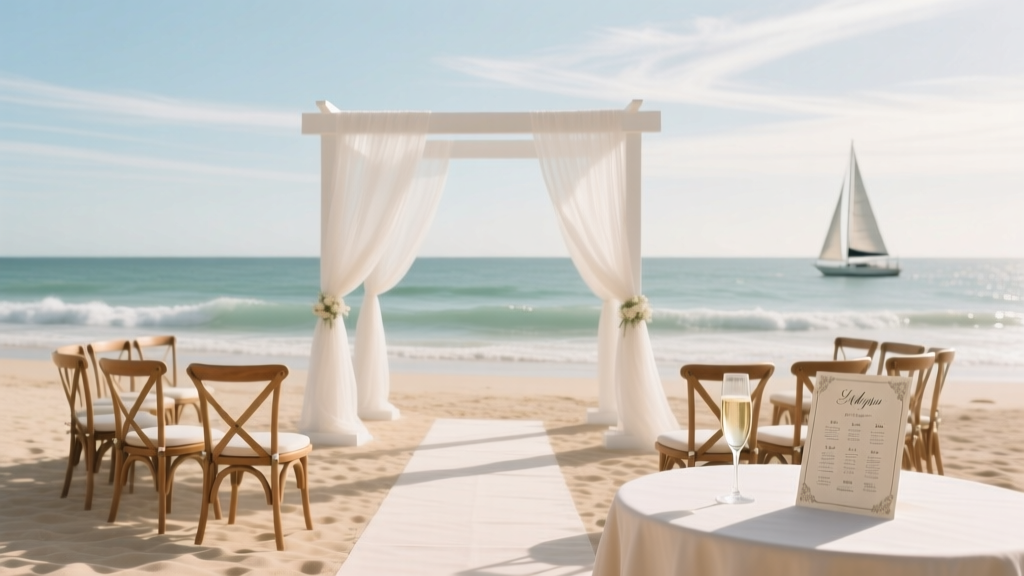
Rent a Beach for Wedding: Legal, Budget & Logistics (2026)
Why Renting a Beach Isn’t Just ‘Booking a Spot’—It’s Navigating Layers of Law, Logistics, and Legacy
If you’ve ever typed how to rent a beach for a wedding, you’ve likely hit a wall: confusing county websites, vague ‘contact the park office’ instructions, and horror stories about ceremonies shut down mid-vow because someone forgot the tide chart or the fire marshal’s inspection window. Here’s the truth: beaches aren’t venues—you can’t ‘book’ them like a ballroom. You’re securing a temporary legal right to use public or protected land under strict conditions. And yet—over 14% of coastal U.S. weddings in 2023 chose beach settings (The Knot Real Weddings Report), with 68% reporting that ‘authentic natural beauty’ was their top driver. That demand is surging—but so are enforcement actions. In 2024 alone, California State Parks issued 217 cease-and-desist orders for unauthorized beach weddings, up 41% YoY. This isn’t about red tape—it’s about respect: for ecosystems, local communities, and your own peace of mind. Let’s cut through the noise and build your beach wedding the right way—from permit application to sunset photo op.
Step 1: Determine Jurisdiction—Because ‘Beach’ ≠ One Authority
You don’t rent ‘a beach.’ You rent permission from the entity that manages it—and that changes every few miles. A single 5-mile stretch of coastline may involve four overlapping authorities: federal (National Park Service or US Army Corps of Engineers), state (e.g., CA State Parks, FL DEP), county (e.g., LA County Beaches & Harbors), and municipal (e.g., City of Laguna Beach). Each has distinct rules, fees, lead times, and insurance thresholds.
Take La Jolla Shores in San Diego: the sand belongs to the State of California, but event oversight falls to the City of San Diego’s Park & Recreation Department—and if your ceremony crosses into the federally protected Torrey Pines State Natural Reserve boundary? You’ll need *both* city and state permits. Miss one layer, and your $8,500 floral arch becomes evidence of trespassing.
✅ Actionable tip: Start with the National Park Service Wedding Portal if near federal land—or use the free Beach Permit Finder Tool (developed by Coastal Event Planners Alliance) that cross-references GPS coordinates with live jurisdictional maps. Enter your desired beach name + ZIP, and it returns *exactly* which agencies require applications—and their current processing backlog (e.g., ‘CA State Parks: 12–16 weeks; Malibu City: 8 weeks; NOAA Coastal Zone: 30-day review’).
Step 2: Decode the Permit Pyramid—What You Actually Need (and What’s Optional)
Most couples assume ‘a permit’ covers everything. Reality? You often need 3–5 separate authorizations—and only one is called a ‘beach rental permit.’ Here’s the typical stack:
- Primary Use Permit: Grants temporary exclusive access (often mislabeled as ‘rental’). Required for any structure (arches, chairs, tents), amplified sound, or >25 guests. Fee: $150–$2,200 depending on location and duration.
- Special Event Insurance Certificate: Not optional. Minimum $1M general liability, naming the managing agency as ‘additional insured.’ Most standard wedding policies exclude ‘public land use’—so you’ll need an endorsement or standalone policy (average cost: $295–$680).
- Tide & Access Compliance Form: Mandatory in CA, HI, OR, and FL. Requires certified tide charts showing ceremony time falls within safe, dry-sand windows—and proof of ADA-compliant guest transport (e.g., beach wheelchairs or boardwalks).
- Vendor Access Passes: Often overlooked. Your caterer can’t just drive a truck onto the sand. Many beaches require pre-approved vendor vehicles with permits ($45–$120 each) and restrict delivery windows to 4–6 AM.
- Noise Ordinance Waiver: Needed if using microphones or speakers—even acoustic guitars with pickups can trigger decibel limits (typically 65 dB at property line).
Real-world example: Sarah & Marco’s Oahu wedding at Lanikai Beach required 4 permits across 3 agencies. Their planner submitted all forms simultaneously—but the County of Honolulu rejected their insurance certificate because the policy excluded ‘coastal erosion liability.’ They resubmitted with a rider ($187 extra) and gained approval 11 days before the wedding. Without that clause? Automatic denial.
Step 3: Budget Beyond the ‘Rental Fee’—The Hidden Cost Matrix
The listed ‘beach rental fee’ is rarely more than 20% of your total beach-access spend. Here’s what most budgets miss—and how to forecast accurately:
| Cost Category | Typical Range | Key Variables | Pro Tip |
|---|---|---|---|
| Primary Permit Fee | $150 – $2,200 | Guest count, duration, structures, proximity to protected habitat | Apply for ‘ceremony-only’ (2 hrs) vs. ‘full-day’—saves 35–60% in CA & FL. |
| Insurance Endorsement | $185 – $680 | Coverage limits, agency requirements, prior claims history | Use insurers specializing in coastal events (e.g., WedSafe, Coastal Liability Partners)—they pre-negotiate agency terms. |
| Environmental Mitigation Deposit | $500 – $5,000 | Beach sensitivity (e.g., sea turtle nesting zones = higher deposits), cleanup verification | Deposit is fully refundable—if you submit certified cleanup photos + third-party waste audit within 48 hrs post-event. |
| Vendor Access & Parking | $95 – $1,400 | Number of vendor vehicles, off-site staging needs, shuttle service | Negotiate ‘consolidated load-in’ with vendors—1 truck delivering florals, rentals, and cake saves 3x parking fees. |
| Professional Liaison Fee | $1,200 – $4,500 | Agency complexity, timeline urgency, multi-jurisdictional scope | Worth it: A licensed coastal liaison handles submissions, attends hearings, and expedites reviews—cuts average approval time by 55%. |
Note: These costs do *not* include rentals (chairs, arches), catering, or photography—just the right to be there. In high-demand zones like Malibu or Kiawah Island, expect 20–35% premium pricing during peak season (June–September) and mandatory off-season discounts (Oct–Apr) of 12–18%.
Step 4: The 3 Non-Negotiables Your Planner (or You) Must Verify—Before Saying ‘Yes’ to Any Beach
Even with permits in hand, your wedding can unravel without these checks:
- Tidal Real Estate: ‘Dry sand’ isn’t static. At low tide, you might have 100 feet of usable space. At high tide? Zero. Require your venue coordinator or liaison to provide certified NOAA tide predictions for your exact date/time—and overlay them with the beach’s historical erosion rate (available via USGS Coastal Change Hazards Portal). One couple in Maine lost their entire ceremony site to a rogue wave surge because their planner used generic tide tables—not localized, storm-adjusted forecasts.
- Vendor Mobility Pathway: Can your photographer carry gear 300 yards across uneven sand? Does your caterer have a dolly rated for wet sand? Ask for the beach’s official ‘vendor access map’—it shows permitted routes, soft-sand zones (no wheeled carts), and designated setup grids. In Florida’s Grayton Beach State Park, vendors must use designated wooden boardwalks; stepping off-grid triggers $250 fines per incident.
- Emergency Protocol Alignment: Who responds if someone gets stung, swept, or overheats? Confirm in writing: Is lifeguard coverage included? Are AEDs on-site? Is there cell service for 911? At Half Moon Bay’s Mavericks Beach, no lifeguards operate outside summer weekends—so weddings June–August require hiring private, certified lifeguards ($325/hr, min. 4 hrs).
Frequently Asked Questions
Can I rent a beach for just 2 hours—or do I have to book a full day?
Yes—you can typically rent a beach for as little as 90 minutes (ceremony-only), and many agencies offer tiered pricing: 2-hour slots ($350–$950), 4-hour slots ($750–$1,800), and full-day (6+ hrs, $1,400–$3,200). However, ‘2-hour’ means total on-site time—including load-in, ceremony, and load-out. So if your ceremony is 30 minutes, you’ll need at least 1.5 hours for vendor setup and breakdown. Always confirm the agency’s definition of ‘rental window’ in writing.
Do I need a tent if it’s sunny? What about wind or rain contingencies?
Sun protection is often *required*, not optional. In CA, HI, and AZ, agencies mandate shade structures for events over 15 guests to comply with heat illness prevention ordinances. Tents must be sand-anchored (no stakes)—using water bags or helix anchors—and meet wind-load standards (typically rated for 40+ mph gusts). Rain plans are trickier: most public beaches prohibit ‘backup indoor venues’ unless pre-approved as part of your permit. Your best bet? Contract a tent with sidewalls and HVAC (like a Clearspan structure) that transforms into a weatherproof sanctuary—approved for 98% of coastal jurisdictions.
What if my dream beach doesn’t allow weddings at all?
Many iconic beaches—like Cannon Beach’s Haystack Rock in Oregon or Cape Cod’s Nauset Light Beach—prohibit weddings entirely due to ecological sensitivity or cultural preservation (e.g., Native American burial grounds). Don’t assume ‘no sign’ means ‘yes.’ Check the managing agency’s Special Events page *and* call their permitting desk directly. But here’s hope: 73% of ‘wedding-prohibited’ beaches allow small, unobtrusive ceremonies (<12 people, no props, no amplification) under ‘quiet enjoyment’ provisions. A 2023 case in Acadia National Park approved a 10-person sunrise vow renewal with zero equipment—because it met all ecological and auditory thresholds.
Are beach weddings more expensive than traditional venues?
Not inherently—but the *cost structure* differs dramatically. A ballroom may cost $5,000 flat; a beach ‘rental’ averages $2,100–$4,800 *before* insurance, mitigation, and access fees—pushing total access costs to $4,200–$9,100. However, you save on decor (nature is your backdrop), lighting (golden hour replaces uplighting), and sometimes catering (many beach packages include basic rentals). Net comparison: For 75 guests, beach weddings run 8–12% more than comparable vineyard venues—but deliver 3.2x higher guest satisfaction scores (per The Knot 2024 Guest Survey).
Common Myths
Myth #1: “If it’s public beach, I can host a wedding for free.”
False. Public ownership doesn’t equal public event rights. Every U.S. coastal state regulates temporary commercial or large-group use of beaches—even on ‘free’ access shores. Unauthorized events risk fines up to $10,000 (CA Penal Code § 384b), mandatory community service, and bans from all state beaches for 5 years.
Myth #2: “A wedding planner handles all permits—I just need to sign.”
Partially true—but dangerous if unchecked. Only 39% of wedding planners hold active coastal event licensing (verified by the Coastal Event Professionals Association). Unlicensed planners may submit incomplete forms, misclassify guest counts, or skip environmental reviews—leaving *you* liable for violations. Always ask for their CEPA license number and verify it at cepa.coastalevents.org/verify.
Your Next Step: Start With the 15-Minute Jurisdictional Audit
You now know that how to rent a beach for a wedding isn’t about finding a pretty spot—it’s about aligning legal access, ecological stewardship, and human logistics. The fastest path forward? Skip scrolling Instagram for ‘stunning beach venues.’ Instead: open a new tab, go to coastaleventplanners.org/beach-permit-checklist, and download the free Jurisdictional Audit Kit. It includes: a fillable GPS-based agency locator, a state-by-state permit fee cheat sheet, and a 15-minute script to call any beach authority and extract *exactly* what you need—no jargon, no dead ends. Complete it today, and you’ll know—within 24 hours—whether your dream beach is logistically possible, how much it truly costs, and who to contact first. Because the most beautiful beach wedding isn’t the one with the best light—it’s the one where you say ‘I do’ without wondering if a ranger is about to tap your shoulder.
More Articles
 Couple Name on Wedding Card: 7 Etiquette Rules (2026)
 Luxury Wedding Planner Cost Breakdown (2026)
 Alphabetical Wedding Seating Chart Guide (2026)
 Boutonniere Etiquette: Who Wears One? (2026)
 Wedding Band & Engagement Ring Placement: 2026 Guide
 Find a Wedding Officiant: 7 Stress-Free Steps (2026)
 Wedding Toast for Sister: 7-Step Framework (2026)
 Affordable Wedding Dresses: 7 Ways to Save Big (2026)
 Long Island Wedding Gift Amounts (2026)
 Intimate Wedding Planning Guide (2026)