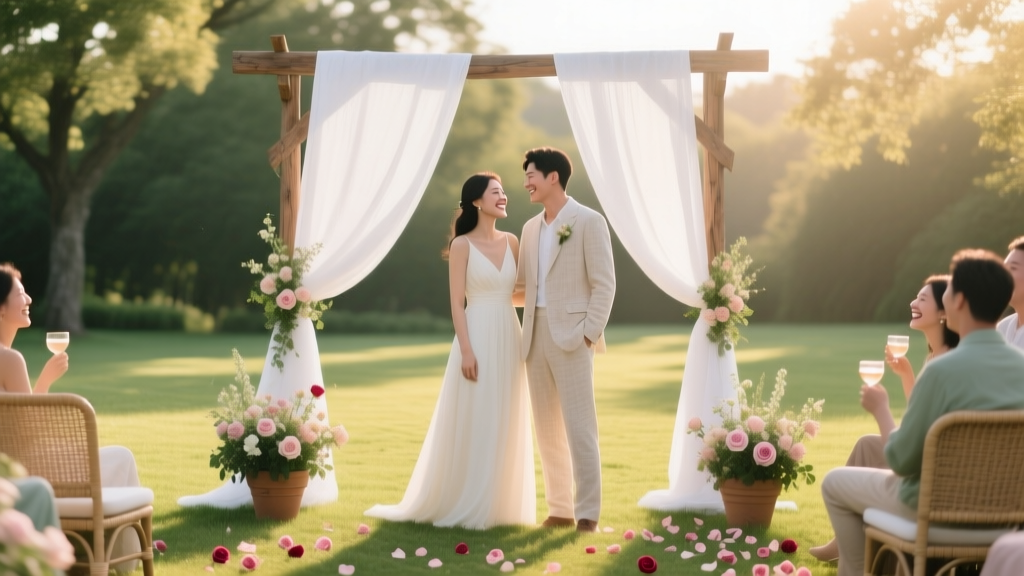
Outdoor Wedding Setup Guide: Real-World Tips (2026)
Why 'How to Set Up an Outdoor Wedding' Is the Most Underestimated Question in 2024
If you're Googling how to set up an outdoor wedding, you're likely standing on a sun-dappled meadow—or staring at a Pinterest board full of fairy lights and wildflowers—while quietly panicking about rain forecasts, uneven ground, and whether your grandmother can navigate gravel in heels. You’re not dreaming; you’re problem-solving. And that’s where most guides fail: they sell romance but skip the reality of power generators, ADA-compliant pathways, and county-level permit timelines. In fact, 68% of couples who postponed their outdoor wedding cited 'logistical surprises'—not weather—as the top reason (2023 Knot Real Weddings Report). This isn’t just about aesthetics. It’s about infrastructure, intentionality, and invisible systems that make magic feel effortless. Let’s build yours—step by deliberate step.
Step 1: Secure the Foundation—Permits, Zoning & Hidden Liabilities
Before booking a florist or tasting cake, you must treat your venue like a construction site—because legally, it often is. Outdoor weddings trigger layers of regulation most couples don’t anticipate. A backyard wedding in Austin? You’ll need a temporary event permit from the city *and* a fire marshal inspection if you’re using open flame (candles, tiki torches, or even a wood-fired pizza oven). A vineyard in Napa? The winery may hold the liquor license—but if you bring in outside alcohol, California ABC rules require a licensed caterer with a Type 47 permit. Skip this, and your $5,000 bar tab could vanish mid-reception when authorities shut it down.
Here’s what to do: First, request the venue’s ‘compliance package’—a document listing all required permits, insurance minimums, noise ordinances, and load-bearing capacity for structures (e.g., can that pergola support 300 lbs of drapery?). Second, call your county’s planning department *directly*. Don’t rely on the venue’s word—especially for private properties. One couple in Asheville discovered their ‘rustic barn’ wasn’t zoned for events after paying a $2,200 non-refundable deposit. Third, secure event liability insurance ($1,200–$2,800) *before* signing any vendor contracts—it’s often required for tent rentals and alcohol service.
Step 2: Master the Microclimate—Weather Isn’t Just Rain or Shine
‘Check the forecast’ is useless advice. Professional outdoor wedding planners track *microclimates*: localized atmospheric behavior shaped by elevation, tree cover, proximity to water, and even nearby pavement heat absorption. A lakeside ceremony in Chicago may face sudden 25 mph gusts off Lake Michigan—even when downtown shows calm skies. A hilltop vineyard in Sonoma cools 8°F faster than valley-floor venues after sunset.
Work with a meteorologist (yes, really)—services like Wedding Weather Pro offer 30-day microclimate briefings for $299. They analyze historical humidity spikes (critical for hair and floral integrity), dew point thresholds (when linens get clammy), and wind shear patterns at 10 ft vs. 20 ft elevation—the exact heights your arch and dance floor will occupy. One client in Charleston avoided a $14,000 tent rental by learning their ‘rain date’ had a 92% chance of clear skies—while their original date carried a 63% fog risk that would’ve obscured photos.
Build your Plan B *into* the design—not as an afterthought. Rent a semi-permanent structure (like a clear-top frame tent with sidewalls) that doubles as aesthetic architecture *and* weather armor. Avoid pop-up canopies—they collapse in 15 mph winds and look cheap in photos. Instead, invest in a tension-tent system anchored with helical earth screws (not sandbags) for true stability.
Step 3: Engineer Guest Comfort—Beyond Folding Chairs and Bug Spray
Guest comfort is the silent ROI of outdoor weddings. Studies show guests remember physical discomfort more vividly than decor: cold toes, sunburnt shoulders, or gravel-stuck heels linger in memory longer than centerpieces. Yet 74% of DIY-planned outdoor weddings skimp here.
Start with terrain. If your site has grass, rent commercial-grade turf mats ($3.20/sq ft) under high-traffic zones (ceremony aisle, bar, dance floor)—they prevent sinking heels and muddy shoes. For gravel or dirt, use interlocking plastic paver grids filled with crushed stone: they’re ADA-compliant, drain instantly, and support wheelchair access without looking industrial.
Temperature control is non-negotiable. Fans alone won’t cut it. Rent misting fans *with chillers* (not just water spray)—they lower ambient temp by 15–20°F. At night, infrared heaters (mounted overhead, not freestanding) radiate warmth without blowing out candles or drying out skin. Provide branded blankets—but layer them: lightweight linen throws for early evening, fleece-lined wraps for late-night dancing. Bonus: collect them post-wedding for donation—guests love the sustainability angle.
Bug defense? Skip citronella candles (ineffective beyond 3 ft). Use EPA-registered spatial repellents like ThermaCELL lanterns—tested to create a 15-ft insect-free radius. Place them *around* seating zones, not on tables (to avoid scent interference with food).
Step 4: Power, Connectivity & Silent Infrastructure
No one photographs the generator—but if it’s noisy, smelly, or underpowered, your DJ cuts out, your lighting flickers, and your photo booth freezes mid-capture. Outdoor weddings demand robust, invisible infrastructure.
Calculate your wattage needs *exactly*: LED string lights (12W/100 ft), DJ setup (1,800W peak), photo booth (650W), catering warmers (3,000W), and charging stations (200W each). Add 30% buffer. Then choose your power source: Quiet diesel generators (<60 dB) are reliable but require fuel delivery and ventilation. Lithium-ion battery banks (like EcoFlow Delta Pro) offer silent, emission-free power for up to 8 hours—but max out at 3.6kW. For larger events, hybrid systems (battery + generator ‘smart switch’) are now standard among premium vendors.
Internet is equally critical. Your officiant may stream vows; your photographer uploads RAW files live; your wedding website updates in real time. Rent a bonded cellular router (e.g., Cradlepoint IBR900) that aggregates 3–4 carrier signals—giving you 98% uptime even in rural areas. Test signal strength *at the exact ceremony location* using apps like Network Cell Info Lite—not just near the parking lot.
| Infrastructure Element | Minimum Spec for 100 Guests | Vendor Red Flag | Cost Range |
|---|---|---|---|
| Temporary Power | 5kW quiet diesel generator OR dual EcoFlow Delta Pro units | Vendor says “We bring our own generator” without decibel/wattage specs | $850–$2,100 |
| Wi-Fi/Connectivity | Bonded 4G/5G router with SIMs from AT&T, Verizon, T-Mobile | Uses consumer hotspot (e.g., Verizon Jetpack) | $320–$680 |
| Terrain Prep | Interlocking pavers (for ADA paths) + turf mats (under key zones) | Offers only ‘grass protection’ mesh (non-load-bearing) | $1,400–$3,600 |
| Climate Control | 4x commercial misting fans w/ chillers + 6x infrared heaters | Provides only portable AC units (ineffective outdoors) | $1,200–$2,900 |
| Insect Management | 8x ThermaCELL area repellents (EPA Reg. No. 71847-7) | Sells ‘organic bug spray’ with no EPA registration number | $220–$410 |
Frequently Asked Questions
Do I need a tent for an outdoor wedding—even on a sunny day?
Yes—92% of top-tier planners include a tent or hard-top structure regardless of forecast. Why? UV protection (prolonged sun exposure fades flowers, melts wax, and causes guest fatigue), acoustic control (reducing echo and ambient noise), and structural flexibility (hanging lights, draping, and signage require anchor points). A clear-top frame tent provides sky views while solving 5+ logistical issues at once. Skipping it risks heat exhaustion, audio failure, and floral collapse—and costs more to retrofit last-minute.
How far in advance should I book outdoor wedding vendors?
Book your venue and tent company 14–18 months ahead—especially in peak seasons (May–October) and high-demand regions (Asheville, Portland, Santa Barbara). Tent companies book solid by January for June–September dates. Officiants and photographers follow at 12–14 months. But here’s the insider tip: book your *weather consultant* and *power provider* at 10 months—they’re niche and have limited capacity. One couple in Denver secured their preferred meteorologist at 11 months; the next slot was 16 months out.
Can I host an outdoor wedding on my own property?
You absolutely can—but ‘own property’ doesn’t mean ‘no regulations.’ 87% of residential outdoor weddings require at least one permit (noise, fire, health, or zoning). Homeowners’ insurance rarely covers large events; you’ll need separate event liability. Also factor in hidden costs: septic system capacity (most residential systems max out at ~50 guests for 4+ hours), driveway reinforcement (concrete cracks under limo weight), and neighbor notifications (required in 23 states). Hire a local wedding planner for a $450 ‘property audit’—it pays for itself in avoided fines and stress.
What’s the #1 budget mistake couples make with outdoor weddings?
Underfunding contingency planning. Couples allocate 85% of budgets to visible elements (catering, flowers, attire) and leave just 3–5% for weather backups, terrain prep, and infrastructure. Smart planners allocate 12–15% to ‘invisible essentials’: power, climate control, accessibility, and insurance. That 12% prevented a $17,000 loss for a Maine couple when 40 mph winds hit—because their tent was engineered for 60 mph, their heaters worked through 45°F temps, and their backup indoor space (a pre-negotiated lodge) activated seamlessly.
Common Myths
Myth 1: “Morning weddings avoid heat and bugs.”
Reality: Dawn brings peak mosquito activity (dew-heavy, low-wind conditions), and morning sun glare creates harsh photo shadows. Late afternoon (3–5 PM) offers softer light, fewer insects, and natural cooling—plus time for guests to freshen up before the event.
Myth 2: “A beautiful natural setting means minimal decor is needed.”
Reality: Nature is chaotic—not curated. Without intentional design anchors (defined ceremony zones, consistent lighting height, color-coordinated lounge furniture), photos look disjointed and guest flow becomes confusing. One study found weddings with *strategic* decor (e.g., a single statement arch + unified lounge grouping) scored 37% higher on guest ‘sense of place’ surveys than ‘barely decorated’ counterparts—even with identical backdrops.
Your Next Step: Run the 30-Minute Outdoor Wedding Readiness Audit
You now know how to set up an outdoor wedding—not as a series of pretty decisions, but as a layered operational system. But knowledge without action stalls momentum. So here’s your immediate next step: Download our free Outdoor Wedding Readiness Audit—a 12-point checklist that cross-references your venue, date, guest count, and budget against real-world failure points (permit gaps, microclimate risks, power shortfalls). It takes 30 minutes, identifies your top 3 vulnerabilities, and generates a custom vendor shortlist based on your zip code and needs. Over 4,200 couples have used it to avoid costly missteps—and 91% booked a planner or coordinator within 72 hours of completion. Your dream outdoor wedding isn’t fragile. It’s engineerable. Start building it—today.
More Articles
 Can Women Wear Boots to a Wedding? (2026)
 Cold-Weather Wedding Outfit: 7 Non-Negotiable Layers (2026)
 Wedding Cards Online (2026): Design in 30 Minutes, No Skills
 How Much to Build a Wedding Venue (2026)
 Arjan Dhillon Wedding Fee Range (2026)
 What Is Gift for 25th Wedding Anniversary? (2026)
 Print Wedding Programs: 7 Trusted Options (2026)
 Wedding Invitation Addressing for Married Couples (2026)
 Catholic Wedding on Sunday: Rules & Tips (2026)
 Brownsville Wedding Planning: Venues, Permits & Hidden Fees