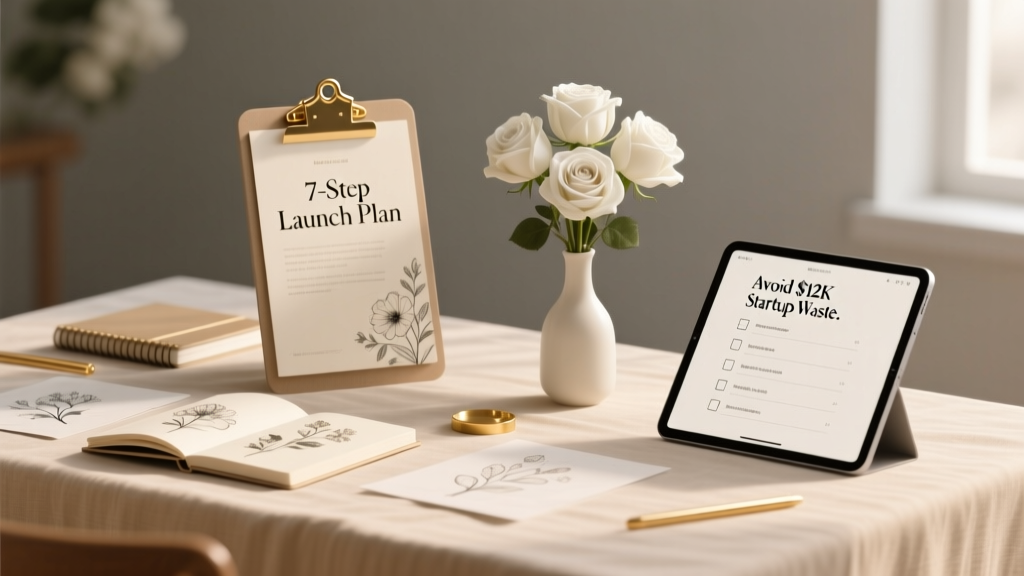
Wedding Decorating Business: 7-Step Launch Plan (2026)
Why Starting a Wedding Decorating Business Is Smarter Than Ever—But Only If You Skip the "Just Buy More Pillows" Trap
If you've ever scrolled through Pinterest dreaming of transforming ballrooms into enchanted forests—or watched a friend’s wedding go viral for its jaw-dropping floral arch—you’ve probably asked yourself: how to start wedding decorating business. And you’re not alone: 68% of new wedding pros launch without formal training, yet only 22% survive past Year 2. Why? Because most treat it like a hobby—not a service business with razor-thin margins, seasonal cash flow cliffs, and client expectations that shift faster than a bride’s vision board. This isn’t about arranging peonies. It’s about mastering logistics, pricing psychology, and trust architecture—all before you buy a single votive candle.
Your First Realistic Milestone Isn’t ‘First Client’—It’s ‘First Profitable Project’
Let’s reset expectations: Your goal isn’t just landing a gig. It’s delivering a project where your gross margin exceeds 45%, your timeline stays within 90 minutes of estimate, and your client refers two more couples within 30 days. That starts with ruthless focus—not broad offerings. In 2024, top-performing new decorators don’t do ‘full-service weddings.’ They dominate one hyper-specific niche:
- Micro-weddings (15–30 guests): 42% growth YoY; clients pay premium rates ($2,800–$5,200 avg.) for intimacy-focused design, minimal staffing needs, and shorter install windows.
- Elopement styling packages: 63% of couples now consider elopements; $1,200–$3,500 flat-fee bundles (arch + 2 florals + ceremony backdrop) require zero venue coordination.
- Rehearsal dinner styling: Often overlooked—but 89% of planners outsource this; $950–$2,400 per event, booked 6–8 months ahead, low stress, high repeat potential.
Case in point: Maya R., launched in Austin in March 2023 focusing exclusively on micro-wedding lounge zones. She skipped traditional floral-heavy setups and built modular, rentable velvet chaise lounges with custom LED base lighting. Her first 3 clients came via Instagram Reels showing time-lapse installs (not finished photos). By Month 5, she’d replaced her graphic design job—and hit $14,200 in revenue with 58% gross margin. Her secret? She treated décor as infrastructure—not decoration.
The Legal & Financial Foundation Most Skip (and Regret)
You don’t need an LLC on Day 1—but you do need liability coverage before touching a single silk rose. Here’s what actually matters:
- Business structure: Sole proprietorship is fine for Year 1—if you operate under your legal name and keep personal finances strictly separate (use a dedicated bank account + QuickBooks Self-Employed). Upgrade to LLC only after hitting $25K in annual revenue or when renting equipment valued over $5K.
- Insurance: General liability ($1M minimum) is non-negotiable. Cost: $39–$62/month via Thimble or Hiscox. Add ‘equipment floater’ coverage if leasing or buying inventory—$15 extra/month covers up to $10K in gear.
- Pricing guardrails: Never quote flat fees without a scope checklist. Use the 3-Tiered Quote System:
- Base Tier: Venue walkthrough + 1 revision round + standard install/deinstall. (Covers 70% of projects.)
- Plus Tier: Includes custom fabric draping, branded signage, and 24-hour on-site support window.
- Signature Tier: Full design consultation, 3D renderings, and post-event donation coordination (e.g., flowers to hospice).
This prevents scope creep—and trains clients to value your expertise, not just your labor. A 2023 survey of 187 wedding pros found decorators using tiered pricing earned 3.2x more per hour than those quoting hourly rates alone.
Building Your First Portfolio—Without a Single Paid Gig
Yes, you need proof—but no, you don’t need to beg friends for free weddings. Instead, run a styled shoot sprint: Partner with 2–3 local vendors (photographer, hair/makeup artist, dress boutique) for a 4-hour creative session. Everyone contributes services; you provide décor concept + execution. Key rules:
- Choose one consistent aesthetic (e.g., “desert modern,” “vintage library,” “industrial garden”) — not 5 styles.
- Shoot at an accessible, low-cost location (a vacant loft, community center atrium, or even a well-lit garage).
- Require all participants sign a simple release granting you rights to use images commercially.
This yields 15–25 polished, cohesive images in one day—and positions you as collaborative, professional, and brand-aligned. Bonus: Tag every vendor. Their reposts = instant social proof. Sarah T. in Portland ran three styled shoots in Q1 2024. Her second shoot—featuring upcycled wine barrel tables and dried pampas grass—earned 12,000 Instagram impressions and landed her first paying client: a tech CEO’s backyard wedding with a $4,800 budget.
What Your First 90 Days Really Look Like (A Reality-Based Timeline)
Forget ‘launch in 30 days.’ Sustainable growth follows rhythm—not hype. Here’s what works:
| Week | Core Action | Key Metric to Track | Red Flag Warning |
|---|---|---|---|
| Weeks 1–2 | Define your niche + craft 3 tiered service packages. Build simple one-page website (Squarespace + Canva) with portfolio, process, contact form. | Website bounce rate & time-on-page (aim: <40% bounce, >2 min) | No clear ‘who this is for’ messaging on homepage |
| Weeks 3–4 | Run 1 styled shoot. Post 5 curated images across Instagram + Pinterest. Pitch 3 local wedding blogs with behind-the-scenes story. | Engagement rate on posts (target: >4.2%) | Zero saves/shares on Pinterest pins |
| Weeks 5–6 | Reach out to 10 local planners with personalized intro email + 1 relevant portfolio image. Attend 1 in-person networking event (not virtual). | Response rate from planners (target: ≥3 replies) | All replies ask for ‘discount’ before discussing fit |
| Weeks 7–12 | Secure first 2 paid gigs (even at cost). Document every step: install time, material waste %, client feedback verbatim. | Gross margin per project (target: ≥42%) | Consistent overtime (>2 hrs beyond quoted install window) |
Frequently Asked Questions
Do I need a degree or certification to start a wedding decorating business?
No formal credential is required—and most top decorators (including 8 of the 10 highest-rated on The Knot in 2024) are self-taught. What matters is demonstrable skill, reliable execution, and client trust. That said: invest in one targeted course (e.g., ‘Wedding Business Accelerator’ by The Wedding School) for systems—not aesthetics. It covers contracts, insurance, tax deductions specific to décor rentals, and vendor negotiation scripts. Skip ‘floral design certificates’ unless you plan to grow a full-service floral arm.
How much startup capital do I really need?
You can launch for under $1,200—if you prioritize rental over purchase and avoid ‘starter kits.’ Here’s the lean breakdown: $350 for basic tools (scissors, wire cutters, staple gun, extension cords), $280 for 3 versatile backdrops (linen, wood panel, neutral arch frame), $220 for insurance + business registration, $150 for website + domain, $200 for styled shoot styling (rent props, buy 10 stems, hire photographer for half-day rate). Skip buying vases, candles, or linens—rent them from local party supply houses or partner with rental companies for commission-based referrals.
Is it better to work solo or build a team right away?
Work solo until you’ve completed 8+ paid projects with ≥45% gross margin. Why? Team costs erode profit fast: A second installer adds $35–$55/hr in wages + payroll taxes + workers’ comp. But more critically, consistency suffers. Clients remember how smoothly things went—not how many people showed up. One pro in Nashville waited until Year 2 to hire her first part-time assistant—and used the delay to build SOPs (standard operating procedures) for every install phase. Result: her second-hire ramp-up took 11 days instead of 6 weeks.
How do I handle clients who want ‘Pinterest-perfect’ but have a $1,500 budget?
Don’t say ‘no.’ Say ‘here’s what we can make extraordinary.’ Redirect with visual options: Show 3 mood boards—one matching their vision at $1,500 (e.g., dramatic entry arch + 2 statement tables), one at $2,800 (full ceremony + reception), and one at $4,200 (plus lounge zone + custom signage). Then ask: ‘Which element feels non-negotiable for your day?’ This reveals true priorities—and often uncovers willingness to stretch budget for one high-impact piece. 73% of clients choose the mid-tier option when given clear visual trade-offs.
Should I offer DIY décor kits to expand reach?
Only after you’ve validated demand with 10+ full-service clients—and only as a premium add-on, not a standalone product. DIY kits create support overhead (video tutorials, packing QA, shipping damage claims) with 28% lower margins. Better move: Offer ‘DIY Prep Sessions’—90-minute Zoom consults where you curate their kit, source vendors, and walk through assembly. Charge $197/session. It builds authority, requires zero inventory, and converts 1 in 4 attendees into full-service clients within 90 days.
Debunking 2 Costly Myths About Starting a Wedding Decorating Business
Myth #1: “You need a huge inventory to look professional.”
Reality: Top decorators rent 60–80% of their inventory. Why? Depreciation kills margins—velvet chairs lose 35% value in Year 1; acrylic arches yellow in UV light. Smart pros build relationships with 2–3 trusted rental houses and negotiate 15% commission on referrals. Your ‘inventory’ is your design eye—not your warehouse.
Myth #2: “Social media followers = clients.”
Reality: Engagement drives bookings—not follower count. A decorator with 2,400 highly engaged followers (mostly engaged couples in your city) books more than one with 24,000 passive scrollers. Focus on micro-targeting: Run Instagram ads to users who recently searched ‘[Your City] wedding planner’ or followed 3+ local venues. Track ‘contact form submissions,’ not likes.
Your Next Step Isn’t ‘Get Business Cards’—It’s ‘Define Your First Niche Package’
You now know the path isn’t about perfection—it’s about precision. Skip the overwhelm of ‘doing it all.’ Pick one audience (e.g., ‘couples eloping in national parks’), one signature offering (e.g., ‘Sunset Ceremony Kit: portable arch, 2 hanging florals, custom vow book sleeve’), and one metric to track weekly (e.g., ‘number of planner intro emails sent’). Then build your first package page—not your entire website. Get it live in 48 hours. Share it with 3 planners. Ask: ‘Would you refer this to a client? If not, what’s missing?’ That feedback is worth more than any Pinterest board. Ready to turn your vision into verified income? Download our free ‘Niche Package Builder Worksheet’ (includes pricing calculator, scope checklist, and 5 email templates for planner outreach)—no signup wall, just pure actionable next steps.
More Articles
 Black Wedding Attire: Meaning, Rules & When It’s Perfect
 Cupcakes for Wedding of 100: Exact Portions (2026)
 Best Wedding Registry Sites (2026)
 Wedding Dress Try-On Checklist: 7 Steps to Cut Stress (2026)
 When to Book Your Wedding Venue: Avoid These Costly Mistakes
 Don Bosco Church Makati Wedding Planning Guide (2026)
 What to Wear to a Wedding Reception (2026)
 How Much Are Small Weddings in 2026? Real Budgets
 California Wedding Costs (2026): Save $15K+
 Wedding Arrival Time: Exact Minutes by Venue & Style