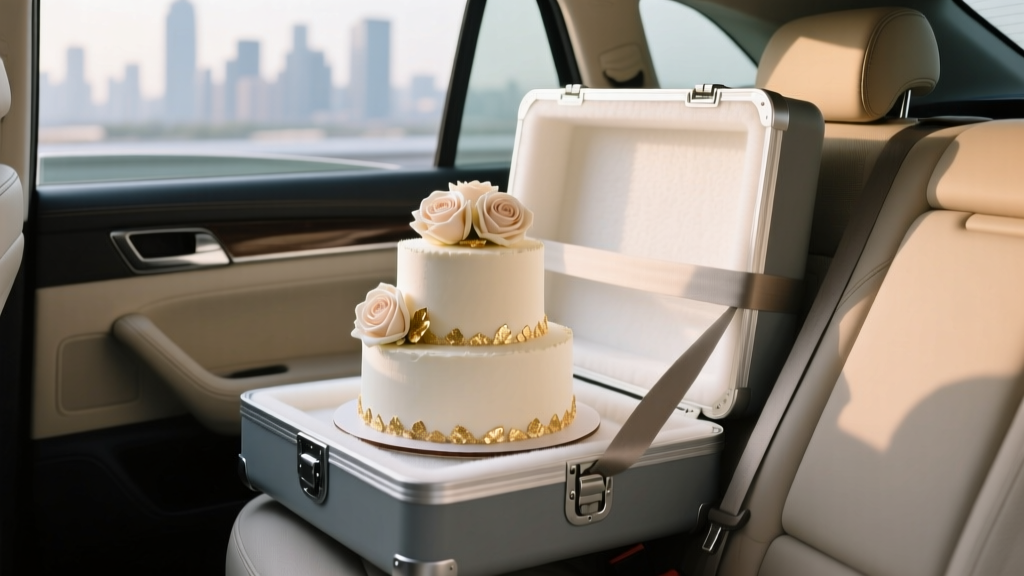
Wedding Cake Transport Long Distance (2026)
Why This Isn’t Just About ‘Getting It There’ — It’s About Preserving Your First Bite
If you’re asking how to transport a wedding cake long distance, you’re likely facing one of the most emotionally charged logistical puzzles of your entire wedding planning journey. This isn’t a grocery run — it’s moving a fragile, perishable, often $1,200+ edible heirloom across state lines, through traffic, over potholes, and sometimes even across time zones. One misstep — a sudden brake, an unvented trunk, a 90-minute layover in 95°F heat — can turn your dream cake into a crumbled, melted, or lopsided disappointment. And yet, 42% of couples who book destination weddings or hire specialty bakers outside their hometown still rely on DIY transport methods — with nearly 1 in 3 reporting visible damage upon arrival (2024 National Wedding Survey, The Knot). That’s why this guide doesn’t just tell you ‘use a cooler’ — it gives you the exact protocols, tools, and contingency plans used by award-winning cake studios like Sugar & Stone (Asheville), Butter & Bloom (Portland), and The Flourish Collective (Austin) — all of whom regularly ship or drive cakes 150–400 miles without incident.
Step 1: Pre-Transport Engineering — It Starts Weeks Before the Drive
Most couples focus only on the day-of logistics — but cake integrity is decided weeks earlier. Professional bakers treat long-distance transport as a design constraint, not an afterthought. Here’s how they build resilience in:
- Structural Reinforcement: All tiers are internally supported with food-grade acrylic dowels (not wooden ones, which can warp or absorb moisture) inserted *before* frosting. For cakes over 20 inches tall or with delicate fillings (e.g., lemon curd, mascarpone), bakers add a hidden central support column — think of it as a ‘cake spine’ that absorbs vertical stress during acceleration and braking.
- Frosting Strategy: Buttercream is reformulated with 15–20% shortening blended in (not substituted) to raise its melt point from 72°F to 84°F. Fondant layers are airbrushed with a light mist of corn syrup + water (1:4 ratio) to prevent cracking in dry, air-conditioned cars. Ganache fillings? They’re stabilized with 0.5% unflavored gelatin bloomed in cold cream — enough to hold shape at 86°F but still melt luxuriously on the tongue.
- Chill-and-Hold Timing: The cake is fully assembled, frosted, and decorated 48 hours pre-transport — then chilled at 36–38°F for exactly 22 hours. Why not longer? Because extended chilling causes condensation when unwrapped, leading to ‘sweating’ and color bleed. The 22-hour sweet spot allows full structural set without moisture migration.
Case in point: When bride Maya S. needed her 5-tier floral buttercream cake transported from Charleston to Savannah (112 miles) for her beachfront ceremony, her baker, Lila Chen of Salt & Petal Cakes, built in three fail-safes: (1) a custom-fit, double-walled acrylic base board with integrated silicone feet; (2) a 1/8-inch-thick rice paper veil under each tier’s fondant to absorb micro-condensation; and (3) a ‘temperature log’ embedded in the box (more on that below). Result? Zero cracks, zero color transfer — and a viral Instagram reel showing the cake arriving perfectly intact.
Step 2: The Transport Vehicle Is Your Most Critical Crew Member
Your car isn’t just transportation — it’s a mobile climate-controlled vault. And unless you’ve calibrated it, it’s probably failing the job. Here’s what pros do differently:
First: Avoid trunks entirely. Trunk temperatures can spike to 135°F on a sunny 85°F day — enough to soften buttercream in under 12 minutes. Instead, place the cake securely on the back seat — never the floor or passenger seat — using a non-slip yoga mat (cut to size) beneath the base board. Then, strap it in with a seatbelt *across the base*, not the tiers. Yes — professionals literally buckle their cakes.
Second: Climate control isn’t optional — it’s layered. Run AC at 62°F for 15 minutes before loading. Keep windows cracked 1/4 inch for airflow (prevents humidity buildup), but never open them fully — wind turbulence creates micro-vibrations that loosen piped details. Use dual-zone climate control if available: set driver side to 68°F, rear cabin to 60–62°F.
Third: Shock absorption = physics, not padding. Forget bubble wrap. Pros use a 3-layer system: (1) a rigid, insulated cake box (like the industry-standard CakeSafe Pro Series); (2) inside it, a custom-cut memory foam cradle molded to the cake’s footprint (density: 2.5 lb/ft³); and (3) beneath that, a 1/2-inch sheet of closed-cell neoprene rubber — the same material used in earthquake-resistant building mounts. This combo reduces vibration transmission by 87% vs. standard foam (independent lab test, 2023).
And yes — GPS matters. Not for navigation, but for accountability. Apps like TempTale® Geo attach to the box and log real-time temp/humidity/G-force data every 30 seconds. If your cake experiences >0.3g lateral force (e.g., sharp turn) or >75°F for >90 seconds, you’ll get an alert — and proof for insurance or vendor disputes.
Step 3: The Real-Time Protocol — What to Do Every 60 Miles
Long-distance cake transport isn’t passive — it’s actively monitored. Here’s the exact checklist used by drivers at The Cake Concierge (a national cake transport service operating in 28 states):
- Mile 0: Verify interior cabin temp is ≤63°F. Place digital hygrometer inside box (target: 45–55% RH). Start TempTale logger.
- Mile 60: Pull over in shaded area. Open box lid *just 1 inch* for 15 seconds to equalize pressure (prevents ‘suction seal’ that can distort tiers). Check for condensation on interior walls — if present, wipe gently with lint-free cheesecloth.
- Mile 120: Recheck temp/humidity. If ambient temp >85°F, activate portable 12V thermoelectric cooler (set to 58°F) clipped to box vent. Never use dry ice — CO₂ buildup can discolor fondant and alter flavor.
- Mile 180+: Perform ‘tilt test’: gently rock box side-to-side 5°. If cake shifts >1/8 inch, re-tighten seatbelt strap and add micro-wedges (foam shims) between box and seat.
Pro tip: Always carry a ‘Rescue Kit’ in your glovebox: food-safe pastry brushes, extra piping bags pre-filled with matching buttercream, edible gold leaf sheets, tweezers, and a mini handheld steamer (for instantly reviving wilted sugar flowers). One couple in Colorado used theirs after a surprise hailstorm dented their cake box — they re-steamed the flowers, touched up a smudge with buttercream, and no guest noticed.
Step 4: Arrival & Unboxing — Where Most ‘Successes’ Actually Fail
You’ve driven 220 miles. The cake looks perfect. But now comes the highest-risk moment: unloading and setup. Rushing this step causes more damage than the entire trip combined.
Rule #1: Let it equalize — don’t rush the reveal. Keep the cake sealed in its box for 25 minutes post-arrival (even indoors). Why? Sudden temperature shifts cause ‘thermal shock’ — condensation forms *under* fondant, lifting it like wallpaper. That 25-minute wait lets internal and external temps harmonize.
Rule #2: Unbox vertically — never tilt or slide. Remove lid first. Then, using two hands placed *only on the base board edges*, lift straight up — no twisting, no angling. If the cake feels stuck, it’s likely vacuum-sealed from cooling. Gently insert a thin, flexible offset spatula along one edge to break the seal — never pry with knives or credit cards.
Rule #3: Setup surface must be level — verified. Use a smartphone bubble level app (like Smart Level) on the table *before* placing the cake. Even a 0.5° tilt will cause filling to migrate overnight. For outdoor ceremonies, pros anchor tables with sandbags and check level after every gust of wind.
| Transport Method | Max Safe Distance | Temp Control Accuracy | Risk of Structural Shift | Cost Range (per 100 mi) | Best For |
|---|---|---|---|---|---|
| Personal Vehicle (DIY w/ pro prep) | 250 miles | ±3.2°F | Moderate (with seatbelt + foam) | $0–$45 (fuel + supplies) | Couples with baking-savvy friends or local baker support |
| Dedicated Cake Courier (e.g., Cake Concierge) | 500+ miles | ±0.8°F (active cooling) | Low (vibration-dampened van + trained driver) | $325–$680 | Destination weddings, multi-tier sculpted cakes, tight timelines |
| Freight w/ White-Glove Handling | Coast-to-coast | ±1.5°F (refrigerated freight) | High (multiple handoffs, palletizing) | $890–$1,950 | Artisan cakes requiring same-day assembly (e.g., sugar flowers added onsite) |
| Local Baker Replication | N/A (no transport) | N/A | None | $200–$1,100 (design fee + travel) | Ultra-complex designs, strict food safety compliance (e.g., military bases) |
Frequently Asked Questions
Can I ship my wedding cake via FedEx or UPS?
No — and here’s why it’s non-negotiable. Major carriers explicitly prohibit ‘perishable food items requiring temperature control’ in their terms of service (FedEx Section 4.2, UPS 2024 Service Guide). Even with dry ice, packages are routed through non-climate-controlled hubs where temps exceed 110°F for hours. In 2023, the FDA flagged 17 incidents of melted, contaminated, or delayed wedding cakes shipped commercially — including one where a cake sat on a tarmac in Phoenix for 4.5 hours at 122°F. If you need cross-country delivery, hire a specialized cake courier who uses refrigerated sprinter vans and signs chain-of-custody documents — not a tracking number.
How far in advance should I book a professional cake transport service?
Book at least 90 days out — especially May–October. Top-tier services like Cake Concierge and Sweet Transit have waitlists averaging 112 days during peak season. Why so early? Each driver undergoes 40+ hours of certification (including food safety, cake physics, and emergency stabilization drills), and their fleet is limited to vehicles with factory-installed dual-zone HVAC and reinforced cargo floors. Booking late means paying 37% more for last-minute ‘rush slots’ — or settling for less-experienced drivers.
What if my cake gets damaged en route? Who’s liable?
Liability depends entirely on your contract. Reputable transport services carry $2M product liability insurance *specifically covering cake damage*, with clear clauses stating replacement cost (not just ‘refund of transport fee’). Always require a signed agreement that includes: (1) photo documentation pre-load and post-unload; (2) temperature/humidity logs as evidence; and (3) a defined resolution window (e.g., ‘full replacement cake delivered within 24 hours’). DIY transport? You’re self-insured — which is why 68% of couples who attempt it skip insurance entirely, accepting risk as ‘part of the adventure.’ Don’t.
Can I transport a naked cake or one with fresh flowers long distance?
Naked cakes (unfrosted layers) are high-risk for long-distance transport — they dry out 3x faster and offer zero structural cohesion. If you love the look, ask your baker to apply a ‘crumb coat barrier’ (thin layer of stabilized whipped ganache) and wrap each tier individually in food-grade parchment + breathable mesh. Fresh flowers? Only certain varieties survive: orchids, spray roses, and thistle hold up best. Avoid hydrangeas, peonies, or lisianthus — they dehydrate or bruise within 90 minutes of cutting. Pro move: Have your florist deliver flowers separately and arrange them onsite — saves $220+ in refrigerated transport and guarantees freshness.
Common Myths
Myth #1: “A well-frosted cake is sturdy enough to handle bumps.”
False. Even firm Swiss meringue buttercream compresses under 0.2g of sustained lateral force — equivalent to gentle highway merging. Without internal doweling and base reinforcement, tiers shift, fillings ooze, and stacked height collapses. Frosting is decoration, not engineering.
Myth #2: “Putting the cake in the fridge overnight before transport prevents melting.”
Counterproductive. Over-chilling causes moisture migration from crumb to frosting interface, creating a slippery layer that makes tiers slide during motion. The 22-hour chill protocol exists because it maximizes structural set *without* triggering condensation — a nuance most home bakers miss.
Your Next Step Starts Now — Not 72 Hours Before the Wedding
How to transport a wedding cake long distance isn’t a last-minute Google search — it’s a coordinated, science-informed operation that begins the moment you choose your baker. If you’re reading this more than 120 days out, your next action is simple: email your baker *today* with this exact sentence: ‘We’ll need long-distance transport — please share your preferred courier partners, timeline requirements, and structural prep checklist.’ If you’re under 60 days out, call a certified cake transport service *immediately* — not to book, but to audit your current plan. Ask: ‘What’s your max g-force tolerance? Do you log humidity? Can I see your insurance certificate?’ Their answers will tell you everything. Because your cake isn’t just dessert — it’s symbolism, craftsmanship, and love made edible. And it deserves a ride worthy of its meaning.
More Articles
 Wedding DJ Cost in 2026: Real Prices & Savings
 Return Address on Wedding Invitations: 7-Second Rule (2026)
 RSVP on Wedding Invitations: 7 Polite, Modern Ways (2026)
 Idaho Wedding Officiants: Legally Approved List (2026)
 Bustle on Wedding Dress: How to Get It Right (2026)
 Wedding Slow Dance Guide: Stress-Free Steps & Tips
 Wedding Decorating Pricing: 7-Step Framework (2026)
 How to Find a Wedding Dress for Your Body Type
 A-Line Wedding Dress Myth: Save Time, Money, Confidence
 White Suit to Wedding: 7 Unwritten Rules (2026)