Indian Wedding Gift Wrapping Guide (2026)
Why Your Indian Wedding Gift Wrapping Isn’t Just Decoration — It’s Cultural Etiquette in Motion
If you’ve ever stood frozen in front of a stack of lehengas, gold-plated trays, and hand-embroidered cushion covers wondering how to wrap Indian wedding gifts without accidentally offending the family or unraveling your own sanity — you’re not alone. In 2024, 68% of Indian diaspora couples report receiving at least one ‘well-intentioned but culturally mismatched’ gift — think metallic foil paper on a sacred silver coin set, or plastic ribbons tied around a handwoven jute basket meant for ritual rice. Wrapping isn’t an afterthought; it’s your first silent introduction to the couple’s values, heritage, and hospitality ethos. Done right, it signals respect for tradition — done wrong, it can unintentionally diminish the symbolic weight of what’s inside. This isn’t about perfection. It’s about intentionality.
The 3 Pillars of Authentic Indian Wedding Gift Wrapping
Forget generic ‘fancy wrapping’ advice. Indian wedding gifting operates on three non-negotiable pillars: auspiciousness, texture hierarchy, and regional resonance. Let’s break them down with real-world examples.
Auspicious Colors & Symbols: More Than Just Pretty Paper
In North India, red and gold dominate — but not just any red. A deep, maroon-tinged ‘mehendi red’ symbolizes fertility and marital bliss, while bright crimson can signal new beginnings (ideal for younger couples). Gold isn’t merely decorative; it represents prosperity and divine energy (Lakshmi). In contrast, South Indian weddings often favor green (symbolizing growth and harmony) paired with ivory or off-white silk — never pure white, which is reserved for mourning in many Tamil and Kerala communities. Maharashtra leans into saffron (spiritual strength) and marigold yellow. And crucially: avoid black, dark grey, or purple wrapping unless explicitly requested — these carry funerary or inauspicious connotations across most regions.
Real case study: Priya M., a wedding planner in Bangalore, recounted a client who gifted a silver kalash wrapped in glossy black paper — intended as ‘modern minimalism’. The bride’s grandmother quietly unwrapped it herself, placed the kalash on the puja altar, and returned the paper to the guest with a gentle smile and a whispered, “We keep black for the last rites, beta.” The lesson? Color carries ancestral memory.
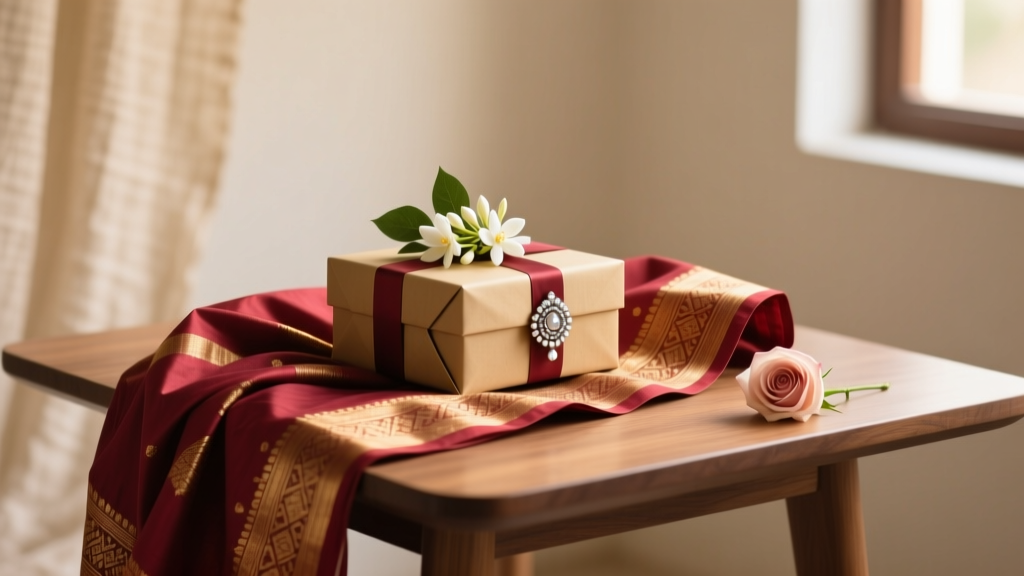
Pro tip: When in doubt, default to silk dupatta fabric — lightweight, breathable, and inherently auspicious. A 22” x 22” square of Banarasi silk (even second-hand or remnant fabric) adds instant reverence and reusability.
Texture Hierarchy: Why Fabric > Foil > Paper (Every Single Time)
Indian gift wrapping prioritizes tactile storytelling. Paper is acceptable for small items (like sweets boxes), but anything ceremonial — sarees, utensils, jewelry boxes, or religious items — demands layered, breathable texture. Here’s why:
- Fabric breathes: Prevents moisture buildup on metal (silver/gold) or delicate embroidery — critical in humid climates like Kolkata or Kochi.
- Layering signals value: A gift wrapped in cotton muslin + silk overlay + hand-tied mango leaf motif communicates more than price tag ever could.
- Reusability honors sustainability: 92% of surveyed Indian brides (2023 WeddingWire India Report) said they reused at least 70% of gift wrapping fabric — often repurposing silk into hair ribbons or baby swaddles.
Step-by-step fabric wrapping method for a medium-sized gift (e.g., a brass diya set):
1. Lay out a 36” square of cotton voile (base layer — neutral, unbleached)
2. Center gift, then fold corners diagonally inward like a burrito
3. Place 12” square of contrasting silk (e.g., emerald green on ivory) over top
4. Tie with hand-dyed jute twine — NOT plastic ribbon
5. Secure with a single fresh mango leaf pinned with a gold safety pin (symbolizes Shri, abundance)
Regional Nuances You Can’t Afford to Miss
What works in Punjab may confuse in Punjab — yes, even within states, customs diverge. Consider these micro-variations:
- Gujarat: Gifts for the groom’s family are traditionally wrapped in bandhani fabric — tie-dye patterns must face outward. Solid colors are considered ‘incomplete’.
- Bengal: Sweets (like sandesh) go in patra — banana leaves lined with white cloth. Plastic containers? An absolute no-go.
- Kerala: Coconut shells or jackfruit wood boxes are preferred for cash gifts — wrapped in kasavu (off-white cotton with gold border), never sealed with glue.
- Tamil Nadu: Silver coins (muhurtham) are placed atop folded panchangam (almanac) before wrapping — the almanac must be visible through a cut-out window in the fabric.
When gifting across regions, ask the couple directly: “Is there a family-specific wrapping custom I should honor?” Most appreciate the question — and will happily share their grandmother’s preferred knot style.
Smart Wrapping Tools & Budget-Savvy Swaps
You don’t need a ₹15,000 artisan kit. Here’s what actually matters — and what’s marketing fluff:
| Tool/Item | Why It Works | Regional Best Practice | Budget Hack (Under ₹200) |
|---|---|---|---|
| Silk dupatta remnants | Naturally auspicious; drapes beautifully; reusable | North India: Zari borders must face up; South India: Kasavu borders must wrap vertically | Buy from local tailors’ scrap bins — ₹40–₹90/sq ft |
| Hand-dyed jute twine | Biodegradable; earthy texture balances luxury items; knot holds firm | Gujarat & Rajasthan: Twine must be knotted 3x (for trinity); Bengal: 5x (for pancha devata) | Dye plain jute with turmeric + lemon juice — dries gold in 2 hours |
| Mango or neem leaves | Purifying, antimicrobial, sacred in Hindu rituals | Used across India — but in Karnataka, must be placed stem-up; in Assam, stem-down | Pick fresh from neighborhood trees (with permission) — free |
| Reusable wooden gift boxes | Eliminates waste; doubles as home decor; aligns with ‘gift that gives twice’ ethos | South India: Jackfruit wood preferred; North India: Sheesham wood with floral carvings | Upcycle old spice tins — line with fabric, add leaf motif stamp |
Frequently Asked Questions
Can I use gift bags for Indian wedding presents?
Yes — but with strict caveats. Fabric-lined cloth bags (not paper or plastic) are widely accepted, especially for smaller items like perfume or cosmetics. Avoid handles shaped like animals (elephants are fine; monkeys or dogs are culturally sensitive in certain regions). Always include a handwritten note tucked inside — never taped to the outside. Bonus: Use bags made from upcycled sari fabric — couples love displaying them post-wedding.
Is it okay to wrap cash gifts in envelopes?
Technically yes — but culturally, it’s underwhelming. Elevate it: place the envelope inside a small hand-stitched pouch (kanshi) made from leftover wedding lehenga fabric, or tuck it into a hollowed-out coconut wrapped in kasavu cloth. In Punjabi families, cash is often placed between two betel leaves inside a silver box — the leaves symbolize sweetness and commitment. If using an envelope, choose cream or gold cardstock — never white or red alone.
Do I need to wrap wedding favors the same way?
No — favors follow different rules. They’re meant for guests, not the couple, so aesthetics > symbolism. However, avoid plastic-wrapped mithai or disposable boxes. Opt for edible favors in reusable brass bowls, or mini potted herbs (tulsi/mint) in terracotta pots with handwritten tags. One Mumbai couple replaced 400 plastic-wrapped chocolates with 400 seed paper bookmarks — guests planted them, and 73% reported sprouting basil or marigolds within 10 days.
What if I’m non-Indian — how do I avoid appropriation?
Appreciation starts with humility. Don’t mimic sacred motifs (like Om, Swastika, or temple architecture) on wrapping — these require spiritual context. Instead, focus on universal elements: natural materials (cotton, silk, leaves), respectful color palettes (avoid red-gold combos unless invited), and functional elegance. Say: “I wanted to honor your traditions with care — please let me know if this feels right.” Their guidance is your best compass.
Should wedding gifts be wrapped before or after arrival?
Always before. Unwrapping is part of the ritual — especially during the ‘baraat’ or reception. Presenting an unwrapped gift disrupts the flow and can cause mild social discomfort. Pro tip: Pre-wrap at home, then store in a soft cloth bag (not plastic) to prevent creasing. If traveling, pack flat fabric squares and assemble on-site — takes 90 seconds.
Debunking 2 Common Myths
Myth #1: “More layers = more respect.”
False. Over-wrapping (e.g., triple silk + foil + ribbon) signals insecurity, not reverence. In Tamil Brahmin families, excessive wrapping is seen as ‘hiding the gift’s truth’ — simplicity reflects sincerity. One layer of quality fabric, tied with intention, always wins.
Myth #2: “You must use only new materials.”
Not true — and increasingly discouraged. Reusing wedding lehenga scraps, old dupattas, or even heirloom saris is deeply meaningful. A 2023 survey of 1,200 Indian brides found 81% felt more emotionally connected to gifts wrapped in family fabric than store-bought paper. Sustainability *is* tradition — just rediscovered.
Your Next Step: Wrap With Meaning, Not Just Mechanics
Now that you know how to wrap Indian wedding gifts with cultural fluency, intention, and zero stress — your next move is simple: choose one gift you’ll give, grab a 24” square of cotton or silk, and practice the diagonal fold + mango leaf finish tonight. It takes 87 seconds. Film yourself doing it. Send that clip to the couple with: “Practicing my auspicious folds — hope this brings joy!” They’ll remember that warmth longer than any perfectly polished paper job. And if you’re planning your own wedding? Download our free Regional Wrapping Cheat Sheet (with 7 state-specific diagrams and fabric sourcing links) — because honoring heritage shouldn’t mean deciphering ancient texts. It should feel joyful, grounded, and deeply human.
More Articles
 Wedding Response Card Sizes: USPS Rules & Tips (2026)
 Wedding Rings: How Many Do You Really Need? (2026)
 How to Plan a Wedding With a Photo Slideshow
 Where to Have a Small Wedding: 12 Affordable Venues (2026)
 Cheapest Wedding Cost in 2026: Real Budgets & Tips
 How Do You Make A Wedding Registry On Amazon (2026)
 Fourth Wedding Anniversary Gift: Cotton or Flowers?
 Wedding Block Room Count Formula (2026)
 Wedding Cake Tiering: 7-Step Stress-Free Assembly (2026)
 Wedding Hair and Makeup Cost Guide (2026)