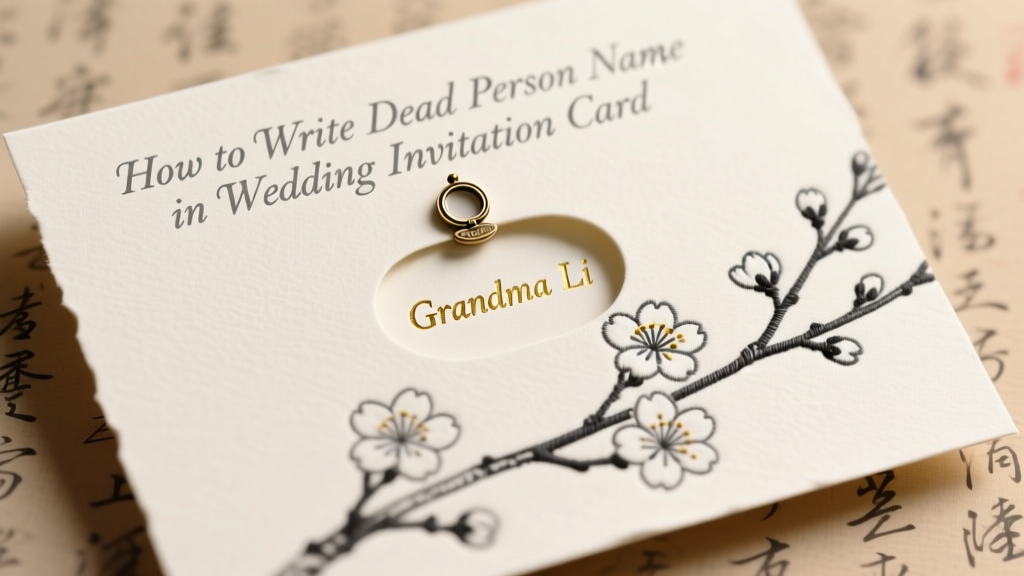
How to Write Deceased Person’s Name on Wedding Invites
Why This Small Detail Carries So Much Weight—And Why Getting It Right Matters More Than Ever
If you’ve ever stared at a blank invitation draft wondering how to write dead person name in wedding invitation card, you’re not alone—and you’re already showing deep emotional intelligence. In today’s weddings, where personalization meets profound meaning, omitting or misrepresenting a beloved deceased parent, grandparent, or mentor isn’t just a formatting oversight—it can unintentionally reopen grief, alienate family members, or even spark quiet tension among guests who expected acknowledgment. Recent data from The Knot’s 2023 Real Weddings Study shows that 68% of couples now intentionally include tributes to deceased loved ones in at least one element of their ceremony or stationery—and 41% report that getting the wording ‘just right’ was more emotionally taxing than choosing their florist or caterer. This isn’t about rigid rules. It’s about intentionality: honoring memory without erasing presence, respecting tradition without silencing modern grief, and communicating love—not loss—as the central theme.
1. The Four Pillars of Respectful Inclusion (Not Just ‘Adding a Name’)
Writing a deceased person’s name isn’t a decorative flourish—it’s an act of narrative curation. Before choosing phrasing, anchor your decision in four non-negotiable pillars:
- Clarity over ambiguity: Guests should instantly understand the person is deceased—no confusion, no awkward double-takes at the reception.
- Cultural fidelity: A phrase that honors a Catholic grandmother may feel inappropriate for a Jewish or Hindu family context.
- Family consensus: Especially when parents are divorced or blended families coexist, unilateral decisions risk unintended hurt.
- Design integrity: The tribute must integrate visually—no cramped footnotes, no jarring font shifts, no asterisks begging for explanation.
Consider Maya and David, a couple from Chicago whose father passed six months before their wedding. They initially drafted: ‘Together with the families of Maya Chen and David Lopez.’ But their mother gently pointed out it erased her late husband’s lifelong role as patriarch. They pivoted to: ‘Together with the family of Maya Chen and the loving memory of Robert Lopez, father of David.’ The change took 90 seconds—but reshaped how 127 guests experienced the day.
2. Phrase-by-Phrase Breakdown: What Works (and What Backfires)
Generic phrases like ‘in loving memory of…’ or ‘deceased’ often fall flat—they’re vague, clinical, or unintentionally somber. Instead, match phrasing to function and feeling. Here’s what top-tier wedding designers and grief-informed officiants recommend:
- For deceased parents hosting in spirit: ‘Honoring the memory of [Full Name], beloved father/mother of [Bride/Groom]’ — places emphasis on relationship and enduring love.
- When both parents are deceased: ‘With deepest gratitude to the enduring love and guidance of [Name] and [Name], parents of [Bride/Groom]’ — avoids passive language like ‘late’ while affirming legacy.
- For step-parents or mentors: ‘Inspired by the wisdom and warmth of [Name], cherished stepfather/mentor to [Bride/Groom]’ — honors non-biological bonds with equal dignity.
- Avoid: ‘Late [Name]’ (feels obituary-like), ‘deceased’ (cold and bureaucratic), or omitting titles (‘John Smith’ vs. ‘John Smith, father of Sarah’) — strips relational context.
Crucially: never use parentheses around names (e.g., ‘Sarah Lee (deceased)’) — it reads like an afterthought. And never list a deceased person *after* living hosts unless intentional (e.g., ‘Mr. & Mrs. Lee and the memory of Mr. James Lee’ implies hierarchy; reverse it if honoring lineage).
3. Religious, Cultural & Regional Nuances You Can’t Afford to Overlook
What feels reverent in one tradition may be spiritually inappropriate—or even forbidden—in another. Here’s a concise, research-backed guide:
| Culture/Religion | Recommended Approach | Phrasing Example | Key Caution |
|---|---|---|---|
| Catholic & Mainline Protestant | Include name with ‘in loving memory’ + relationship | ‘In loving memory of Eleanor Hayes, mother of the bride’ | Avoid implying intercession (e.g., ‘praying with us’) unless confirmed by clergy |
| Jewish (Ashkenazi & Sephardic) | Use Hebrew name + ‘z”l’ (zichrono livracha / alav hashalom) | ‘David ben Moshe z”l, father of the groom’ | Never use ‘deceased’ or ‘late’—z”l is universally understood and sacred |
| Hindu & Sikh | Reference spiritual continuity, not absence | ‘Guided by the grace of Lata Devi, mother of the bride’ | Avoid ‘passed away’—use ‘attained moksha’ (Hindu) or ‘merged with Waheguru’ (Sikh) only if family affirms |
| Muslim | Invoke dua (prayer) & emphasize mercy | ‘With prayers for the soul of Amina bint Yusuf, mother of the bride’ | Never imply the deceased is ‘present’—focus on divine mercy and remembrance |
| Black American & Southern Traditions | Embrace oral-history rhythm & ancestral reverence | ‘Celebrating with joy—and honoring the legacy of Reverend Isaiah Johnson, grandfather of the groom’ | Avoid sterile terms; ‘legacy’, ‘foundation’, ‘light’ resonate deeply |
Pro tip: When in doubt, consult a cultural liaison—not just a vendor. Atlanta-based planner Tasha Boone shares: ‘I once had a couple invite their Yoruba grandmother’s name using English phrasing that accidentally invoked Orisha energy inappropriately. We paused, called her auntie, rewrote it in Yoruba with tonal marks—and turned a risk into a highlight.’
4. Design Integration: Where Words Meet Visual Dignity
Your wording means little if layout undermines its weight. Top designers agree: placement, typography, and whitespace are 60% of the emotional impact. Here’s how to execute flawlessly:
- Position matters: Deceased names belong in the host line—not buried in ‘in memory of’ footers. If both sets of parents are living, add a dedicated ‘In Loving Memory’ line *above* the main host line (not below).
- Typography: Use the same font and size as living hosts—but consider subtle distinction: light italic (not bold) for ‘in loving memory’, or a single thin rule (—) before the name instead of a bullet.
- Whitespace: Add 12–16pt padding above/below the tribute line. Crowding implies afterthought; breathing room signals reverence.
- Color: Never use grey or faded ink. Black or deep navy maintains formality and visibility. Reserve gold foil only if used elsewhere for consistency.
Real example: San Francisco couple Lena and Amir printed their invitation on textured cotton paper. Their late fathers were honored in identical serif type, centered, with a single laurel motif (not a cross or crescent) flanking each name—visually unifying, culturally neutral, and quietly powerful.
Frequently Asked Questions
Can I list a deceased person as a formal host (e.g., ‘Mr. & Mrs. Thompson and the late Robert Thompson’)?
No—this misrepresents legal and social hosting roles. Deceased individuals cannot host. Instead, use relationship-centered phrasing: ‘Together with the family of Elena Thompson and the enduring presence of Robert Thompson, father of the groom.’ This honors his role without assigning active agency.
Is it okay to include multiple deceased people—like both grandparents and a sibling?
Yes—if done with clear hierarchy and brevity. Prioritize direct lineage (parents first), limit to 3 names max, and use parallel structure: ‘In loving memory of Maria Chen, mother of the bride; Thomas Lopez, father of the groom; and Daniel Lopez, brother of the groom.’ Avoid stacking adjectives—‘beloved, cherished, devoted’ dilutes impact.
What if my family disagrees—some want inclusion, others say ‘keep it joyful’?
This is common—and resolvable. Host a 20-minute ‘memory mapping’ session: ask each side to name *one specific way* the deceased shaped the couple’s values (e.g., ‘Grandma taught us Sunday dinners = love’). Then choose wording that reflects that shared value—not the person’s status. Often, this yields stronger, more unified tributes than name-only inclusion.
Do digital invitations change the rules?
Yes—interactivity adds dimension. Embed a 15-second audio clip of the deceased’s voice (e.g., saying ‘I’m so proud of you’) linked to their name. Or use hover text: ‘[Name] — 1942–2022 | Taught us courage’. Digital space allows layered meaning—don’t waste it on static text alone.
Should I explain the tribute to guests in advance?
Only if context is essential—e.g., honoring a transgender parent pre-transition, or someone estranged then reconciled. A brief note in your wedding website’s ‘Our Story’ section works better than an invitation footnote: ‘You’ll see the name of our beloved Aunt Rosa on our invites—she held our hands at every milestone, and her laughter still fills our home.’
Common Myths
Myth #1: “If I don’t mention them, I’m being disrespectful.”
False. Silence isn’t erasure—it’s sometimes the most respectful choice, especially if the deceased expressed strong views against public mourning or if inclusion would cause active distress to living relatives. Intentional omission, communicated with care, is valid.
Myth #2: “Using ‘late’ is always appropriate and widely understood.”
Not true. ‘Late’ carries British colonial baggage in many Global South contexts and feels transactional in U.S. Black and Indigenous communities. It also subtly frames death as a temporal delay rather than a completed transition—clashing with many spiritual worldviews.
Your Next Step: Draft, Reflect, and Release
You now hold more than phrasing—you hold permission to grieve, celebrate, and curate meaning all at once. Writing a deceased person’s name on your wedding invitation isn’t about checking a box. It’s about declaring: Love persists. Legacy lives. We carry you forward—not as absence, but as foundation. So open your draft. Try three versions using the pillars above. Read them aloud—do they sound like *you*, spoken with love? Share one with the person who knew your loved one best. Then trust your heart, not a template. Ready to bring your vision to life? Download our free Culturally Responsive Tribute Phrasing Guide—with 22 customizable templates, religious glossary, and printable layout grids. Your story deserves to be told—exactly as it’s felt.
More Articles
 White Top to Wedding: When It’s Okay (2026)
 How to Stop Wedding Dress Creasing in Car (2026)
 Wedding Photos That Flatter: 7 Stylist-Tested Tips (2026)
 Can Women Wear White Pants to a Wedding? (2026)
 Women’s Wedding Suits: 7 Style Mistakes to Avoid (2026)
 Wedding Gift Deadline: Evidence-Backed Timeline (2026)
 How Long In Advance To Send Wedding Invitations (2026)
 How to Put Time on Wedding Invitation (2026)
 Wedding Veil from Tulle: No Sewing, Under $12 (2026)
 How to Buy a Wedding Dress When Pregnant (2026)