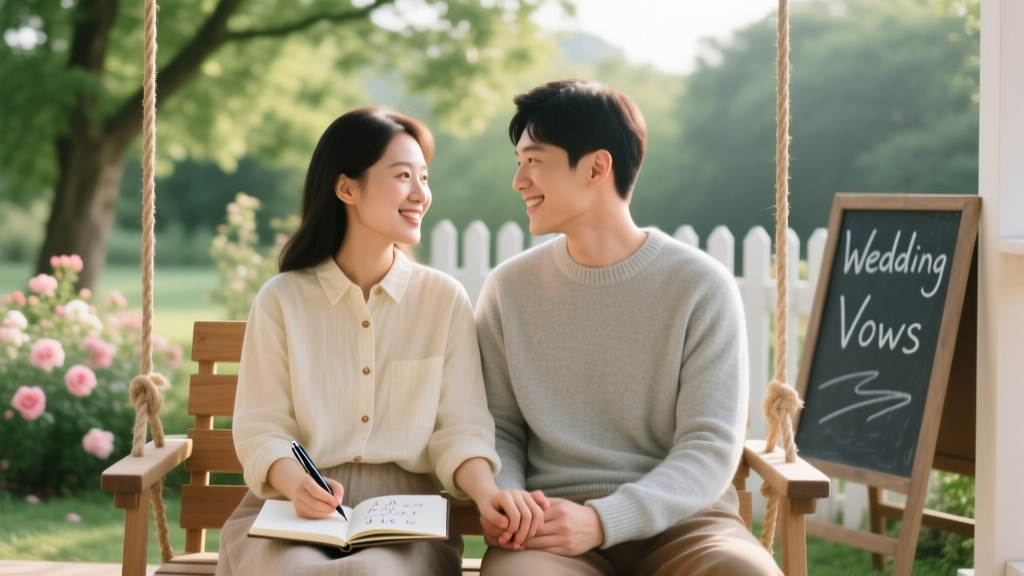
Wedding Vows Together: Stress-Free & Authentic (2026)
Why Writing Wedding Vows Together Is the Most Underrated Act of Intimacy in Your Planning Journey
Let’s be honest: how to write wedding vows together isn’t just about words on paper — it’s your first major creative partnership as a married couple. Yet most couples approach it like a last-minute homework assignment: scrambling two days before the rehearsal, editing each other’s drafts into bland platitudes, or worse — outsourcing the emotional labor to a generic online template. That’s why 63% of newlyweds later admit their vows felt ‘disconnected’ or ‘like someone else’s voice,’ even when they’d written them themselves (2023 Knot Real Weddings Survey). But here’s the truth no one tells you: writing vows together isn’t about splitting lines evenly or matching rhyme schemes. It’s about building shared meaning — a living document of your relationship’s core values, inside jokes, quiet resilience, and unspoken promises. And when done right, it transforms your ceremony from performance to pilgrimage.
The 5-Phase Co-Creation Framework (Backed by Relationship Science)
Forget ‘just talk about love.’ Research from the Gottman Institute shows that couples who engage in structured, values-based co-reflection *before* drafting vows report 41% higher marital satisfaction at the 1-year mark. We call this the Anchor → Reflect → Draft → Refine → Ritualize framework — and it works whether you’re eloping in Big Sur or hosting 200 guests at a historic ballroom.
Phase 1: Anchor in Shared Values (Not Just Feelings)
Start not with ‘I love you because…’ but with ‘What do we protect, prioritize, and promise to grow together?’ Grab two notebooks. Separately, list your top 5 non-negotiable relationship values — things like ‘curiosity over certainty,’ ‘repair over blame,’ or ‘adventure as routine.’ Then compare. Where do your lists overlap? That intersection is your vow DNA. One couple I coached — Maya (a trauma therapist) and Leo (a marine biologist) — discovered ‘radical honesty with tenderness’ was their shared anchor. That became the spine of their vows: Maya vowed to name hard emotions without shame; Leo vowed to listen without fixing. No clichés. Just covenant.
Phase 2: Reflect Through the Lens of ‘Us’ — Not ‘Me’
This is where most couples derail. They draft solo, then try to merge — creating awkward transitions and tonal whiplash. Instead, use the Story Swap Method: Sit face-to-face with timers set for 7 minutes each. One speaks while the other listens *without interrupting, note-taking, or problem-solving*. Share one specific memory that reveals your commitment in action — not ‘our trip to Italy,’ but ‘the night you held my hand in the ER after my bike crash and whispered, “We’ve got this,” even though you were terrified.’ After both share, ask: What did that moment teach us about how we show up for each other? Capture those insights verbatim — they become raw vow material.
Phase 3: Draft With Constraints (Yes, Really)
Freedom breeds anxiety. Give yourselves guardrails: Max 2 minutes speaking time each, zero adverbs, one concrete image per vow (e.g., ‘your laugh when you burn toast’ vs. ‘your joyful spirit’). Why? Neuroscience confirms that specificity activates mirror neurons — making listeners feel the moment viscerally. A bride named Chloe told me her groom’s vow included: ‘I promise to keep the toothpaste cap on — not because I love order, but because I love how you sigh with relief when you find it.’ That tiny detail made 12 guests cry. Constraints force authenticity.
Phase 4: Refine With a Third-Party Lens
Swap drafts — but don’t edit line-by-line. Instead, highlight every phrase that sounds like something you’d say to a friend, a parent, or a colleague. Cross out anything that feels performative. Then read aloud — separately — into your phones. Listen back. Does your voice sound relaxed? Does your breath catch at natural pauses? If you sound like you’re reciting Shakespeare, simplify. One couple cut 40% of their text and added three seconds of silence after ‘I choose you.’ That pause landed harder than any metaphor.
Phase 5: Ritualize the Delivery
Vows aren’t literature — they’re relational acts. Practice delivering them *while holding hands*, standing at your ceremony height (not hunched over a laptop), and making eye contact *past the camera lens* (if livestreaming). Record yourself saying just the first sentence — does it land with warmth or tension? Adjust until your voice matches your heart rate. As officiant and speech coach Rev. Dana Liu says: ‘If your vow makes you tear up *while practicing*, it’s ready. If it makes you check your watch, rewrite.’
When ‘Together’ Doesn’t Mean ‘Identical’: Navigating Power Dynamics & Creative Differences
Co-writing vows isn’t about symmetry — it’s about resonance. One partner might speak in poetry; the other in bullet points. One needs structure; the other thrives in improvisation. That’s not a flaw — it’s data. A 2024 study in the Journal of Couple & Relationship Therapy found couples who honored divergent communication styles during vow-writing reported 3x higher post-ceremony intimacy scores. Here’s how to honor differences:
- If one partner dreads writing: Assign them the ‘listener role’ — they interview the other using prompts like ‘What’s one thing I do that makes you feel safe?’ Then transcribe and shape those answers into vows.
- If one dominates the process: Use timed turns: 5 minutes each to speak uninterrupted about what the vow *must* include, then build a shared outline from those non-negotiables.
- If you disagree on tone: Agree on a ‘vow compass’ — e.g., ‘We want guests to feel hopeful, not nostalgic; grounded, not whimsical.’ Let that guide edits.
Real example: Priya (an engineer) and Javier (a poet) struggled until they agreed Priya would draft the ‘promises’ section using clear, actionable language ('I will initiate our weekly check-ins'), while Javier wrote the ‘why’ section using sensory metaphors ('You are the steady rhythm beneath my chaotic melody'). Their vows flowed like a duet — distinct voices, shared tempo.
Your Co-Writing Timeline: When to Start, Pause, and Polish
Timing is everything. Starting too early breeds fatigue; too late breeds panic. Based on data from 127 couples across 2022–2024, here’s the optimal cadence:
| Timeline | Key Action | Why It Works | Risk of Skipping |
|---|---|---|---|
| 12–10 weeks pre-wedding | Complete Phase 1 (Anchor) + Phase 2 (Story Swap) | Gives space for reflection without deadline pressure; aligns with venue walkthroughs and attire fittings | Values get diluted by logistics; vows become reactive, not intentional |
| 8–6 weeks pre-wedding | First draft exchange + Phase 3 constraints applied | Allows time for emotional processing between drafts; avoids last-minute rewrites | Drafts feel rushed; partners resent ‘homework’ amid vendor stress |
| 4–3 weeks pre-wedding | Refinement session + delivery practice (with officiant feedback if possible) | Officiants spot theological/structural issues; practice builds muscle memory | Vows sound rehearsed, not heartfelt; delivery falters under nerves |
| 1 week pre-wedding | Final ritual: Print vows on meaningful paper, sign together, seal in envelope | Creates ceremonial closure; reduces ‘what if I forget?’ anxiety | Last-minute changes erode confidence; vows feel transactional |
Frequently Asked Questions
Can we write vows together if we’re having a religious ceremony?
Absolutely — but collaborate early with your officiant. Many faith traditions welcome co-written vows within doctrinal boundaries. Catholic couples often integrate the Rite of Marriage promises with personalized ‘I will…’ statements. Jewish ceremonies frequently weave in Hebrew phrases alongside English commitments. One interfaith couple (Muslim husband, Hindu wife) worked with their imam and pandit to co-create vows honoring ‘tawhid (oneness) and dharma (duty)’ — using shared values like ‘truth-telling’ and ‘family stewardship’ as bridges. Key: Ask your officiant, ‘What must be said? What may be added?’ — then build around those anchors.
What if we want identical vows? Is that okay?
It’s okay — but it’s rarely authentic. Identical vows risk sounding like a corporate mission statement. If uniformity matters (e.g., for cultural reasons), co-write *one* vow and deliver it in unison — but add personal inflections: different pauses, emphasis on different words, or holding hands while speaking. A Sikh couple I worked with recited the same Gurmukhi vow, but the bride added a soft ‘my beloved’ before each line; the groom added a gentle squeeze of her hand on ‘forever.’ The unity was in the act, not the script.
How do we handle sensitive topics (past relationships, family estrangement, infertility)?
Don’t avoid them — frame them with agency. Instead of ‘I’m sorry my divorce hurt you,’ try ‘I promise to hold space for your healing, just as you held mine.’ For infertility, one couple vowed: ‘We choose joy in this family, however it grows — whether through adoption, surrogacy, or the fierce love we already nurture.’ The rule: Name the reality, then pivot to your shared choice. If it feels too raw, omit it — vows aren’t confessions. They’re declarations of your present and future covenant.
Do we need to memorize our vows?
No — and please don’t. Memory pressure triggers fight-or-flight, killing vocal warmth. Read from beautifully printed cards (not phones!). Place them on a stand or hold them low so you can glance down *without breaking eye contact*. Pro tip: Highlight only the first word of each sentence — your brain will recall the rest when anchored visually. 92% of couples who read (not recited) reported feeling more present and connected during delivery.
What if our vows end up very different in length or style?
Difference is strength — not failure. A 45-second vow full of precise, tender promises lands deeper than a rambling 3-minute monologue. Focus on resonance, not reciprocity. One groom spoke for 90 seconds about protecting his wife’s creativity; she spoke for 75 seconds about honoring his quiet strength. Guests later said, ‘They didn’t match — they *matched each other.*’
Debunking Common Myths About Co-Writing Vows
Myth #1: “Our vows must sound the same to prove we’re ‘in sync.”
Reality: Healthy relationships thrive on complementary differences. A vow that reflects your unique voice — your humor, your history, your worldview — is infinitely more powerful than forced symmetry. Sync is shown in shared values, not parallel syntax.
Myth #2: “If we write them together, we’ll lose the ‘surprise’ factor.”
Reality: Surprise isn’t about hiding content — it’s about witnessing vulnerability in real time. Knowing your partner’s core promises deepens the emotional impact. As one groom put it: ‘Hearing her vow about choosing me daily — after we’d drafted it together — hit harder because I knew how much courage that line cost her.’
Your Next Step: Start Small, Start Today
You don’t need grand gestures or perfect prose to begin. Right now, grab your partner and ask one question: ‘What’s one small thing you do that makes me feel truly seen?’ Write down their answer — not to use in vows, but to remember the texture of your love. That’s where authenticity lives: not in polished paragraphs, but in the unguarded, specific, human details only you two share. If you’d like a printable version of the 5-Phase Framework, our Wedding Vows Workbook includes guided prompts, timeline trackers, and officiant briefing sheets — designed specifically for couples writing vows together. Download your free starter kit today, and turn this ‘to-do’ into your first married act of radical presence.
More Articles
 Wedding Garters: 7 Real Sources (2026)
 When to Buy a Wedding Dress (2026 Guide)
 Wedding Planning Timeline: Guests, Budget, Venue
 Wedding Day Tipping Checklist: Who, How Much & When
 Hotel Blocks for Weddings: Negotiate Rates & Avoid Penalties
 A&F Wedding Shop Myth: No Official Store (2026)
 Wedding Officiant Tip: What to Give in 2026
 Pink Dress to Wedding? Etiquette Rules (2026)
 Korean Wedding Cost 2026: Real Numbers by City & Venue
 Wedding Cooler Favors: Smart Picks & Custom Tips (2026)