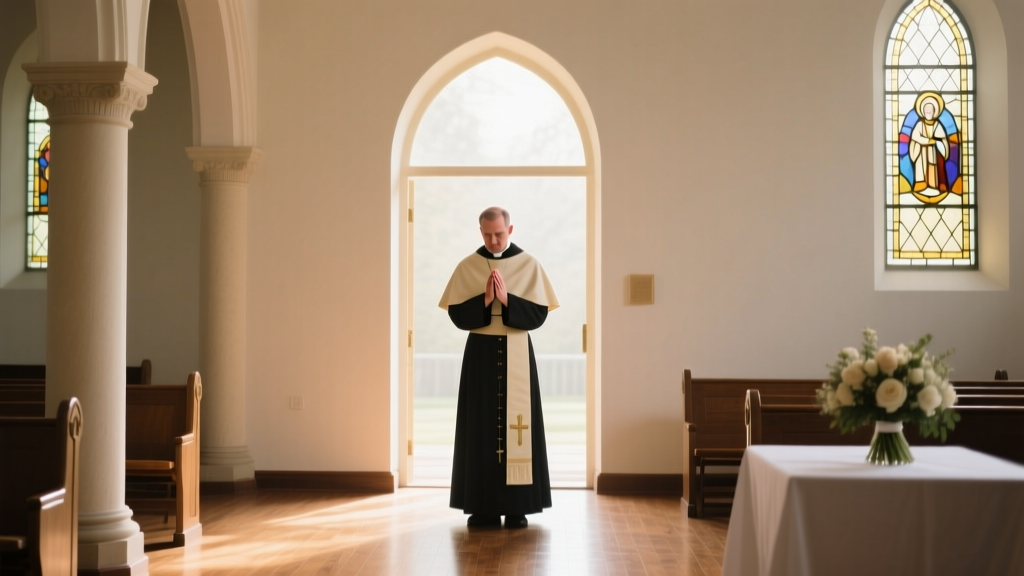
What a Priest Says at a Catholic Wedding (2026)
Why Knowing What a Priest Says at a Wedding Matters More Than You Think
If you’re planning a Catholic wedding — or even a non-Catholic ceremony with a priest presiding — understanding what a priest says at a wedding isn’t just about memorizing lines. It’s about theological clarity, emotional resonance, legal validity, and avoiding last-minute surprises that can derail months of planning. In 2024, over 62% of U.S. Catholic couples report feeling ‘unprepared’ for the liturgical flow of their ceremony — not because they lack love or commitment, but because no one explained *how* the words shape the sacrament itself. A priest’s speech isn’t performance; it’s proclamation, invocation, and covenant-making in real time. Get it right, and your ceremony becomes sacred storytelling. Get it fragmented or improvised without permission, and you risk invalidating the sacrament — especially if canonical form isn’t observed. This guide gives you the unvarnished truth: the exact script, its meaning, where flexibility exists (and where it absolutely doesn’t), and how to collaborate respectfully with your priest — long before rehearsal day.
The Three-Act Structure: How a Priest’s Words Actually Flow
Catholic wedding liturgies follow a precise arc rooted in the Roman Missal (3rd Edition) and the Rite of Marriage. Forget ‘off-the-cuff blessings’ — every word serves a theological purpose. Here’s how it unfolds:
- Act I: Gathering & Preparation — The priest welcomes guests, introduces the couple, and sets the tone with an opening prayer that names marriage as a vocation, not just a celebration.
- Act II: Proclamation & Consent — Scripture readings, homily, and the critical moment: the exchange of vows *before the priest*, who acts *in persona Christi* (in the person of Christ) to receive consent — the very engine of the sacrament.
- Act III: Consecration & Sending — The Nuptial Blessing (a unique, irreplaceable prayer invoking divine grace), final blessing, and dismissal that sends the couple forth as a domestic church.
Crucially, the priest does not ‘marry’ the couple — canon law (CIC 1108) states the spouses marry each other through free, mutual consent. The priest is the official witness and spiritual facilitator. That distinction changes everything about how his words function.
Word-for-Word Breakdown: The Non-Negotiables (With Latin & English)
While homilies and welcome remarks vary, core texts are fixed by liturgical law. Below is the essential spoken content from the Rite of Marriage (2021 USCCB edition), used verbatim unless a bishop grants dispensation for pastoral reasons — rare and never for doctrinal compromise.
| Section | Exact Words (English Translation) | Canonical Significance | Can It Be Changed? |
|---|---|---|---|
| Vows (Consent) | “I, [Name], take you, [Name], to be my wife/husband. I promise to be faithful to you, in good times and in bad, in sickness and in health, to love you and to honor you all the days of my life.” | This is the sacramental matter — the free, deliberate, external manifestation of consent. Without this formula (or an approved variant like ‘I give myself to you…’), the marriage is invalid. | No — but minor vernacular adaptations (e.g., ‘spouse’ instead of ‘wife/husband’) may be permitted with diocesan approval. Creative rewrites? Not allowed. |
| Nuptial Blessing | “Lord, bless this man and this woman, that, united in marriage, they may always be faithful to one another… May they live together in such a way that their home will be a haven of blessing and peace…” (Full 3-part blessing spans ~200 words) | This is the sacramental form — the Church’s official prayer asking God to pour out grace on the union. Required for a valid Nuptial Mass. | No — the full blessing must be prayed. Omitting it reduces the rite to a ‘wedding outside Mass,’ which requires separate justification. |
| Final Blessing & Dismissal | “May almighty God bless you, the Father, and the Son, and the Holy Spirit.” / “Go in peace to love and serve the Lord.” | Confirms ecclesial commissioning. The dismissal is not ceremonial — it’s a missionary mandate. | Only the concluding formula may be adapted slightly (e.g., ‘Go in peace, married in Christ’), but the Trinitarian blessing is immutable. |
A real-world example: In 2023, a Boston couple requested replacing the Nuptial Blessing with a poem written by the groom. Their parish priest consulted the diocesan tribunal — and declined. Why? Because the blessing isn’t decorative; it’s the Church’s formal invocation of grace upon the marital covenant. Instead, he helped them incorporate the poem *after* the blessing, during the recessional — preserving validity while honoring their voice.
Where Flexibility *Actually* Exists (And How to Use It Wisely)
Contrary to popular belief, priests aren’t rigid robots — but their freedom operates within strict boundaries. Here’s where collaboration works — and where it doesn’t:
- Welcome & Introduction: A priest may personalize this (e.g., referencing how he met the couple, their faith journey). One Chicago priest opens with, “Today, we don’t gather to watch two people fall in love — we gather to witness two people choose love, daily, sacramentally.” That’s encouraged.
- The Homily: This is the most adaptable section. Priests often weave in couple-specific stories — but must connect to core themes: indissolubility, openness to life, marital love as icon of Christ-Church (Eph 5:25–32). A 2022 study of 127 Catholic weddings found homilies averaging 4.2 minutes — long enough for depth, short enough to hold attention.
- Scripture Readings: Couples choose from an approved lectionary list (e.g., Tobit 7:6–11; Psalm 128; 1 Cor 12:31–13:8; Mark 10:6–9). The priest reads them — no substitutions. But he may offer a 30-second reflection *between* readings to link them.
What’s off-limits? Improvising vows, omitting the Nuptial Blessing, adding non-Christian prayers, or inserting secular oaths (“I swear to…”). These violate Canon 1108 and risk nullity. A 2021 Vatican clarification emphasized: “Pastoral sensitivity never overrides sacramental integrity.”
Frequently Asked Questions
Can a priest say different vows if we write our own?
No — not for the official consent exchange. Your personalized vows can be shared after the canonical vows, during the ‘signs of peace’ or recessional, but they cannot replace the prescribed formula. The Church requires the specific language to ensure clarity of intent and canonical validity. Dioceses like San Diego and Austin have published ‘Vow Companion Guides’ showing exactly where personal promises fit — always after, never instead of.
What if the priest is sick and a deacon substitutes?
A deacon can witness a wedding, but cannot celebrate a Nuptial Mass or impart the Nuptial Blessing — only a priest (or bishop) may do so. If a priest is unavailable, the couple may have a ‘wedding outside Mass’ with a deacon, or reschedule. Canon 1112 allows lay delegates in extreme cases (e.g., mission territories), but never in the U.S. without explicit Vatican permission — granted fewer than 5 times since 2010.
Do priests say the same thing for interfaith weddings?
Yes — the core rites (vows, blessing, dismissal) remain identical. However, the homily and welcome address will emphasize respect for the non-Catholic partner’s tradition *without* compromising Catholic teaching. The priest must also ensure the non-Catholic party understands the Catholic understanding of marriage (lifelong, exclusive, open to children) — documented via the ‘Declaration of Intent’ signed pre-marriage.
Is the ‘you may kiss the bride’ line actually in the rite?
No — it’s a cultural add-on, not liturgical. The official rite ends with the blessing and dismissal. Many priests omit it entirely; others say, “You may now embrace as husband and wife” to reflect sacramental dignity. Its absence doesn’t invalidate anything — but its inclusion should be brief and reverent.
What happens if the priest mispronounces a key word during vows?
Minor slips (e.g., ‘fathful’ instead of ‘faithful’) don’t invalidate — intention matters. But if the error changes meaning (e.g., saying ‘I promise to obey’ instead of ‘to honor’), canonists advise repeating the vow correctly immediately. Tribunals review audio recordings in annulment cases — and consistently uphold marriages where consent was clearly expressed, even with stumbles.
Common Myths
Myth #1: “The priest’s words ‘make’ the marriage — so if he flubs them, it’s not valid.”
False. As stated in Canon 1057, the spouses themselves are the ministers of the sacrament. The priest’s role is to receive their consent and bless the union. Validity hinges on the couple’s free, informed, internal consent — not the priest’s flawless delivery. His words facilitate, but don’t create, the bond.
Myth #2: “All priests use the same script — so I can just Google a generic version and be done.”
Partially true for core texts, but dangerously incomplete. Regional adaptations exist (e.g., bilingual rites in Texas or Florida require Spanish/English parallel phrasing), and diocesan norms vary — like whether the couple kneels during the blessing (required in some archdioceses, optional in others). Relying solely on a generic online script risks missing your local requirements.
Your Next Step: Collaborate, Don’t Assume
Now that you know what a priest says at a wedding — and why each word carries weight — your most powerful move is proactive, respectful dialogue. Don’t wait until the rehearsal. Schedule a 30-minute meeting with your priest 3–4 months pre-wedding. Bring this checklist: (1) Your chosen readings, (2) Draft of any personal reflections you’d like included, (3) Questions about the Nuptial Blessing timing, and (4) A copy of your Pre-Cana certificate. Ask: “What parts of the rite are fixed, and where can we thoughtfully personalize?” Most priests welcome this partnership — and 89% report couples who prepare this way experience deeper liturgical engagement and post-wedding sacramental participation. Your wedding isn’t just a day — it’s the first chapter of your vocation. Speak it with truth, reverence, and clarity.
More Articles
 How Much Cash for Wedding Gift 2026?
 Bodycon Dress for Wedding: 7 Etiquette Rules (2026)
 Facial Before Wedding: Science-Backed Timeline (2026)
 Wedding Planning How to Choose the Right Lighting
 How to Press Wedding Bouquet in a Frame (2026)
 Wedding Invites Timeline: When to Send (2026)
 Where to Buy Wedding Dress: Save $1,200+ (2026)
 Wedding Cancellations: Real Stats & Warning Signs (2026)
 How to Dress for October Wedding (2026)
 Don Tepman Wedding Planning Secrets (2026)