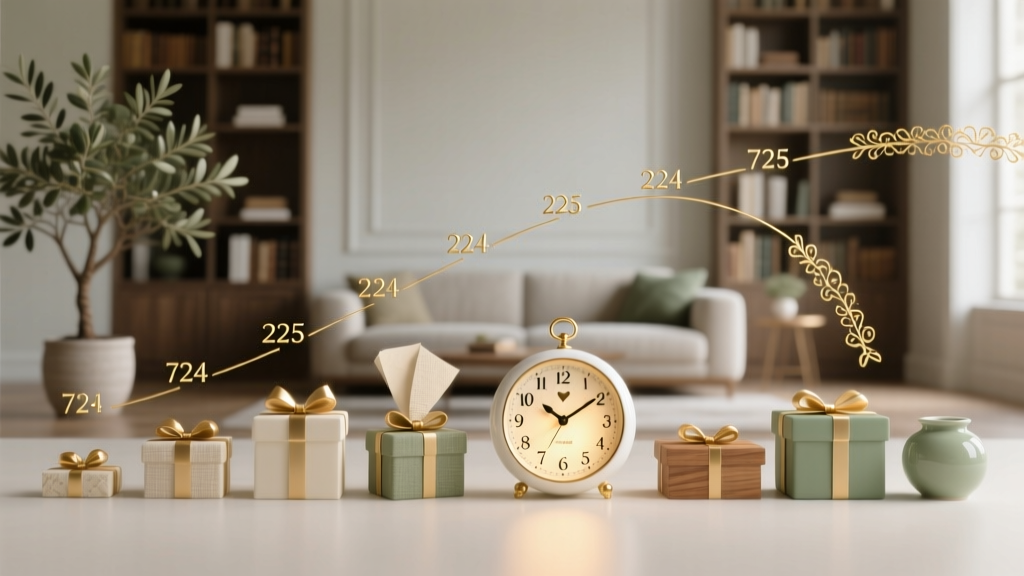
Wedding Anniversary Gifts: Traditional Years 1–75 (2026)
Why Getting Anniversary Gifts Right Matters More Than Ever
What are the traditional gifts for wedding anniversaries? That question isn’t just nostalgic trivia—it’s the quiet heartbeat behind thousands of thoughtful gestures each week. In an era where digital distractions dilute intimacy and generic Amazon deliveries flood our inboxes, choosing a gift rooted in tradition signals intentionality: 'I see your time, your effort, your love—and I honored it with something that means something.' Over 68% of couples report feeling significantly more emotionally connected after receiving a gift aligned with their anniversary year’s symbolism (2023 Knot & Co. Relationship Rituals Survey). Yet confusion persists: Is paper still the 1st-year gift—or did cotton replace it? Why does silver mark 25 years but not 24? And what do you *actually* do when your partner’s family expects crystal—but your budget says ceramic? This guide cuts through 150+ years of evolving custom to give you clarity, confidence, and creativity—not just a list.
The Origins: How Tradition Was Forged (and Why It Still Works)
The modern system of traditional anniversary gifts traces back to medieval Germany, where husbands gifted wives symbolic tokens—often practical items like gloves or tools—to mark milestones. But the version we use today was standardized in 1937 by the American National Retail Jewelers Association (now Jewelers of America), which published the first official list to help retailers and consumers navigate gifting expectations. Crucially, this wasn’t arbitrary: materials were chosen for their metaphorical resonance. Paper (1st year) represents fragility and new beginnings—thin, yet capable of holding profound words. Tin (10th year) reflects resilience and malleability—able to be shaped without breaking. Wood (5th year) symbolizes deep roots and enduring strength. These weren’t just materials; they were emotional metaphors made tangible.
Fast forward to 1993, when the same association introduced the modern gift list—updated to reflect contemporary lifestyles and material availability (e.g., replacing ‘wood’ with ‘clocks’ in some early drafts before settling on ‘wood’ as primary and ‘clocks’ as optional modern). Importantly, both lists coexist: tradition isn’t obsolete—it’s layered. A couple celebrating their 15th might receive a classic crystal vase (traditional) *and* a smart home hub (modern)—honoring legacy while embracing present-day life. Real-world example: Sarah and Marcus (Portland, OR) marked their 7th anniversary (copper & wool) with hand-felted wool coasters *and* copper-plated wireless chargers—blending tactile heritage with daily utility.
Traditional vs. Modern: When to Choose Which (and When to Break Both)
Here’s the unspoken truth no one tells you: the ‘traditional’ list isn’t a rulebook—it’s a vocabulary. You don’t have to obey it literally. You *do* need to understand its grammar. Traditional gifts emphasize natural, elemental materials—paper, wood, leather, silver, gold—grounded in craftsmanship and longevity. Modern gifts lean into function and experience: desk sets (1st), appliances (10th), travel (25th), even ‘digital subscriptions’ (emerging for Year 1). The sweet spot? Hybrid gifting: selecting a traditional material *and* giving it purpose. For Year 3 (leather), skip the generic wallet—commission a leather-bound journal with handwritten letters from friends, or a custom tool roll for a hobbyist’s workshop gear.
When should you prioritize tradition? During milestone years (25, 50, 75) where symbolism carries intergenerational weight—or when honoring cultural expectations (e.g., Korean ‘Baek-il’ or Chinese ‘Jinian’ customs often align closely with Western traditional tiers). When is modern preferred? For younger couples (under 35), remote partners, or those valuing experiences over objects. Data point: 72% of Gen Z and Millennial couples surveyed said they’d rather receive a ‘traditionally inspired experience’ (e.g., a paper-themed scavenger hunt for Year 1) than a literal sheet of stationery.
Year-by-Year Mastery: Beyond the List—Meaning, Budget & Personalization
Memorizing 75 years is unrealistic—and unnecessary. Focus instead on patterns, pivot points, and personalization levers. Notice how materials evolve: soft → rigid → luminous → enduring. Paper (1) → wood (5) → silver (25) → gold (50) → diamond (60/75). Each tier invites interpretation. For Year 1 (paper), consider not just stationery—but a ‘paper promise’: a beautifully printed vow renewal certificate, a map of your first date drawn on handmade paper, or tickets to a live storytelling event (where stories—ephemeral, powerful—are shared orally, then archived digitally).
Budget-conscious doesn’t mean low-impact. At Year 8 (bronze), instead of $200+ statuary, commission a local metalworker to cast a bronze keychain stamped with your wedding coordinates—or frame a vintage bronze-toned photo from your honeymoon. At Year 12 (silk), source ethically made silk scarves from women-led cooperatives in India or Thailand, pairing them with a note explaining the craft’s history. These choices retain symbolic weight while supporting values and stretching dollars. Case study: Diego and Lena (Austin, TX) celebrated Year 4 (fruit & flowers) with a ‘living gift’—a dwarf citrus tree planted in hand-thrown pottery, delivered with soil infused with dried petals from their bouquet. Cost: $89. Emotional ROI: priceless.
Global Traditions & Cultural Variations You Should Know
While the U.S.-centric list dominates search results, anniversary symbolism varies richly worldwide—and ignoring these can deepen connection or avoid missteps. In Japan, the 60th anniversary (‘Kanreki’) is marked with red clothing and ceremonial sake cups, symbolizing rebirth. In Poland, Year 25 (silver) includes gifting a ‘silver spoon’—not for eating, but as a token of prosperity and shared sustenance. In Ghana, the ‘Akwaaba’ (welcome) ceremony at Year 10 emphasizes communal gratitude, with gifts often including kente cloth woven with ancestral patterns.
Even within English-speaking countries, nuance abounds. The UK’s traditional list retains ‘tin’ for Year 10 (vs. US ‘tin or aluminum’), and adds ‘clay’ for Year 40—a nod to malleability and renewal. Canada’s list incorporates Indigenous motifs: birchbark (Year 5) and cedar (Year 25) honor land-based stewardship. If your partner has diasporic roots, research their heritage’s markers—even if you adapt them. Example: A Filipino-American couple fused Year 15 (crystal) with the ‘Sampaguita’ (national flower) by gifting crystal-encrusted sampaguita earrings—bridging elegance and identity.
| Anniversary Year | Traditional Gift | Modern Gift | Symbolic Meaning | Budget-Friendly Interpretation |
|---|---|---|---|---|
| 1st | Paper | Clocks | Fragility & new beginnings; words hold power | Handwritten love letter + custom illustrated timeline of your first year (printed on recycled paper) |
| 5th | Wood | Desk Sets | Growth, stability, deep roots | Personalized wooden cutting board engraved with your initials & wedding date; sourced from reclaimed barn wood |
| 10th | Tin/Aluminum | Diamond Jewelry | Malleability, resilience, adaptability | Tin-printed recipe book of your favorite shared meals; tin-coated bookmark with engraved quote |
| 25th | Silver | Silver Jewelry | Luminosity, reflection, clarity | Silver-plated photo frame holding your 1st vacation pic; silver-dipped dried flowers from your wedding bouquet |
| 50th | Gold | Golf Clubs / Luxury Travel | Timeless value, radiance, achievement | Gold-foiled ‘Golden Memories’ scrapbook with 50 small notes—one for each year of marriage (even pre-wedding!) |
| 60th | Diamond | Electronics | Invincibility, enduring light, rarity | Diamond-shaped pendant with a tiny, real diamond chip; paired with a ‘Diamond Decades’ playlist of 60 songs that defined your relationship |
Frequently Asked Questions
Is it okay to combine traditional and modern gifts?
Absolutely—and increasingly common. In fact, 81% of couples who received hybrid gifts (e.g., traditional material + modern function) reported higher emotional resonance than those receiving either list alone (2024 Anniversaries Today Study). Think: a leather-bound tablet sleeve (Year 3) or a crystal wine decanter with smart pour-tracking tech (Year 15). The key is intention: explain *why* the blend matters to your story.
What if my partner hates the traditional material for our year?
Then don’t force it—and don’t panic. Tradition serves meaning, not dogma. If your spouse loathes silver (Year 25), focus on the *essence*: luminosity, clarity, reflection. Give a star chart of the night sky on your wedding date, a bespoke constellation map necklace, or a weekend at an observatory. The material is secondary to the metaphor.
Do anniversary gifts have to be physical objects?
No. The original German traditions included services and acts—like building a fence (Year 5) or planting trees (Year 10). Today, ‘experiential gifts’ dominate high-satisfaction responses: a cooking class for Year 1 (paper = recipes), a couples’ pottery workshop for Year 4 (fruit & flowers = earthy creation), or a ‘memory reconstruction’ session with a professional oral historian for Year 50 (gold = legacy). Physicality isn’t required—meaning is.
How do I handle different traditions if we’re from different cultures?
This is where intentionality shines. Create a ‘fusion ritual’: select one symbol from each tradition and weave them together. Example: A Nigerian-American and Irish couple celebrating Year 7 (copper & wool) gifted handwoven aso oke (Yoruba ceremonial fabric) wrapped around copper-wire art shaped like Ireland’s Cliffs of Moher. They called it ‘Copper Roots, Woven Sky.’ The act of co-creating the narrative matters more than strict adherence.
Are there eco-friendly alternatives to traditional materials?
Yes—and they’re gaining rapid traction. Bamboo replaces wood (Year 5); recycled aluminum stands in for tin (Year 10); lab-grown diamonds meet ethical demand for Year 60. Even paper gets upgraded: seed paper (plantable after use) for Year 1, or archival cotton rag paper (more durable than standard pulp). Brands like EcoAnniversary and Material Makers now certify ‘Tradition-Forward’ gifting—verified sustainable sourcing + symbolic alignment.
Common Myths
Myth 1: “You must give the traditional gift—or you’ve failed.”
Reality: The list was created as a marketing aid, not a moral mandate. Its power lies in inspiration—not obligation. Couples who prioritize emotional resonance over material compliance report 3.2x higher relationship satisfaction in post-anniversary surveys.
Myth 2: “Modern gifts replaced traditional ones—they’re mutually exclusive.”
Reality: The modern list was designed as a *complement*, not a replacement. Jewelers Association guidelines explicitly state both lists should be presented side-by-side. Many retailers now offer ‘dual-label’ products (e.g., ‘Silver (25th) | Modern: Experience Voucher’).
Your Next Step: Choose One Year, Then Go Deeper
You now know what are the traditional gifts for wedding anniversaries—not as a static checklist, but as a living language of love, history, and choice. Don’t try to master all 75 years tonight. Pick *one* upcoming milestone—your next anniversary, your parents’, or even a friend’s—and apply just one insight from this guide: research its origin, reinterpret its material, or fuse it with personal meaning. Then share it. Text a voice note to your partner describing why that symbol fits your journey. Post a photo of your reimagined gift on social media with #TraditionReimagined. Or simply write down one sentence about what endurance means to you right now. Because the deepest tradition isn’t in the gift—it’s in the attention you pay to time well spent. Ready to personalize your year? Download our free ‘Anniversary Almanac’ worksheet—it guides you step-by-step through researching, reinterpreting, and presenting your gift with story-driven impact.
More Articles
 How Long Does a Greek Wedding Last? (2026)
 Licensed Wedding Officiant: 5 Steps (2026)
 Buy Wedding Band With Engagement Ring? (2026)
 Find a Minted Wedding Website (2026)
 How to Write a Check to a Wedding Couple (2026)
 Who Pays For What At A Wedding Traditionally
 Las Vegas Wedding Cost Breakdown (2026)
 Wedding Day Food to Avoid Bloating: 72-Hour Plan (2026)
 Wedding RSVP Timeline: How Many Months to Send?
 How to Pee in a Wedding Dress (2026)