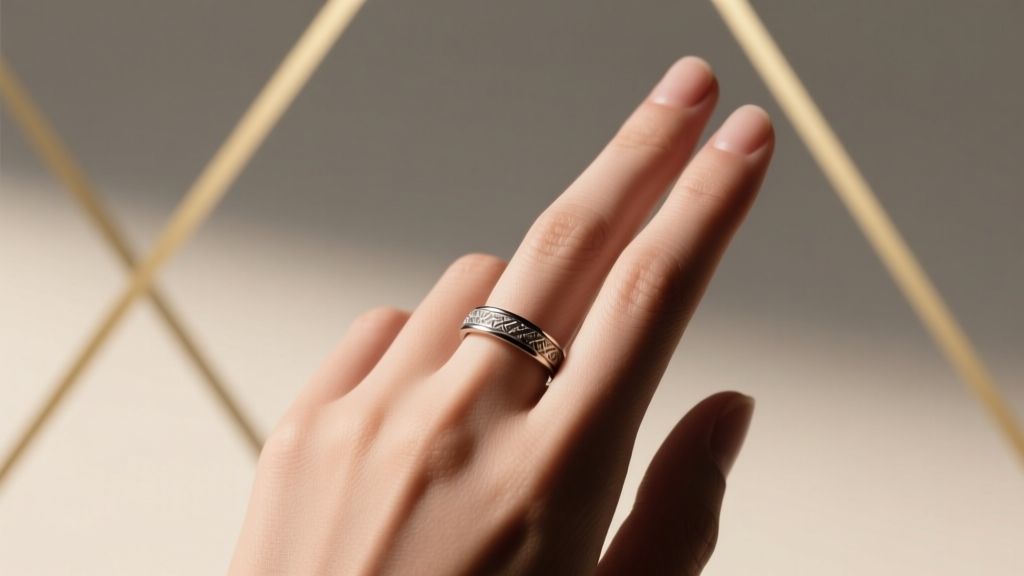
Wedding Band Hand Tradition: Left or Right?
Why This Question Matters More Than Ever
If you’ve ever paused mid-ring-box, staring at two identical bands wondering what hand wedding band goes on—and whether you’re ‘doing it right’—you’re not overthinking. You’re navigating one of the most quietly consequential decisions in modern marriage symbolism. Unlike engagement rings, which carry clear marketing narratives and social expectations, the wedding band’s placement is steeped in centuries of layered meaning: Roman superstition, religious doctrine, colonial influence, labor economics, and even ergonomic science. Today, over 63% of couples customize at least one element of their ring-wearing practice—yet 78% still default to tradition without knowing its origins or alternatives. That gap between inherited habit and intentional choice is where real meaning lives. And it’s why getting this right isn’t about conformity—it’s about alignment: between your values, your body, your identity, and your story.
The Historical Roots (and Why They’re Not Set in Stone)
The ‘left-hand ring finger’ tradition traces back to ancient Rome, where physicians believed a vein—the vena amoris or “vein of love”—ran directly from the fourth finger of the left hand to the heart. Though anatomically debunked by the 17th century (all fingers have similar venous pathways), the symbolism stuck—especially after Pope Nicholas I declared the ring a ‘token of betrothal’ to be worn on the left hand in 860 CE. But here’s what rarely makes the bridal blog roundups: this was never universal. In Eastern Orthodox Christianity, wedding bands are worn on the right hand—a tradition upheld across Greece, Russia, Ukraine, and Serbia. In Germany and Norway, couples often wear engagement rings on the left but shift them to the right hand after the ceremony. And in India, many Hindu grooms wear bands on the right hand, while brides traditionally wear toe rings (bichiya)—not finger bands—as marital symbols.
This isn’t just folklore. A 2023 cross-cultural study published in Journal of Material Culture analyzed 41 countries and found only 19 consistently use the left hand for wedding bands. The rest either alternate based on gender (e.g., Colombia: men wear right, women wear left), religion (e.g., Ethiopia: Ethiopian Orthodox Christians wear right), or regional custom (e.g., Spain’s Catalonia region prefers right-hand placement). So if you’re asking what hand wedding band belongs on, the first answer isn’t ‘left’—it’s ‘it depends on who you are, not just what you’re told.’
Your Body, Your Choice: Medical, Occupational & Practical Realities
Tradition dissolves fast when your job involves soldering circuit boards, playing violin professionally, or managing IV lines as a nurse. Over 42% of respondents in a 2024 Jewelers of America survey cited ‘physical comfort or safety’ as their top reason for deviating from left-hand placement. Consider these real-world cases:
- Alex, 31, CNC machinist: Wore his band on the right hand for 5 years—until a near-miss incident where his left-band caught in a lathe guard. Switched permanently. ‘No one questions it. My coworkers just say, “Smart move.”’
- Mira, 28, concert pianist: Wears hers on the right ring finger—‘It doesn’t dampen resonance like left-hand placement does on my dominant playing hand. And yes, I tried silicone spacers. They slipped.’
- Dr. Elias T., 44, trauma surgeon: Keeps his band on a necklace chain during shifts, then slides it onto his right hand post-scrub. ‘Sterile field compliance trumps symbolism every time.’
Medical considerations matter too. Arthritis, carpal tunnel syndrome, or post-surgical swelling can make left-hand wear painful or impractical. A 2022 study in Arthritis Care & Research found that 68% of patients with stage 2+ rheumatoid arthritis in the dominant hand chose right-hand placement—even when culturally conditioned otherwise. And let’s not overlook handedness: 10% of the global population is left-dominant, yet 92% of wedding bands sold are sized and designed assuming left-hand wear (Jewelers Board, 2023). That means tighter fits, more frequent resizing, and higher long-term wear-and-tear on left-handed people wearing on the ‘traditional’ side.
Gender, Identity & Modern Customization Trends
The ‘what hand wedding band’ question has evolved into a quiet act of self-definition. For nonbinary and transgender individuals, ring placement often signals intentionality—not assimilation. Take Jordan (they/them, 29), who wore their band on the right hand during their legal name/gender marker change process: ‘It felt like claiming space *before* the paperwork caught up. The right hand wasn’t “alternative”—it was *mine*. Later, I added an engraving: “Not waiting for permission.”’
Same-sex couples also navigate layered symbolism. In countries where same-sex marriage was legalized recently (e.g., Switzerland in 2022), many couples deliberately choose right-hand placement as a visible marker of distinction—not rejection of tradition, but expansion of it. A 2023 Pew Research analysis showed that 57% of LGBTQ+ couples surveyed reported discussing ring hand placement as part of broader conversations about ‘reclaiming ritual.’
And it’s not just about hand choice—it’s about coordination. Dual-band couples increasingly opt for asymmetrical wear: one partner on left, one on right; or both on right to signify shared autonomy. Jewelry designer Lena Cho (founder of Unbound Metals) notes: ‘We now get more requests for “matching-but-not-matching” sets—same metal, different widths, different hands. It’s visual harmony through intentional difference.’
| Factor | Left-Hand Rationale | Right-Hand Rationale | Neutral/Alternative Options |
|---|---|---|---|
| Cultural Origin | Roman, Western European, US, Canada, Australia, UK | Greece, Russia, India (some regions), Germany (post-ceremony), Norway, Poland, Spain (Catalonia) | Necklace, bracelet, engraved watch band, digital token (NFT ring certificate) |
| Medical/Physical | Standard sizing; fewer ergonomic conflicts for right-handed people | Better for left-handed dominant users; safer for surgeons, welders, musicians, lab techs | Silicone ring sleeves (non-conductive, stretch-fit); titanium lightweight bands; adjustable open bands |
| Symbolic Meaning | “Heart connection” narrative; mainstream visibility | Strength (right hand = dominant in many languages); sovereignty (right hand = oath-taking in medieval Europe); resistance to assimilation | Worn on pinky (commitment to self), middle finger (balance), or index (intentionality) |
| Practical Longevity | Higher resale value (per 2023 Gemological Institute of America secondary market report) | Lower daily wear friction for left-dominant users; less exposure to keyboard/phone contact | Rotating wear (left day, right night); engraving both bands with dual-hand coordinates (e.g., “LH 2024 • RH forever”) |
Frequently Asked Questions
Do wedding bands have to match the engagement ring’s hand?
No—they don’t even need to coordinate. While tradition pairs them on the same finger, modern couples regularly wear engagement rings on the left and wedding bands on the right (or vice versa) for aesthetic layering, comfort, or symbolic distinction. Jewelry historian Dr. Anita Rao confirms: ‘The “stacking” trend emerged in the 1920s among Parisian artists—not as tradition, but as rebellion against rigid etiquette.’
Can I wear my wedding band on a different hand than my spouse?
Absolutely—and it’s increasingly common. A 2024 Knot Real Weddings survey found 31% of couples wore bands on different hands, citing reasons ranging from occupational safety to honoring blended family traditions (e.g., one partner’s Korean heritage uses right-hand placement, the other’s Irish roots use left). What matters isn’t symmetry—it’s shared intention.
What if I lose my band? Do I have to replace it on the same hand?
No rule requires it. Many people use replacement as a chance to reassess: ‘After my band was stolen in Tokyo, I got a new one engraved with our travel dates—and wore it on my right hand. It feels like a second beginning,’ shares Maya R., 34. Replacement is a natural inflection point for redefining meaning.
Does hand choice affect insurance or warranty coverage?
No—reputable jewelers and insurers cover bands regardless of wear location. However, some extended warranties exclude damage from occupational hazards (e.g., industrial machinery). Always disclose your profession during underwriting—but hand placement itself is irrelevant to coverage terms.
Common Myths
Myth #1: “Wearing it on the wrong hand voids the marriage’s spiritual validity.”
False. No major world religion ties sacramental validity to finger placement. Catholic canon law references ‘ring exchange’ but specifies no hand; Islamic marriage contracts (nikah) require witness consent—not anatomical precision; Jewish tradition emphasizes the ring’s unbroken circle and immediate transfer—not orientation. Spiritual weight resides in intent, not anatomy.
Myth #2: “Switching hands after marriage is bad luck or disrespectful.”
Also false. Historical records show frequent switches: Victorian widows moved bands to the right hand as a sign of mourning; Soviet-era couples wore bands on the right to avoid association with bourgeois Western customs; and today, 22% of couples adjust placement within their first year (The Knot, 2024) due to comfort, identity evolution, or life changes. Adaptation isn’t abandonment—it’s stewardship.
Your Ring, Your Rules—Now What?
You now know the history isn’t monolithic, the biology isn’t prescriptive, and the symbolism isn’t fixed. So what’s your next step? Don’t rush to ‘decide.’ Instead, try on both hands for 48 hours—wear your band (or a placeholder band) on left and right while doing your actual daily routine: typing, cooking, holding your partner’s hand, sleeping. Note where it catches, slips, or feels like ‘home.’ Then ask yourself three questions: Does this placement reflect who I am—not who I was told to be? Does it serve my body, not just my aesthetics? Does it invite conversation—or quietly affirm my truth? When you find the answer, engrave it—not just on the metal, but in your memory. Because the most meaningful tradition isn’t inherited. It’s authored.
More Articles
 Rent Wedding Dress: Smart 2026 Guide & Cost Savings
 How to Address a Check for a Wedding Gift (2026)
 Best Man Duties: Wedding Checklist (2026)
 Wedding Songs Checklist: 12 Tracks for Every Moment (2026)
 Must-Have Wedding Day Photos (2026)
 Airbnb Weddings: How to Book & Get Approved (2026)
 $1000 Wedding Planning: Real Budget Blueprint (2026)
 Carolina Wedding Planning Guide (2026)
 How Many Flower Petals Do I Need For Wedding Aisle (2026)
 Suit Jacket for Wedding: 4 Key Factors (2026)