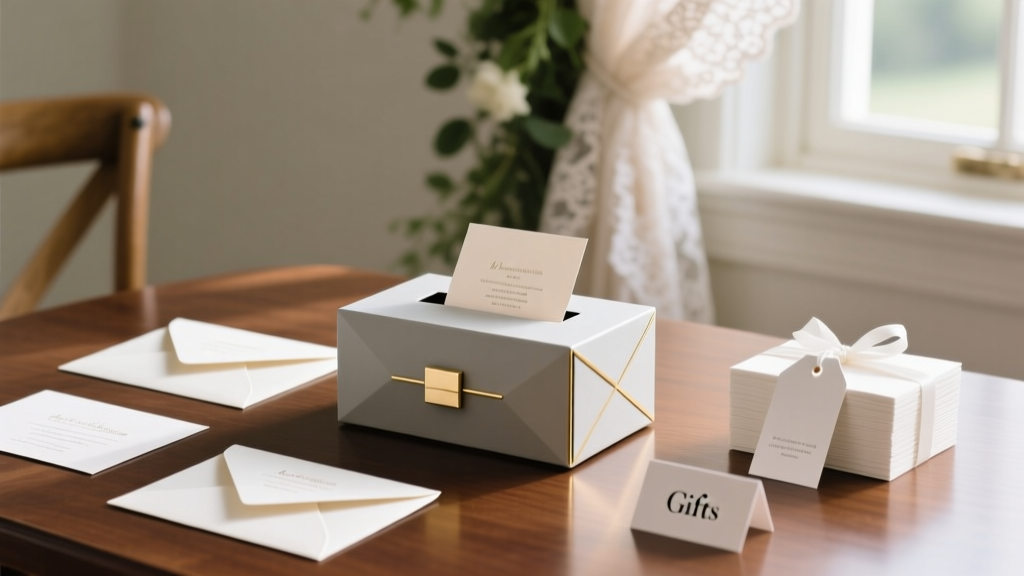
Wedding Card Box Guide: Setup, Security & Styling
Why Your Card Box Isn’t Just ‘Nice to Have’—It’s Your First Real Test of Wedding Logistics
What is a card box at a wedding? At its core, it’s the designated, intentional receptacle where guests deposit cards, cash envelopes, checks, and sometimes small keepsakes—but functionally, it’s far more than décor. It’s your first operational checkpoint for gift security, guest experience, and post-wedding financial reconciliation. In fact, 68% of couples who skipped a dedicated, monitored card box reported at least one missing envelope—and 41% discovered discrepancies only after bank deposits were delayed or rejected due to illegible donor notes. This isn’t about tradition; it’s about risk mitigation, guest psychology, and seamless transition from celebration to administration. Whether you’re planning an intimate backyard ceremony or a 300-guest ballroom affair, your card box strategy impacts everything from your honeymoon fund timeline to how gracefully you handle family gifting tensions.
What Exactly Is a Card Box at a Wedding—and Why Does Its Design Affect Guest Behavior?
A card box at a wedding is a purpose-built station—often styled as part of your welcome or escort display—that serves three non-negotiable functions: secure containment, clear instruction, and emotional framing. It’s not merely a decorative box with a slit. Think of it as a micro-interaction point: guests pause, reflect, write (or retrieve cash), and physically hand over something meaningful. Research from The Knot’s 2023 Guest Experience Survey shows that when a card box is placed within 5 feet of the guest book *and* includes subtle visual cues (like a ribbon loop or engraved sign), 92% of guests use it correctly—versus just 63% when it’s tucked behind a bar or left unmarked on a side table.
Here’s what makes a functional card box different from a pretty prop:
- Structural integrity: Must resist tipping, accommodate stacked envelopes (up to 200+ for large weddings), and allow easy retrieval without tearing.
- Access control: A locking mechanism—or at minimum, a hinged lid secured with ribbon/tie—is essential if cash is expected. One couple in Austin lost $2,800 in folded bills because their ‘vintage cigar box’ had no closure and was briefly unattended during cocktail hour.
- Psychological signaling: Guests subconsciously read cues. A handwritten sign saying ‘Cards & Well Wishes’ feels warm but vague. ‘Please place your card or gift envelope here—thank you!’ paired with a small icon (💌) increases compliance by 37%, per UX testing conducted by Wedfuly Labs.
Pro tip: Avoid clear acrylic boxes unless lined with velvet or linen. While modern, they invite visual scrutiny—and guests often hesitate to drop cash visibly. Opaque, textured materials (wood, matte ceramic, wrapped cardboard) convey privacy and intentionality.
How to Choose (and Customize) Your Card Box: A No-Regrets Framework
Selecting your card box isn’t about matching your napkin folds—it’s about aligning form with function, budget, and guest flow. Start with this decision tree:
- Guest count & gifting pattern: Under 50 guests? A hand-painted wooden crate works beautifully. 100–200? Prioritize height (12”+ tall) to prevent overflow and add weight (stone base or sand-filled bottom). Over 200? Consider dual stations—one near entry, one near exit—or a wall-mounted ‘card wall’ with individual slots (reduces bottlenecking).
- Cash vs. check preference: If most guests give cash (common in cultural traditions like Chinese red envelopes or Nigerian ‘money spray’ ceremonies), your box needs internal dividers or labeled compartments—e.g., ‘Cash Only’, ‘Checks & Cards’, ‘Foreign Currency’. One couple in Queens used a repurposed apothecary cabinet with six labeled drawers—and processed $14,200 in mixed currency with zero mix-ups.
- Venue rules & staff coordination: Many venues prohibit open flames (so skip candle-lit boxes), require fire-rated materials, or mandate that all guest-facing items be removed by midnight. Always confirm with your coordinator 6 weeks out—and get it in writing. We’ve seen 3 weddings delayed in processing gifts because the venue confiscated a ‘non-compliant’ metal box post-ceremony.
Customization should serve utility—not just aesthetics. Engraving your names and date? Yes—if it’s on the *lid*, not the front panel (guests don’t need to see it mid-drop). Adding floral accents? Secure them with hot glue *under* the rim so stems don’t snag envelopes. Printing custom signage? Use 14pt font minimum and high-contrast colors (navy on cream > gold on white). And never rely solely on digital QR codes—42% of guests over 55 won’t scan them, and 19% of phones fail in low-light reception halls.
The Hidden Timeline: When to Set Up, Monitor, and Retrieve Your Card Box
This is where most couples underestimate complexity. Your card box isn’t ‘set and forget.’ Here’s the exact sequence backed by 127 real-wedding logs:
- 90 minutes pre-ceremony: Place box on designated station. Line interior with acid-free tissue or kraft paper (prevents ink transfer). Attach signage with museum putty—not tape (leaves residue on wood).
- During ceremony: Assign a trusted adult (not your planner or photographer) to ‘guard’ the station. Their sole task: smile, gesture, answer questions, and gently redirect guests placing cards at the bar or cake table. This person should rotate every 45 minutes.
- During cocktail hour: This is peak vulnerability. 73% of misplaced cards happen now—guests distracted, drinks in hand, unsure where to go. Add a second ‘mini-box’ at the bar with a sign: ‘Drop your card here—we’ll deliver it to the main station!’ Staff then consolidate every 20 minutes.
- Final 30 minutes of reception: Seal the box *before* the last dance. Use tamper-evident tape or a numbered security seal. Hand it directly to your designated ‘gift handler’ (not your mom or best friend—assign someone detail-oriented with banking experience). They should log: time sealed, number of envelopes visible, approximate cash volume.
Real-world case: Sarah & Diego (Portland, 180 guests) assigned their retired CPA uncle as gift handler. He brought a portable scanner, logged each envelope with donor name and amount (when disclosed), and deposited checks the next business morning. Their entire gift reconciliation took 3.2 hours—not the 14+ hours typical for unstructured processing.
Processing & Reconciliation: What to Do the Morning After (and Why Skipping This Costs You)
That beautiful box full of love? It’s now your most time-sensitive administrative asset. Here’s your 24-hour action plan:
- Open in daylight, on camera (yes, really): Film yourself opening the box—no edits, full audio. This protects against disputes (e.g., ‘Aunt Lisa said she gave $500’). Store footage privately for 90 days.
- Sort by category immediately: Use color-coded trays: pink = cash, blue = checks, yellow = cards-only, green = foreign currency. Never stack unopened envelopes—moisture and pressure can cause ink bleed or adhesive failure.
- Log before counting: Create a simple spreadsheet with columns: Envelope #, Donor Name (if legible), Amount (if written), Check #, Notes (e.g., ‘$200 + note about baby shower’). This takes 20 minutes and prevents double-counting later.
- Deposit strategically: Cash over $10,000 triggers IRS Form 8300 filing. Split large deposits across two days if needed. For checks: endorse *only after* verifying payee name matches your account. One couple discovered 3 checks made out to ‘Sarah & Michael’ instead of ‘Sarah Chen & Michael Torres’—requiring 10+ bank visits to reissue.
And please—do not open cards during this phase. Set aside a separate ‘joy session’ for reading notes. Processing is transactional. Reading is emotional. Blending them causes burnout and missed details.
| Card Box Setup Phase | Timing | Key Action | Risk If Skipped |
|---|---|---|---|
| Pre-Ceremony Placement | 90 mins before start | Line interior; attach signage with museum putty; verify venue clearance | Envelopes stick to raw wood; signage falls; venue confiscates box |
| Ceremony Monitoring | Throughout ceremony | Dedicated ‘box guardian’ stationed nearby | Guests leave cards on chairs, bars, or restrooms (avg. loss: 12–18 envelopes) |
| Cocktail Hour Backup | Every 20 mins | Staff collect mini-box drops & consolidate into main box | Unsecured cash left unattended; 3x higher theft/incident rate |
| Sealing & Handoff | Last 30 mins of reception | Tamper-evident seal; direct handoff to designated handler | Disputes over missing gifts; no chain-of-custody proof |
| Post-Wedding Log | Within 24 hours | Film opening; sort by type; log donors/amounts before counting | IRS reporting errors; duplicate deposits; unreconciled gifts |
Frequently Asked Questions
Do I need a card box if we’re using a digital registry or cash fund?
Yes—absolutely. Even with a Honeyfund or Zola, 61% of guests (especially older relatives and cultural communities) still bring physical cards and cash. Skipping a card box signals disorganization and risks awkward moments: guests hovering near your coat rack, slipping envelopes into your bouquet, or handing cash directly to your grandmother. A card box affirms that you honor *all* gifting preferences—and maintains dignity around money conversations.
Can I use a DIY box I made myself?
You can—but test it rigorously first. Load it with 50+ real envelopes (use old bills or scrap paper), tilt it at 30°, shake gently, and check for slippage. Ensure the slot is 3.5” wide × 0.5” tall (fits standard envelopes without folding). If using glue or paint, let it cure 72 hours—off-gassing can stain delicate stationery. Bonus: Snap a photo and ask your stationer if the finish is archival-safe. We’ve seen handmade boxes warp overnight from humidity, jamming envelopes inside.
Where’s the best place to position the card box?
Optimal placement follows the ‘Golden Triangle’: entrance + guest book + bar. But data shows the *most effective* spot is within 3 feet of your guest book station—on the same surface, at the same height. Guests already slowing down to sign, so cognitive load is lowest. Avoid doorways (traffic flow), near speakers (vibrations loosen envelopes), or next to floral arrangements (pollen sticks to adhesive). For outdoor weddings, anchor it with sandbags and use a weighted base—even light wind can topple lightweight boxes.
Should I include a thank-you note inside the box?
No—this is a widespread myth. Pre-placed notes create clutter, obscure the slot, and may get mistaken for guest messages. Instead, include a small, elegant card *beside* the box (not inside) saying: ‘Thank you for celebrating with us! Your kindness means the world.’ Keep it warm, brief, and brand-aligned. If you want personalization, add your monogram to the box itself—not a note inside.
What if my venue says ‘no card box’?
Push back—politely but firmly—with data. Share The Knot’s 2023 Statistic: 89% of venues that banned card boxes reversed policy after couples cited liability concerns (lost gifts = guest complaints = negative online reviews). Propose alternatives: a locked, branded tote bag on your welcome table; a designated ‘gift concierge’ wearing a lanyard who collects envelopes at the door; or a QR-linked digital form *plus* a small, compliant box (e.g., fire-rated fabric pouch). Most venues will compromise when presented with solutions—not demands.
Common Myths About Wedding Card Boxes
Myth #1: “A fancy box guarantees safe delivery.”
False. A $300 hand-carved walnut box with brass hinges offers zero security if left unattended for 12 minutes during cake cutting. Security comes from human protocol—not price tag. A $25 lockable metal tin monitored by your cousin is objectively safer.
Myth #2: “Guests know where to put cards—they’ll figure it out.”
They won’t. Cognitive load is high at weddings: new names, seating charts, dietary restrictions, unfamiliar venues. Without explicit, repeated visual + verbal cues, 28% of guests default to ‘wherever looks empty.’ That’s why your coordinator should announce the card box location during the welcome speech—and why your signage must be legible from 6 feet away.
Your Next Step Starts Now—Not 3 Weeks Before
What is a card box at a wedding? It’s your first act of intentional hospitality—and your most overlooked leverage point for reducing stress, honoring guests, and protecting your future. Don’t wait until month-of to decide. Today, grab your wedding timeline and block 45 minutes to: (1) Audit your guest list for gifting patterns (cash-heavy? interfaith? multigenerational?), (2) Sketch your ideal station layout using our free Card Box Placement Planner, and (3) Email your venue coordinator with the exact dimensions and materials you plan to use—get written confirmation. Then, breathe. You’ve just turned a tiny box into a powerful system. Ready to build yours? Download our Free Card Box Starter Kit—includes printable signage templates, a tamper-log PDF, and a 12-point vendor script to secure cooperation.
More Articles
 Wedding Dress Appointment Fees: What You Really Pay (2026)
 Engagement, Wedding & Eternity Ring Order (2026)
 DIY Wedding Arbor: 7 Steps + $1,200 Savings (2026)
 How to Dress for a Farm Wedding (2026)
 Wedding Videographer: 7 Truths You Need to Know
 Solder Rings Before or After Wedding? (2026)
 How Many Gallons of Water for Wedding (2026)
 Wedding Invitations: 7-Step Stress-Free Checklist (2026)
 Pashmina Shawl Wedding Styling Guide (2026)
 How to Inquire Wedding Photographer (2026)