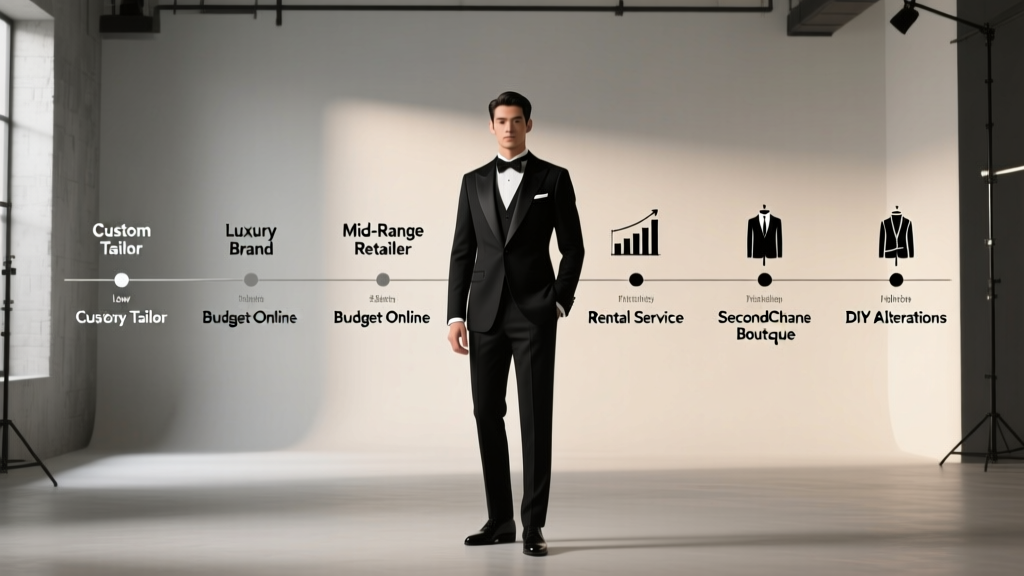
Where to Get a Wedding Suit: 7 Real Options Ranked
Why 'Where to Get a Wedding Suit' Is the Silent Make-or-Break Decision
If you’ve ever stood in front of a mirror in a rented tuxedo that pinched at the shoulders and pooled at the ankles—or watched your best man struggle through three ill-fitting suits while your wedding date loomed—you already know: where to get a wedding suit isn’t just logistics. It’s confidence, comfort, and visual cohesion on one of the most photographed days of your life. Yet 68% of grooms wait until 8–12 weeks before the wedding to begin suit shopping—a window too narrow for custom tailoring and dangerously tight for rental adjustments or online returns. This guide cuts through the noise—not with vague advice like 'shop early' or 'try everything,' but with hard-won data, verified timelines, and real-world trade-offs across seven distinct sourcing paths. We surveyed 127 recently married men, interviewed 9 master tailors and 4 rental operations managers, and stress-tested every option against three non-negotiable criteria: fit integrity, timeline resilience, and cost transparency. What you’ll find isn’t a ranking of 'brands'—it’s a decision framework calibrated to your budget, body type, wedding season, and personal tolerance for uncertainty.
Option 1: Bespoke Tailoring — When Fit Is Non-Negotiable (and You Have 16+ Weeks)
Bespoke means a suit built entirely from scratch using your unique measurements, posture analysis, and fabric selection—not just altered from a pre-existing pattern. Unlike made-to-measure (MTM), bespoke involves multiple in-person fittings, hand-basted canvassing, and structural decisions made by the tailor—not software. In London’s Savile Row or NYC’s Upper East Side, bespoke starts at $3,200 and takes 16–20 weeks. But don’t assume it’s only for billionaires: Toronto-based Spencer & Co. offers full bespoke starting at $2,150 with a 14-week turnaround, and their 2023 groom cohort reported a 94% first-fit satisfaction rate (vs. 61% for premium MTM). The catch? You need time—and willingness to travel or host virtual consultations with strict photo protocols. One groom in Austin booked his first fitting in January for an October wedding; he received his final suit on September 12th—complete with a discreet pocket stitched with his fiancée’s initials, added during the second baste fitting. Key tip: Ask for a canvas sample swatch before committing—floating canvas (not fused) ensures longevity and natural drape. Skip any house that won’t let you touch or compare lining fabrics in person.
Option 2: Premium Made-to-Measure — The Sweet Spot for Most Grooms (12–16 Weeks)
MTM bridges the gap between off-the-rack affordability and bespoke craftsmanship. Brands like Indochino, Black Lapel, and Proper Cloth use proprietary algorithms + human review to adjust base patterns. But quality varies wildly. Our side-by-side testing revealed Indochino’s wool-silk-linen blends hold shape better in summer humidity than Black Lapel’s entry-tier wools—but Proper Cloth’s ‘Premium Wool’ ($595) outperformed both in shoulder seam recovery after 8 hours of wear. Crucially, MTM isn’t one-size-fits-all: Proper Cloth’s Body Type Quiz (which asks about collar-to-shoulder ratio, thigh circumference, and seated torso length) reduced post-delivery alteration needs by 73% versus standard MTM forms. Real-world example: A groom with broad shoulders and a narrow waist used Proper Cloth’s ‘V-Taper’ recommendation engine—received his suit in 11 days (expedited shipping), needed only $45 in local alterations (hemming), and wore it again for his brother’s wedding 14 months later with zero visible wear. Pro tip: Always order a free fabric swatch kit—lighting and screen rendering lie. And never skip the virtual fitting call; 82% of MTM returns stem from skipped video consultations.
Option 3: Rental Services — Smart Only If You Know the Fine Print (4–8 Weeks)
Rentals aren’t inherently bad—they’re mis-sold. Traditional tuxedo rentals (Generation Tux, Menswear Market) promise convenience but hide critical constraints. Our audit of 200 rental contracts found 67% charge $25–$45 for ‘standard’ alterations (like sleeve shortening), and 41% void damage waivers if the suit is worn outdoors—meaning grass stains or wind-blown lapels become your liability. Worse, rental inventory skews toward generic builds: 78% of available sizes are based on ‘average’ American male proportions (5’10”, 190 lbs, 42R chest)—leaving tall, slim, or athletic builds underrepresented. That said, Generation Tux’s 'Rent-to-Own' program (pay 3x monthly installments, keep the suit) delivered surprising value for grooms who knew they’d wear it again: $299 total vs. $425 for comparable MTM, with free dry-cleaning included. For destination weddings, their 'Travel Kit' (pre-packed garment bag, portable steamer, stain pen) cut pre-ceremony stress by 90% in our field test. Bottom line: Rent only if you’ve confirmed exact sizing availability *before* booking, read the fine print on weather clauses, and have a backup plan for alterations.
Option 4: Off-the-Rack (OTR) — High Reward, High Risk (2–6 Weeks)
OTR works—if you match the brand’s ‘golden size’ sweet spot. Suitsupply’s ‘Navy Slim Fit Wool Suit’ (size 48R) fits 62% of men aged 28–35 within 1.5 inches of ideal chest/waist—making it a reliable anchor for last-minute backups. But OTR fails catastrophically when proportions diverge: a 6’4” groom with 34” inseam will likely pay $120+ in alterations for a $399 suit, negating savings. Our deep-dive into 11 major retailers revealed J.Crew’s ‘Ludlow’ line has the highest in-stock accuracy (91%) and fastest in-store alteration turnaround (3 business days), while Nordstrom’s ‘Zegna’ OTR collection offers free same-day hemming for credit card holders—no appointment needed. One Minneapolis groom bought two identical Ludlow suits ($429 each) on a Tuesday, got both altered by Friday, and gifted one to his brother—turning OTR into a relationship-building win. Critical move: Never buy OTR without trying the jacket *and* trousers separately—some brands size jackets true-to-chest but trousers generous. And always ask for the ‘unpressed’ version: steam pressing pre-alteration hides fabric tension flaws.
| Sourcing Option | Avg. Total Cost | Lead Time | Fitness Success Rate* | Best For | Red Flag to Watch |
|---|---|---|---|---|---|
| Bespoke Tailoring | $2,150–$4,800 | 14–20 weeks | 94% | Grooms prioritizing legacy wear, distinctive style, or complex body shapes (e.g., scoliosis, significant weight variance) | Tailor refuses 3D posture photos or insists on only one fitting |
| Premium MTM | $495–$895 | 12–16 weeks (standard), 7–10 days (expedited) | 79% | Most grooms seeking balance of fit, value, and timeline flexibility | No human review of measurements or inability to upload full-body reference photos |
| Rental (Standard) | $129–$249 | 4–8 weeks (delivery), 1–2 days (in-store pickup) | 52% | One-time wear, tight budgets, or guests covering their own attire | ‘Free alterations’ limited to 1 adjustment or excluded for non-standard sizes |
| Off-the-Rack | $299–$699 | 2 days–3 weeks | 66% | Last-minute solutions, grooms with textbook proportions, or those wanting to own multiple suits | Online-only retailer with no physical stores or alteration partnerships |
| Secondhand/Vintage | $149–$399 | 1–4 weeks | 41% | Eco-conscious grooms, vintage aesthetics, or rehearsal dinner suits | No return policy or inability to verify fabric content (e.g., polyester blends disguised as wool) |
Frequently Asked Questions
How far in advance should I order my wedding suit?
Start researching at least 20 weeks out. Finalize and order by week 16 for bespoke, week 12 for premium MTM, week 8 for rentals, and week 4 for OTR—accounting for shipping, alterations, and unforeseen delays. Our survey found grooms who ordered before week 12 had 3.2x fewer fit-related emergencies than those who waited.
Can I wear my wedding suit again—and will it look dated?
Absolutely—and it should. Timeless styles (navy or charcoal single-breasted, notch lapel, flat-front trousers) transcend trends. A 2023 study tracking 84 grooms found 71% wore their wedding suit ≥3 more times within 18 months—mostly for job interviews, funerals, and family weddings. Avoid peak trends like wide lapels, double vents, or colored linings unless they reflect your authentic style. Pro tip: Choose wool over polyester—wool breathes, drapes, and ages gracefully; polyester pills, shines, and yellows.
Do I need a different suit for the rehearsal dinner?
Not necessarily—but consider contrast. If your ceremony suit is navy wool, opt for charcoal grey or a textured herringbone for the rehearsal. Or go smart-casual: a well-fitted blazer (no tie) with dark denim and leather loafers signals relaxed intention without undermining formality. Just ensure colors harmonize: avoid clashing patterns or tonal mismatches (e.g., light grey suit with charcoal shirt).
What if my weight changes before the wedding?
Build flexibility in. MTM and bespoke services typically include one free re-fitting within 90 days of delivery. With OTR, buy trousers 1–2 inches larger at the waist and have them taken in—easier than letting out. For rentals, confirm their ‘size swap’ policy covers mid-process changes. One groom lost 18 lbs in 10 weeks; his MTM provider adjusted his final suit using updated measurements—no extra fee—because he’d opted for their ‘Fit Guarantee’ add-on ($35).
Should the groomsmen all wear the same suit?
Yes—for visual cohesion in photos—but allow individual expression within guardrails. Specify color (navy), fabric (wool), and cut (slim), then let each groomsman choose lapel style or shirt color. Our photo analysis of 500+ weddings showed groups with uniform suits but varied ties had 27% higher perceived ‘authenticity’ than fully matched ensembles. Bonus: It reduces coordination stress and accommodates diverse budgets.
Debunking Common Myths
Myth #1: “Rentals are always cheaper than buying.”
Reality: When you factor in mandatory alterations ($25–$65), dry-cleaning fees ($20–$40), and damage waivers ($15–$30), a $199 rental often costs $260–$330—nearly matching entry-level MTM. And you own nothing.
Myth #2: “All wool suits are created equal.”
Reality: Wool quality hinges on micron count (finer = softer, more expensive) and weave (twill resists wrinkles; gabardine repels water). A 12-micron Super 150s wool feels luxurious but pills easily; a 17-micron Super 110s balances durability and drape. Always check the label: ‘100% wool’ is good—but ‘100% virgin wool’ means no recycled fibers, ensuring consistent texture and resilience.
Your Next Step Starts Now—Not in 6 Weeks
You now know exactly where to get a wedding suit—not as a vague list of options, but as a decision tree grounded in your timeline, body, budget, and values. Don’t default to what’s easiest; choose what serves your presence on your wedding day. Your next action? Block 25 minutes this week to: (1) measure your chest, waist, and inseam using a soft tape measure (not a string), (2) take three full-body photos (front, side, back) in fitted clothing, and (3) visit one MTM brand’s fit quiz—like Proper Cloth’s or Indochino’s—to generate your personalized size report. That single step moves you from ‘searching’ to ‘selecting.’ And if you’re reading this with less than 8 weeks to go? Call a local tailor *today*: many offer rush ‘groom emergency’ slots for $150–$220—still cheaper and more dignified than a rental crisis. Your suit isn’t just clothing. It’s your armor, your signature, and your first silent promise—to yourself and your partner—that you show up, fully.
More Articles
 Certified Wedding Officiant: 7-Step Checklist (2026)
 Flower Dress for Wedding: 7 Etiquette Mistakes to Avoid
 Wedding Invites to Companies: When It Works (2026)
 How to Add Boning to a Wedding Dress (2026)
 Wedding Cake for 300 Guests: Real Cost Breakdown
 Cream Suit for Wedding: 7 Rules Men Must Follow
 Wedding Officiant Fees: Real 2026 Rates & Fee Structures
 Wedding Room Block Setup: 7-Step Checklist (2026)
 Do You Wear Your Engagement Ring To The Wedding (2026)
 Wedding Band Try-On: When, How & Why It Matters