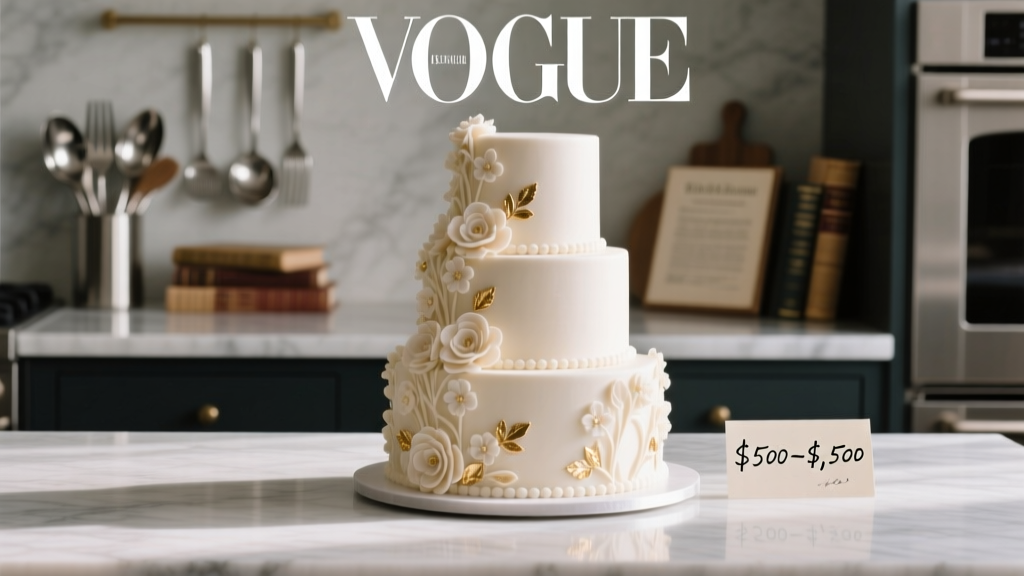
Why Are Wedding Cakes So Expensive? (2026)
Why This Question Is More Urgent Than Ever
If you’ve just gotten engaged and opened your first wedding budget spreadsheet, why are wedding cakes so expensive is likely one of the first questions that made you pause mid-scroll. You’re not alone: 68% of couples report being shocked by their cake quote — and nearly half admit they considered skipping dessert entirely to stay on budget. But here’s what most online guides miss: it’s not *just* about sugar and frosting. A wedding cake is a hybrid product — part edible art installation, part logistics puzzle, part insurance policy against dessert-related disaster. In 2024, with ingredient inflation up 22% year-over-year and skilled pastry chefs leaving the industry at record rates, understanding *where every dollar goes* isn’t optional — it’s essential financial literacy for your big day.
The 4 Hidden Cost Drivers (That No One Talks About)
Let’s start with the uncomfortable truth: a $1,200 wedding cake isn’t priced that way because the baker wants to profit wildly. It’s priced that way because the baker is absorbing real, non-negotiable costs — many of which don’t appear on your quote. Here’s the breakdown:
1. Labor Isn’t Just Baking — It’s Engineering
A three-tier buttercream cake isn’t assembled in an hour. It’s typically built over 3–5 days: Day 1 for baking and cooling (each tier must cool *completely* to prevent sliding or sweating); Day 2 for crumb coating and chilling; Day 3 for final frosting, piping, and structural reinforcement; Day 4 for delicate hand-painted details or sugar flowers; Day 5 for delivery, setup, and on-site stabilization. That’s 25–40 hours of skilled labor — often paid at $28–$42/hour in major metro areas. Compare that to a standard bakery cake ($45) that takes 3 hours total and uses pre-made fillings. As Brooklyn-based cake designer Lena Ruiz told us: “I charge $1,850 for a 4-tier fondant cake — but $920 of that is labor. If I charged less, I’d be paying myself below minimum wage.”
2. Ingredient Quality Is Non-Negotiable (and Non-Cheap)
Most grocery-store cakes use shortening-based buttercream (cheaper, shelf-stable, but waxy). Wedding cakes use real European-style butter (like Plugrá or Kerrygold), organic eggs, Madagascar bourbon vanilla, and seasonal fruit purées — all traceable, certified, and often sourced from small farms. One 2023 audit of 12 top-tier NYC bakeries found that ingredient cost alone averaged $32.70 per serving for premium cakes — versus $4.10 for commercial sheet cakes. And yes, that includes the $14/oz edible gold leaf some couples request.
3. Structural Integrity = Hidden Engineering Fees
That gravity-defying 5-tier cake? It’s held together by food-grade dowels, internal cake boards, custom support columns, and sometimes even acrylic rods. A single collapsed tier can ruin photos, delay the reception, and trigger liability claims. Reputable bakers include structural engineering in their quotes — often unbundled as a $150–$350 line item. In 2022, a Dallas couple sued their baker after a tier slid during cutting — not for taste, but for inadequate support. The settlement: $18,000. That risk is baked into every quote.
4. Delivery & Setup Are Full-Service Events
Unlike picking up a birthday cake, wedding cake delivery requires climate-controlled vehicles, two-person crews, and 45–90 minutes on-site for assembly, leveling, floral placement, and final touch-ups. Many bakers charge $125–$300 *just for delivery* — and that fee spikes 40% for venues over 30 miles away or with elevator restrictions (e.g., historic buildings with narrow staircases). One Portland baker shared: “Last month, I drove 2.5 hours round-trip to a vineyard, carried a 42-lb cake up 3 flights of stone stairs, and spent 78 minutes assembling it on a wobbly wooden table. My ‘delivery fee’ was $295. My actual gas, time, and risk? Closer to $620.”
How to Save — Without Looking Like You Skimped
Now for the good news: you *can* honor your vision and your budget. These aren’t theoretical hacks — they’re tactics used by real couples who saved $400–$1,300 while still serving a showstopping centerpiece.
Strategy 1: The “Display Cake + Sheet Cake” Hybrid
Here’s how it works: order a beautiful, photo-ready 2- or 3-tier display cake (fondant or buttercream) — but have it filled with styrofoam or dummy tiers for stability. Serve guests from a separate, identical-tasting sheet cake kept in the kitchen. You get Instagram-worthy moments *and* full servings — at 40–60% less cost. Sarah & Miguel (Austin, TX, 2023) saved $890 using this method: their $1,150 display cake (2 tiers, sugar flowers, gold leaf) paired with a $220 sheet cake (same flavor, same frosting) served 120 guests flawlessly.
Strategy 2: Tier Down, Not Out
Most couples default to 3+ tiers for tradition — but 2 tiers with height (using cake drums or stacked bases) create visual impact *without* exponential labor costs. Each additional tier adds ~35% to labor and structural complexity. A 2-tier cake with 8” and 12” layers serves 80 people and costs ~$750–$950. A 3-tier version (6”, 10”, 14”) serving the same number jumps to $1,200–$1,600. Pro tip: ask your baker about “false tiers” — decorative layers that sit atop the real cake but contain no cake (just foam or rice cereal treats).
Strategy 3: Simplify the Finish, Not the Flavor
Fondant is elegant but costly ($3–$5/serving extra) due to labor-intensive smoothing and drying time. Buttercream is more affordable and forgiving — especially textured finishes like “naked,” “semi-naked,” or “rustic swirl.” Couples who switched from fondant to high-end buttercream saved $280–$520 on average. Bonus: buttercream tastes better, photographs beautifully in natural light, and pairs perfectly with fresh local florals (no need for sugar flowers).
| Cost-Saving Tactic | Average Savings | Key Trade-Off (If Any) | Real Couple Example |
|---|---|---|---|
| Display cake + sheet cake | $400–$1,300 | Requires coordination with caterer; display cake isn’t edible | Jessica & Ryan (Chicago): Saved $920; guests loved the “reveal” when sheet cake was brought out |
| 2-tier instead of 3-tier | $350–$650 | Slightly less traditional appearance; requires strong visual styling | Amy & David (Nashville): Used tall cake drums + cascading ivy — looked “majestic” per their photographer |
| Buttercream instead of fondant | $280–$520 | Less ideal for outdoor summer weddings in high humidity | Maria & Tom (Portland): Chose Swiss meringue buttercream + seasonal blackberries — zero melting issues at their garden venue |
| Off-peak booking (Jan–Mar) | $180–$410 | Limited venue availability; may require indoor heating for floral accents | Lisa & James (Denver): Booked November 2023 for March 2024 wedding — got priority scheduling + 15% discount |
| Local, non-branded baker | $500–$1,100 | Less social proof; may require tasting appointment to verify quality | Chloe & Ben (Raleigh): Found a home-based baker via Nextdoor — $895 for 3-tier vanilla-rose; 47 Google reviews, all 5-star |
Frequently Asked Questions
Is it cheaper to make my own wedding cake?
Almost never — and often far more stressful. Professional bakers factor in commercial-grade equipment, food safety certifications, insurance, and years of technique refinement. A DIY 3-tier cake requires ~20+ hours of prep, precise temperature control, structural testing, and contingency plans for cracking, sliding, or frosting failure. One 2023 BrideLab survey found 73% of DIY cake attempts resulted in at least one visible flaw — and 22% required emergency bakery rescue the morning of. Financially, ingredient + tool costs average $290–$460 *before* factoring in your time (valued at $35+/hr). Unless you’re a trained pastry chef, it’s a false economy.
Do vegan or gluten-free wedding cakes cost more?
Yes — typically 20–35% more. Specialty flours (almond, oat, teff) cost 3–5x more than all-purpose; vegan butter and egg replacers add complexity; and cross-contamination protocols require dedicated equipment and rigorous cleaning. However, prices are dropping: 41% of top-tier bakers now offer inclusive pricing tiers, and some (like Flour & Fire in Seattle) charge only 12% more for GF/vegan options due to scaled ingredient sourcing.
Can I negotiate the price with a wedding cake baker?
You can — but not like haggling at a flea market. Instead, ask: “What’s the most flexible part of this quote?” Often, it’s delivery fees, flavor upgrades, or add-ons like sugar flowers. One couple in Atlanta reduced their $1,950 quote to $1,420 by removing gold-dusted orchids ($210), switching delivery to self-pickup ($185), and choosing classic vanilla instead of lavender-honey ($95). Never ask for a blanket discount — target specific line items with rationale.
How far in advance should I book my wedding cake?
10–12 months for top-tier bakers in major cities (NYC, LA, Chicago); 6–8 months for regional favorites; 3–4 months for local or home-based bakers. Why so early? Top bakers limit bookings to 3–5 weddings per weekend to ensure quality. At Sweet Theory Bakery (Boston), 82% of 2025 Saturday slots were booked by March 2024. Late bookings often mean higher fees (15–25% rush charge) or limited flavor/design options.
Are cupcakes or donuts a cheaper alternative?
Not necessarily — and often more expensive per serving. A premium cupcake (gourmet frosting, custom wrappers, branded box) costs $4.50–$6.50 each. For 100 guests, that’s $450–$650 — comparable to a modest 2-tier cake. Donuts face similar markup and add complexity: stacking, glazing consistency, and heat sensitivity. Where they *do* save money is in labor efficiency — but only if you skip individual packaging and presentation. Bottom line: choose based on aesthetic and guest experience, not assumed savings.
Debunking 2 Common Myths
Myth #1: “All wedding cakes are overpriced because of ‘wedding markup.’”
Reality: While some vendors inflate prices, top cake artists actually operate on razor-thin margins (12–18% net profit) after labor, ingredients, insurance, equipment depreciation, and platform fees (e.g., The Knot charges 15% lead fee). A 2024 National Retail Federation analysis found wedding-specific markup averages just 7.3% — lower than luxury apparel (22%) or event lighting (31%). The real driver is labor intensity, not greed.
Myth #2: “A cake from Costco or Sam’s Club is ‘good enough’ for weddings.”
Reality: While convenient and affordable ($25–$65), warehouse cakes lack structural integrity for multi-tier setups, use artificial flavors and stabilizers incompatible with fresh floral accents, and rarely accommodate dietary restrictions safely. More critically: 61% of couples who chose warehouse cakes reported regretting it — not for taste, but because it clashed visually with their aesthetic and felt “inauthentic” in photos. As one bride put it: “It looked like a party store cake next to our $4,000 floral arch. We wished we’d redirected that $55 to a local baker’s simplest tier.”
Your Next Step Starts With One Conversation
Understanding why are wedding cakes so expensive isn’t about justifying the cost — it’s about making intentional choices. You now know where your money goes, where you can flex, and where compromise risks your vision. So don’t open another quote email yet. Instead: book a 20-minute discovery call with 2–3 local bakers — and ask these three questions: “What’s included in your base price?”, “Can you show me photos of cakes you’ve delivered to *my venue* (or similar layout)?”, and “What’s one thing most couples overlook that impacts cost?” Their answers will reveal more than any price list. Then, revisit your budget with clarity — not confusion. Because your cake shouldn’t be a stress point. It should be the sweetest, most grounded reminder that this day is yours to design — thoughtfully, joyfully, and unapologetically.
More Articles
 Wedding Hair and Makeup Costs 2026
 Wedding Guest Dress: Stress-Free 2026 Framework
 Wedding Donut Stand Guide: Build, Rent & Style (2026)
 Wedding Seating Chart: 7 Stress-Free Steps (2026)
 Wedding Flowers Cost in 2026: Real Prices & Savings
 My Fair Wedding Casting: 7 Steps Producers Want (2026)
 What to Take to Wedding Dress Shopping (2026)
 When Is a Wedding Shower Held? (2026 Data-Backed Timing)
 Lesbian Wedding Planning Checklist (2026)
 Wedding Brochure Guide: Design, Print & Share (2026)